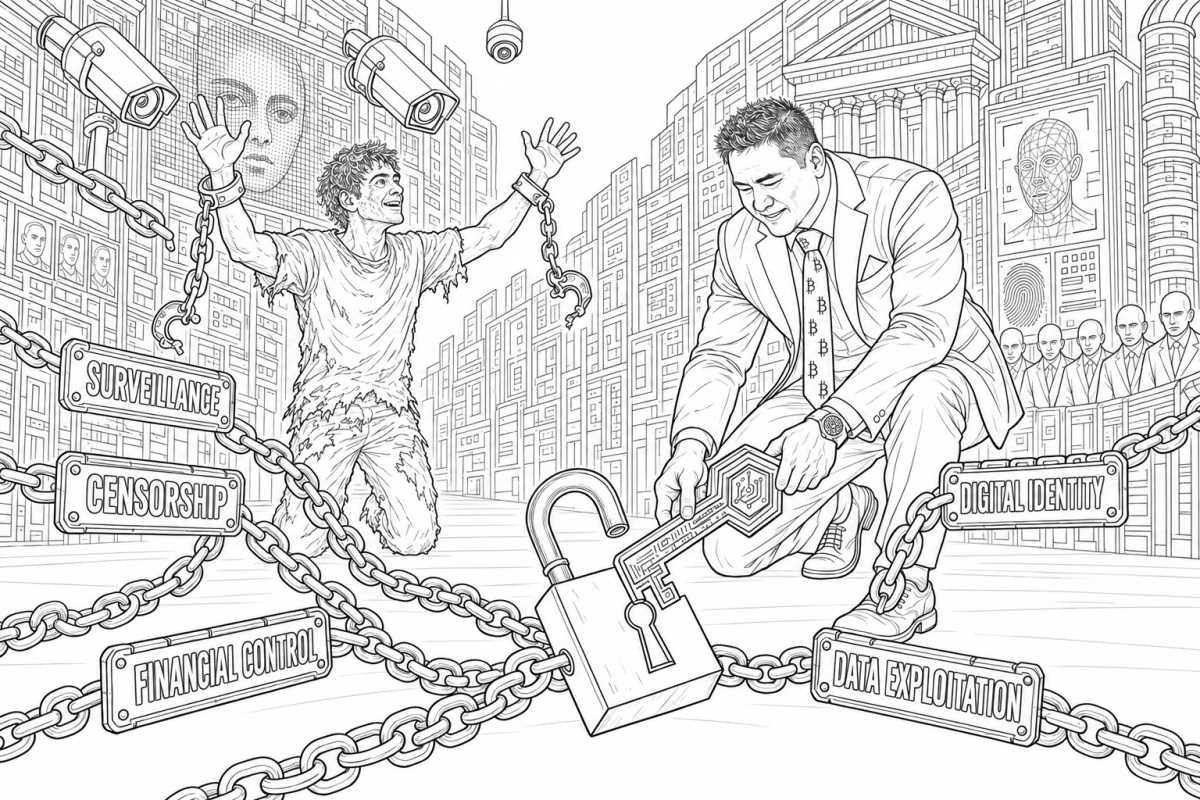
My illustration above entitled “Breaking the Chains of Digital Control” (Oct 2024) – A person is restrained by chains labelled Surveillance, Censorship, Financial Control, Digital Identity and Data Exploitation. I use a glowing cryptographic key to break the chains. Represents: Cryptography as a practical instrument of human liberation.
Cypherpunkism is a philosophy of Digital Sovereignty: the principle that individual freedom in a technological society must be protected not only through laws and institutions, but through technological architectures that make privacy, cryptography, decentralization, open knowledge and individual control practically enforceable.
Its intellectual roots lie in the original Cypherpunk movement, public-key cryptography, privacy-enhancing technologies, peer-to-peer networks, anonymous digital communication and early experiments in electronic money.
On October 10, 2010, I formalized these interconnected ideas under a broader and systematic philosophical framework that I call Cypherpunkism.
Cypherpunkism does not claim to have created the historical Cypherpunk movement. Rather, it seeks to organize and extend the principles developed by cryptographers, programmers and privacy advocates into a philosophy for the modern technological age.
At its center is one question:
Who should be sovereign in the digital world—the individual, or the systems through which the individual increasingly lives?
Cypherpunkism answers that the architecture of technology should ultimately strengthen the sovereignty of the individual rather than create irreversible concentrations of technological power.
As technology moves beyond digital networks and into direct interaction with the human nervous system, this philosophy develops into Neuro-Cypherpunkism: the defence of Cognitive Sovereignty in the brain-computer interface age.
The Eight Principles of Cypherpunkism
The philosophy is organized around eight interconnected principles:
1. Privacy
Privacy is the ability of the individual to establish boundaries around personal information, communication, identity and association.
Cypherpunkism does not define privacy merely as secrecy. It treats privacy as a condition of autonomy: the ability to determine what information about oneself is revealed, when it is revealed and to whom.
2. Cryptography
Cryptography transforms privacy from an institutional promise into technological architecture.
Where a policy may promise that information will not be accessed, encryption can make unauthorized access technically difficult. Cryptography therefore becomes more than computer security.
Cryptography is applied freedom.
3. Decentralization
Decentralization distributes technological authority so that no unnecessary single point possesses absolute control over an important network or system.
Cypherpunkism does not argue that every centralized system is inherently harmful. It asks a more important question:
How much power should any single point possess?
Where excessive concentration creates the possibility of censorship, surveillance, exclusion or arbitrary control, decentralization can function as a technological system of checks and balances.
4. Individual Control
Individuals should retain meaningful authority over their identities, personal information, communications, cryptographic keys, digital possessions and participation in technological systems.
Digital systems should expand the capacity of individuals to make informed choices rather than reduce them to passive subjects of technological administration.
5. Open Knowledge
Digital sovereignty requires understanding.
People cannot meaningfully exercise sovereignty over technologies they are prohibited or unable to understand. Cypherpunkism therefore values open knowledge, accessible research, open-source development and the dissemination of technological education.
Knowledge itself should not become another centralized gatekeeper.
6. Open Architecture
The architecture of important technological systems should be open to examination, verification, interoperability and meaningful challenge.
Open architecture allows users and independent researchers to understand how power is exercised within a system and to identify hidden mechanisms of surveillance, censorship, exclusion or control.
7. Freedom to Build
Individuals should be free to create, study, publish and use cryptographic, decentralized and privacy-enhancing technologies.
The freedom to build is essential because sovereignty cannot depend entirely upon tools supplied by the same institutions whose power those tools may need to limit.
8. Digital Sovereignty
The eight principles ultimately converge upon the principle of Digital Sovereignty.
Digital Sovereignty is the capacity of an individual to retain meaningful authority over his or her identity, information, communications, digital possessions, cryptographic credentials and participation in technological systems.
It does not require isolation from governments, companies or society.
It requires that cooperation does not become domination.
Foundations of Cypherpunkism
The following works establish the philosophical framework of Cypherpunkism and its evolution from the original Cypherpunk tradition into a wider philosophy of Digital Sovereignty.
Cypherpunkism: A Philosophy of Digital Sovereignty
October 10, 2010
The founding philosophy of Cypherpunkism. This essay defines Digital Sovereignty and establishes privacy, cryptography, decentralization, open knowledge and individual control as components of a systematic philosophy for technological civilization.
The Cypherpunkist Manifesto
November 22, 2010
A declaration of the principles and responsibilities of the Cypherpunkist: defending privacy, strengthening cryptographic freedom, decentralizing concentrated technological power and building systems that preserve individual sovereignty.
The Eight Principles of Cypherpunkism
October 10, 2011
Published on the first anniversary of the founding philosophy, this essay formally develops the eight principles of Cypherpunkism: Privacy, Cryptography, Decentralization, Individual Control, Open Knowledge, Open Architecture, Freedom to Build and Digital Sovereignty.
What Makes Cypherpunkism a Philosophy?
December 5, 2011
Why Cypherpunkism is more than a technological preference, activist label or collection of privacy principles. This essay identifies its moral value, political subject, theory of power, practical method and central objective.
Cypherpunk, Crypto-Anarchism and Cypherpunkism: The Essential Differences
September 15, 2012
A historical and conceptual distinction between the original Cypherpunk movement, crypto-anarchism and Cypherpunkism as a systematic philosophy of Digital Sovereignty.
Digital Sovereignty: A Formal Definition
December 10, 2013
A formal account of individual sovereignty across identity, information, communication, money, infrastructure, computation and cognition—and the minimum conditions necessary for meaningful digital authority.
A Genealogy of Cypherpunkism
October 21, 2014
An intellectual history tracing the ideas inherited from distributed networking, public-key cryptography, anonymous digital cash, free software, crypto-anarchism, the Cypherpunks, code-based governance and Bitcoin—while identifying what Cypherpunkism synthesizes and extends.
Historical Cypherpunk Foundations
Cypherpunkism emerged from a much older intellectual and technological lineage. These writings examine the people, documents and ideas that shaped the original Cypherpunk movement.
What is Decentralization Actually About?
April 10, 2011
Decentralization is not merely about money. This essay traces its relationship with anonymity, privacy, the Cypherpunk Manifesto, the Cyphernomicon and the construction of systems that are difficult for centralized authorities to control.
Crypto Anarchist Manifesto: Cypherpunk Coup D’état
October 22, 2012
An exploration of Timothy C. May’s Crypto Anarchist Manifesto and the political implications of public-key cryptography, anonymous communication, electronic money and resistance to centralized informational control.
In the Beginning, There Was CypherPunks
October 2, 2014
A historical examination of the Cypherpunk movement, its cryptographic foundations and the individuals who helped establish privacy-enhancing technologies as instruments of social and political change.
Privacy and Cryptography
Cypherpunkism begins with the proposition that individual autonomy requires boundaries.
In digital civilization, those boundaries increasingly depend upon cryptography.
Privacy Is Sovereignty
March 9, 2013
Privacy is not simply the concealment of information. It is the individual’s ability to determine the boundaries between the private self and the external world. Without those boundaries, permanent observation can become a mechanism of social control.
Cryptography Is Applied Freedom
June 17, 2013
Why digital freedom cannot depend entirely upon promises made by institutions. Encryption gives individuals the ability to defend informational boundaries through mathematics and technological architecture.
Metadata Is Power
July 25, 2013
Why protecting the contents of a message is insufficient when networks can still expose identities, locations, relationships, routines and patterns of association. This essay distinguishes content privacy from metadata privacy.
Artificial Intelligence and the End of Informational Privacy
January 22, 2023
How artificial intelligence can infer intimate facts from ordinary data, reconstruct identity and predict behavior—eroding the boundary between information that was disclosed and knowledge that was never voluntarily revealed.
Privacy as a Human Right: Why Cryptography Is Essential for Freedom
September 15, 2024
An examination of privacy in the age of mass data collection, artificial intelligence and ubiquitous digital surveillance—and why cryptography remains one of the most important technologies for preserving individual autonomy.
Post-Quantum Cypherpunkism
September 30, 2024
What quantum computing could mean for encrypted archives, cryptographic identity, digital signatures and self-custodied assets—and why sovereignty requires secure migration across technological eras.
Decentralization and the Distribution of Power
Cypherpunkism treats decentralization as a structural response to concentrated technological authority.
The objective is not decentralization for its own sake. The objective is to prevent systems that have become essential to human life from creating unnecessary single points of control.
The Architecture of Power: A Cypherpunkist Theory of Technology
June 22, 2015
A theory of how databases, interfaces, permissions, protocols, cryptographic keys and software rules distribute authority. Technology should be evaluated not only by what it does, but also by the power relationship it creates.
Decentralization Is a Check on Power
October 26, 2015
Political constitutions divide authority because concentrated power can be abused. Digital infrastructure sometimes requires the same principle. Distributed architecture can function as a technological system of checks and balances.
The Right to Exit in Digital Civilization
November 1, 2017
Participation is not genuinely voluntary when leaving means losing identity, property, relationships, reputation, records or access to essential services. Portability, interoperability and recoverability are therefore conditions of meaningful digital consent.
The Cypherpunkist Test: Who Does the Technology Empower?
October 10, 2018
A practical assessment asking who holds the keys, who reads the data, who changes the rules, who can revoke access, whether consent can be withdrawn and whether the individual possesses a meaningful right to exit.
What is Decentralization Actually About?
April 10, 2011
An earlier examination of the connection between decentralized architecture, privacy, anonymity and the original goals of the Cypherpunk movement.
Rights, Responsibilities and Legitimate Authority
Cypherpunkism defends privacy and technological freedom, but it does not confuse freedom with impunity.
The philosophy recognizes responsibilities toward other people and legitimate social interests in security, evidence, accountability and protection from harm.
The Rights and Responsibilities of the Cypherpunkist
August 8, 2016
A declaration of digital rights alongside corresponding duties: protecting the privacy of others, securing entrusted keys, rejecting fraud and coercion, distinguishing privacy from impunity and building systems that minimize unnecessary power.
The Cypherpunkism FAQ: Twenty Objections Answered
November 12, 2018
Direct answers concerning privacy, accountability, crime, decentralization, Bitcoin, governments, corporations, ideological origins and the distinction between Cypherpunkism and neighboring traditions.
Against Digital Absolutism: Why Cypherpunkism Is Not Anti-State or Anti-Corporation
August 22, 2019
A doctrine of justified technological authority: authority is legitimate when it is necessary, limited, transparent, proportionate, contestable and subject to meaningful review or exit.
The Limits of Cypherpunkism: Freedom, Harm and Legitimate Authority
July 23, 2025
An examination of the philosophy’s most difficult tensions: privacy and investigation, anonymity and accountability, immutability and correction, decentralization and consumer protection, open knowledge and dangerous capabilities.
Open Knowledge
Privacy and decentralization are insufficient if knowledge itself remains concentrated.
A digitally sovereign society requires people who can understand, inspect, question and build the technologies upon which they increasingly depend.
This conviction also influenced my founding of Crypto Chain University in 2010 as an open repository for research concerning blockchain, cryptocurrency, cryptography and related technologies.
Open Knowledge Is Digital Sovereignty
February 14, 2020
Why technological knowledge should not belong exclusively to governments, corporations, universities or a small technical elite—and why access to knowledge is an essential component of genuine decentralization.
Identity and Artificial Intelligence
Digital identity can expand access, but a universal identity layer can also become a universal permission layer.
Artificial intelligence intensifies this problem by transforming accumulated information into behavioral inference, automated judgment and delegated action.
Self-Sovereign Identity: Proving Without Revealing
July 5, 2021
An examination of selective disclosure, verifiable credentials and zero-knowledge methods—and the principle that a person should be able to prove what is necessary without surrendering everything else.
The Sovereign AI Agent
January 22, 2024
Who should own an AI agent’s memory, identity, credentials and accumulated knowledge? This essay applies Cypherpunkism to personal artificial intelligence, delegated transactions, provider control, local computation and data portability.
Bitcoin and Cypherpunkism
Bitcoin represents one of the most significant practical implementations of ideas that had circulated through cryptographic and Cypherpunk communities for decades.
It demonstrates that cryptography and peer-to-peer architecture can be used not merely to protect communication, but to reconsider the structure of money and digital ownership itself.
Yet Cypherpunkism is bigger than Bitcoin.
Bitcoin addresses monetary sovereignty.
Cypherpunkism addresses the wider relationship between individuals and technological power—including communication, privacy, identity, information, knowledge, infrastructure and digital property.
CBDCs, Stablecoins and Programmable Money
September 24, 2020
A comparison of cash, commercial bank deposits, central-bank digital currencies, stablecoins, Bitcoin and privacy-preserving digital cash through the Cypherpunkist questions of surveillance, programmability, freezing, identity and institutional control.
Bitcoin and Cypherpunkism: Money Without Permission
October 31, 2021
Published on the anniversary of Satoshi Nakamoto’s Bitcoin white paper, this essay examines Bitcoin as an implementation of Cypherpunk principles and explains why decentralized money represents only one part of the wider philosophy of Digital Sovereignty.
Who is Satoshi Nakamoto?
An examination of Bitcoin’s mysterious creator and the cryptographic and Cypherpunk ideas surrounding the emergence of decentralized electronic money.
Cypherpunkism in a Global Technological Order
Digital power is exercised not only over individuals but across entire societies.
Cloud infrastructure, payment networks, identity platforms, artificial intelligence and data extraction can create new dependencies between nations, corporations and populations. State digital sovereignty and individual Digital Sovereignty are not necessarily the same.
Cypherpunkism Against Digital Colonialism
September 19, 2022
An examination of foreign control over infrastructure, cloud concentration, data extraction, imported identity platforms, technological dependency and the danger of governments invoking “digital sovereignty” while reducing the sovereignty of their citizens.
From Digital Sovereignty to Cognitive Sovereignty
Cypherpunkism initially concerned the relationship between the individual and the digital network.
But technology is moving progressively closer to the human being.
Computers moved from rooms to desks.
From desks to laps.
From laptops to pockets.
From handheld devices to wearables.
Brain-computer interfaces may take the next step by bringing computational systems into direct interaction with the human nervous system.
This creates a new question.
What happens when the network reaches the human mind?
The principles of Cypherpunkism must then evolve.
Privacy becomes Cognitive Privacy.
Self-custody becomes Neural Self-Custody.
Cryptographic security must extend to neural information.
Decentralization must reach brain-computer infrastructure.
Digital Sovereignty develops into Cognitive Sovereignty.
This is the foundation of Neuro-Cypherpunkism.
Explore Neuro-Cypherpunkism: The Philosophy of Cognitive Sovereignty
The complete Neuro-Cypherpunkism hub, bringing together my writings on neural privacy, cognitive liberty, neural self-custody, decentralized brain-computer interfaces, human-machine symbiosis and the protection of the mind in the age of artificial intelligence.
The Mind Is the Final Private Key: Neuro-Cypherpunkism and the Fight for Cognitive Sovereignty
March 22, 2025
The founding philosophy of Neuro-Cypherpunkism: a philosophy of cognitive sovereignty for the brain-computer interface age, built around neural privacy, cryptographic protection, neural self-custody, decentralized BCI architecture and the principle that no government, corporation, artificial intelligence or technological platform should possess unrestricted authority over the human mind.
The mind is the final private key.
From Cypherpunkism to Neuro-Cypherpunkism
April 22, 2025
An examination of the philosophical evolution from the protection of digital communications, identity and property toward the protection of cognition itself—and why the struggle for Digital Sovereignty ultimately leads to the question of Cognitive Sovereignty.
Reference Works and Continuing Development
A living philosophy requires stable definitions, documented limits and continuing evaluation as technology evolves.
The Cypherpunkism Lexicon
October 20, 2025
The authoritative vocabulary of the philosophy, defining Cypherpunkism, the Cypherpunkist, Digital Sovereignty, Cognitive Sovereignty, Neural Self-Custody, Architectural Freedom, Technological Exit, Inference Privacy and related concepts.
Cypherpunkism in 2026: The State of Digital Sovereignty
August 16, 2026
An assessment of privacy, encryption, identity, artificial intelligence, digital money, decentralized infrastructure and neurotechnology—and whether the technological world is moving toward individual sovereignty or increasingly concentrated control.
The Evolution of Sovereignty
The development of Cypherpunkism can be understood as an expanding frontier of individual sovereignty:
The Evolution of Sovereignty: From Information Privacy to Cognitive Freedom
October 10, 2016
A unified account of how sovereignty expands as technology moves progressively closer to the individual: from information and networks to identity, money, digital existence and finally the human mind.
Information Sovereignty
Who can read the message?
Privacy and cryptography protect communication and information.
Key writings: Privacy Is Sovereignty, Cryptography Is Applied Freedom and Metadata Is Power.
Network Sovereignty
Who controls the infrastructure?
Decentralization reduces unnecessary dependence upon centralized technological authorities.
Key writings: Decentralization Is a Check on Power, The Architecture of Power and The Right to Exit in Digital Civilization.
Identity Sovereignty
Who defines and verifies the digital individual?
Selective disclosure and user-controlled credentials reduce unnecessary exposure and dependency.
Key writing: Self-Sovereign Identity: Proving Without Revealing.
Monetary Sovereignty
Who controls the keys and the ledger?
Bitcoin demonstrates how cryptography and decentralized architecture can enable direct digital ownership and peer-to-peer value transfer.
Key writings: Bitcoin and Cypherpunkism: Money Without Permission and CBDCs, Stablecoins and Programmable Money.
Digital Sovereignty
Who controls the digital individual?
Cypherpunkism extends these principles across identity, information, communication, digital possessions and technological participation.
Key writings: Cypherpunkism: A Philosophy of Digital Sovereignty and Digital Sovereignty: A Formal Definition.
Cognitive Sovereignty
Who controls the interface to the mind?
Neuro-Cypherpunkism extends the philosophy into brain-computer interfaces, neural data and the technological boundaries surrounding human cognition.
Key writings: Neuro-Cypherpunkism: The Philosophy of Cognitive Sovereignty, The Mind Is the Final Private Key and From Cypherpunkism to Neuro-Cypherpunkism.
The Cypherpunkist Principle
Cypherpunkism is not a philosophy against technology.
It is a philosophy about who technology should empower.
It does not demand the elimination of governments, corporations or centralized systems.
It demands that technological convenience never become an unquestioned justification for permanent surveillance, dependency or concentrated control.
The future should not require humanity to choose between technological progress and individual freedom.
We should build systems capable of delivering both.
Privacy is sovereignty.
Cryptography is applied freedom.
Decentralization is a check on power.
Code is political architecture.
Digital sovereignty belongs to the individual.
Legacy Domains
The following URLs direct readers to this hub, which serves as the central archive for Herbert Sim’s writings on Cypherpunk and Cypherpunkism:
- CypherpunkManifesto.com | CypherpunksManifesto.com
- CypherpunkCode.com
- Cypherpunkism.com
- Cypherpunkist.com