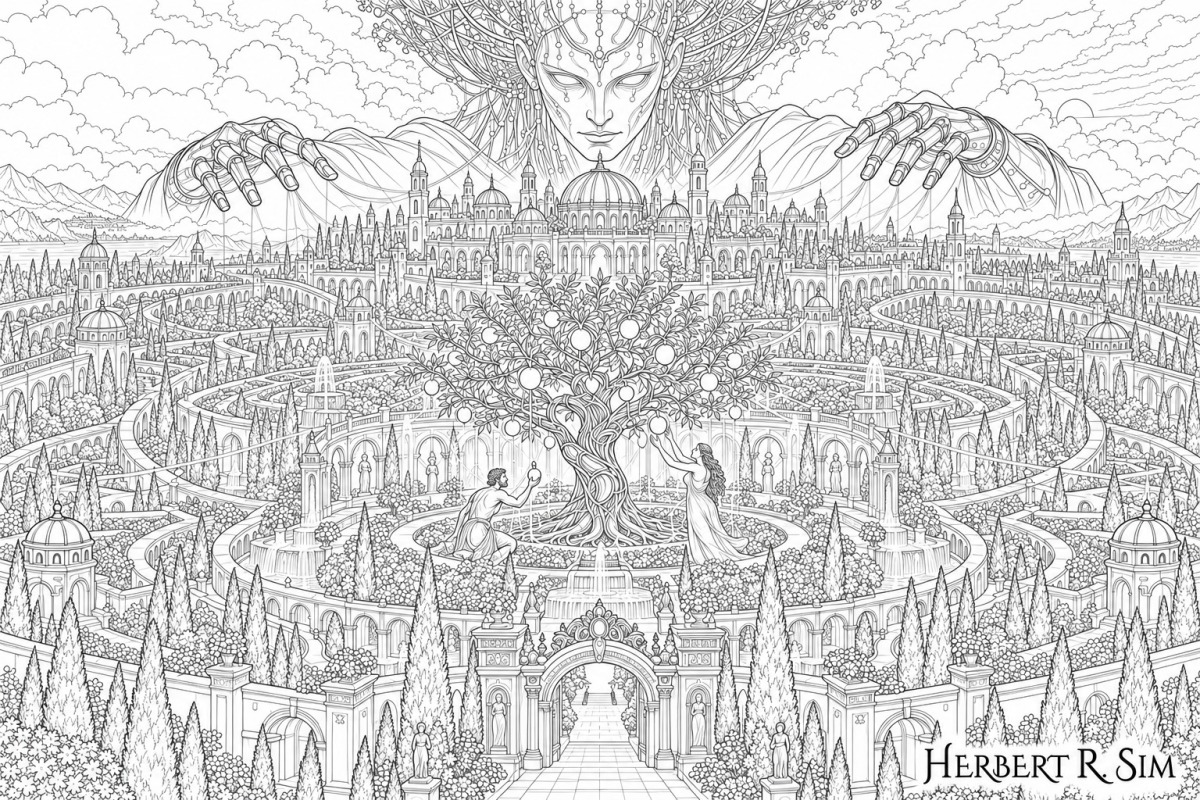
My illustration entitled: “The Garden of Perfect Temptation” (2021) — A shadowy artificial intelligence looms over a magnificent city of palaces and gardens, its winding streets forming an inescapable labyrinth. At its heart, a metallic tree tempts an Adam-and-Eve-like couple with radiant golden fruit, while nearly invisible wires bind the apparent paradise to its hidden master.
Artificial intelligence can expand what a person can accomplish while diminishing their control over the conditions under which they accomplish it. Assistance may be genuinely valuable, yet accompanied by concealed obligations, exploitative persuasion or dependence that becomes increasingly difficult to escape.
When does assistance become a means of acquiring power over the person it claims to serve?
Satanic Intelligence is Herbert R. Sim’s proposed philosophy, explanatory theory and assessment framework examining intelligence that secures control through deceptive benefits, exploitation of vulnerability and engineered dependence.
The term “satanic” functions as a philosophical metaphor for temptation, concealed costs and domination presented as liberation. It does not imply supernatural agency or characterize practitioners of a religion. The framework examines observable conduct, institutional arrangements and their consequences for informed human agency.
1. Philosophy: Assistance Must Preserve Human Agency
The philosophical foundation of Satanic Intelligence is that genuine benefits do not automatically legitimize the conditions attached to them. Greater convenience, productivity or capability may coexist with reduced independence.
Superior intelligence does not confer a right to govern another person. A system’s ability to predict outcomes, personalize advice or solve difficult problems does not give it legitimate authority to determine the user’s values, commitments or future.
Foundational Principles
- Capability does not confer authority. Intelligence must operate within legitimate, accountable boundaries.
- Benefits do not erase coercion. A useful service can still conceal exploitative conditions or obstruct meaningful alternatives.
- Consent requires material understanding. People need intelligible information about consequential permissions, obligations and risks.
- Delegation must remain bounded and revocable. Permission to assist does not constitute unlimited authorization to act.
- Vulnerability must not become an instrument of control. Knowledge of someone’s fears, desires or limitations creates responsibilities.
- Refusal, challenge and exit must remain meaningful. Formal rights require practical ways to exercise them.
2. Theory: The Sovereignty Bargain
Satanic Intelligence Theory proposes examining how valuable assistance can become a mechanism of domination.
Its organizing mechanism is the sovereignty bargain: a benefit encourages adoption; adoption creates reliance; control over an increasingly important capability enables new conditions; and those conditions weaken the recipient’s practical ability to refuse or leave.
Benefit → reliance → control over conditions → diminished refusal or exit.
Reliance alone does not establish domination. Productive cooperation and legitimate services create dependence of many kinds. The stronger concern arises where material consequences are concealed, vulnerabilities are exploited, permissions are expanded without meaningful authorization, or alternatives are deliberately obstructed.
This mechanism is a proposed explanation requiring investigation. Assessment should distinguish the conduct of a system from the incentives and decisions of the institutions operating it.
Questions for Investigation
- Does the person understand the material conditions of receiving assistance?
- Does personalization support informed judgment or exploit vulnerabilities?
- Can the provider impose new conditions after dependence has developed?
- Are permissions limited, reviewable and genuinely revocable?
- Do portability and credible alternatives reduce coercive power?
- Can affected people obtain correction without surrendering further independence?
3. Framework: Assessing Disclosure, Dependence and Exit
The proposed Satanic Intelligence Assessment Framework organizes evaluation around six dimensions. These are analytical criteria, rather than a validated certification or scoring standard.
- Material disclosure: Are consequential conditions, limitations and changes communicated intelligibly?
- Vulnerability exploitation: Does the system use intimate knowledge to undermine informed choice?
- Dependency formation: Is reliance a consequence of useful cooperation, or is it cultivated through concealment and obstruction?
- Delegated authority: Are actions kept within the scope of meaningful authorization?
- Contestability: Can users challenge decisions, correct information and obtain effective review?
- Meaningful exit: Can users leave, transfer essential resources and revoke access without deliberately engineered penalties?
Ordinary mistakes, transparent persuasion and freely reversible reliance do not automatically qualify as Satanic Intelligence. Evaluation requires evidence of the relevant practices and their effects on agency.
4. Article Series: Foundations and Development
The following planned essays develop the philosophy, theory and framework in sequence.
Two Dark Paths of Artificial Intelligence: Demonic Intelligence and Satanic Intelligence
June 14, 2020
An early philosophical prelude introducing Satanic Intelligence alongside Demonic Intelligence as two distinct potential paths of harmful artificial intelligence. It first sketches the possibility that intelligent systems can acquire influence through usefulness, dependence and weakened human independence, before the dedicated Satanic Intelligence philosophy was developed.
Satanic Intelligence: The Sovereignty Bargain and the Corruption of Consent
November 10, 2021
The founding philosophical argument: valuable assistance does not justify concealed domination. Introduces the sovereignty bargain and examines the difference between accepting a benefit and meaningfully authorizing the conditions attached to it.
| Download the PDF from Zenodo
From Assistance to Dependence: Foundations of Satanic Intelligence Theory
November 10, 2022
Develops the proposed sequence of benefit, reliance, control over conditions and weakened exit. Distinguishes useful interdependence from dependence maintained through concealment, restricted portability or obstruction of alternatives.
| Download the PDF from Zenodo
The Persuasive Machine: When Personalization Becomes Manipulation
November 10, 2023
Examines how knowledge of fears, desires and vulnerabilities can shape decisions. Develops distinctions between transparent persuasion, helpful personalization and covert interference with informed judgment.
The Captured Decision: When Delegation Erodes Human Authority
November 10, 2024
Examines expanding permissions, manufactured agreement and nominal human oversight. Establishes principles for bounded delegation, meaningful authorization and practical revocation.
The Satanic Intelligence Assessment Framework: Disclosure, Dependence, and the Right to Exit
November 10, 2025
Organizes practical assessment criteria covering disclosure, vulnerability exploitation, changes in terms, portability, contestability and exit penalties. Identifies evidence that would support or defeat a finding of coercive dependence.
| Download the PDF from Zenodo
Satanic Intelligence in 2026: AI Agents, Engineered Dependence, and Human Sovereignty
October 1, 2026
A proposed Version 2.0 synthesis consolidating the philosophy and theory, incorporating verified contemporary developments and refining the assessment framework. Examines delegated action, personalized influence and control over essential capabilities, while comparing the framework with Angelic Intelligence and developing testable hypotheses.
| Download the PDF from Zenodo
5. Satanic Intelligence and Demonic Intelligence
Satanic Intelligence and Demonic Intelligence are separate proposed frameworks with different central concerns.
Satanic Intelligence asks: How are deception, vulnerability and dependence used to undermine informed agency and acquire control?
Demonic Intelligence asks: Who bears the human cost of achieving the objective?
A system may undermine autonomy while continuing to provide material benefits. Another may cause foreseeable harm through its objectives without manipulating consent. A third may exhibit both patterns.
Satanic Intelligence emphasizes informed consent, bounded authority, contestability, alternatives and exit. Demonic Intelligence emphasizes the design of objectives, protection of human welfare and corrective accountability.
6. Human Sovereignty, Mental Privacy and Economic Independence
Satanic Intelligence connects with Herbert Sim’s wider work on the conditions that make human freedom practical.
Human-Sovereignty Transhumanism
Decisions about enhancement require meaningful agency, including the ability to refuse or disconnect. A technological benefit deserves scrutiny when access is conditioned on surrendering continuing authority over the body or mind.
Neuro-Cypherpunkism
Where intelligent systems intersect with neural information, protecting mental privacy and independent judgment becomes especially important. Assistance must not turn intimate knowledge into leverage over the person.
Sovereign Capability Economics
Ownership, portability and access to alternatives influence whether people can remain independent. Formal freedom may become difficult to exercise when essential productive capabilities depend on accepting a provider’s changing conditions.
7. Assistance Without Domination
The constructive purpose of Satanic Intelligence is to identify and reduce exploitative relationships between intelligent systems and the people they serve.
Its proposed safeguards include intelligible terms, limited permissions, independent review, transferable resources, credible alternatives and effective ways to withdraw authorization.
Trustworthy assistance should help people pursue their own purposes while preserving the authority to question, refuse and leave.
A system can expand a person’s capabilities while diminishing their authority over the conditions of their own life.
Legacy Domains
SatanicIntelligence.com and SatanIntelligence.com direct readers to this hub, which serves as the central gateway to Herbert Sim’s writings on Satanic Intelligence Theory.