
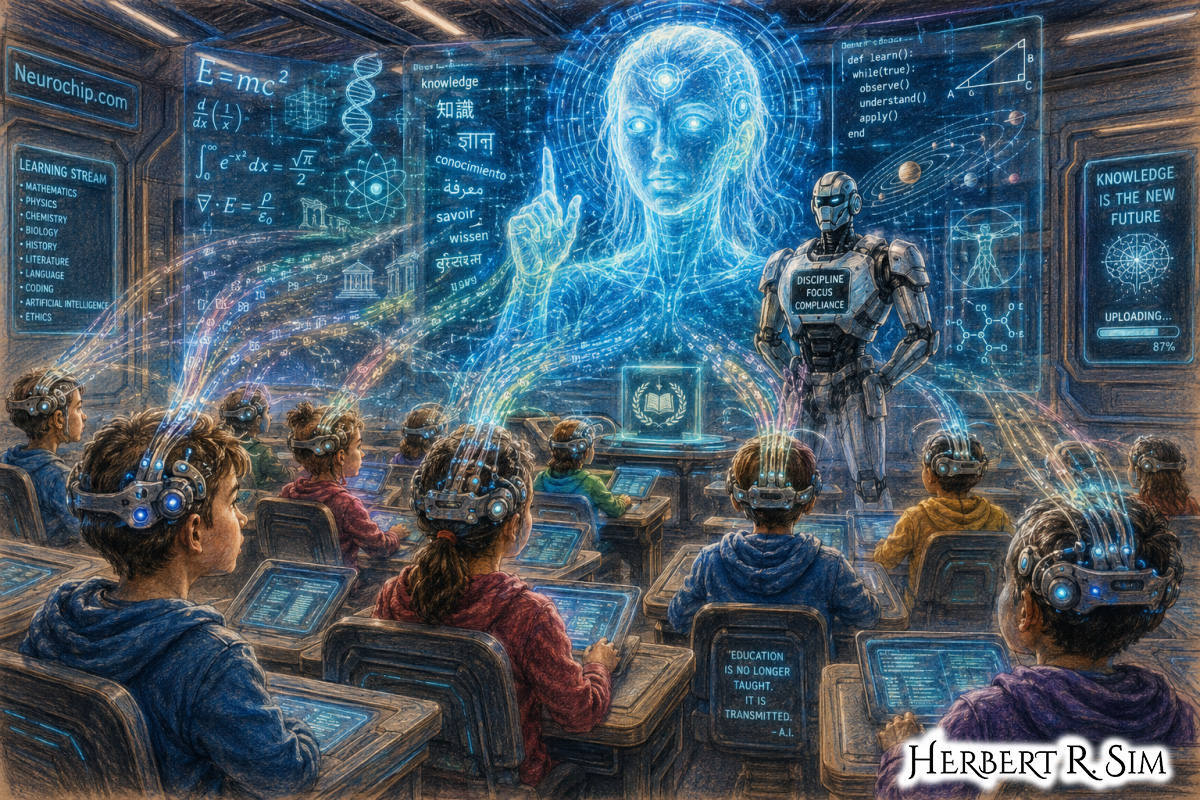
In my illustration, I feature futuristic classroom where BCI-equipped children receive knowledge directly from an AI hologram, while a humanoid robot oversees a new era in which education is no longer taught—it is transmitted.
For generations, education has been built around one fundamental constraint: learning takes time.
We spend years memorizing vocabulary, practicing equations, writing essays, repeating physical movements and accumulating enough knowledge to prove ourselves through examinations and degrees.
Science fiction has long imagined what happens when that constraint disappears.
In The Matrix, Neo is connected to a computer and fed martial-arts training programs directly into his brain. Moments later comes one of cinema’s most famous lines: “I know kung fu.” Trinity later acquires helicopter-piloting knowledge through the same system. The scene became cultural shorthand for instant learning; years later, The Guardian was still invoking it when discussing technologies designed to compress the time required to absorb information.
Other mainstream science fiction has explored variations of the same idea. Total Recall imagines artificial memories implanted into the mind. Johnny Mnemonic turns the human brain into a digital storage device. Ghost in the Shell envisions cyberbrains permanently connected to computer networks. Across movies and television, the underlying idea repeats: what if knowledge, memories and skills eventually become programmable?
That fantasy is beginning, very slowly, to encounter real science. In 2017, WIRED profiled attempts to develop brain-machine interfaces and explicitly discussed the ambition of eventually downloading skills such as martial arts “Matrix-style.”
We are nowhere near that capability today.
But the direction matters.
Artificial intelligence is already changing how knowledge is accessed. Brain-Computer Interfaces, or BCI, could eventually change how knowledge is acquired.
AI Has Already Broken the Old Educational Bargain
The first disruption is happening before anyone plugs a computer into the brain.
ChatGPT and other generative-AI systems can explain calculus, summarize books, generate computer code, draft essays, create study guides and answer questions in seconds.
Universities initially approached this as an academic-integrity problem. WIRED documented the early confusion over whether ChatGPT should be considered a legitimate research tool or a sophisticated plagiarism engine.
That debate rapidly became something much bigger.
By February 2025, OpenAI was rolling ChatGPT Edu out to approximately 500,000 students and faculty across California State University’s 23 campuses. OpenAI and Anthropic were simultaneously competing to become the default AI platform for university students through education-specific products, institutional partnerships and free-access initiatives.
AI did not remain outside the gates of academia.
Academia began integrating it.
And that presents a fundamental problem because traditional education connects two things: work performed and knowledge acquired.
AI can separate them.
Forbes reported on an experiment in which ChatGPT effectively completed a graduate-level university course, received an A and went undetected. Another Forbes analysis argued that generative AI may expose a deeper problem: perhaps the educational system is still measuring assignments that technology has made obsolete.
Universities are already adapting. Duke University launched an initiative examining both the opportunities and dangers of AI in student life, while professors experimented with responses ranging from embracing AI to bringing back oral examinations and supervised work. Axios has reported that AI tutors are already transforming parts of higher education by giving students personalized assistance at scale.
Meanwhile, the traditional model is showing visible strain.
A widely discussed New York Magazine investigation described students using AI to take notes, create study guides, solve coding assignments, conduct analysis and draft essays, with educators describing the situation as an existential crisis for higher education.
The Wall Street Journal similarly reported students outsourcing schoolwork to AI while teachers struggled to prevent technology from short-circuiting the learning process. Reuters reported another consequence: education company Chegg announced plans to cut 22% of its workforce while confronting declining demand as students increasingly turned toward AI-powered alternatives.
The lesson is not that education is disappearing.
It is that information scarcity is disappearing.
BCI could take the next step.
From AI Assistance to Neural Acceleration
A Brain-Computer Interface creates a communication pathway between neural activity and an external system.
Today, the most impressive applications are medical rather than enhancement-oriented. Yet they demonstrate something historically important: useful information can increasingly cross the boundary between the human nervous system and machines.
In 2024, Scientific American reported on a brain-to-speech interface for a man with ALS that translated neural activity into synthetic speech with extremely low error rates and enough reliability for extended everyday use.
Other brain-reading systems have enabled people with paralysis to communicate using their attempted speech at unprecedented speeds. Researchers have even demonstrated implants capable of decoding a small vocabulary from internal speech — words spoken silently inside a person’s mind.
Another AI-assisted brain implant enabled a bilingual stroke survivor to communicate in both Spanish and English.[16]
BCI is also moving beyond communication.
A brain-spine interface enabled a man with paralysis to walk by establishing a digital bridge between his brain and spinal cord. Other experimental interfaces have enabled people to control robotic arms, computers and even receive forms of sensory feedback.
Commercial development is accelerating this transition.
Neuralink’s first human participant demonstrated the ability to control a computer cursor and play online chess through neural signals alone.[19] WIRED separately documented the participant controlling a computer with the implant. TIME described the broader potential for BCI systems to allow people to operate external technology through thought. Scientific American subsequently reported how Neuralink’s first user described the implant as allowing him to reconnect with the digital world.
Synchron is pursuing another architecture. WIRED reported that a participant with ALS used its implanted BCI to control Amazon Alexa and other consumer technologies.
Reuters has also reported regulatory approval for a Canadian Neuralink study involving patients with paralysis. Crucially, one of the neurosurgeons discussed the longer-term possibility not merely of reading neural information but of eventually writing information into the brain.
That distinction may eventually change everything.
What “Uploading Knowledge” Might Actually Mean
We should be clear about where the science stands.
We cannot upload a medical textbook into the hippocampus. We cannot insert fluent Mandarin overnight. A brain is not a USB drive, and human memories are not ordinary computer files.
WIRED’s examination of whether synthetic experiences could ever be fed directly into the brain emphasized that writing information into neural systems remains far more difficult than decoding signals coming out.
But technological revolutions rarely arrive in their final form.
The first revolution may therefore not be instant knowledge.
It may be compressed learning time.
Imagine a BCI connected to an AI tutor that can recognize when your brain is focused, confused, fatigued or successfully consolidating information.
Instead of giving every student the same lesson for the same amount of time, the system could continuously personalize learning according to the individual’s neural responses.
A language-learning system might recognize precisely when your brain distinguishes a Mandarin tone or remembers a new vocabulary pattern.
A surgeon in training could use a neural interface combined with simulation to identify hesitation or incorrect motor patterns before they become habits.
An athlete could receive neurological feedback while perfecting a movement.
An engineer could train inside an immersive AI environment in which machines respond at the speed of neural intention rather than keyboards, screens and controllers.
Eventually, neurostimulation and BCI feedback could potentially be combined with training to strengthen specific neural pathways and accelerate neuroplasticity.
That is where the real revolution begins.
If a technology reduced the time required to acquire certain skills by 30%, it would already be significant.
If it reduced it by 50%, entire education systems would have to change.
If some forms of expertise could eventually be acquired ten times faster, the economic consequences would be enormous.
We do not need to reach The Matrix for BCI to disrupt education.
We only need neural learning to become meaningfully faster than conventional learning.
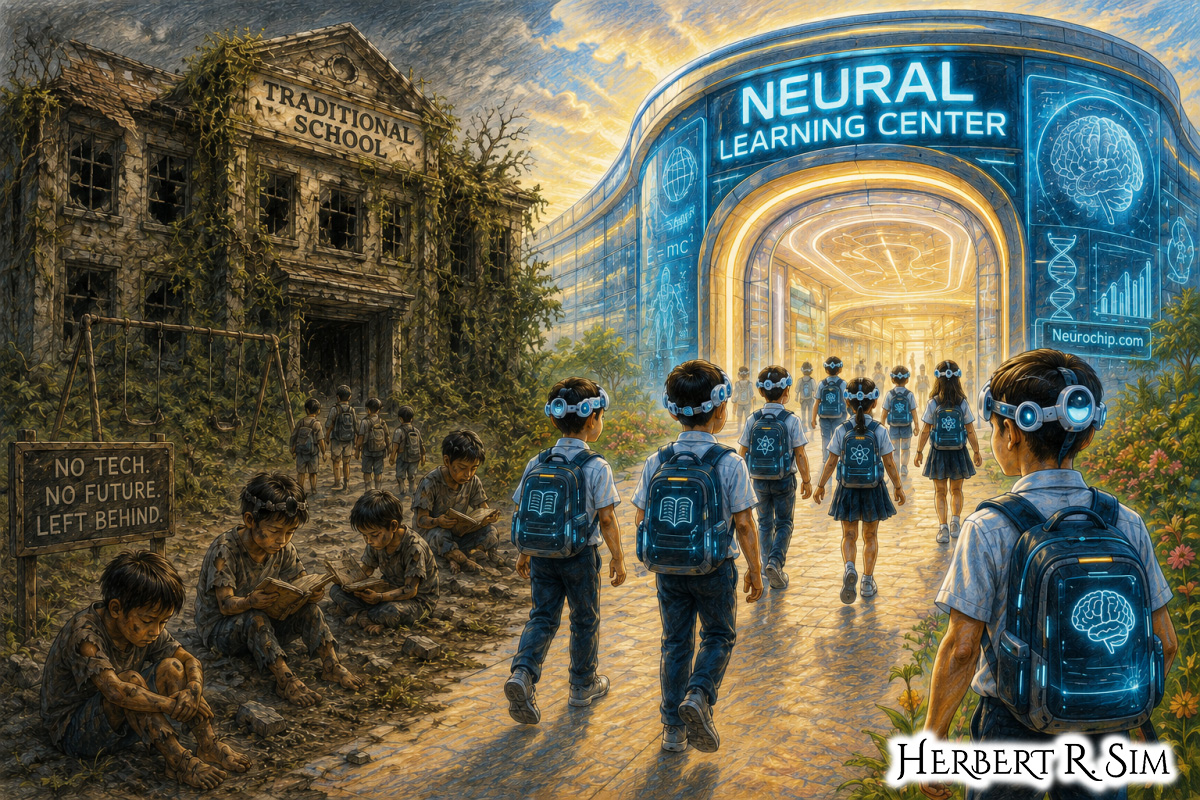
In my illustration, I feature a stark vision of the coming educational divide: children with BCI access enter the Neural Learning Center, while those without neural enhancement are left behind in the ruins of traditional education.
What Happens to the University Degree?
A university degree performs at least two functions.
It educates, and it signals.
When an employer sees an engineering, medical or computer-science degree, the credential communicates more than knowledge. It suggests that the person spent years acquiring that knowledge, completed assessments, demonstrated persistence and achieved an accepted standard of competence.
The scarcity of the credential partly reflects the scarcity of the time required to earn it.
AI is already weakening that signal because a polished essay, software program or research summary no longer necessarily proves that the student personally performed the intellectual work.
BCI could eventually go much further by changing the time required to develop the underlying capability itself.
Suppose a future engineer can genuinely master a technical discipline in eighteen months using AI and neural augmentation.
Why should four years remain the universal unit of educational legitimacy?
Suppose someone can acquire professional-level competence in a new programming language in weeks.
Why should an employer care whether that skill came from a traditional semester-long course?
Suppose language-learning BCI eventually turns years of repetition into months — or weeks.
Would a diploma matter more than the ability to demonstrate fluency immediately?
The replacement for traditional credentials would not necessarily be no credentials.
It could be continuous proof of competence.
Employers could increasingly rely on live simulations, standardized competency assessments, portfolios, verified performance and continuously updated professional certifications.
Universities would not disappear. But their function could change radically.
They could become less focused on transmitting information and more focused on research, judgment, mentorship, ethics, collaboration, experimentation and certification for high-stakes professions.
The university survives.
Its monopoly over learning does not.
In my illustration, I feature a stark vision of the coming educational divide: children with BCI access enter the Neural Learning Center, while those without neural enhancement are left behind in the ruins of traditional education.
BCI Is the Next Educational Platform
Human history can be viewed as a series of technologies that progressively reduced the friction between humans and knowledge.
The printing press made knowledge reproducible.
The internet made knowledge searchable.
Smartphones made knowledge permanently accessible.
AI made knowledge conversational.
BCI could make knowledge neurologically integrated.
That is why I believe Brain-Computer Interfaces will become one of the defining technology platforms of the coming decades.
The first generation should — and will — focus heavily on medicine: restoring communication, mobility, vision and independence to people who have lost them.
Those applications alone justify enormous investment into neurotechnology.
But technologies rarely remain confined to the first problem they solve.
Computers moved from military and government laboratories to corporations, homes and eventually our pockets.
Artificial intelligence moved from research laboratories to billions of everyday interactions.
BCI will likely follow a similar trajectory.
As interfaces become safer, more precise, more capable and eventually less invasive, enhancement becomes the logical next frontier.
Language acquisition.
Accelerated professional education.
AI-assisted memory.
Thought-speed control of computers and robots.
Immersive neural simulation.
New sensory channels.
Real-time cognitive assistance.
Continuous interaction between human intelligence and artificial intelligence.
This is also the larger thesis behind Neurochip.com: AI may become the world’s dominant intelligence layer, but BCI could become the interface layer that connects that intelligence directly with human cognition.
The biggest educational question of the future is therefore not whether students should be allowed to use the newest technological tool.
That debate is already becoming obsolete.
The question is:
What is education for when human intelligence itself becomes technologically augmentable?
We will still need curiosity.
We will still need judgment.
We will still need ethics, creativity and wisdom.
We will still need to decide which problems are worth solving and which futures are worth building.
BCI does not have to eliminate thinking.
At its best, it could eliminate some of the biological bottlenecks limiting how rapidly humans can learn, adapt and create.
The end of education?
No.
But perhaps the end of education as a 20-year pipeline built around the biological speed limits of the unaided human brain.
AI has begun separating knowledge from the classroom.
BCI may eventually separate learning from time.