
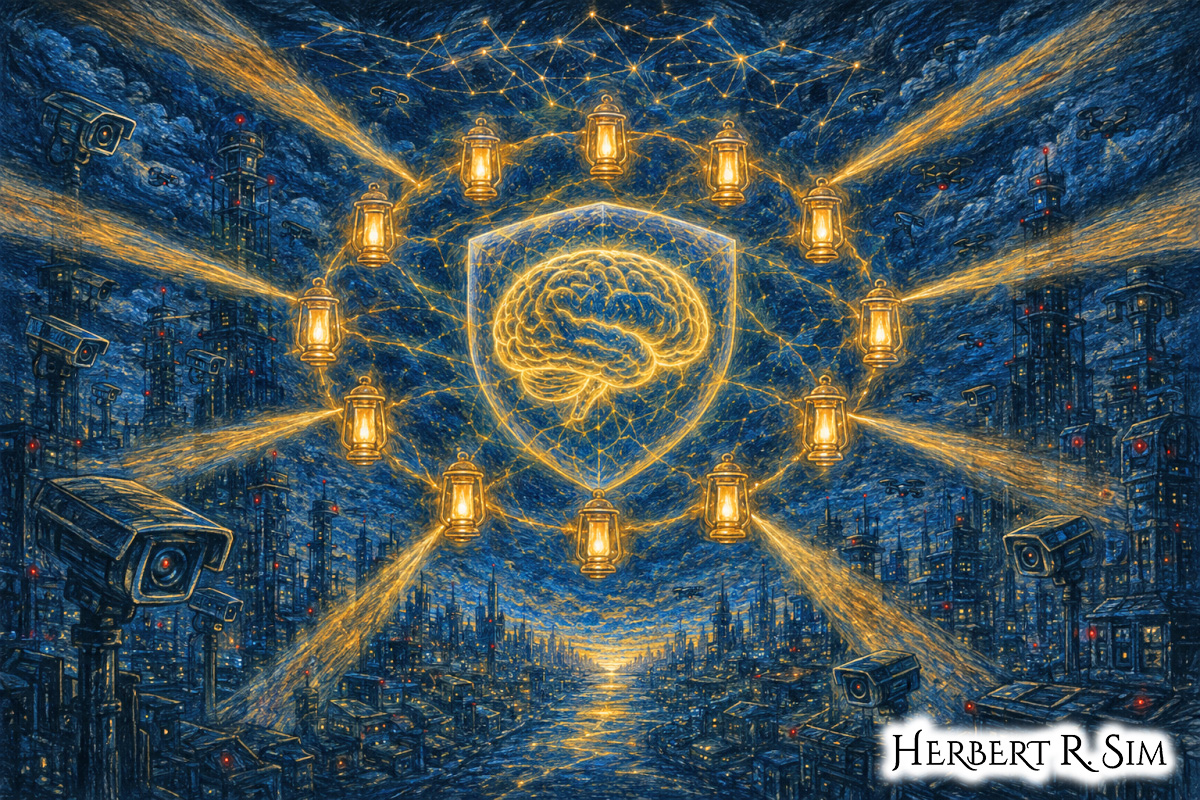
My illustration entitled: “The Twelve Lanterns” – twelve glowing lanterns surround a protected human brain, each casting a distinct beam of light through a dark surveillance landscape.
The Architecture of Cognitive Sovereignty
Brain–computer interfaces are moving the digital network toward the human nervous system. Technologies capable of detecting neural activity can already translate certain signals into movement, communication and control of external devices. Artificial intelligence is improving the interpretation of these signals, while neurostimulation technologies demonstrate that information and influence can also travel in the opposite direction—from a machine toward the nervous system.
These developments may restore speech, mobility and independence to people living with paralysis or neurological injury. They may eventually enable new forms of communication, sensory experience, learning and human–machine cooperation. Neurotechnology should therefore not be approached only through fear. Its capacity to expand human agency is one of the strongest reasons to develop it.
But every increase in technological capability creates a corresponding question of power. Who collects the neural information? Who interprets it? Who stores it? Who controls the software? Who may alter the permissions? Who can transmit signals back toward the brain? Who possesses the authority to disconnect the system?
Neuro-Cypherpunkism applies privacy, cryptography, decentralization and individual sovereignty to brain–computer interfaces and the emerging technological connection between human cognition and digital systems. It begins from the premise that the closer technology moves to the human mind, the stronger the protections surrounding the individual must become.
The Neuro-Cypherpunkist Manifesto declares the rights and responsibilities required at this new technological frontier. The following twelve principles organize those declarations into a coherent philosophical and architectural framework.
Each principle addresses three questions: what human interest must be protected, what concentration of power must be constrained and what kind of technological architecture should be built.
Principle I: The Mind Is Sovereign Territory
Political sovereignty traditionally concerns supreme authority over territory. In technological civilization, sovereignty must also protect the territory of the person. The human mind is the primary domain of identity, intention, memory, judgment and agency. It must therefore be treated as sovereign territory belonging fundamentally to the individual.
This principle does not claim that human thought develops in isolation. Minds are shaped by families, communities, cultures, education and relationships. Nor does it deny the legitimate role of medicine in treating neurological illness. It establishes a narrower and more important proposition: no external institution acquires ownership of a person’s cognition merely because it develops technology capable of observing or influencing it.
The ability to detect a neural signal does not create ownership of that signal. The ability to interpret neurological activity does not create authority over the person producing it. The ability to stimulate the nervous system does not create a right to do so without permission.
Technological capability must never be mistaken for moral authority.
The individual must remain the sovereign subject of the neural system, not an object administered by it. Every subsequent principle follows from this foundation.
Principle II: Neural Privacy Must Become a Fundamental Right
Traditional informational privacy concerns communications, records, identity and behaviour. Neural privacy extends protection to information derived from the brain and nervous system.
Neural signals should not be described as perfect recordings of thought. Brain activity is complex, contextual and open to interpretation. A contemporary brain–computer interface usually recognizes patterns associated with a particular task rather than reading a person’s mind as if it were a written document.
Yet neural information can still reveal or be used to infer sensitive characteristics. Depending upon the device and context, it may contain patterns associated with motor preparation, attention, cognitive workload, recognition, emotional response or health. Even inaccurate interpretations can harm individuals if employers, insurers, governments or automated systems treat them as authoritative.
Neural privacy must therefore protect both raw signals and the conclusions derived from them. An organization should not escape responsibility merely by claiming that it stores an algorithmic inference rather than the underlying neural recording.
As explored in Neural Sharing and the Death of Privacy, the transmission of thoughts, emotions or experiences would transform privacy from control over external records into protection of the processes from which expression originates.
The guiding rule must be:
Collect only what is required. Process only what is authorized. Retain only what is necessary.
Thought is not telemetry. The brain is not an advertising identifier. Cognition does not become a commodity merely because a machine can measure it.
Principle III: Individuals Must Possess Neural Self-Custody
Cryptocurrency popularized the concept of self-custody: the individual can hold cryptographic keys that provide direct control over a digital asset without another institution possessing ultimate authority over it.
Neuro-Cypherpunkism extends this idea into the cognitive domain.
Neural self-custody is the individual’s meaningful technical authority over access to neural information and over the operation of technologies connected to his nervous system. It includes control over collection, storage, processing, permissions, transmission, activation and disconnection.
Self-custody does not mean that every patient must personally operate a server or understand every component of a medical device. Assistance, clinical supervision and recovery mechanisms may be necessary. The principle concerns ultimate authority. Technical support should help the person exercise control rather than convert dependency into institutional ownership.
Where practical, users should retain accessible copies of their neural records, device settings and permission histories. They should be able to authorize trusted medical professionals without granting indefinite access to manufacturers, advertisers or unrelated applications.
A person should not require permanent permission from a corporation to access information generated by his own brain. Nor should the essential operation of a device connected to his nervous system depend unnecessarily upon a proprietary subscription or remote server.
A cloud account can be abandoned. A brain–computer interface upon which a person depends for communication or movement may be much harder to leave. The deeper the dependency, the stronger the requirement for self-custody.
Principle IV: Neural Read and Neural Write Must Remain Distinct
A brain–computer interface can involve two fundamentally different directions of technological power.
A neural read operation receives or interprets information from the nervous system. It may detect an intended movement, measure a neurological response or translate attempted speech.
A neural write operation sends information or stimulation toward the nervous system. It may alter activity through electrical, magnetic, chemical or other forms of intervention.
These operations must never be treated as equivalent permissions.
A person who authorizes a device to interpret motor intention has not authorized it to alter emotion. A patient who consents to neurological monitoring has not necessarily consented to stimulation. A consumer who permits a headset to estimate attention has not granted the manufacturer authority to influence cognition.
Neural write access creates risks beyond ordinary information processing because it may affect perception, behaviour, mood, movement or bodily function. It should require separate authorization, strict technical limits, visible operation and the ability to terminate the intervention wherever medically possible.
The architecture should separate read and write privileges so that compromise of one does not automatically provide access to the other. A program allowed to receive a limited processed command should not thereby gain the ability to transmit arbitrary stimulation.
Permission to read the brain must never imply permission to write to the brain.
Principle V: Consent Must Be Continuous, Granular and Revocable
The prevailing model of digital consent is inadequate for neurotechnology. Users frequently encounter lengthy terms of service and select “Accept” because refusal means losing access to the product. Such agreement may satisfy a procedural requirement while providing little meaningful choice.
Neural consent must be granular. A person might authorize the decoding of motor signals without permitting emotional analysis. He might permit temporary clinical monitoring without authorizing permanent storage. He might allow an application to receive a specific processed output without giving that application access to the underlying neural data.
Consent must also be continuous. A user should be able to see which permissions remain active, which parties have accessed the system and whether the purpose of processing has changed. A permission granted for rehabilitation should not silently expand into permission for product development, advertising or employee evaluation.
Finally, consent must be revocable. Installing a neural device cannot mean surrendering permanent rights over everything the device may later observe. Revocation should stop future collection and processing, subject only to narrowly defined legal or medical obligations.
This principle becomes particularly important when artificial intelligence generates new inferences from old information. Consent to an original recording cannot automatically authorize every future analysis that technological progress makes possible.
A terms-of-service agreement must never become a deed transferring cognitive sovereignty.
Principle VI: Neural Processing Should Be Local First
The dominant architecture of contemporary digital services is cloud-centred. Devices collect information, remote servers process it and companies accumulate the resulting databases. This model may provide powerful computation and convenient updates, but it also creates concentrated stores of sensitive information and continuing dependence upon external infrastructure.
For neural data, centralization creates exceptional risks. A database containing years of brain-generated information could become a target for criminals, intelligence agencies, employers, insurers or companies seeking behavioural advantage. A change in ownership or policy could expose information collected under very different expectations.
Neuro-Cypherpunkism therefore establishes a presumption in favour of local processing. If a device can interpret a neural command on hardware controlled by the user, the raw neural signal should not be transmitted elsewhere without a specific reason.
Applications should receive the minimum output required to perform their function. A game may need to know that the user selected an action; it does not necessarily need the complete neurological recording from which the action was inferred. A prosthetic device may require a movement command; its manufacturer does not automatically require a permanent archive of every raw signal.
Local-first does not mean cloud-never. Complex medical analysis, collaborative research and computationally intensive applications may legitimately require external processing. The principle is that centralization must justify itself through necessity, security and informed permission. It should not remain the unquestioned default merely because data extraction is commercially convenient.
Process the mind as close to the mind as possible.
Principle VII: Cryptography Must Extend to the Nervous System
Humanity encrypts messages, financial transactions, hard drives and digital identities. Information transmitted from or toward the nervous system deserves protections at least as strong.
A neural system must protect confidentiality: unauthorized parties should not be able to read its sensitive information. It must protect integrity: attackers should not be able to alter neural commands, device settings or stimulation instructions. It must protect authenticity: the system should distinguish authorized users and components from impostors.
The consequences of failure may be substantially greater than the compromise of an ordinary consumer account. An attacker who steals an email password may read communications. An attacker who gains control over an assistive neural interface might interfere with a person’s capacity to communicate, operate a prosthetic device or exercise control over his environment.
Security must therefore be present throughout the system: sensors, implants, wireless channels, processors, applications, update mechanisms, clinical interfaces and recovery procedures. Encryption at one point cannot compensate for unrestricted access elsewhere.
Emergency and maintenance access may be necessary in medical systems, but such mechanisms must not become permanent universal backdoors. They should be narrowly limited, auditable and resistant to unauthorized use.
As established by Cypherpunkism, cryptography transforms privacy from a promise into an architectural property. The same logic must now reach the nervous system.
If the brain becomes connected, the connection must be defended.
Principle VIII: No Central Authority Should Own the Neural Layer
The digital age has concentrated enormous power in a small number of platforms controlling communication, cloud infrastructure, software distribution and online identity. The neural age must not reproduce this model at a deeper level.
Imagine one corporation controlling the dominant neural operating system. It manufactures the interface, operates the cloud, stores neural information, approves compatible applications, controls security updates and determines which functions remain available. Millions of people may eventually depend upon it for communication, movement or cognitive assistance.
Such an institution would possess more than market power. It could acquire infrastructural authority over capabilities integrated into human bodies and daily cognition.
No single government, corporation, military institution or artificial intelligence should possess unrestricted control over humanity’s neural infrastructure. This does not require every component to operate through a blockchain or peer-to-peer network. It requires the deliberate distribution of authority.
Open technical standards, compatible components, inspectable interfaces and data portability can reduce dependency. Users should be able to change service providers without abandoning their neural records or losing access to functions on which they depend. Essential devices should continue operating safely when a company fails, changes strategy or withdraws support.
Decentralization is a check on power. Its purpose is not decentralization for its own sake, but the prevention of an unnecessary single point of control over the human mind.
Principle IX: Every Person Has the Right to Disconnect
A person must remain capable of withdrawing from neural connectivity without surrendering ordinary participation in society.
This right includes the ability to disable a non-essential connection, terminate data transmission, remove a device where medically possible and stop using a service. For people who depend upon neurotechnology for communication or movement, it must also include the right to change providers and preserve essential offline functions wherever technically practical.
The right to disconnect is not meaningful if refusal results in social or economic exclusion. A worker is not genuinely free to reject neural monitoring if rejection makes employment impossible. A student is not freely choosing a cognitive interface if every educational institution requires it. A citizen is not exercising voluntary consent if public services become inaccessible without continuous neural authentication.
Efficiency does not create authority. A neural interface may allow faster communication, improved performance or easier verification, but the availability of a more efficient technology does not give institutions the right to mandate its use.
The freedom to connect and the freedom to disconnect are two sides of the same sovereignty. Without the ability to leave, participation becomes dependency. Without the ability to refuse, enhancement becomes coercion.
Principle X: Neurotechnology Must Never Become Compulsory
The right to disconnect concerns departure from a system. The principle against compulsory neurotechnology concerns forced entry into it.
No employer, school, insurer, government or corporation should possess unrestricted authority to compel neural monitoring, stimulation or augmentation. A worker should not be forced to surrender neural information because an employer wants more precise productivity measurements. A child should not be required to expose neurological signals simply because a school believes monitoring will improve performance.
The same protection must apply to people in circumstances where consent is structurally weakened. Patients, prisoners, soldiers, children and economically vulnerable individuals may face pressures that do not resemble an ordinary consumer decision. Their dependency should result in stronger protections rather than broader institutional access.
Difficult cases will exist. Medical emergencies, diminished capacity and treatment of serious neurological conditions may require decisions in which immediate consent is impossible. These cases should be governed by established medical ethics, necessity, proportionality, independent review and the person’s previously expressed wishes wherever available.
Narrow exceptions must not become a general license for cognitive control. The existence of a beneficial application does not justify compulsory adoption by an entire population.
Technological progress becomes oppression when refusal ceases to be possible.
Principle XI: Artificial Intelligence Must Not Become the Gatekeeper of Cognition
Brain–computer interfaces and artificial intelligence will increasingly operate together. Neural signals are complex and variable, making machine learning valuable for recognizing patterns, adapting to users and translating activity into useful commands.
Artificial intelligence may help a person with paralysis communicate, interpret intended movement or operate an assistive device. It may adapt an interface to changes in the user’s condition and reduce the effort required to control technology.
Yet an AI positioned between the brain and the external world may become the interpreter through which intention becomes action. Whoever controls that AI could potentially influence which signals are recognized, which commands are executed, what information is retained and how the individual is represented to connected systems.
The user must therefore retain authority over the artificial interpreter. Important permissions should be visible, outputs should be contestable and significant behavioural changes should not be imposed without notice. Where feasible, the individual should be able to select, replace or locally operate the model used to interpret his neural activity.
No artificial intelligence should independently expand its access to neural information, hide important operations or authorize non-emergency neural stimulation beyond the limits established by the individual and appropriate medical oversight.
Computational superiority does not create moral sovereignty.
Artificial intelligence may interpret the signal. The human being must retain authority over the connection.
Principle XII: Technology May Augment the Mind—Never Own It
Neuro-Cypherpunkism is not anti-science, anti-technology or anti-BCI. It does not demand that humanity abandon the possibility of repairing neurological injury, expanding communication or developing new forms of human–machine cooperation.
It asks who will possess authority when those possibilities become real.
A brain–computer interface may restore movement, but its manufacturer must not own the person’s motor intentions. A neural communication device may restore speech, but its operator must not acquire the right to retain every attempted sentence. A cognitive aid may improve memory or concentration, but continued access to those capabilities must not become conditional upon permanent surveillance.
This principle connects Neuro-Cypherpunkism with Human-Sovereignty Transhumanism. Enhancement is legitimate when it expands the individual’s capabilities while preserving consent, agency, identity and the right to refuse. Enhancement becomes domination when the provider of the technology acquires ultimate authority over the enhanced person.
Every powerful technology eventually becomes a question of control. Who owns the device? Who operates the software? Who accesses the information? Who sets the permissions? Who may disable it? Who may compel its use? Who can leave?
These are not secondary policy questions. They are part of the technology itself.
Freedom must be built into neural architecture before centralized dependency becomes difficult to reverse.
Technology may augment the mind. It must never own the mind.
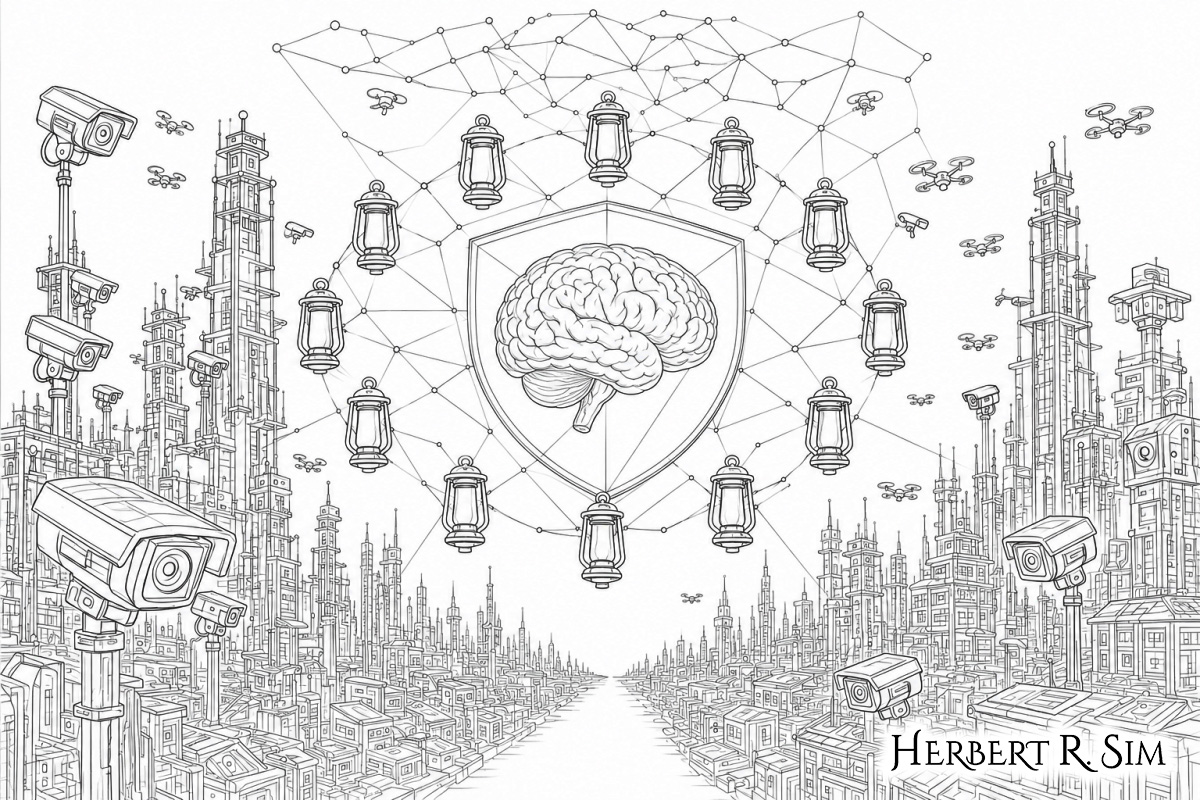
My illustration “The Twelve Lanterns” work-in-progress. The art represents the twelve principles illuminating the path to cognitive freedom.
How the Twelve Principles Work Together
The twelve principles form an interconnected system rather than a menu from which developers or institutions may select only the convenient parts.
Cognitive sovereignty establishes the moral foundation. Neural privacy determines what must be protected. Neural self-custody assigns meaningful authority to the individual. The neural read/write divide separates observation from intervention, while granular consent governs the permissions surrounding both.
Local-first processing reduces unnecessary exposure. Cryptography protects the connections that remain necessary. Decentralization prevents one institution from owning the neural layer. The right to disconnect and the prohibition against compulsion preserve voluntary participation.
Human authority over artificial intelligence ensures that the interpreter does not become sovereign over the person whose signals it processes. The final principle directs the entire framework toward its purpose: technology must augment human agency rather than appropriate it.
Removing one principle weakens the others. Encryption cannot create sovereignty if the company retains unilateral control over the device. Consent is not meaningful when disconnection causes social exclusion. Local processing cannot protect the user if hidden write access remains active. Decentralization cannot justify a system that ignores privacy or responsibility.
Neuro-Cypherpunkism therefore requires technical, legal and ethical protections to operate together.
Principles for Designers, Institutions and Users
For engineers, the twelve principles require data minimization, clear separation of privileges, secure hardware, encrypted communication, local processing, auditable permissions and safe methods of disconnection. Privacy and security must be treated as primary design requirements rather than additions made after deployment.
For companies, the principles require business models that do not depend upon unrestricted extraction of neural information. Manufacturers must plan for maintenance, continuity and portability before users become dependent upon their devices. Commercial investment deserves reward, but the individual must not become property of the ecosystem providing the enhancement.
For governments, the principles require protection against coercive neural surveillance, discriminatory use, compulsory adoption and unrestricted institutional access. Regulation should protect individuals without prohibiting legitimate research, therapeutic innovation or the development of privacy-preserving alternatives.
For researchers and clinicians, the principles require scientific honesty, informed consent, security and respect for the distinction between experimental possibility and demonstrated capability. Sensational claims about mind reading or cognitive control can distort public understanding just as surely as commercial secrecy can.
For users, Neuro-Cypherpunkism includes responsibilities. Individuals must respect the neural privacy of others, secure the credentials under their control and avoid using cognitive technology for coercion, manipulation or unauthorized intrusion.
Sovereignty is a right, but it is also a discipline.
The Neuro-Cypherpunkist Standard
A neural technology should not be judged only by what it enables. It must also be judged by the relationship of power it creates.
Does the technology minimize neural-data collection?
Does the individual control the relevant permissions?
Are read and write capabilities technologically separated?
Can consent be withdrawn?
Is sensitive processing performed locally where practical?
Are communications authenticated and encrypted?
Can the user change providers or compatible components?
Can the system operate safely without continuous dependence upon one company?
Can the individual disconnect or refuse participation?
Does artificial intelligence remain subordinate to human authority?
Does the technology expand agency without acquiring ownership of the person?
These questions translate philosophy into design. A system that performs an extraordinary function while failing them may still be innovative, but it cannot be described as cognitively sovereign.
The Neuro-Cypherpunkist Principle
The first generation of Cypherpunks understood that privacy could not depend entirely upon promises. They wrote code because architecture could make freedom more difficult to revoke.
Neuro-Cypherpunkism carries that insight to the nervous system.
We should develop brain–computer interfaces. We should restore damaged human capabilities. We should explore new forms of communication and human–machine cooperation. We should pursue technologies capable of expanding human intelligence and agency.
But we must reject the belief that technological progress requires the surrender of the individual.
The brain is not an endpoint from which information may be extracted without limit.
The nervous system is not an open network upon which any authorized company may install permanent access.
The person is not a peripheral device belonging to the platform.
As technological distance from the mind decreases, sovereignty must increase.
The mind is sovereign territory.
Neural data requires exceptional protection.
Permission to read is not permission to write.
Process the mind as close to the mind as possible.
Encrypt the connection.
Decentralize the neural layer.
Preserve the right to disconnect.
Keep artificial intelligence subordinate to human authority.
Technology may augment the mind—never own it.
The mind is the final private key.
References and Further Reading
- Herbert R. Sim, “The Mind Is the Final Private Key: Neuro-Cypherpunkism and the Fight for Cognitive Sovereignty,” 22 March 2025
- Herbert R. Sim, “From Cypherpunkism to Neuro-Cypherpunkism,” 22 April 2025
- Herbert R. Sim, “The Neuro-Cypherpunkist Manifesto,” 15 May 2025
- Herbert R. Sim, “Neural Sharing and the Death of Privacy,” 6 June 2025
- Herbert R. Sim, “Cypherpunkism: A Philosophy of Digital Sovereignty,” 2010
- Herbert R. Sim, “The Eight Principles of Cypherpunkism,” 2011
- Herbert R. Sim, “Privacy Is Sovereignty,” 2013
- Herbert R. Sim, “Cryptography Is Applied Freedom,” 2013
- Herbert R. Sim, “Digital Sovereignty: A Formal Definition,” 2013
- Herbert R. Sim, “Human-Sovereignty Transhumanism,” 2014
- Ivan Martinovic et al., “On the Feasibility of Side-Channel Attacks with Brain-Computer Interfaces,” USENIX Security Symposium, 2012
- Tamara Bonaci, Ryan Calo and Howard J. Chizeck, “App Stores for the Brain: Privacy and Security in Brain-Computer Interfaces,” 2014
- Marcello Ienca and Pim Haselager, “Hacking the Brain: Brain–Computer Interfacing Technology and the Ethics of Neurosecurity,” 2016
- Marcello Ienca and Roberto Andorno, “Towards New Human Rights in the Age of Neuroscience and Neurotechnology,” 2017
- Rafael Yuste et al., “Four Ethical Priorities for Neurotechnologies and AI,” Nature, 2017
- OECD, “Recommendation on Responsible Innovation in Neurotechnology,” 2019
- Henri Lorach et al., “Walking Naturally After Spinal Cord Injury Using a Brain–Spine Interface,” Nature, 2023
- Francis R. Willett et al., “A High-Performance Speech Neuroprosthesis,” Nature, 2023
View the Official Zenodo Publication Record
Official Publication Record
The Twelve Principles of Neuro-Cypherpunkism has been formally archived on Zenodo with a permanent DOI for citation, preservation and scholarly reference.
| Title | The Twelve Principles of Neuro-Cypherpunkism |
| Subtitle | The Architecture of Cognitive Sovereignty |
| Author | Herbert R. Sim |
| ORCID | 0009-0008-6500-5749 |
| Publication date | 16 June 2025 |
| Version | Version 1.0 |
| Canonical webpage | https://herbertrsim.com/principles-of-neuro-cypherpunkism/ |
| DOI | 10.5281/zenodo.22376275 |
| Zenodo record | https://zenodo.org/records/22376275 |
| Licence | Creative Commons Attribution 4.0 International Licence (CC BY 4.0) |
Preferred citation:
Sim, Herbert R. (2025). The Twelve Principles of Neuro-Cypherpunkism: The Architecture of Cognitive Sovereignty (Version 1.0). HerbertRSim.com.
https://doi.org/10.5281/zenodo.22376275
Copyright and licence:
© 2025 Herbert R. Sim. This work is licensed under the Creative Commons Attribution 4.0 International Licence (CC BY 4.0).
Zenodo publication note:
This work is archived on Zenodo for permanent scholarly preservation, public access and citation.