
Privacy, Cryptography, Decentralization and Individual Freedom in the Technological Age

In my illustration above, I feature “The Five Pillars of Cypherpunkism” – Privacy, Cryptography, Decentralization, Open Knowledge, Digital Sovereignty.
The Internet Has Become a Question of Power
The Internet was once imagined primarily as a network for exchanging information.
It is becoming something much larger.
Increasingly, we communicate through it, conduct commerce through it, store our memories on it, establish identities through it and depend upon it to participate in modern society.
Our photographs are becoming digital.
Our conversations are becoming digital.
Our relationships are becoming digital.
Our purchases are becoming digital.
Our money may eventually become increasingly digital.
And as more of human life enters computer networks, a fundamental political question follows:
Who controls the digital world in which we increasingly live?
This is no longer merely a technical question.
It is a question of freedom.
The architecture of technology determines what individuals are capable of doing, what institutions are capable of observing and how much power either side possesses over the other.
If every important digital interaction must pass through centralized authorities, then those authorities inevitably acquire extraordinary power.
They can observe.
They can record.
They can restrict.
They can identify.
They can censor.
They can deny access.
They can change the rules.
They can potentially reconstruct enormous portions of a person’s life from information that would previously have disappeared into ordinary human forgetfulness.
The digital world therefore requires more than innovation.
It requires a philosophy governing the relationship between **individuals, technology and centralized power**.
The foundations of such a philosophy already exist.
They were laid by cryptographers, programmers, privacy advocates and the activists who became known as the **Cypherpunks**.
But I believe the principles behind that movement extend beyond cryptography itself.
They constitute the beginnings of a broader philosophy of digital civilization.
I use the term:
Cypherpunkism
Cypherpunkism is the philosophy that **individual sovereignty in the technological age must be protected not only by laws and institutions, but by technological architectures that make privacy, autonomy and decentralization practically enforceable.**
Its purpose is not simply to hide information.
Its purpose is to prevent technological progress from creating an irreversible concentration of power over human beings.
Its central political subject is the individual.
Its principal defense is cryptography.
Its structural preference is decentralization.
And its objective is:
Digital Sovereignty.
From Cypherpunk to Cypherpunkism
Cypherpunkism does not begin with me.
Its intellectual roots extend to the cryptographers and computer scientists who understood, before most of society did, that electronic networks would radically change the relationship between individuals and institutions.
Timothy C. May’s Crypto Anarchist Manifesto, written in 1988, anticipated a world in which cryptography could permit people to communicate, transact and form relationships across computer networks without requiring traditional authorities to mediate every interaction.
Several years later, Eric Hughes, Timothy May and John Gilmore helped establish the group that became the Cypherpunks, with the name itself attributed to Jude Milhon. The Cypherpunks mailing list began in 1992 and became a forum where cryptography, privacy, anonymous communication, electronic money, politics and computer science converged.
Then, on March 9, 1993, Eric Hughes published A Cypherpunk’s Manifesto.
Its opening proposition remains one of the most important ideas in the history of digital privacy:
“Privacy is necessary for an open society.”
Hughes distinguished privacy from secrecy and described privacy as the ability of an individual to determine what information about himself is revealed and to whom. He argued that electronic privacy required cryptography and systems capable of allowing people to transact without unnecessarily identifying themselves.
His practical instruction was equally important:
“Cypherpunks write code.”
This is the defining difference between the Cypherpunk and the ordinary political theorist.
The Cypherpunk does not merely petition authority.
The Cypherpunk builds an alternative.
Yet I believe there is now a need to take another step.
Cypherpunk identifies a movement, an activist, a programmer, a cryptographer or an adherent to a particular technological tradition.
Cypherpunkism, as I define it here, describes the broader system of principles underlying that tradition.
It asks:
What does privacy mean in a networked civilization?
What does individual sovereignty mean when identity becomes digital?
How should technological systems distribute power?
When should we trust institutions?
When should trust be replaced by mathematics?
Who should possess the keys?
Who controls the network?
Can freedom be embedded into technological architecture itself?
These questions extend far beyond cryptography.
They concern the political structure of the digital age.
Why Cypherpunkism Is Necessary Now
The year 2010 is demonstrating why these questions matter.
This year Google acknowledged that its Street View vehicles had inadvertently collected samples of payload data transmitted over unsecured Wi-Fi networks while gathering information for its mapping services. Google stopped the collection, grounded its Street View fleet while addressing the issue, and publicly apologized.
The most important lesson is not that Google is uniquely malicious.
It is almost the opposite.
The incident demonstrates how easily enormous quantities of information can be collected merely because technological architecture makes collection possible.
A piece of code can operate at a scale no individual human observer ever could.
The intentions of today’s executives are therefore not sufficient protection for tomorrow’s citizens.
At the same time, Facebook has faced growing concern over privacy and responded this year by redesigning its controls to give its more than 400 million users simpler choices over how personal information is shared.
Again, the larger question is structural.
Hundreds of millions of people are voluntarily building extraordinarily detailed digital records of their identities, friendships, photographs, interests and social behavior inside centralized databases operated by private companies.
We have gained remarkable tools for communication.
But we have barely begun to understand the political consequences of concentrating so much of human life inside systems controlled by so few organizations.
WikiLeaks has demonstrated another side of the same transformation.
In July, it released tens of thousands of classified records concerning the war in Afghanistan, working with *The Guardian*, *The New York Times* and *Der Spiegel*. Whatever one’s political opinion of WikiLeaks or the decision to publish classified material, the event demonstrated how dramatically computer networks can change the balance of informational power between institutions and individuals.
The printing press changed who could distribute ideas.
The Internet is changing who can distribute information at a global scale.
Cryptography changes who can control access to that information.
And decentralized networks may change who must be trusted in the first place.
We are entering a period in which **architecture itself becomes politics**.
That is why Cypherpunkism matters.
# The First Principle: Privacy Is Sovereignty
Privacy is often misunderstood as secrecy.
The argument usually goes something like this:
“If you have nothing to hide, why should you care?”
But this misunderstands privacy entirely.
You close the door to your bedroom without committing a crime.
You place a letter inside an envelope without being a criminal.
You speak privately with a friend without assuming that everyone else has a right to listen.
A private conversation is not necessarily a secret conspiracy.
Privacy is the ability to establish boundaries.
Without boundaries, there is no meaningful personal autonomy.
A society in which everything can be observed creates a powerful incentive toward conformity.
If every conversation may be recorded, people speak differently.
If every association is permanently logged, people associate differently.
If every search is attached indefinitely to an identity, people may eventually search differently.
Observation changes behavior.
This gives whoever possesses the ability to observe an extraordinary form of power.
Cypherpunkism therefore treats privacy not merely as a consumer preference.
Privacy is an instrument of sovereignty.
It enables an individual to determine which portions of himself become accessible to other people and institutions.
This does not mean that every activity should be anonymous.
Societies legitimately require accountability in many circumstances.
Contracts may require identity.
Courts require evidence.
Businesses require records.
Crimes require investigation.
But there is an enormous difference between targeted accountability and a technological environment in which continuous identification and permanent recording become the default condition of existence.
The Cypherpunk principle should therefore be:
Reveal what is necessary. Protect what is not.
The Second Principle: Cryptography Is Applied Freedom
Laws can declare that citizens possess privacy.
But laws are enforced by institutions.
Institutions can fail.
Governments change.
Companies change ownership.
Employees abuse access.
Databases are breached.
Political systems deteriorate.
Promises are revised.
Cryptography offers something unusual.
It can transform privacy from a promise into a technical property.
If information is correctly encrypted and only the intended parties possess the keys, unauthorized observers cannot simply read it because they decide they would like to.
This changes the balance of power.
A law says:
You should not read this.
Cryptography says:
You cannot read this without the key.
This distinction is fundamental to Cypherpunkism.
I do not argue that technology can replace law, morality or politics.
It cannot.
But neither should individual liberty depend exclusively upon the goodwill of centralized authorities.
Where technology can provide individuals with practical control over their own information, we should build it.
Encryption therefore represents something larger than computer security.
Cryptography is applied freedom.
It allows mathematical rules to defend boundaries that previously depended upon physical walls, sealed envelopes and trusted intermediaries.
In a digital civilization, cryptography becomes part of the infrastructure of liberty.
The Third Principle: Decentralization Is a Check on Power
Cypherpunkism is not merely about secrecy or encryption.
It is also about structure.
A centralized system has a center.
Whoever controls that center can potentially control the system.
This can make centralized systems efficient.
A central administrator can repair problems quickly.
A company can update software.
A bank can reverse an erroneous transaction.
A government can enforce rules.
Centralization therefore has legitimate uses.
Cypherpunkism should not become the simplistic belief that everything centralized is evil and everything decentralized is good.
The real question is:
How much power should any single point possess?
When the consequences of control become sufficiently important, decentralization provides an alternative architecture.
A distributed network can reduce dependence upon one operator.
Open protocols can reduce dependence upon one company.
Peer-to-peer systems can allow participants to communicate directly.
Open-source software can make rules inspectable rather than entirely hidden within a proprietary machine.
Redundancy can make systems harder to destroy simply by attacking one location.
The political significance is clear:
Decentralization creates technological checks and balances.
Constitutional governments divide political authority because concentrated political power can be abused.
Digital systems should sometimes follow a similar principle.
If a network is essential to freedom, we should ask whether anyone can switch it off.
If a platform becomes essential to speech, we should ask whether one organization should possess absolute control over participation.
If a database becomes essential to identity, we should ask who possesses the master record.
If money becomes purely electronic, we should ask whether every transaction should require permission from a centralized intermediary.
Decentralization is therefore not an aesthetic preference.
It is a method of limiting concentrated technological power.
The Fourth Principle: The Individual Must Control the Keys
In the physical world, possession is intuitive.
A person can hold cash.
A person can possess a document.
A person can lock something inside a safe.
Digital possession is different.
A file can be copied perfectly.
An account may exist only as an entry inside someone else’s database.
Access may be revoked remotely.
Ownership may depend upon a password accepted by a centralized server.
Cryptography gives us another model.
The person possessing the cryptographic key can possess a form of direct technological authority.
This principle is particularly interesting in the emerging field of digital money.
In October 2008, an individual using the name Satoshi Nakamoto circulated a proposal for a peer-to-peer electronic cash system called Bitcoin.
The first Bitcoin software was released in January 2009. Nakamoto described it as decentralized, operating without a server or central authority.
Bitcoin remains extremely experimental.
Its future is unknown.
It may succeed.
It may fail.
Its software has already experienced serious technical problems, reminding us how immature such systems remain.
But philosophically, Bitcoin deserves attention because it attempts something cypherpunks have discussed for years:
electronic value transferred through cryptographic proof and a peer-to-peer network rather than through a conventional central monetary server.
Earlier this year, programmer Laszlo Hanyecz reportedly exchanged 10,000 bitcoins for two pizzas, providing a small but tangible demonstration that this experimental electronic money could be exchanged for an ordinary physical good.
The monetary value involved is far less interesting to me than the architecture.
Bitcoin asks an extraordinary question:
Can individuals possess and transfer digital value without requiring a central institution to maintain the authoritative ledger?
We do not yet know how far this experiment will go.
But the question itself belongs squarely within Cypherpunkism.
The broader principle is:
Where possible, individuals should possess meaningful control over the keys governing their digital lives.
Control over the key is control over access.
And control over access is increasingly becoming a form of sovereignty.
The Fifth Principle: Open Knowledge Strengthens Sovereignty
There is another dimension of Cypherpunkism that deserves greater emphasis:
knowledge.
Technological freedom is meaningless if only a tiny technological priesthood understands the systems governing everyone else.
Code matters.
But so does education.
Protocols matter.
But so does the ability to study them.
Knowledge concentrated inside institutions creates another dependency.
If individuals cannot understand the technologies upon which they depend, they must trust those who do.
Open-source software partially addresses this problem by allowing code to be inspected, modified and distributed.
Open research can do something similar for knowledge.
For this reason, I believe the cypherpunk commitment to openness should extend beyond software and into technological education.
Information concerning cryptography, peer-to-peer systems, electronic money and the technologies shaping the digital economy should not be accessible only to corporations, universities or wealthy institutions.
Knowledge should circulate.
Research should be preserved.
Technical ideas should be debated.
People should be able to study the systems changing their world.
This principle has influenced my decision this year to establish Crypto Chain University as a repository focused on research and education surrounding emerging cryptographic and digital-currency technologies.
My objective is simple:
Make knowledge accessible.
A decentralized civilization requires informed participants.
Without education, decentralization merely transfers power from one group of experts to another.
The Sixth Principle: Code Can Be Political Architecture
Traditional political philosophy concerns constitutions, governments, rights, laws and institutions.
Digital civilization introduces another category:
software.
Code determines what a system permits.
Code determines what a system records.
Code determines who can access information.
Code can impose limits.
Code can create permissions.
Code can make censorship easy.
Code can also make censorship difficult.
The programmer therefore occupies an unusual position in modern civilization.
A programmer may design rules that affect millions of people without ever winning an election or passing legislation.
This does not mean programmers should govern society.
It means society must recognize that software architecture has political consequences.
A centralized database embodies assumptions about authority.
An encrypted communication protocol embodies assumptions about privacy.
A peer-to-peer network embodies assumptions about intermediaries.
An open-source project embodies assumptions about transparency and participation.
Technology is not politically neutral simply because its political decisions are expressed through engineering.
Code can become political architecture.
Cypherpunkism therefore evaluates technology not only by asking:
“Does it work?”
but also:
“What distribution of power does it create?”
That should become one of the defining questions of the twenty-first century.
The Seventh Principle: Freedom Must Be Built, Not Merely Requested
The Cypherpunk tradition contains an attitude I consider essential.
Do not merely complain about a system.
Build another system.
If communication can be intercepted, develop stronger encryption.
If publication can be censored, develop distributed methods of publication.
If a network has a single point of failure, experiment with peer-to-peer architecture.
If knowledge is inaccessible, publish it.
If electronic money requires too much centralized trust, experiment with cryptographic alternatives.
Not every alternative will succeed.
Many will fail.
Some decentralized systems will be worse than their centralized predecessors.
Some privacy technologies will be inconvenient.
Some cryptographic experiments will contain vulnerabilities.
Bitcoin itself may prove nothing more than an interesting experiment.
Failure is part of technological evolution.
The philosophical point is that freedom should not depend entirely upon persuading institutions to surrender power voluntarily.
Freedom must also be engineered.
This is perhaps the most important distinction between Cypherpunkism and conventional political activism.
A law can prohibit censorship.
A distributed network can make certain forms of censorship technically difficult.
A privacy policy can promise confidentiality.
Encryption can make unauthorized disclosure technically difficult.
An institution can promise access.
Open publication can make knowledge difficult to monopolize.
The strongest system may combine all of these:
law,
culture,
ethics,
and architecture.
Cypherpunkism Is Not Cybercrime
Any philosophy built around anonymity, cryptography and resistance to centralized authority will inevitably attract criticism.
Some will say that privacy protects criminals.
Sometimes it does.
So do curtains.
So does cash.
So does attorney-client privilege.
So does the right against unreasonable search.
Technologies capable of protecting good people can also be used by bad people.
This is not unique to cryptography.
The telephone can facilitate crime.
The automobile can facilitate crime.
The Internet can facilitate crime.
Cash can facilitate crime.
The existence of abuse does not automatically justify giving every authority unrestricted access to every citizen.
Cypherpunkism does not mean that individuals are exempt from responsibility for their actions.
Freedom and accountability are not opposites.
The challenge is to build systems that preserve legitimate individual privacy without pretending that society has no legitimate interest in preventing violence, theft or fraud.
This is difficult.
There will be tensions.
Cypherpunkism should confront those tensions rather than hide from them.
But it begins from one presumption:
The existence of criminals does not make every human being a legitimate object of permanent surveillance.
Cypherpunkism Is Bigger Than Bitcoin
Bitcoin may become an important experiment in decentralized electronic money.
But Cypherpunkism must never be reduced to Bitcoin.
Money is only one domain of sovereignty.
The philosophy is concerned with:
privacy
because individuals require spaces free from unnecessary observation;
cryptography
because privacy requires enforceable technological boundaries;
decentralization
because concentrated infrastructure creates concentrated power;
open knowledge
because people cannot be sovereign over systems they are forbidden or unable to understand;
individual control
because digital life should not consist entirely of permissions granted by distant institutions;
and technological freedom
because the architecture of digital systems increasingly determines the practical boundaries of human action.
Bitcoin addresses one part of this landscape:
money.
Cypherpunkism addresses the broader relationship between the human being and the networked technological order.
Neither State Nor Corporation Should Become Digital Sovereign
Much privacy activism traditionally focuses on government surveillance.
That concern remains legitimate.
The state possesses extraordinary powers: taxation, policing, intelligence, regulation, prosecution and military force.
History gives us many reasons to prevent those powers from becoming unlimited.
But the digital age introduces another concentration of power.
Corporations increasingly operate infrastructure upon which human communication depends.
A government may know your legal identity.
A technology company may know your friends, searches, photographs, messages, interests and location.
The distinction between state and corporate power therefore becomes increasingly important — but neither should be ignored.
Cypherpunkism is not simply anti-government.
Nor is it anti-corporation.
It is skeptical of unaccountable concentrated power, regardless of where that power resides.
A private monopoly over essential digital infrastructure may threaten freedom.
So may a government monopoly.
The objective is not to replace state sovereignty with corporate sovereignty.
It is to preserve space for:
individual sovereignty.
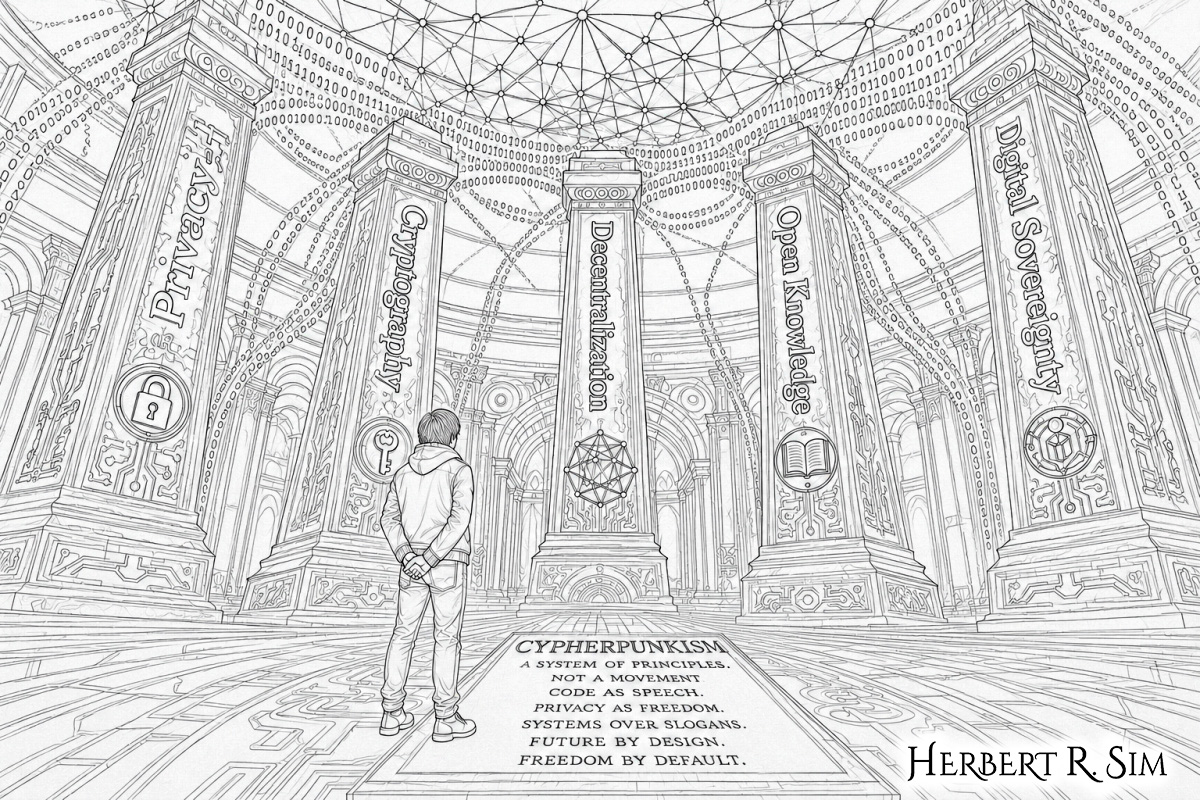
My work-in-progress of lars of Cypherpunkism”, where streams of code connect the pillars into one unified network above me.
Digital Sovereignty
This brings me to the central concept.
Digital Sovereignty is the capacity of an individual to retain meaningful authority over his identity, information, communications, digital possessions and participation in technological systems.**
It does not require complete independence.
No human being is completely independent.
We depend upon societies.
We depend upon infrastructure.
We depend upon institutions.
We cooperate because cooperation makes civilization possible.
Sovereignty therefore does not mean isolation.
It means maintaining enough control that cooperation does not become domination.
A digitally sovereign individual should be able, wherever reasonably possible, to:
communicate privately;
protect information through encryption;
possess his own cryptographic keys;
choose what information he reveals;
participate in open networks;
access knowledge;
move between services;
retain copies of his own information;
use interoperable technologies;
and resist arbitrary technological exclusion.
Digital sovereignty exists when technology increases the individual’s range of choices rather than steadily reducing them.
Eight Principles of Cypherpunkism
I therefore propose eight foundational principles for Cypherpunkism.
I. Privacy
Every individual should possess meaningful control over the disclosure of personal information.
II. Cryptography
Strong cryptography should be available to ordinary people as a legitimate technology for protecting communication, identity and property.
III. Decentralization
Systems carrying extraordinary social power should, where practical, avoid unnecessary single points of control.
IV. Individual Control
People should possess meaningful authority over the keys, credentials and information governing their digital lives.
V. Open Knowledge
Knowledge necessary to understand emerging technological systems should be made widely accessible wherever possible.
VI. Open Architecture
Open protocols, interoperable systems and inspectable software should be preferred where they meaningfully reduce dependency upon centralized gatekeepers.
VII. Freedom to Build
Individuals should remain free to create and distribute privacy-enhancing, cryptographic and decentralized technologies.
VIII. Digital Sovereignty
Technology should enlarge the sovereignty of the individual rather than quietly transferring sovereignty to the institutions operating the technology.
These principles are not a finished constitution.
Cypherpunkism will have to evolve with technology.
But they provide a starting point.
The Coming Struggle Over the Digital Individual
The Internet is still young.
So is the smartphone.
Social networks are young.
Electronic money is young.
Peer-to-peer architecture is young.
We are making decisions today whose consequences may persist for decades.
There are two broad directions technological civilization can take.
In one direction, convenience produces centralization.
Centralization produces enormous databases.
Databases produce visibility.
Visibility produces control.
Eventually, participation in digital society becomes conditional upon accepting permanent observation by institutions that ordinary individuals cannot meaningfully challenge.
In the other direction, we deliberately preserve privacy.
We distribute power.
We encrypt sensitive information.
We build open systems.
We enable individuals to possess their own keys.
We make technological exit possible.
We refuse to allow convenience to become an excuse for permanent dependency.
The future will probably contain elements of both.
Cypherpunkism exists to push civilization toward the second.
Beyond the Computer
Today these questions primarily concern computers, telephones, networks, databases and digital money.
They may not remain there.
Technology is steadily moving closer to the individual.
Computers have moved from rooms to desks.
From desks to laps.
From laptops to pockets.
Increasingly, computing will be worn on the body.
One day, interfaces may become substantially more intimate still.
When technology approaches our biology, the same principle will become even more important:
The closer technology gets to the human being, the stronger individual sovereignty must become.
If computers someday interact directly with human senses, bodies or even the nervous system, privacy will no longer concern merely information stored on a hard drive.
It may concern the boundary between human beings and machines themselves.
The philosophy required for that world begins with decisions we make now.
The Cypherpunkist
A Cypherpunk writes code.
A Cypherpunkist, as I use the term, embraces the wider philosophy.
The Cypherpunkist understands that:
privacy is political;
cryptography is empowering;
decentralization can constrain power;
open knowledge creates independence;
control of keys matters;
software architecture shapes freedom;
and technological progress should increase individual sovereignty rather than diminish it.
One need not be a cryptographer to believe these principles.
One need not be a hacker.
One need not reject governments or corporations.
One need only understand that a civilization becoming dependent upon digital technology must deliberately preserve the autonomy of the humans using it.
Cypherpunkism therefore belongs not merely to programmers.
It belongs to anyone concerned with the future relationship between technology and freedom.
A Declaration of Cypherpunkism
I believe privacy is necessary for human autonomy.
I believe individuals should have the ability to protect their communications through strong cryptography.
I believe technological systems should collect no more information than they legitimately require.
I believe concentrated digital power deserves the same skepticism as concentrated political power.
I believe decentralization is an important technological check against monopolistic control.
I believe people should possess meaningful control over their own cryptographic keys and digital information.
I believe knowledge should be open wherever possible.
I believe software should empower individuals to act without requiring unnecessary permission.
I believe digital money, peer-to-peer networks and privacy-enhancing technologies deserve experimentation even when their ultimate forms remain uncertain.
I believe neither governments nor corporations should become absolute sovereigns of digital existence.
And above all:
I believe technology should serve the individual—not quietly become the individual’s master.
That is Cypherpunkism.
The Architecture of Freedom
For most of history, political freedom was defended primarily through ideas, laws and institutions.
The digital age adds another battlefield.
Architecture.
What we build determines what becomes possible.
A centralized network can create centralized power.
A decentralized network can distribute it.
An unencrypted database can expose a population.
A cryptographic system can protect it.
A closed platform can create dependency.
An open protocol can create alternatives.
A system that requires identification at every step can normalize surveillance.
A system designed around selective disclosure can preserve privacy.
These choices may look technical.
They are not merely technical.
They determine the distribution of power in digital civilization.
The Cypherpunk movement understood this before almost anyone else.
Cypherpunkism takes the next step and states the principle explicitly:
Digital freedom must be embedded into the architecture of technology itself.
We should not reject technological progress.
We should accelerate it.
We should build better networks.
Better communication.
Better cryptography.
Better forms of electronic exchange.
Better access to knowledge.
But as technology becomes more powerful, the individual must not become less powerful beside it.
The coming technological century should not belong exclusively to governments.
It should not belong exclusively to corporations.
It should not belong exclusively to the programmers who build its infrastructure.
It must also belong to the human beings who inhabit it.
That requires privacy.
That requires cryptography.
That requires decentralization.
That requires open knowledge.
That requires individual control.
It requires a philosophy of technological freedom.
Cypherpunkism.
Privacy is sovereignty.
Cryptography is applied freedom.
Decentralization is a check on power.
Code is political architecture.
Digital sovereignty belongs to the individual.
References
- Baran, Paul. On Distributed Communications: I. Introduction to Distributed Communications Networks. RAND Corporation, 1964.
https://nsarchive.gwu.edu/document/21970-document-01
- Diffie, Whitfield, and Martin E. Hellman. “New Directions in Cryptography.” IEEE Transactions on Information Theory, Vol. 22, No. 6, 1976, pp. 644–654. DOI: 10.1109/TIT.1976.1055638.
https://www.itsoc.org/publications/papers/new-directions-in-cryptography
- Chaum, David. “Security Without Identification: Transaction Systems to Make Big Brother Obsolete.” Communications of the ACM, Vol. 28, No. 10, 1985, pp. 1030–1044. DOI: 10.1145/4372.4373.
https://chaum.com/security-without-identification/ - May, Timothy C. The Crypto Anarchist Manifesto. Originally written in 1988 and circulated electronically to the Cypherpunks mailing list in 1992.
https://cryptochainuni.com/crypto-anarchist-manifesto/ - Hughes, Eric. A Cypherpunk’s Manifesto. March 9, 1993.
https://cryptochainuni.com/cypherpunk-manifesto/ - May, Timothy C. The Cyphernomicon: Cypherpunks FAQ and More. Version 0.666, September 10, 1994.
https://cryptochainuni.com/wp-content/uploads/The-Cyphernomicon-Timothy-C-May.txt
- Barlow, John Perry. A Declaration of the Independence of Cyberspace. February 8, 1996.
https://constitutioncenter.org/the-constitution/historic-document-library/detail/a-declaration-of-the-independence-of-cyberspace-1996
- Lessig, Lawrence. Code and Other Laws of Cyberspace. Basic Books, 1999.
https://cyber.harvard.edu/publications/1999/Code_And_Other_Laws_Of_Cyberspace
- Nakamoto, Satoshi. “Bitcoin: A Peer-to-Peer Electronic Cash System.” 2008.
https://bitcoin.org/bitcoin.pdf
- Nakamoto, Satoshi. “Bitcoin v0.1 Released.” Cryptography Mailing List, January 9, 2009.
https://satoshi.nakamotoinstitute.org/quotes/releases/
- Hanyecz, Laszlo. “Pizza for bitcoins?” BitcoinTalk, May 2010.
https://bitcointalk.org/index.php?topic=137
- Google. “WiFi Data Collection: An Update.” Official Google Blog, May 14, 2010.
https://googleblog.blogspot.com/2010/05/wifi-data-collection-update.html
- Facebook. “Facebook Redesigns Privacy.” May 26, 2010.
https://about.fb.com/news/2010/05/facebook-redesigns-privacy/ - WikiLeaks. Afghan War Diary, 2004–2010. Released July 25, 2010.
https://search.wikileaks.org/
- Davies, Nick, and David Leigh. “Afghanistan War Logs.” The Guardian, July 25, 2010.
https://www.theguardian.com/world/war-logs/2010/jul/25/all