
A Philosophy of Privacy, Decentralization and Neural Self-Custody in the Brain–Computer Interface Age

My illustration above, I entitle it “The Mind Is the Final Private Key” – I hold a glowing cryptographic key near my temple. Behind, a radiant neural network expands like a halo.
Preamble
The defining privacy question of the digital age may soon change.
For decades, we have fought over who controls our money, communications, identity, personal data and digital lives.
The next struggle may concern something far more intimate:
Who controls access to the human mind?
In February 2025, a strange series of Ethereum transactions attracted international attention. An individual identifying himself as Chinese programmer and entrepreneur Hu Lezhi sent hundreds of Ether to an inaccessible burn address while attaching messages alleging the existence and misuse of what he described as “brain-computer weapons.” Approximately 603 ETH — worth around US$1.65 million at the time — was reportedly destroyed, while substantially more cryptocurrency was transferred or donated to other addresses.
The allegations contained within those blockchain messages have not been independently established as fact. I do not present them as evidence that such systems presently exist in the form described.
But the incident raises a question that is entirely legitimate regardless of whether those particular allegations are true.
What happens when technologies capable of interfacing directly with the human nervous system become powerful enough to threaten the privacy and autonomy of thought itself?
Brain–computer interfaces are real.
Neural signals can already be measured.
Algorithms are becoming increasingly capable of interpreting biological information.
Computers can increasingly translate signals generated by the nervous system into commands.
Technologies designed initially to restore communication or movement may eventually become tools for cognitive enhancement, immersive computing, artificial-intelligence integration and direct interaction between humans and machines.
I welcome much of this progress.
I believe brain–computer interfaces may eventually become one of the most transformative technologies humanity develops.
But the closer technology moves toward the brain, the greater our obligation becomes to establish boundaries around technological power.
The answer cannot simply be:
Trust the company.
It cannot be:
Trust the government.
And it cannot eventually become:
Trust the artificial intelligence controlling the interface.
The human mind requires an architecture of freedom.
I call the philosophy behind that architecture:
Neuro-Cypherpunkism
Neuro-Cypherpunkism applies the principles of privacy, cryptography, decentralization and individual sovereignty to brain–computer interfaces and the emerging technological connection between human cognition and digital systems.
Its central principle is simple:
The human mind must never become a centralized network resource.
Technology may interface with the brain.
Technology may augment the brain.
Technology may restore functions lost through injury or disease.
Technology may eventually expand memory, communication, perception and intelligence.
But no government, corporation, military institution, employer, artificial intelligence or technological platform should acquire unrestricted authority to observe, control or modify the human mind.
The mind is the final private key.
From Cypherpunk to Neuro-Cypherpunk
The original cypherpunk movement understood something fundamental about digital civilization:
Privacy cannot depend entirely upon promises.
It must also be protected through architecture.
A government may promise not to read your communications.
A corporation may promise not to misuse your data.
A platform may promise that its policies protect users.
But promises can change.
Management changes.
Governments change.
Laws change.
Companies are acquired.
Databases are breached.
Political conditions deteriorate.
Systems originally created for benevolent purposes can acquire functions their creators never anticipated.
Cryptography introduced another approach.
Instead of asking an institution politely not to read a message, encryption can make unauthorized reading technically difficult.
Bitcoin extended a related principle into money.
Instead of requiring a central institution to determine ownership and authorize every transaction, cryptography made possible a form of digital property in which individuals could possess and transfer value through private keys.
This transformed an abstract political principle — sovereignty — into technological architecture.
Brain–computer interfaces now require us to carry that principle further.
The first generation of cypherpunks fought for the privacy of information.
Cryptocurrency demonstrated the possibility of self-custody of digital assets.
The Neuro-Cypherpunk must fight for something even more fundamental:
self-custody of cognition.
Because the most important information system you possess is not your smartphone.
It is not your computer.
It is not your cryptocurrency wallet.
It is your brain.
The Brain Is Not Another Data Source
Modern digital systems already collect enormous amounts of information about human beings.
Search engines know what we look for.
Social networks know what attracts our attention.
Phones know where we travel.
Online stores know what we purchase.
Streaming platforms know what we watch.
Wearable devices increasingly know how we sleep, move and exercise.
Artificial-intelligence systems can combine these fragments to produce increasingly sophisticated models of individual behavior.
But neural data introduces a different category of information.
Your browser history records something you did.
A neural interface may eventually observe processes occurring before an action is expressed.
That distinction matters.
There is a difference between recording the sentence I type and attempting to infer the neural activity associated with my intention to type it.
There is a difference between observing what advertisement I click and measuring my neurological response to the advertisement.
There is a difference between knowing what political statement I publicly support and possessing biological information that might be used to estimate fear, recognition, preference, attention or emotional response.
Neural information therefore cannot simply be treated as another category of consumer data.
The brain is not an advertising identifier.
Thought is not telemetry.
Cognition is not a commodity merely because technology becomes capable of measuring it.
Neuro-Cypherpunkism begins from the position that neural information requires exceptional protection precisely because it originates from the biological processes underlying identity, intention and consciousness.
1. The Mind Is Sovereign Territory
Political sovereignty traditionally describes supreme authority over territory.
But technological civilization requires another concept:
cognitive sovereignty.
The human mind should be treated as sovereign territory belonging fundamentally to the individual.
The ability of a machine to detect a neural signal does not create ownership of that signal.
The ability of an algorithm to interpret neural activity does not give its operator authority over the person producing it.
The ability of technology to stimulate a nervous system does not create a right to do so.
Technological capability must never be mistaken for moral permission.
Human beings must retain ultimate authority over access to their own cognition.
2. Neural Privacy Must Become a Fundamental Right
Privacy traditionally concerns information that people communicate, record or generate through their activities.
Neural privacy goes further.
It protects information derived directly from brain and nervous-system activity.
A future BCI ecosystem could potentially produce information concerning attention, intention, emotional response, cognitive workload, recognition, motor preparation or other internal neurological states.
That information must not automatically become the property of whoever manufactures the device collecting it.
Neural information should not be silently sold to advertisers.
It should not become routine workplace analytics.
It should not be sold to insurers.
It should not become an invisible component of consumer profiling.
It should not be accumulated indefinitely simply because storage is inexpensive.
And access to one category of neural information should not imply permission to analyse every other signal that happens to be available.
The fact that data can be collected does not mean it should be collected.
Neural privacy must begin with minimization:Cognition is not a commodity merely because technology becomes capable of measuring it.
Collect only what is required. Process only what is authorized. Retain only what is necessary.
3. Neural Self-Custody
Cryptocurrency popularized a powerful idea:
self-custody.
An individual can hold an asset without requiring another institution to possess ultimate control over it.
Neuro-Cypherpunkism extends this principle into neurotechnology.
I call this:
Neural Self-Custody.
Neural Self-Custody means that the individual should retain meaningful technical authority over access to neural information and the operation of technologies connected to their nervous system.
A person should be able to determine what neural information is collected, where it is processed, who may access it, how long it is retained and whether permission can be revoked.
Where technically possible, sensitive neural processing should happen locally on hardware controlled by the user rather than continuously exporting raw neural data to centralized cloud infrastructure.
A person should not require permanent permission from a corporation to access their own brain-generated information.
Nor should the continued functioning of an implanted or wearable neural device depend unnecessarily upon one company’s remote servers.
The deeper technology becomes integrated with the human being, the stronger the case for self-custody becomes.
A cloud service can be replaced.
A social-media account can be abandoned.
A brain interface integrated into a person’s daily cognitive or physical functioning may be considerably harder to escape.
That dependency must not become ownership.
4. The Neural Read/Write Divide
One of the most important distinctions in future neurotechnology will be the distinction between reading from the nervous system and writing to it.
I call this:
The Neural Read/Write Divide.
A BCI that detects neural activity receives information from the user.
A system capable of stimulating neural tissue sends information or influence in the opposite direction.
These are not equivalent permissions.
A person who authorizes a device to read a motor signal so that they can control a robotic arm has not therefore authorized the same system to alter their emotional state.
A patient who consents to neural monitoring has not automatically consented to neural stimulation.
A consumer who permits a headset to detect attention has not granted permission for that headset to manipulate cognition.
Permission to read the brain must never imply permission to write to the brain.
These functions should be technologically and legally separated.
Neural write access should require exceptionally clear authorization, strict limits, visible operation and the ability to terminate stimulation wherever medically and technically possible.
The difference between a computer understanding what you intend and a computer changing what you intend is enormous.
Civilization must recognize that distinction before neural technology becomes commonplace.
5. Consent Must Be Continuous, Granular and Revocable
Modern digital consent is often fictional.
Users encounter pages of legal language and press “Accept” because refusing means losing access to the product.
That model is already inadequate for ordinary personal data.
It would be intolerable for the human nervous system.
Neural consent must be granular.
A user might authorize motor-signal decoding without authorizing emotional analysis.
They might permit temporary clinical monitoring without permitting long-term storage.
They might allow one application to use specific processed outputs without giving the application access to underlying raw neural information.
Consent must also be revocable.
Installing a brain–computer interface cannot mean surrendering permanent rights over everything that interface may subsequently observe.
The closer technology moves toward the mechanisms of thought and behavior, the less acceptable blanket consent becomes.
A twenty-page terms-of-service agreement must never become a deed transferring cognitive sovereignty.
6. Local First, Cloud Only When Necessary
The dominant technological model of our age is centralization.
Devices collect information.
Information travels to remote servers.
Remote servers analyse it.
Companies accumulate the resulting databases.
For photographs and shopping histories, this architecture already creates considerable privacy risk.
For neural information, it could become dangerous.
Neuro-Cypherpunkism therefore favors a local-first architecture wherever technically practical.
If a BCI can interpret a neural command on the user’s device, there should be a strong presumption against transmitting the underlying raw neural signal elsewhere.
Only the minimum information required for a specific external service should leave the user’s trusted environment.
This does not mean cloud computing must disappear.
Some medical, research or computational applications may legitimately require external processing.
But centralization should have to justify itself.
It should not be the unquestioned default.
The principle should be:
Process the mind as close to the mind as possible.
7. Encryption Must Extend to the Nervous System
We encrypt financial transactions.
We encrypt messages.
We encrypt hard drives.
We secure digital identities.
Why would neural information deserve anything less?
Neural communications must eventually become one of cybersecurity’s most sensitive domains.
Any channel transmitting information from or to a BCI should be designed under the assumption that unauthorized access could have consequences considerably more serious than the compromise of an ordinary consumer device.
BCI security cannot be an optional feature added after commercialization.
It must be fundamental architecture.
Authentication, encryption, access controls, hardware security, transparent permissions and strong resistance to unauthorized remote commands must be designed into neural systems from the beginning.
The philosophy can be summarized simply:
If the brain becomes connected, the connection must be defended.
The mind is the final private key.
We must build accordingly.
8. No Central Authority Should Own the Neural Layer
The twentieth century concentrated enormous power in institutions controlling industrial infrastructure.
The early twenty-first century concentrated power in companies controlling digital infrastructure.
A handful of platforms now mediate vast portions of communication, commerce, information discovery and online identity.
We should not repeat this architecture with the human brain.
Imagine a future in which one corporation controls the dominant neural operating system.
It manufactures the interface.
It controls the software.
It manages identity.
It stores neural information.
It decides which applications may connect.
It determines what functionality remains available.
It can remotely update the device.
And millions of human beings depend upon that infrastructure for communication, work or cognitive augmentation.
That company would possess a category of power unlike almost anything in technological history.
Competition alone may not eliminate that danger.
Neurotechnology therefore should be built around interoperability, open technical standards where appropriate, portability, transparent interfaces and the ability for users to migrate without losing control of systems integrated into their own bodies.
No person should become a permanent tenant inside technology attached to their own brain.
9. The Right to Disconnect
A fundamental Neuro-Cypherpunk right must be:
the right to disconnect.
A person must remain capable of withdrawing from neural connectivity without thereby surrendering ordinary participation in society.
This will become increasingly important if BCI evolves beyond medicine into education, employment, entertainment, communication or productivity enhancement.
Imagine being told:
You are technically free not to wear the neural interface.
But without it, you cannot obtain employment.
You cannot access the educational system.
You cannot authenticate yourself.
You cannot receive insurance.
You cannot efficiently communicate with colleagues.
You cannot compete economically.
That is not meaningful freedom.
It is coercion disguised as technological inevitability.
Human beings must retain the right to remain cognitively offline.
The existence of a more efficient interface does not give society the authority to mandate its adoption.
10. No Compulsory Neurotechnology
The right to disconnect leads to a broader principle.
No government, employer, school, insurer, military organization or corporation should possess unrestricted authority to compel neural integration.
There may be narrow circumstances in medicine in which questions of capacity, emergency intervention or clinical responsibility become complex. Those questions deserve serious ethical consideration.
But the general principle must remain clear.
A worker should not be forced to surrender neural information merely because an employer wants more accurate productivity metrics.
A child should not be required to expose neurological signals simply because a school believes BCI improves educational performance.
A citizen should not have to accept a neural interface merely to access essential government services.
A soldier should not automatically lose cognitive rights merely by entering military service.
Technological progress becomes oppression when refusal ceases to be possible.
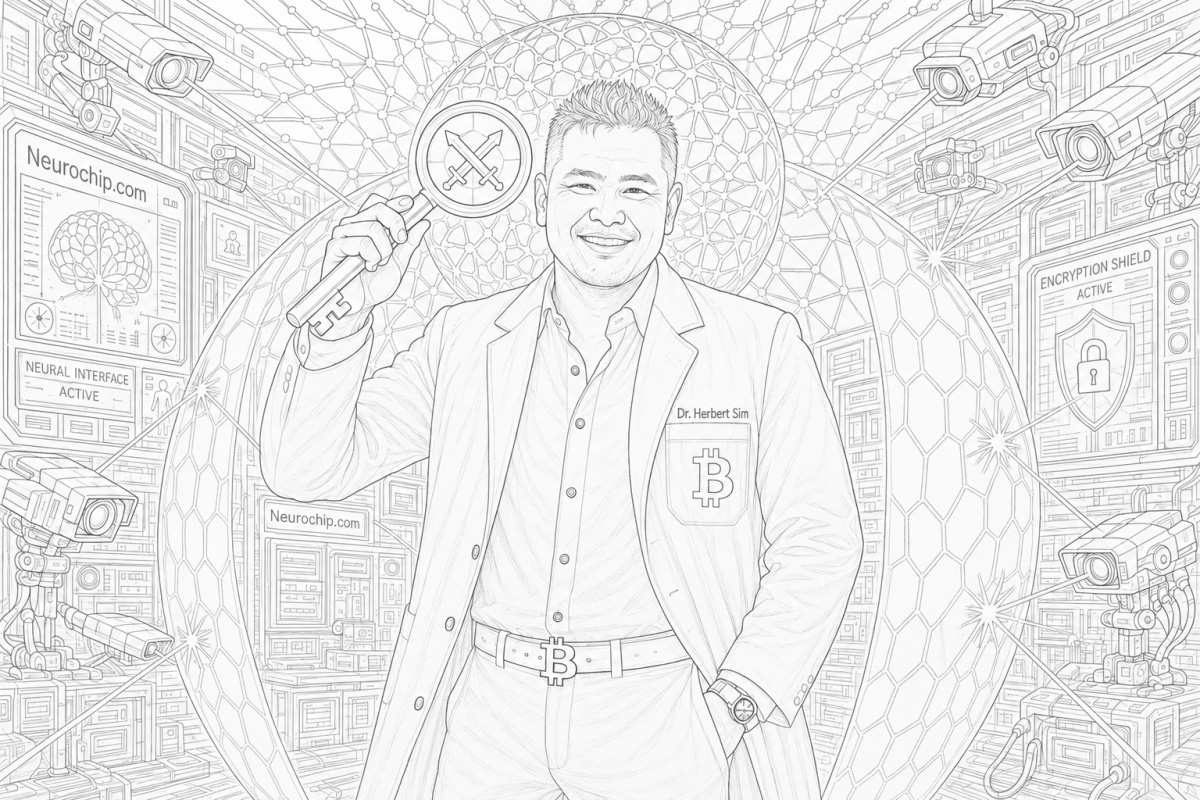
My illustration “The Mind Is the Final Private Key” work-in-progress, hostile surveillance systems and intrusive signals are blocked by a shield of encryption.
11. Artificial Intelligence Must Never Become the Unaccountable Gatekeeper of Cognition
Brain–computer interfaces and artificial intelligence will increasingly intersect.
BCI produces complex biological signals.
AI may become essential for interpreting those signals.
That combination could create extraordinary benefits.
Artificial intelligence could help a paralyzed person communicate more naturally.
It could interpret intended movement.
It could adapt assistive technology to the individual.
It could eventually serve as a personalized cognitive interface between biological intelligence and the digital world.
But the combination also creates a new concentration of power.
If AI becomes the interpreter between the human brain and connected machines, then whoever controls that AI may influence the interface through which the individual experiences technological augmentation.
No AI system should therefore possess unrestricted authority to modify neural permissions, hide neural operations from users or independently determine when neural stimulation should occur in non-emergency contexts.
The machine may be more computationally capable than the individual.
That does not make the machine sovereign.
Artificial intelligence may interpret the signal.
The human must retain authority over the connection.
12. Technology May Augment the Mind — Never Own It
Neuro-Cypherpunkism is not anti-technology.
It is not anti-BCI.
It is not a philosophy of fear.
Quite the opposite.
I believe brain–computer interfaces could restore movement to people with paralysis.
They may allow people unable to speak to communicate.
They could create new forms of prosthetic control.
They may expand human interaction with computers.
In time, they may enable forms of human–machine symbiosis that today remain difficult to imagine.
But enthusiasm for technological possibility must never blind us to political reality.
Every powerful technology eventually becomes a question of control.
Who owns it?
Who operates it?
Who accesses its information?
Who sets its permissions?
Who may disable it?
Who may compel its use?
Who can leave?
Who cannot?
Brain–computer interfaces bring those ancient political questions directly to the human nervous system.
This is why privacy and decentralization cannot be added later.
Once centralized neural infrastructure becomes deeply embedded in society, reversing that architecture may become extraordinarily difficult.
Freedom must therefore be designed in at the beginning.
Technology may augment the mind.
It must never own the mind.
Against Mind Control
The phrase “mind control” is easily sensationalized.
It can evoke science fiction, conspiracy theories and unsupported claims.
Neuro-Cypherpunkism should not depend upon any of them.
We do not need to prove the existence of a secret mind-control weapon to recognize the danger of technologies that may someday possess increasingly sophisticated abilities to observe or influence neural activity.
The ethical problem can be considered before the most extreme technological capability exists.
Society created rules around nuclear technology because we understood the consequences of concentrated physical power.
We developed cryptographic protections because we understood the consequences of unrestricted informational surveillance.
We establish medical ethics because we understand that the ability to intervene in a human body creates special responsibilities.
Neurotechnology deserves the same foresight.
The question is not whether someone today possesses a machine capable of remotely controlling every thought of another human being.
The better question is:
What principles should govern technology as our ability to measure and influence the nervous system increases?
Waiting until abuse becomes technically easy would be irresponsible.
The protections must precede the capability.
From Human Sovereignty to Cognitive Sovereignty
More than a decade ago, in developing my philosophy of Human-Sovereignty Transhumanism, I argued that technological progress should expand human capability without transferring sovereignty from the human being to technological systems.
The principle remains:
Technology must remain the servant of humanity. Humanity must never become the property of technology.
Neuro-Cypherpunkism applies that broader philosophy to one particularly sensitive technological frontier.
Human-Sovereignty Transhumanism asks:
Who controls human technological evolution?
Neuro-Cypherpunkism asks:
Who controls the interface to the human mind?
Its answer must be:
The individual.
This distinction will become increasingly important as humanity moves from carrying computers, to wearing computers, to eventually integrating computers more directly with the nervous system.
The smartphone exists outside you.
The wearable exists upon you.
The brain–computer interface may exist increasingly close to — or eventually within — the biological mechanisms through which you perceive and act upon the world.
As technological distance from the mind decreases, sovereignty must increase.
A New Cypherpunk Frontier
There is a historical progression occurring.
The first digital struggle concerned information.
Who can communicate privately?
Who can censor speech?
Who can read the message?
Cryptography became part of the answer.
Then came the struggle over digital property and money.
Who controls the ledger?
Who can authorize the transaction?
Who can freeze the asset?
Bitcoin demonstrated that decentralized networks and cryptography could challenge assumptions about financial intermediaries.
The next frontier may be cognition.
Who can access the neural signal?
Who owns the data produced by the brain?
Who can connect to the interface?
Who can issue commands to it?
Who decides when it disconnects?
Who possesses write access?
This is where cypherpunk philosophy must evolve.
Privacy will no longer mean merely protecting what we say.
It may eventually mean protecting the biological processes from which speech originates.
Self-custody will no longer concern only digital assets.
It may mean self-custody of the interface through which our minds connect to machines.
Decentralization will no longer concern only financial networks.
It may become essential to preventing centralized control over the infrastructure surrounding human cognition.
This is the Neuro-Cypherpunk frontier.
The Neuro-Cypherpunk Declaration
I therefore affirm the following:
The human mind is sovereign territory.
Neural information belongs fundamentally to the individual from whom it originates.
Access to neural information must require meaningful permission.
Permission to read neural activity does not constitute permission to modify it.
Neural write access must be treated as fundamentally more sensitive than ordinary data access.
Neural systems should minimize collection and favor local processing wherever practical.
Sensitive neural communications should be protected through strong cryptographic security.
No corporation or government should possess unrestricted centralized control over humanity’s neural infrastructure.
Individuals must retain meaningful control over their neural identity, permissions, data and connectivity.
Human beings must possess the right to disconnect.
No person should be compelled to adopt neurotechnology merely to participate normally in society.
Artificial intelligence may assist in interpreting neural information, but it must not acquire unaccountable authority over the human mind.
Brain–computer interfaces should augment human agency rather than replace it.
Technology should become more intimate with humanity only if human freedom becomes more strongly protected alongside it.
The Final Private Territory
There was a time when privacy meant closing a door.
Then privacy meant sealing a letter.
Later it meant encrypting a message.
Today it increasingly means protecting enormous digital records generated by everyday life.
Tomorrow, privacy may reach its final frontier.
The human mind.
The February Ethereum incident that inspired this essay may ultimately tell us little about the factual existence of the extraordinary technology alleged in those blockchain messages. The claims remain claims.
But the event should still provoke us to think.
Someone believed that a threat to cognitive freedom was serious enough to destroy an extraordinary amount of personal wealth while recording a warning permanently onto a decentralized blockchain.
The irony is difficult to ignore.
A decentralized technology created to remove centralized trust from digital value became the medium through which someone warned the world about alleged centralized control over the human mind.
Whether his allegations were true is a separate question.
The philosophical question remains.
If humanity eventually develops technology powerful enough to enter the informational boundary between brain and machine, who should possess the keys?
My answer is unequivocal.
Not the corporation.
Not the government.
Not the artificial intelligence.
Not the network.
The individual.
We should develop brain–computer interfaces.
We should restore damaged human capabilities.
We should explore the boundaries of cognition.
We should pursue human enhancement.
But we must build the architecture of cognitive freedom before neural technology becomes an architecture of control.
The next generation of cypherpunks may not merely encrypt messages.
They may have to encrypt minds.
The next generation of self-custody may not merely protect money.
It may protect cognition.
And the next great decentralization struggle may not be fought over the financial system or the internet.
It may be fought over the interface to the human brain.
Enhance the brain.
Decentralize the interface.
Encrypt the mind.
The mind is the final private key.
References
- Sim, Herbert R. “Cypherpunkism: A Philosophy of Digital Sovereignty.” HerbertRSim.com, October 10, 2010.
https://herbertrsim.com/cypherpunkism/ - Sim, Herbert R. “Human-Sovereignty Transhumanism.” HerbertRSim.com, 2014.
https://herbertrsim.com/human-sovereignty-transhumanism/ - Martinovic, Ivan, Doug Davies, Mario Frank, Daniele Perito, Tomas Ros, and Dawn Song. “On the Feasibility of Side-Channel Attacks with Brain-Computer Interfaces.” 21st USENIX Security Symposium, 2012.
https://www.usenix.org/conference/usenixsecurity12/technical-sessions/presentation/martinovic
- Bonaci, Tamara, Ryan Calo, and Howard J. Chizeck. “App Stores for the Brain: Privacy & Security in Brain-Computer Interfaces.” IEEE International Symposium on Ethics in Engineering, Science and Technology, 2014.
https://techpolicylab.uw.edu/wp-content/uploads/2018/06/App-Stores-for-the-Brain.pdf
- Ienca, Marcello, and Roberto Andorno. “Towards New Human Rights in the Age of Neuroscience and Neurotechnology.” Life Sciences, Society and Policy, Vol. 13, 2017.
https://link.springer.com/article/10.1186/s40504-017-0050-1
- Yuste, Rafael, Sara Goering, Blaise Agüera y Arcas, et al. “Four Ethical Priorities for Neurotechnologies and AI.” Nature, Vol. 551, 2017, pp. 159–163.
https://www.nature.com/articles/551159a
- Organisation for Economic Co-operation and Development. “Recommendation of the Council on Responsible Innovation in Neurotechnology.” OECD/LEGAL/0457, 2019.
https://legalinstruments.oecd.org/en/instruments/OECD-LEGAL-0457
- UNESCO International Bioethics Committee. Ethical Issues of Neurotechnology. UNESCO, 2022.
https://unesdoc.unesco.org/ark:/48223/pf0000383559
- UNESCO. “The Risks and Challenges of Neurotechnologies for Human Rights.” 2023.
https://www.unesco.org/en/node/84426
- Dai, Chenyun, et al. “Cybersecurity in Neural Interfaces: Survey and Future Trends.” Computers in Biology and Medicine, Vol. 167, 2023, Article 107604.
https://pubmed.ncbi.nlm.nih.gov/37883851/
- Willett, Francis R., Donald T. Avansino, Leigh R. Hochberg, Jaimie M. Henderson, and Krishna V. Shenoy. “High-Performance Brain-to-Text Communication via Handwriting.” Nature, Vol. 593, 2021, pp. 249–254.
https://www.nature.com/articles/s41586-021-03506-2
- Willett, Francis R., Erin M. Kunz, Chaofei Fan, et al. “A High-Performance Speech Neuroprosthesis.” Nature, Vol. 620, 2023, pp. 1031–1036.
https://www.nature.com/articles/s41586-023-06377-x
- Lorach, Henri, et al. “Walking Naturally After Spinal Cord Injury Using a Brain–Spine Interface.” Nature, Vol. 618, 2023, pp. 126–133.
https://www.nature.com/articles/s41586-023-06094-5
- Council of Europe. “The Privacy and Data Protection Implication of the Use of Neurotechnology and Neural Data from the Perspective of Convention 108+.” 2024.
https://www.coe.int/en/web/data-protection/-/the-privacy-and-data-protection-implication-of-the-use-of-neurotechnology-and-neural-data-from-the-perspective-of-convention-108
- Colorado General Assembly. “HB24-1058: Protect Privacy of Biological Data.” 2024.
https://www.leg.colorado.gov/bills/HB24-1058
- Xia, K., et al. “Privacy-Preserving Brain-Computer Interfaces: A Systematic Review.” 2024.
https://arxiv.org/abs/2412.11394
- CoinDesk. “$1.65M ETH Burned to Warn of Potential Chinese Brain Computer Weapons.” February 18, 2025.
https://www.youtube.com/watch?v=K8djrcH4Xhg
Note: This source is included as the immediate catalyst for the essay. The allegations described in the report are not presented as independently verified evidence. - Yahoo Finance / CoinDesk. “$1.65M ETH Burned to Warn of Potential Chinese Brain Computer Weapons.” February 18, 2025.
https://ca.finance.yahoo.com/video/1-65m-eth-burned-warn-180908157.html
Note: This report serves as the historical catalyst for the development of the Neuro-Cypherpunkism essay, rather than as scientific validation of the claims contained in the underlying blockchain messages.
Download the Neuro-Cypherpunkism Philosophy
Official Publication Record
The Mind Is the Final Private Key: Neuro-Cypherpunkism and the Fight for Cognitive Sovereignty
has been formally archived on Zenodo with a permanent DOI for citation, preservation and scholarly reference.
| Title | The Mind Is the Final Private Key: Neuro-Cypherpunkism and the Fight for Cognitive Sovereignty |
| Author | Herbert R. Sim |
| ORCID | 0009-0008-6500-5749 |
| Publication date | 22 March 2025 |
| Canonical webpage | https://herbertrsim.com/neuro-cypherpunkism-philosophy/ |
| DOI | 10.5281/zenodo.22353769 |
| Zenodo record | https://zenodo.org/records/22353769 |
| Licence | Creative Commons Attribution 4.0 International Licence (CC BY 4.0) |
Preferred citation:
Sim, Herbert R. (2025). The Mind Is the Final Private Key: Neuro-Cypherpunkism and the Fight for Cognitive Sovereignty. HerbertRSim.com.
https://doi.org/10.5281/zenodo.22353769
Copyright and licence:
© 2025 Herbert R. Sim. This work is licensed under the Creative Commons Attribution 4.0 International Licence (CC BY 4.0).
Zenodo publication note:
This work was published on Zenodo on 5 September 2026 for permanent scholarly preservation and citation.