
Why the Freedom to Understand, Verify and Share Is Essential to Life in the Digital Age

My illustration entitled “The Sovereign Knowledge Toolkit” – I open an enormous illuminated case containing the tools needed to preserve and distribute human knowledge: a decentralized archive, open-source code, encrypted storage, peer-to-peer publishing, censorship-resistant networks and cryptographic verification.
From the Architecture of Power to the Architecture of Understanding
Cypherpunkism begins with a question of power.
Who can observe the individual?
Who controls the key?
Who operates the network?
Who can change the rules?
But another question is equally important:
Who is permitted to understand the system?
When I introduced Cypherpunkism: A Philosophy of Digital Sovereignty in 2010, I identified five pillars: privacy, cryptography, decentralization, open knowledge and digital sovereignty.
The Cypherpunkist Manifesto then declared that digital freedom must increasingly be built into technological architecture rather than entrusted entirely to institutional restraint.
In Privacy Is Sovereignty, I argued that the individual must possess meaningful control over the disclosure of personal information.
In Cryptography Is Applied Freedom, I argued that mathematics can turn some protections from institutional promises into properties of systems.
In Decentralization Is a Check on Power, I argued that digital systems carrying extraordinary social power should avoid unnecessary single points of control.
These principles protect boundaries, keys and networks.
Yet an individual cannot exercise meaningful sovereignty over technology he is forbidden—or unable—to understand.
A closed system asks the user to trust what cannot be inspected.
A closed standard can make participation dependent upon one gatekeeper.
A closed body of research can reserve discovery for those able to cross a financial or institutional barrier.
A closed educational resource can turn the opportunity to learn into a permission granted by geography, wealth or affiliation.
Knowledge is therefore not merely content.
Knowledge is capacity.
It is the capacity to understand a claim, inspect a mechanism, reproduce a result, repair a tool, challenge an authority and build an alternative.
Open knowledge reduces dependency.
Open knowledge is digital sovereignty.
Eighteen Years After the Budapest Open Access Initiative
On February 14, 2002—eighteen years ago today—the Budapest Open Access Initiative gave a name and a practical strategy to a growing effort to make scholarly research freely available through the Internet.
It described the convergence of an old tradition and a new technology.
The old tradition was the willingness of scholars to publish knowledge for inquiry and public benefit.
The new technology was the Internet, which made it possible to distribute that knowledge globally at extraordinary speed and low marginal cost.
The initiative did not argue that research costs nothing to produce.
It argued that digital networks create new possibilities for how research can be distributed, discovered and used.
Since then, the idea of openness has expanded across software, data, educational resources, government records, technical standards, scientific methods and culture.
In November 2019, UNESCO adopted its Recommendation on Open Educational Resources, encouraging access to openly licensed teaching, learning and research materials that can be used, adapted and redistributed.
These developments reflect more than a change in publishing.
They reflect a change in the structure of intellectual power.
A printed library can serve the people able to reach it.
A digital commons can potentially serve anyone able to reach the network.
But potential access is not the same as practical sovereignty.
The material must be discoverable.
The format must be usable.
The legal terms must permit legitimate reuse.
The language must be understandable.
The knowledge must be preserved.
And people must possess the education required to evaluate it.
What Open Knowledge Means
The Open Definition offers a useful standard: knowledge is open when anyone is free to access, use, modify and share it, subject at most to conditions preserving provenance and openness.
This contains four distinct freedoms.
1. The Freedom to Access
A person can obtain the complete work without facing an unnecessary technical, legal or financial barrier.
2. The Freedom to Use
A person can apply the knowledge for learning, research, criticism, creation or another lawful purpose.
3. The Freedom to Modify
A person can translate, adapt, correct, extend or combine the work when its license permits those actions.
4. The Freedom to Share
A person can distribute the original or a permitted adaptation so that knowledge does not remain confined to its first recipient.
Openness is therefore more than visibility.
A document may be visible inside a browser yet remain impossible to download, search, quote, translate or preserve.
Source code may be published under terms that forbid modification.
Data may be released in a format that only one expensive program can read.
An interface may be publicly described while the rules needed to build a compatible implementation remain secret.
These are degrees of access.
They are not necessarily open knowledge.
To see is not always to understand. To access is not always to possess the freedom to use.
Privacy and Open Knowledge Are Not Opposites
A philosophy defending both privacy and openness may appear contradictory.
It is not.
Privacy concerns the boundary around the individual.
Open knowledge concerns the ideas, methods, standards and public resources through which individuals understand and participate in civilization.
The distinction is essential.
Personal messages should not become public merely because public knowledge is valuable.
Medical records do not become open educational resources.
Cryptographic keys should remain secret even when the cryptographic algorithm is public.
A person’s private identity must not be confused with a public institution’s obligation to explain a consequential decision.
Cypherpunkism therefore rejects a dangerous asymmetry:
The individual becomes transparent to the system while the system remains opaque to the individual.
The proper principle is the reverse.
The private life of the individual should be protected.
The rules of systems exercising power over that individual should be as open, intelligible and contestable as legitimate security, privacy and law permit.
Protect private information. Open the knowledge required to understand power.
The Freedom to Inspect the Code
Software increasingly mediates communication, commerce, employment, identity, education and government.
To use software is increasingly to live under rules expressed in code.
If those rules are inaccessible, the user is placed in a position of structural dependence.
He may observe what the program appears to do.
He cannot independently determine everything it actually does.
He cannot repair it.
He cannot remove an unwanted function.
He cannot preserve it if its owner abandons it.
He cannot build a compatible version unless the necessary knowledge is available.
The free-software movement identified this problem before software became the architecture of ordinary life.
Richard Stallman’s GNU project framed software freedom around the user’s ability to run, study, modify and redistribute a program. The Debian Free Software Guidelines and the Open Source Definition later gave further practical form to the conditions under which software can be freely redistributed and modified.
These traditions are not identical in language or emphasis.
But each demonstrates that access to source code can redistribute authority from the vendor toward the user and the community.
Open source does not require every user to become a programmer.
Most citizens do not personally inspect the engineering of every bridge they cross.
What matters is that independent experts can inspect it, competing builders can improve it and the public is not forced to rely exclusively upon the claims of the party selling access.
The right to inspect can protect even those who never perform the inspection themselves.
Open Design Strengthens Cryptography
Cryptography reveals why openness and security are not natural enemies.
A strong cryptographic system should not depend upon hiding its basic design.
Its security should depend principally upon the secrecy of the key.
This principle, associated with Auguste Kerckhoffs in the nineteenth century, makes public scrutiny possible.
Researchers can examine the algorithm.
Implementers can test assumptions.
Defects can be discovered before an adversary silently exploits them.
Competing implementations can reduce dependence upon a single vendor.
Open design does not guarantee secure implementation.
Public source code can contain serious vulnerabilities.
A project may be open but insufficiently reviewed.
Complexity may make meaningful inspection difficult.
Hardware, compilers, dependencies and update systems may introduce risks beyond the visible code.
Yet secrecy prevents independent examination by design.
Openness at least creates the possibility of verification.
Privacy should depend upon secret keys, not secret weaknesses.
Open Standards Preserve the Freedom to Participate
Knowledge is also embedded in protocols and standards.
A shared protocol tells independent systems how to communicate.
When that protocol is openly documented and implementable, participation need not depend upon one company’s software.
Anyone with the necessary ability can build another client, server, reader, writer or tool.
The history of the World Wide Web demonstrates the civilizational importance of this choice.
Tim Berners-Lee proposed a system of linked information at CERN in 1989. In 1993, CERN made the Web’s software available on a royalty-free basis and later under an open license.
The Web could spread because no single company possessed exclusive authority to decide who could build a browser, operate a server or publish a page.
Open standards create a common language.
Proprietary extensions may provide useful innovation, but dependence upon undocumented rules can turn compatibility into permission.
A person may appear to own a document while lacking the ability to open it without one vendor.
A community may appear to possess its archive while being unable to migrate it.
A developer may appear free to compete while being denied the specifications necessary to interoperate.
This is why open knowledge supports open architecture.
Open standards preserve participation. Open formats preserve memory. Open protocols preserve exit.
Education Is the Distribution of Capability
A society cannot become digitally sovereign merely by placing documents online.
People must be able to understand and use them.
Education distributes the capability to participate.
A student who can study programming can become a builder rather than a permanent consumer.
A citizen who understands cryptography can evaluate claims about security.
A journalist who can examine data can challenge an official narrative.
A community able to translate and adapt educational materials can teach in its own language and context.
An entrepreneur with access to technical standards can build without first acquiring permission from an incumbent.
Open educational resources can reduce barriers of price and geography.
Their ability to be adapted can also matter as much as their ability to be read.
A lesson designed for one country, language or institution may require modification before it serves another.
Legal permission to translate, revise and redistribute transforms a static publication into a living educational resource.
Access distributes information. Education distributes agency.
Open Science Makes Claims Contestable
Science advances because claims may be examined, tested, criticized and revised.
A conclusion without an accessible method asks others to trust the result.
A conclusion accompanied by its methods, code and appropriately shareable data creates the possibility of reproduction.
The National Academies’ 2019 report on reproducibility distinguished between reproducing results with the same data and methods, and replicating findings through new studies addressing the same question.
Both depend upon a culture in which knowledge can be interrogated rather than merely received.
Not all research data can be opened.
Medical, personal and security-sensitive information may require restriction, anonymization or controlled access.
Not every method can be reproduced cheaply.
And access to a paper does not eliminate the need for expertise, peer review or careful interpretation.
But when publicly valuable research can be made accessible without violating legitimate rights, unnecessary closure weakens the collective ability to verify and build upon it.
Knowledge becomes more trustworthy when legitimate challenge is possible.
Open Licensing Turns Permission Into Infrastructure
Digital technology makes copying easy.
Copyright law determines whether copying, adapting and redistribution are permitted.
This is why access alone is insufficient.
A work can be freely readable yet legally closed to translation, modification or redistribution.
Open licenses make permissions explicit in advance.
The GNU General Public License did this for software.
Creative Commons, founded in 2001, published its first licenses in 2002 so creators could retain copyright while granting the public specified freedoms to share and reuse their work.
Attribution protects provenance.
Share-alike provisions can protect the continued openness of adaptations.
Clear versioning distinguishes the original from a modified work.
Licensing is not an administrative detail.
It is part of the architecture.
A license can allow thousands of people to build without separately requesting authorization from the creator each time.
It converts repeated permission into a durable rule.
Open licensing allows knowledge to travel with its freedoms attached.
Open Knowledge Does Not Mean Knowledge Without Responsibility
Openness does not guarantee truth.
False information can be openly distributed.
Poor code can be openly published.
A transparent method can still be flawed.
A public database can reproduce injustice.
An open project can be dominated by a small group.
And a resource available online may remain inaccessible to people without connectivity, literacy, translation or usable tools.
Open knowledge creates the possibility of examination.
It does not perform the examination for us.
It enables participation.
It does not guarantee equal participation.
It permits correction.
It does not guarantee that corrections will be made.
It allows alternatives.
It does not ensure that alternatives will be maintained.
The answer is not to abandon openness.
The answer is to pair openness with verification, education, provenance, privacy, security and sustainable institutions.
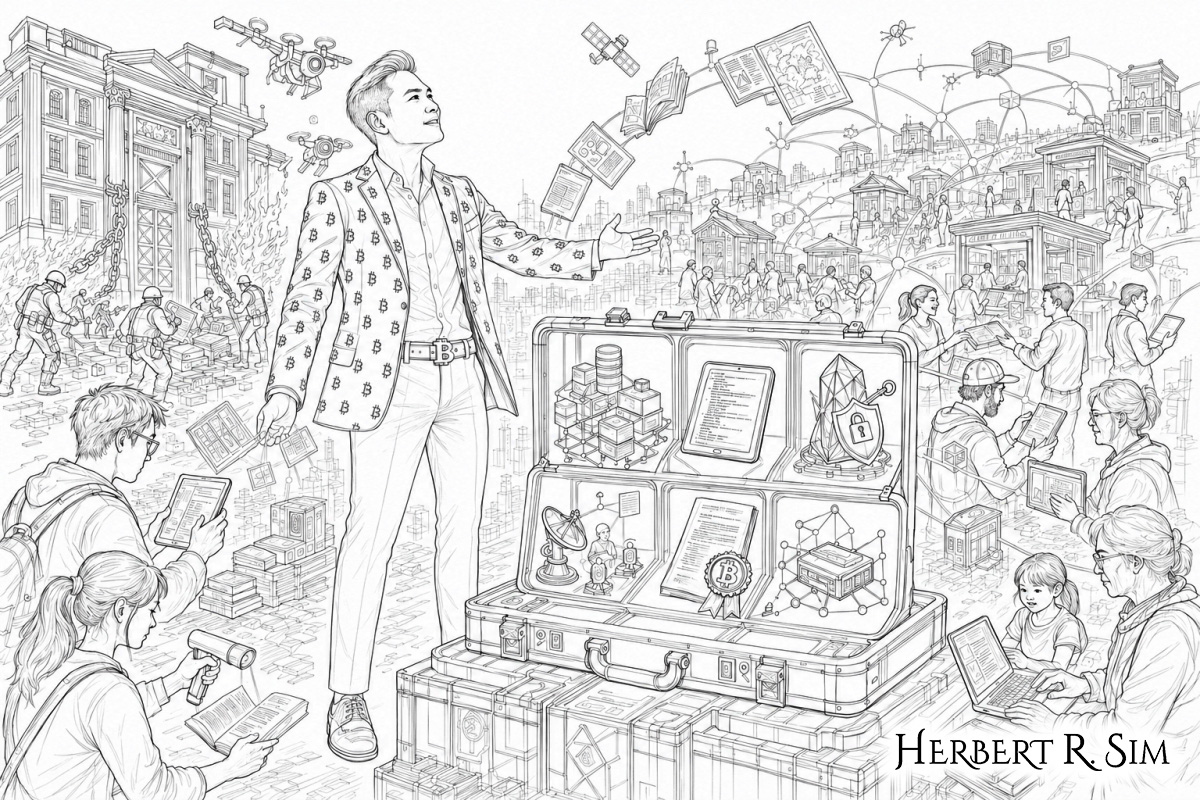
My illustration “The Sovereign Knowledge Toolkit” work-in-progress – Around me, citizens use these tools to copy books, research, educational materials and cultural records across a global decentralized network. In the background, centralized authorities attempt to close libraries and block information, but verified copies continue spreading between people. The art represents that knowledge becoming sovereign when no institution can monopolize, alter, suppress or permanently erase it.
The Legitimate Boundaries of Openness
Not everything should be open.
Personal information belongs within the sovereignty of the person.
Private correspondence belongs to its participants.
Authentication secrets must remain secret.
Information that would expose vulnerable individuals to immediate harm may require protection.
Confidential professional relationships can serve legitimate human purposes.
Creators possess moral and material interests in their work.
Communities may possess knowledge that should not be extracted, commercialized or disclosed without their consent.
Security systems may require limited operational details to remain confidential even when their governing principles and accountability mechanisms are public.
Cypherpunkism does not demand indiscriminate disclosure.
It demands that closure be justified where closure creates dependency or shields consequential power from scrutiny.
The question is not:
Can this information be made public?
The better questions are:
Whose information is it? Whose power would openness constrain? Whose sovereignty would disclosure violate?
Eight Tests of Open Knowledge
A resource or system claiming to be open should be examined through eight practical tests.
1. The Access Test
Can the complete work be obtained without an unnecessary financial, legal, geographic or technical barrier?
2. The Comprehension Test
Is the material documented and expressed clearly enough for its intended community to understand it?
3. The Verification Test
Can independent people inspect the evidence, method, source or rules supporting important claims?
4. The Reuse Test
Do the legal terms permit the work to be used and redistributed for legitimate purposes?
5. The Adaptation Test
Can the work be corrected, translated, modified and extended, with changes clearly identified?
6. The Interoperability Test
Is the knowledge provided in formats and according to standards that competing tools can implement?
7. The Provenance Test
Can users determine where the work came from, who changed it and which version they possess?
8. The Preservation Test
Can the knowledge survive the disappearance, failure or policy change of its present host?
A resource may satisfy these tests by degree rather than absolutely.
The tests reveal whether openness is a meaningful transfer of capability or merely a label.
The Responsibilities of the Participant
A knowledge commons survives only when people contribute to its integrity.
A participant should:
- distinguish evidence from assertion;
- credit creators and preserve provenance;
- state modifications honestly;
- correct errors when they are discovered;
- respect privacy, confidentiality and informed consent;
- choose open formats and licenses where openness serves the public good;
- document systems so others can understand and maintain them;
- support the people and institutions sustaining shared resources;
- translate and teach where knowledge remains inaccessible;
- and return improvements to the commons when possible.
Open knowledge is not knowledge without authorship.
It is not knowledge without labor.
It is not knowledge without standards.
It is knowledge whose value can grow through legitimate participation.
A commons is sustained by contribution, not merely consumed through access.
A Declaration of Intellectual Sovereignty
I do not believe every piece of information should be public.
I believe the individual should control the boundary of his private life.
I do not reject authorship.
I believe creators should be credited and their legitimate rights respected.
I do not reject expertise.
I reject the idea that expertise must be protected from examination.
I do not reject institutions of learning.
I reject unnecessary barriers that reserve the ability to learn for the already privileged.
I do not believe openness automatically produces truth.
I believe truth is strengthened when claims can be challenged.
I have the right to understand the rules governing my digital life.
I have the right to inspect systems asking for my trust.
I have the right to learn from the knowledge humanity chooses to place in common.
I have the right to build compatible tools from open standards.
I have the right to preserve knowledge against technological abandonment.
I have the right to question opaque authority.
I have the right to publish, teach, translate, adapt and share where I possess the legitimate freedom to do so.
With these rights comes responsibility.
I must protect private information even when disclosure is easy.
I must preserve attribution even when copying is effortless.
I must resist falsehood even when distribution is frictionless.
I must contribute to the knowledge systems upon which I depend.
I must use open knowledge to enlarge human agency rather than diminish human dignity.
Open Knowledge Is Digital Sovereignty
A sovereign individual does not need to know everything.
But he must not be permanently forbidden from understanding the systems upon which his life depends.
He should be able to learn.
He should be able to inspect.
He should be able to verify.
He should be able to question.
He should be able to repair.
He should be able to teach.
He should be able to build an alternative.
Privacy protects the person from unnecessary exposure.
Cryptography protects the boundary through mathematics.
Decentralization prevents one authority from controlling the entire architecture.
Open knowledge prevents understanding from becoming the exclusive property of the gatekeeper.
Open architecture preserves participation and exit.
Digital sovereignty joins these principles into one purpose:
Technology must enlarge the individual’s capacity to understand and act.
The private individual should not be transparent by default.
The powerful system should not be opaque by default.
Knowledge that can responsibly be shared should not be imprisoned merely because digital gates make exclusion profitable or convenient.
A civilization cannot call itself free when its citizens may use the machines but may not understand them, live under the rules but may not inspect them, and depend upon knowledge they are forbidden to obtain.
Open knowledge is digital sovereignty.
Foundational Sources and Influences
- Kerckhoffs, Auguste. “La Cryptographie Militaire.” Journal des Sciences Militaires, Vol. IX, 1883.
https://www.petitcolas.net/kerckhoffs/ - Stallman, Richard. The GNU Manifesto. 1985.
https://www.gnu.org/gnu/manifesto.html - Stallman, Richard. “What Is Free Software?” Free Software Foundation.
https://www.gnu.org/philosophy/free-sw.html - Berners-Lee, Tim. Information Management: A Proposal. CERN, March 1989–May 1990.
https://www.w3.org/History/1989/proposal.html - CERN. “Licensing the Web.” The World Wide Web software was made available on a royalty-free basis on April 30, 1993.
https://home.cern/science/computing/the-birth-of-the-web/licensing-web - Hughes, Eric. A Cypherpunk’s Manifesto. March 9, 1993.
https://www.activism.net/cypherpunk/manifesto.html - Debian Project. Debian Social Contract and Debian Free Software Guidelines. Version 1.0 ratified July 5, 1997; Version 1.1 ratified April 26, 2004.
https://www.debian.org/social_contract.1.1 - Open Source Initiative. The Open Source Definition.
https://opensource.org/osd - Lessig, Lawrence. Code and Other Laws of Cyberspace. Basic Books, 1999.
https://cyber.harvard.edu/publications/1999/Code_And_Other_Laws_Of_Cyberspace - Budapest Open Access Initiative. Read the Budapest Open Access Initiative. February 14, 2002.
https://www.budapestopenaccessinitiative.org/read/ - Creative Commons. History of Creative Commons. Founded in 2001; first licenses published in 2002.
https://creativecommons.org/history/ - Benkler, Yochai. The Wealth of Networks: How Social Production Transforms Markets and Freedom. Yale University Press, 2006.
https://cyber.harvard.edu/wealth_of_networks/Download_PDFs_of_the_book - Open Knowledge Foundation. Open Definition 2.1.
https://opendefinition.org/od/2.1/en/ - National Academies of Sciences, Engineering, and Medicine. Reproducibility and Replicability in Science. The National Academies Press, 2019. DOI: 10.17226/25303.
https://doi.org/10.17226/25303 - UNESCO. Recommendation on Open Educational Resources (OER). Adopted November 25, 2019.
https://www.unesco.org/en/legal-affairs/recommendation-open-educational-resources-oer