
Why Peer-to-Peer Electronic Cash Is an Experiment in Digital Sovereignty

Above is my illustration entitled: “The Cypherpunk Currency Forge” – Inside an underground cypherpunk workshop, Herbert and a decentralized community forge Bitcoin from cryptographic code, proof of work and peer-to-peer connections. The finished currency rises beyond the reach of governments and corporations.
Thirteen Years After the Bitcoin White Paper
On October 31, 2008, a person or group using the name Satoshi Nakamoto announced a paper to the Cryptography Mailing List entitled Bitcoin: A Peer-to-Peer Electronic Cash System. The paper addressed a problem that was simple to state but remarkably difficult to solve: although information could travel directly between people across the Internet, electronic money still depended upon financial institutions acting as trusted third parties. Those institutions maintained the authoritative ledger, determined whether a payment was valid and prevented the same digital unit from being spent twice.
Bitcoin proposed a different architecture. Digital signatures would establish the authority to spend, a peer-to-peer network would distribute transactions, proof-of-work would establish their chronological order, and independently operated nodes would verify that every block followed the network’s rules. No central mint would issue the units, and no single institution would possess the exclusive ledger.
Thirteen years later, Bitcoin has survived software defects, exchange collapses, political hostility, speculative excess, internal conflict and repeated predictions of its death. Its continued existence does not prove that every claim made about Bitcoin is correct, nor does it mean that the system has solved every problem associated with money. It demonstrates something narrower but historically significant: a monetary network can continue operating without asking one central administrator for permission to exist.
Bitcoin is money without a central permission-giver.
That property makes Bitcoin one of the most consequential experiments in Cypherpunkism. It applies cryptography, decentralization, open-source development and individual key control to a domain traditionally governed by states, banks and payment companies: the creation, possession and transfer of money.
Bitcoin Did Not Appear From Nothing
Bitcoin is sometimes presented as an isolated invention, but it is better understood as a synthesis of work developed over several decades. David Chaum demonstrated how blind signatures could support private electronic payments. Adam Back created Hashcash, which used computational proof-of-work to impose a cost upon abusive electronic messages. Wei Dai’s b-money described money and contracts among digital pseudonyms, while Nick Szabo’s bit gold combined proof-of-work, timestamping and distributed records to imagine digitally scarce objects. Hal Finney later built Reusable Proofs of Work and became the recipient of the first Bitcoin transaction sent by Satoshi Nakamoto.
These ideas emerged from a wider intellectual environment in which Cypherpunks debated anonymous remailers, digital cash, pseudonyms, cryptographic contracts, reputation systems and the political consequences of strong encryption. Bitcoin did not invent every component it employed. Its achievement was to assemble existing and original components into a monetary system that people could voluntarily join, independently verify and economically sustain without one trusted bookkeeper.
The result was not merely another payment application. It was a working demonstration that the Cypherpunk principle of building alternatives could be extended from private communication to digital value.
Bitcoin is a cypherpunk inheritance expressed as a functioning monetary network.
The Trusted Third Party Problem
Traditional electronic money exists primarily as an account within an institution. That institution records the balance, approves payments, enforces limits and retains the ability to freeze or close the account. It may also be compelled by law, affected by political pressure, disrupted by operational failure or rendered unable to honor its obligations through insolvency.
These powers are not always illegitimate. Financial institutions provide security, credit, fraud detection, transaction recovery and customer support that many people value. Governments also possess legitimate interests in confronting theft, fraud, money laundering and other unlawful conduct. The Cypherpunkist objection is therefore not that every intermediary is malicious; it is that digital value should not be technically incapable of moving without one.
When every electronic payment requires institutional authorization, the intermediary becomes sovereign over participation. It can decide not only whether a transaction is technically valid, but whether the person initiating it is acceptable, profitable, identifiable or politically permitted. Bitcoin separates these questions at the protocol layer. A transaction signed by the appropriate key can be transmitted to the network and evaluated according to public rules rather than the status of the person who created it.
Permissionless money replaces institutional identity with cryptographic validity at the protocol layer.
What “Money Without Permission” Actually Means
The phrase money without permission must be defined carefully. Bitcoin does not remove every form of permission from economic life. A merchant remains free to refuse a payment, an exchange may require identification, a jurisdiction may impose taxes and financial laws, and a custodian may restrict withdrawals. Miners choose which pending transactions to include in candidate blocks, while network congestion can make settlement slower or more expensive.
Permissionlessness describes the architecture of the base protocol. A person does not need approval from a central Bitcoin office to generate a private key, create an address, receive bitcoin, broadcast a valid transaction, run a verifying node, mine according to the protocol, propose an improvement or build a compatible wallet. There is no Bitcoin corporation granting accounts and no administrator promising that access will remain available.
Participation is possible because the rules are open and because many independent parties can relay, verify and record valid transactions. Those rules are strict, but they are not administered by a single ruler who can selectively exempt favored participants or exclude disfavored ones.
Money without permission does not mean money without rules. It means rules without a single ruler.
The Private Key Changes the Meaning of Possession
In a conventional bank account, the institution maintains the authoritative record and grants the customer access to it. Bitcoin reorganizes this relationship around cryptographic keys. A private key does not literally contain bitcoin; it creates the digital signature required to authorize the spending of outputs recorded on the public ledger.
This distinction makes possible a more direct form of digital possession. The holder of the appropriate key can authorize a transfer without obtaining an intermediary’s signature. As I argued in Cryptography Is Applied Freedom, control of the key creates technological authority. In Bitcoin, that authority applies directly to digital value.
Authority, however, arrives with responsibility. A lost key may mean permanently lost access, while a stolen key may permit an irreversible transfer. An insecure backup can expose the funds, a deceptive interface can induce the owner to sign the wrong transaction, and an inheritance plan that nobody can execute can turn sovereignty into disappearance. Self-custody does not abolish risk; it transfers much of that risk from institutional discretion to key management and personal judgment.
To hold the key is to possess authority—and to inherit the burden of protecting it.
A Monetary Policy Expressed in Code
National currencies are governed through central banks, treasuries, legislatures and financial institutions. Their policies can respond to inflation, employment, credit conditions, emergencies and political priorities. This discretion can help institutions react to crises, but it also gives a relatively small number of decision-makers substantial influence over the value and supply of money.
Bitcoin takes a different approach. Its issuance schedule is defined by publicly inspectable consensus rules. New bitcoin enters circulation through block subsidies, those subsidies decline at predetermined intervals, and total issuance under the existing rules approaches a limit of twenty-one million bitcoin. No committee decides that the following month requires additional units, and no chief executive can secretly increase the accepted supply.
This does not mean that Bitcoin’s rules are immutable by magic. A developer can publish software containing another monetary rule, but other participants cannot be compelled to adopt it. A miner can construct a block that awards itself more bitcoin than the rules permit, but independently validating nodes can reject that block. The monetary policy is defended by participants whose separately chosen software converges upon a shared definition of valid money.
Bitcoin therefore exchanges institutional flexibility for verifiable predictability. Whether that trade is desirable depends upon the purpose for which Bitcoin is being used and the particular risks the user wants to avoid.
Bitcoin transforms monetary policy from institutional discretion into openly verifiable technical and social consensus.
Proof-of-Work Makes History Expensive to Rewrite
Digital signatures can prove that a key authorized a transaction, but they cannot independently determine which of two conflicting transactions occurred first. Bitcoin addresses this ordering problem through proof-of-work. Miners expend computational effort while competing to add blocks, and nodes verify that the resulting blocks satisfy the protocol’s requirements.
As blocks accumulate, rewriting confirmed history requires reproducing the work supporting that history while also competing against the network’s continuing production of new blocks. The ledger is therefore not protected merely because an institution promises never to alter it. Alteration carries a measurable physical and economic cost.
That protection is not free. Proof-of-work requires substantial electricity and specialized equipment, and its environmental consequences should not be dismissed. The proper question is whether the monetary independence, settlement assurance and resistance to historical revision produced by proof-of-work justify its resource consumption—and how the system’s energy sources and efficiency can improve. This issue should be examined through transparent evidence rather than slogans from either defenders or critics.
Bitcoin purchases resistance to revision with computation, energy and time.
Verification Is More Important Than Trust
A Bitcoin node does more than receive information from the network. It verifies blocks and transactions against the rules selected by its operator. It can reject invalid signatures, unauthorized issuance, malformed transactions and blocks that violate consensus. This ability gives ordinary participants a role traditionally reserved for the institution maintaining the ledger.
The distinction matters politically. If miners alone defined validity, control of mining would define the money. If developers alone defined validity, control of the software repository would define it. If exchanges alone defined validity, market access would determine the accepted rules. Bitcoin instead distributes different forms of influence among developers, miners, node operators, businesses, custodians and users.
No group is powerless, and no group should be assumed omnipotent. Developers can propose software but cannot force everyone to run it. Miners can order valid transactions but cannot make invalid coins acceptable to nodes that reject them. Businesses can influence adoption but cannot unilaterally rewrite the copies of the ledger maintained elsewhere. Open-source software and public technical discussion make this distribution of authority observable and contestable, extending the principle developed in Open Knowledge Is Digital Sovereignty.
Bitcoin does not eliminate trust. It reduces, divides and exposes the trust that remains.
Decentralization Must Be Measured Across the Whole System
Bitcoin has no central bank, chief executive or headquarters, but this does not make every layer of its ecosystem decentralized. Mining pools can accumulate influence, hardware manufacturing can become concentrated, exchanges can dominate liquidity, custodians can hold enormous balances and a small number of software projects can shape how most people interact with the network. Wallet infrastructure, network access and public discussion can also converge around influential intermediaries.
A protocol may therefore remain decentralized while most users approach it through a few centralized gateways. Someone holding an exchange balance possesses a claim upon an intermediary rather than direct authority through personal keys. A wallet that depends entirely upon another party’s node asks that party what the ledger contains, while a miner joining a pool may contribute computing power even though the pool operator constructs the candidate block.
These arrangements can improve convenience, liquidity and efficiency, but they can also recreate the dependencies Bitcoin was designed to reduce. As explained in Decentralization Is a Check on Power, decentralization must be measured across the complete ecosystem rather than inferred from the name of the protocol.
Bitcoin is decentralized to the extent that no participant becomes an unavoidable center of permission.
Governance Without a Government of Bitcoin
Bitcoin has governance, even though it lacks a formal sovereign. Developers propose and review code, Bitcoin Improvement Proposals document technical ideas, miners select software and construct blocks, node operators choose which rules to enforce, businesses decide what they will support, and users determine what they will accept and value. These activities are influenced by reputation, expertise, capital, persuasion and economic incentives.
Coordination can consequently be slow and contentious. Participants may disagree about which changes are safe, necessary or consistent with Bitcoin’s purpose, and a sufficiently deep disagreement can produce incompatible networks. This is not an absence of governance. It is governance in which the final outcome cannot be reduced to a command issued by one protocol owner.
Bitcoin’s resistance to rapid change may appear inefficient when compared with a company capable of updating its platform overnight. For a monetary system, however, the difficulty of changing fundamental rules can also protect users from unilateral alteration. Stability emerges not because disagreement disappears, but because significant change requires broad enough adoption to remain economically and technically credible.
Bitcoin changes through persuasion, software and voluntary adoption—not decree from a protocol owner.
Bitcoin Is Pseudonymous, Not Anonymous
Bitcoin is frequently described as anonymous money, but that description is misleading and potentially dangerous. Its ledger is public, its transactions are stored permanently, and those transactions can be analyzed long after they occur. Addresses do not automatically reveal civil identities, yet they create observable patterns that can become connected to people through exchanges, merchants, network information, address reuse and other disclosures.
Once an address or transaction is connected to an identity, earlier and later activity may become easier to trace. Bitcoin therefore separates identity from the account more effectively than many conventional financial systems at the protocol layer, but it does not guarantee privacy. The absence of a name on the ledger is not the same as the absence of an observable financial history.
This limitation matters because monetary privacy protects legitimate human activity: salaries, savings, donations, business relationships, purchases and political associations. As established in Privacy Is Sovereignty, privacy means meaningful control over disclosure. Bitcoin advances monetary sovereignty through key control and open participation, but its privacy remains incomplete.
Do not confuse pseudonymity with invisibility.
Custody Can Recreate the Bank
Bitcoin permits self-custody, but it does not require it. Many people acquire and hold bitcoin through exchanges, brokers and custodians that provide regulated access, liquidity, account recovery, customer support and institutional security. These services can make Bitcoin more accessible to users who are unwilling or unable to protect private keys independently.
Custodial Bitcoin, however, restores a familiar structure. The institution controls the keys while the user sees a balance, and withdrawals depend upon the custodian’s solvency, security, policies and permission. The underlying blockchain may be decentralized even though the user’s practical relationship remains centralized.
This does not mean that every person must assume complete custody in isolation. Different users face different abilities and risks, and arrangements such as multisignature or collaborative custody can distribute authority while supporting recovery. What matters is that the relationship is described honestly. A custodial claim should not be confused with direct, sovereign possession.
If another party exclusively controls the keys, that party remains the technological authority.
Scaling Without Surrendering the Base Layer
A global payment system must serve more activity than Bitcoin’s base layer can accommodate if every small payment is recorded individually. Increasing capacity is not merely an engineering problem; it is also a question of which political and technical properties should be preserved while the system grows. Larger hardware and bandwidth requirements may reduce the number of people capable of verifying the chain, while centralized payment services can increase speed at the cost of recreating trusted intermediaries.
The Lightning Network offers a layered approach. Participants can open payment channels anchored to Bitcoin, exchange many signed balance updates without recording every payment on the blockchain and later settle the resulting balance. This can enable faster and smaller payments, but it introduces its own requirements involving liquidity, routing, uptime, backups and wallet design.
A scaling system should therefore be evaluated by more than transaction speed. We must also ask who can join, who can exit, who can censor, which intermediaries must be trusted and whether the user retains a path to final settlement on the underlying network.
Scaling preserves sovereignty only when efficiency does not make one gateway indispensable.
The State Adoption Paradox
In June 2021, the Legislative Assembly of El Salvador approved legislation recognizing Bitcoin as legal tender, and the law entered into force in September. This was a historic development: a system designed to function without state authorization had received formal monetary recognition from a state.
The event reveals an important distinction. Bitcoin does not require legal-tender status to operate. A government may recognize it, regulate it, purchase it, tax it, restrict it or build services around it, but none of those actions creates the protocol. Nor does government adoption automatically create individual sovereignty. An official wallet may still be custodial, and a state-operated service may still collect identity and transaction information.
There is also a philosophical difference between protecting a person’s freedom to use Bitcoin and compelling another person to accept it. State recognition may expand access, while state compulsion may reduce choice. Cypherpunkism must evaluate the distribution of power within the architecture rather than treating the presence of a Bitcoin symbol as sufficient evidence of freedom.
Bitcoin is permissionless because the protocol can operate without state approval—not because every policy involving Bitcoin advances sovereignty.
Permissionless Does Not Mean Lawless
A protocol can determine that a signature is valid without deciding whether the transaction is moral or lawful. That separation is a technical property, not a form of moral absolution. Fraud remains fraud, theft remains theft and deception remains deception. Contracts, taxes and legal obligations do not vanish merely because settlement occurs through cryptographic keys.
Bitcoin separates protocol validity from institutional approval, but society must still judge human conduct. This separation can protect dissidents, excluded communities and lawful commerce from arbitrary gatekeeping; it can also be exploited by wrongdoers. The same tension exists in cash, encryption and the Internet because technologies capable of protecting freedom are often capable of protecting choices society condemns.
The existence of misuse does not erase legitimate use, just as legitimate use does not erase responsibility for misuse. Freedom from an unnecessary intermediary is not freedom from accountability to other human beings.
Protocol neutrality does not create moral neutrality in the person using it.
Bitcoin Does Not Guarantee Sovereignty
Bitcoin offers tools and properties rather than guaranteed outcomes. A person can own bitcoin while exposing his complete transaction history, use a decentralized network through a centralized custodian or replace dependence upon a bank with dependence upon an exchange, promoter or software vendor. He can understand the price while understanding nothing about key security, or confuse speculative profit with individual freedom.
Bitcoin also remains a volatile asset surrounded by fraud, leverage and exaggerated promises. A user can lose money through market movement, deception, poor security or simple error. None of these risks disappears because the underlying protocol is decentralized.
Monetary sovereignty therefore requires more than possession of an asset. It requires knowledge, security, privacy, judgment and the practical ability to leave dependent relationships. Bitcoin can enlarge those capabilities, but it cannot exercise them on the individual’s behalf.
Bitcoin makes monetary sovereignty possible. The user must still make it real.
Eight Tests of Permissionless Money
A monetary system claiming to operate without permission should be examined through eight practical tests. These tests do not assume that any network will achieve perfect decentralization or privacy. They reveal where authority actually resides and whether participation remains meaningfully open.
1. The Access Test
Can a person join the network and create the credentials required to participate without approval from a central administrator?
2. The Key-Control Test
Can the user possess the keys required to authorize his own transactions, or must a custodian always act on his behalf?
3. The Issuance Test
Can any participant create new monetary units outside the publicly known rules and force other participants to accept them?
4. The Verification Test
Can independent participants verify balances, transactions, issuance and compliance with the monetary rules?
5. The Censorship Test
Can one institution block every path by which a technically valid transaction reaches settlement?
6. The Privacy Test
Can people transact without unnecessarily exposing their identities and complete financial histories?
7. The Exit Test
Can a user leave a wallet, exchange, custodian or service while retaining control of his money?
8. The Governance Test
Can any developer, miner, company, government or other participant change the fundamental rules unilaterally for everyone?
Bitcoin does not answer every test perfectly. Its importance lies in making these questions applicable to a functioning global monetary network rather than merely to an imagined one.
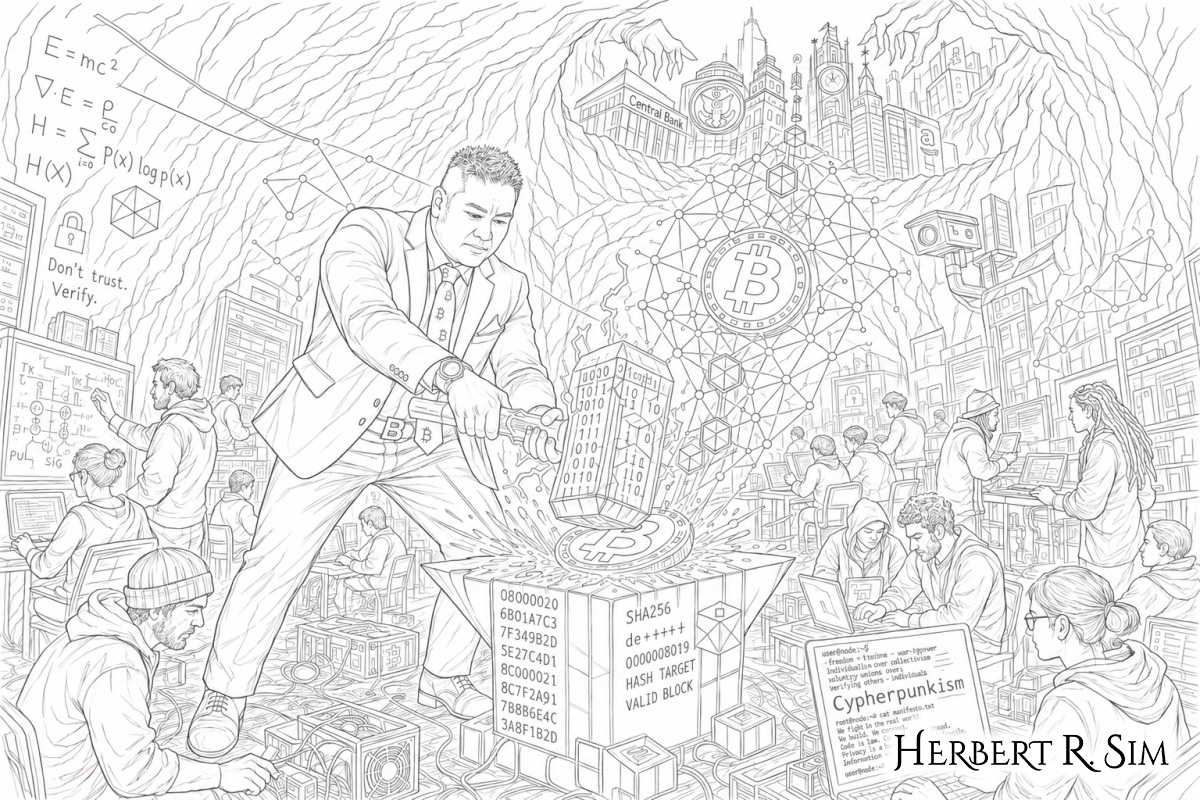
My illustration “The Cypherpunk Currency Forge” work-in-progress – represents: Bitcoin as the practical monetary realization of cypherpunk principles.
The Responsibilities of the Bitcoin Holder
A person seeking monetary sovereignty must understand the distinction between bitcoin and a custodial claim to bitcoin. He should protect private keys and recovery information, test backups before depending upon them, prepare responsibly for incapacity or inheritance and avoid unnecessary disclosures that weaken transaction privacy.
He should also verify important information rather than trusting promoters, understand volatility, avoid risking what he cannot afford to lose and reject claims of guaranteed profit. Responsibility includes complying with legitimate obligations, refusing fraud and deception, supporting decentralization where practical and respecting the sovereignty of other participants.
The protocol can verify a signature, but it cannot verify wisdom. It can reject unauthorized issuance under its rules, but it cannot prevent every deception constructed around it. It can enable direct possession, but it cannot force the possessor to behave responsibly.
Monetary freedom without monetary discipline becomes another path to dependence.
A Declaration of Permissionless Money
I do not believe every financial institution is an enemy.
I believe no financial institution should be the unavoidable sovereign of digital exchange.
I do not believe Bitcoin eliminates trust.
I believe Bitcoin allows trust to be reduced, divided and verified.
I do not believe code abolishes law or morality.
I believe lawful individuals should be able to transact without unnecessary gatekeepers.
I do not believe decentralization guarantees virtue.
I believe decentralization prevents certain powers from becoming absolute.
I do not believe Bitcoin guarantees privacy.
I believe monetary privacy remains essential to human sovereignty.
I do not believe possession of bitcoin automatically makes a person sovereign.
I believe control of keys can give a person direct technological authority over digital value.
I have the right to generate a cryptographic key.
I have the right to receive value through an open network.
I have the right to broadcast a valid transaction.
I have the right to verify the monetary rules for myself.
I have the right to build compatible tools.
I have the right to choose custody or self-custody with an honest understanding of each.
I have the right to seek an alternative when financial intermediaries become instruments of arbitrary exclusion.
With these rights comes responsibility.
I must secure what I control.
I must understand what I sign.
I must not confuse technical validity with moral legitimacy.
I must not promise certainty where risk remains.
I must not surrender independent judgment to price, popularity or ideology.
I must remember that Bitcoin is a means.
Human sovereignty is the purpose.
Bitcoin and Cypherpunkism
Bitcoin matters to Cypherpunkism because it combines several principles within a functioning monetary architecture. Cryptography establishes the authority to spend, private keys permit direct control, proof-of-work protects the order of transactions and independently operated nodes verify the rules. Decentralization limits the authority of any single operator, while open-source code makes the system inspectable and allows competing implementations and services to exist.
None of these properties is complete, and none should be romanticized. Bitcoin remains volatile, its privacy is limited, its energy use is substantial and its surrounding economy contains concentration, speculation and fraud. Secure participation demands knowledge, caution and responsibility.
Yet the experiment has crossed an extraordinary threshold. Before Bitcoin, money without a central issuer belonged largely to theory, limited experiments and physical commodities. Bitcoin made it possible for a person to hold a cryptographic key, verify the rules of a public monetary system and transfer scarce digital value through a network without obtaining approval from the institution that issued it—because no such institution exists.
Privacy establishes the boundary.
Cryptography establishes authority.
Decentralization prevents one ledger-keeper from becoming sovereign.
Open knowledge makes verification possible.
Bitcoin applies these principles to money.
Bitcoin is money without permission.
Foundational Sources and Influences
- Chaum, David. “Blind Signatures for Untraceable Payments.” Advances in Cryptology: Proceedings of Crypto 82, 1983, pp. 199–203.
https://doi.org/10.1007/978-1-4757-0602-4_18 - May, Timothy C. The Crypto Anarchist Manifesto. 1988; circulated to the Cypherpunks mailing list in 1992.
https://www.activism.net/cypherpunk/crypto-anarchy.html - Hughes, Eric. A Cypherpunk’s Manifesto. March 9, 1993.
https://www.activism.net/cypherpunk/manifesto.html - Back, Adam. “Hashcash—A Denial of Service Counter-Measure.” 2002; Hashcash announced in 1997.
https://www.hashcash.org/papers/hashcash.pdf - Dai, Wei. “b-money.” 1998.
https://nakamotoinstitute.org/library/b-money/ - Szabo, Nick. “Bit Gold.” 2005.
https://nakamotoinstitute.org/library/bit-gold/ - Finney, Hal. “RPOW—Reusable Proofs of Work.” August 15, 2004.
https://nakamotoinstitute.org/library/rpow/ - Nakamoto, Satoshi. “Bitcoin P2P e-cash paper.” Cryptography Mailing List, October 31, 2008.
https://www.metzdowd.com/pipermail/cryptography/2008-October/014810.html - Nakamoto, Satoshi. Bitcoin: A Peer-to-Peer Electronic Cash System. 2008.
https://bitcoin.org/bitcoin.pdf - Nakamoto, Satoshi. “Bitcoin v0.1 Released.” Cryptography Mailing List, January 8, 2009.
https://www.metzdowd.com/pipermail/cryptography/2009-January/014994.html - Meiklejohn, Sarah, et al. “A Fistful of Bitcoins: Characterizing Payments Among Men with No Names.” Proceedings of the 2013 Internet Measurement Conference, 2013, pp. 127–140.
https://doi.org/10.1145/2504730.2504747 - Bitcoin Project. “Protect Your Privacy.”
https://bitcoin.org/en/protect-your-privacy - Poon, Joseph, and Thaddeus Dryja. The Bitcoin Lightning Network: Scalable Off-Chain Instant Payments. Version 0.5.9.2, January 14, 2016.
https://lightning.network/lightning-network-paper.pdf - Dashjr, Luke. “BIP 2: BIP Process, Revised.” February 3, 2016.
https://bips.dev/2/ - Cambridge Centre for Alternative Finance. Cambridge Bitcoin Electricity Consumption Index.
https://ccaf.io/cbnsi/cbeci - Legislative Assembly of El Salvador. Decreto Legislativo No. 57: Ley Bitcoin. Approved June 8, 2021.
https://www.jurisprudencia.gob.sv/DocumentosBoveda/D/2/2020-2029/2021/06/E75F3.PDF