

My illustration entitled: “The Four Gates of Freedom” – I walks through four monumental gates labelled DATA, IDENTITY, BODY and MIND. The final gate opens into a vast blue-and-gold horizon shaped like a human neural network.
Sovereignty is traditionally understood as the possession of supreme authority. In political theory, it usually describes the authority of a state over its territory, institutions and population. But technological civilization is producing another question: what form of sovereignty belongs to the individual?
This question cannot be answered solely through geography. Increasing portions of human life now take place inside systems that are not bounded by physical territory. Conversations pass through communication networks. Identities are assembled from databases. Money can be represented by cryptographic records. Social relationships are organized by platforms, while personal behaviour is continuously translated into information.
Technology is also moving progressively closer to the human being. Computers moved from institutions into homes, from desks onto laps and from pockets onto the body. Wearable sensors can observe movement, sleep, location and physiology. Experimental brain–computer interfaces are beginning to translate neural activity into commands for external devices.
Each movement closer to the individual creates new capabilities. It also moves technological power closer to the boundaries of the self.
The evolution of sovereignty must therefore be understood as an expanding frontier. It begins with the right to protect information, develops into control over networks, identity, money and digital existence, and ultimately reaches the freedom of the human mind.
Sovereignty Begins with a Boundary
Individual sovereignty does not mean complete independence from society. Human beings depend upon families, communities, markets, governments and shared infrastructure. Cooperation makes civilization possible.
Sovereignty instead requires a boundary between the individual and the systems upon which the individual depends. Within that boundary, a person must retain enough authority to form beliefs, make decisions, maintain relationships and develop an identity without being completely exposed to external control.
Privacy is the first expression of this boundary. The right to privacy has historically protected the home, correspondence, family life and the interior spaces in which personality can develop. Samuel Warren and Louis Brandeis described privacy in 1890 as a right to be left alone. Article 12 of the Universal Declaration of Human Rights later prohibited arbitrary interference with privacy, family, home and correspondence.
The arrival of computer networks does not eliminate this principle. It changes the architecture through which it must be defended.
A physical letter can be placed inside an envelope. A private conversation can occur behind a closed door. Digital information, by contrast, may pass through distant servers, be copied without visible alteration and remain accessible long after its original purpose has ended. The boundary is no longer constructed only from walls, distance and social convention. It must also be constructed from software, protocols and cryptography.
This is why privacy is sovereignty. Privacy gives the individual authority over the boundary between the private self and the external world.
The First Frontier: Information Sovereignty
Information sovereignty concerns the ability of an individual to determine what information about himself is revealed, to whom it is revealed and for what purpose. Its foundational question is simple:
Who can read the message?
The original original Cypherpunks recognized that informational privacy could not depend entirely upon institutional promises. Eric Hughes wrote in A Cypherpunk’s Manifesto that privacy in an open society required anonymous transaction systems and the use of cryptography. The Cypherpunk response was practical: build tools capable of defending privacy through mathematics.
Cryptography is applied freedom because it converts a social preference into a technical constraint. A privacy policy states that information should not be read. Encryption can make that information unreadable without the appropriate key.
Information sovereignty is nevertheless broader than secrecy. It includes the authority to decide when disclosure is appropriate. A person may reveal medical information to a doctor, financial information to a bank or personal information to a trusted friend without consenting to universal disclosure.
Privacy therefore does not require the concealment of everything. It requires control over context.
The challenge becomes greater when information is collected indirectly. A person may encrypt the contents of a message while the surrounding network still records the sender, recipient, location, time and frequency of communication. As explored in Metadata Is Power, patterns of association can reveal intimate structures of a person’s life without exposing the words of a single conversation.
Information sovereignty must consequently protect both content and context. It asks not only whether the message is private, but whether the surrounding system can reconstruct the person from the traces the message leaves behind.
The Second Frontier: Network Sovereignty
Protecting information is insufficient if access to communication depends upon infrastructure controlled by a single authority. This produces the second frontier of sovereignty:
Who controls the network?
A centralized network can be efficient and useful. Central administrators can maintain standards, remove harmful material and repair failures. Centralization is not automatically illegitimate. The problem emerges when an institution acquires such extensive control that participation becomes conditional upon its continuing permission.
A network operator may determine who can communicate, what identities must be disclosed, which software may connect and what information is retained. If the network becomes indispensable, these administrative choices acquire political significance.
This is the central argument of The Architecture of Power: databases, permissions, interfaces, protocols and cryptographic keys do not merely make a system function. They distribute authority among the people and institutions using it.
Decentralization can provide a structural response. Peer-to-peer networks, open protocols and distributed systems reduce unnecessary reliance upon a single controlling point. They do not guarantee justice or efficiency, but they can make censorship, unilateral exclusion and arbitrary rule changes more difficult.
Political constitutions divide authority because concentrated power can be abused. Digital infrastructure sometimes requires the same principle. In this sense, decentralization is a check on power.
Network sovereignty exists when individuals can communicate, publish and participate without one institution possessing absolute authority over the conditions of their digital existence.
The Third Frontier: Identity Sovereignty
As social and economic activity enters computer networks, identity itself becomes an object of technological administration. Accounts, profiles, credentials, photographs, contact lists, behavioural histories and reputation scores increasingly determine how a person is represented.
Identity sovereignty asks:
Who defines the digital individual?
In the physical world, identity is distributed across many contexts. A person can be a citizen, employee, customer, friend, patient and anonymous stranger without presenting the same information in every situation. Each relationship reveals only part of the person.
Centralized digital identity systems can collapse these distinctions. When one account, device or identifier connects many areas of life, activities that were previously separate become easy to correlate. A service may know not only a person’s legal name but also his location, relationships, interests, purchases and communications.
Identity then ceases to be something expressed by the individual and becomes something administered by the database.
Identity sovereignty does not mean that people may never be identified. Contracts, public services and legal proceedings may legitimately require identity. The principle is proportional disclosure: reveal what is necessary for a particular relationship while protecting what is not.
Cryptographic credentials may eventually allow a person to prove a relevant fact without exposing an entire identity. One might prove authorization, membership or eligibility without providing unrelated personal information. Different credentials could operate in different contexts rather than creating a universal identifier through which every activity can be connected.
A sovereign identity architecture should allow the individual to understand which attributes are being requested, consent to their disclosure and prevent their reuse beyond the intended purpose. No government or corporation should become the exclusive owner of the person’s digital existence.
The Fourth Frontier: Monetary Sovereignty
Money is another domain in which digital architecture changes the meaning of possession. Cash can be physically held and transferred without asking a remote computer to update an account. Most electronic money, however, exists as a record maintained by an institution.
Monetary sovereignty asks:
Who controls the keys and the ledger?
Bitcoin represents an important experiment in answering this question. It combines public-key cryptography, a distributed ledger and peer-to-peer networking to permit the transfer of digital value without a conventional central operator maintaining the authoritative record.
This does not mean that Bitcoin has solved every monetary problem. Its price is volatile, its interfaces remain difficult for many users and the irreversible loss of cryptographic keys can destroy access to funds. Exchanges and wallet providers may also reintroduce centralized custody around a decentralized protocol.
Its philosophical importance lies elsewhere. Bitcoin demonstrates that digital possession can be structured around cryptographic authority rather than institutional permission alone. It asks whether an individual can directly control a digital asset when no physical object exists.
Monetary sovereignty does not require the elimination of banks, governments or conventional currencies. It requires that the movement toward electronic money does not silently eliminate every means of transacting outside continuous identification, observation and discretionary permission.
A society in which every transaction passes through a small number of centralized ledgers creates a new concentration of power. Whoever controls those ledgers may be able to observe economic relationships, freeze assets or exclude a person from participation. Such authority may sometimes be exercised for legitimate reasons, but it should never become unlimited, invisible or impossible to challenge.
The Fifth Frontier: Digital Sovereignty
Information, networks, identity and money are not separate questions. Together they form the conditions of life in an emerging digital civilization.
Digital sovereignty is the capacity of an individual to retain meaningful authority over his identity, information, communications, digital possessions, cryptographic credentials and participation in technological systems.
Its central question is:
Who controls the digital individual?
A person may possess informational privacy while remaining dependent upon a platform that can revoke his account. He may possess secure communications while having no control over the identity required to access essential services. He may control a cryptographic asset while relying upon proprietary software he cannot inspect or replace.
Sovereignty therefore cannot be reduced to a single technology. It requires an architecture of complementary freedoms: privacy, cryptography, decentralization, individual control, open knowledge, open architecture and the freedom to build.
These are the foundations of the Eight Principles of Cypherpunkism. Together they seek to ensure that technological cooperation does not become technological domination.
Digital sovereignty is strongest when an individual can possess his own keys, retain copies of his information, move between services, understand important rules and use interoperable alternatives. It is weakest when identity, property and relationships can be removed through one administrative decision from an institution the individual cannot meaningfully challenge.
This is why sovereignty requires more than access. A tenant may be given access to a building without possessing authority over it. Likewise, a user may be given access to an account without owning the identity, information or relationships contained within it.
Access is permission. Sovereignty is authority.
Technology Is Moving Toward the Mind
The evolution of technological sovereignty does not end at the screen. Digital systems are moving from the external environment toward the human body and nervous system.
Wearable devices already collect information about movement, exercise, sleep and heart rate. Smartphones function as extensions of memory and attention. Algorithms influence what people see, which messages reach them and how information is ordered. Neuroimaging can reveal patterns associated with perception and mental activity, while experimental brain–computer interfaces have enabled people with severe paralysis to control cursors and robotic devices through neural signals.
These developments can profoundly expand human freedom. A person unable to move may communicate through a neural interface. A prosthetic limb may respond more naturally to intention. Neurotechnology may eventually assist in restoring sight, hearing or other lost capabilities.
But the same proximity that makes such technology powerful also makes it intimate. A computer connected to the nervous system does not merely process information about the external world. It may process signals produced by the individual’s own cognitive and biological activity.
This leads to the final frontier:
Who controls the interface to the mind?
The Sixth Frontier: Cognitive Sovereignty
Cognitive sovereignty is the authority of the individual over the technological boundaries surrounding thought, attention, memory, intention and neural activity.
Its practical expression is cognitive freedom: the ability to think, perceive, remember and form judgments without unauthorized technological observation, manipulation or interference.
The concept extends informational privacy inward. Information sovereignty asks who can read the message. Cognitive sovereignty asks what happens when technology can observe signals involved in forming the message before it is spoken.
Present brain–computer interfaces remain limited and experimental. Neural data should not be treated as a transparent recording of thought. Electrical activity is complex, dependent upon interpretation and frequently ambiguous. We should resist exaggerated claims that machines can simply read the mind.
Nevertheless, ethical principles should be established before technical capability becomes widespread. Waiting until neural systems are commercially entrenched would repeat the history of digital privacy, in which vast systems of collection were constructed before society developed adequate rules for governing them.
Neural information should therefore receive protections appropriate to its intimacy. No employer, government, insurer or technology provider should acquire unrestricted access to neural signals merely because a person uses a device. Collection should be limited to the function requested by the user. Secondary use should require explicit and informed consent. Security should be designed into the architecture rather than added only after abuse occurs.
The individual must also retain authority over activation. A cognitive or neural device should be capable of being disconnected, disabled or replaced wherever medically and technically possible. The person should understand what the system records, where that information is stored and who can modify its operation.
As I argued in Human-Sovereignty Transhumanism, technological enhancement should expand human capability without transferring ultimate authority over the person to the technology’s operator. The same principle applies here. A device may become integrated with the body, but integration must not become ownership by an external institution.
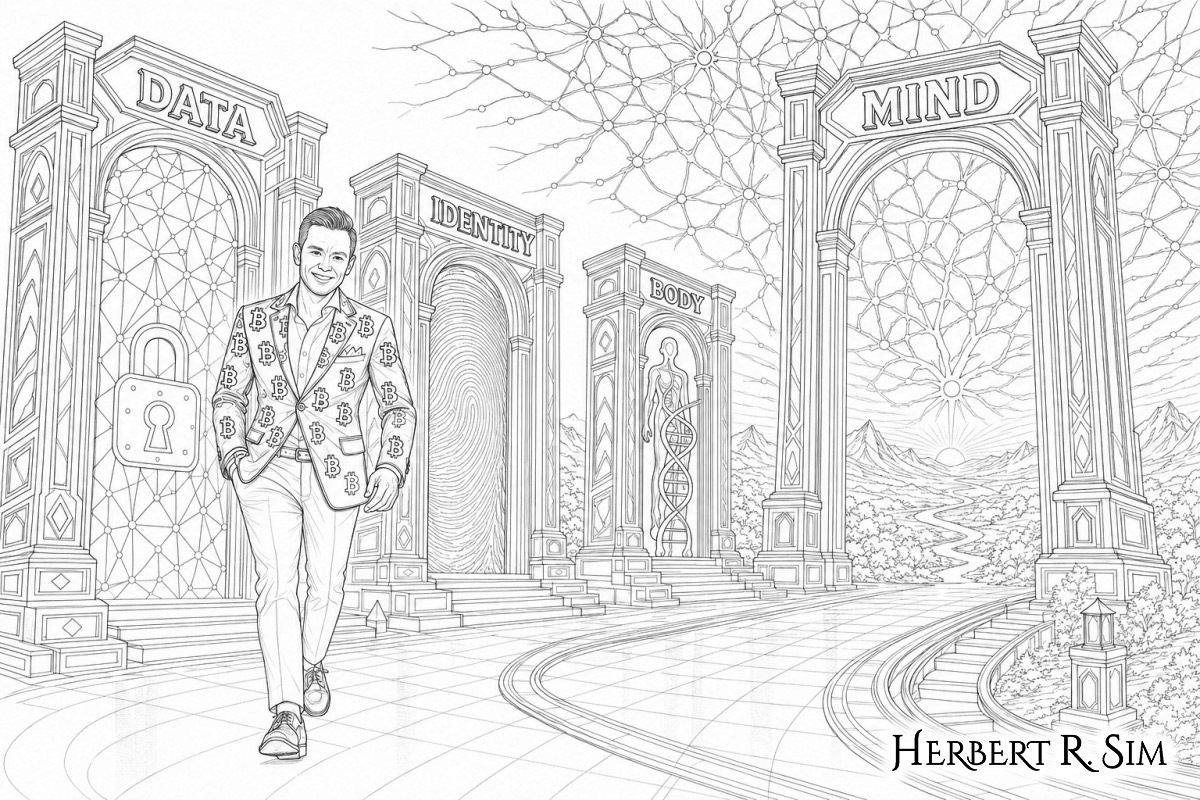
My illustration “The Four Gates of Freedom” work-in-progress. The art represents that the expanding frontier of liberty—from protecting personal data to protecting consciousness itself.
From Cognitive Privacy to Cognitive Freedom
Cognitive privacy is the protection of information relating to mental and neural activity. Cognitive freedom is broader. It concerns the conditions under which an individual can form and exercise thought.
A person may possess privacy while still being manipulated. Information does not need to be extracted from the mind if an external system can continuously direct attention, shape emotional responses or narrow the range of perceived choices.
This danger does not require futuristic brain implants. Digital platforms already compete for attention through notifications, personalized feeds and behavioural analysis. Persuasion has always existed, but computational systems can personalize and repeat persuasive interventions at a scale unavailable to any previous institution.
The issue is not whether technology influences thought. Language, education, art, advertising and social relationships all influence thought. Cognitive freedom does not require an impossible state of complete mental isolation.
The question is whether influence becomes hidden, involuntary and technologically inescapable. Is the individual aware that a system is attempting to alter his behaviour? Can he refuse? Can he inspect or change the mechanism? Can he leave without losing essential access to society?
Cognitive freedom requires spaces in which attention is not permanently captured, beliefs are not continuously profiled and mental activity is not converted into an asset belonging to someone else.
The Continuum of Sovereignty
The evolution from information privacy to cognitive freedom can be understood as a continuum:
- Information sovereignty: Who can read, collect and retain information about the individual?
- Network sovereignty: Who controls the infrastructure through which the individual communicates?
- Identity sovereignty: Who defines, verifies and may revoke the individual’s digital identity?
- Monetary sovereignty: Who controls the keys, records and permissions governing digital value?
- Digital sovereignty: Who possesses meaningful authority over the individual’s existence within technological systems?
- Cognitive sovereignty: Who controls the interface between technology and the human mind?
These stages do not replace one another. Cognitive freedom cannot exist without informational privacy. Digital sovereignty cannot exist without secure networks. Monetary sovereignty is fragile when identity and communication remain under centralized control.
Each frontier incorporates the protections of the previous one while extending them closer to the individual.
Rights Must Be Matched by Responsibilities
Sovereignty is not impunity. The right to use encryption does not create a right to commit fraud. Control over personal information does not justify exposing the information of others. Cognitive freedom does not excuse coercive manipulation conducted in the name of experimentation.
As established in The Rights and Responsibilities of the Cypherpunkist, those who build sovereignty-enhancing technologies acquire duties alongside rights. They should secure the information entrusted to them, disclose known vulnerabilities responsibly, minimize unnecessary collection and avoid architectures that place hidden power in their own hands.
The closer technology moves to the human person, the greater these responsibilities become. A failure in an ordinary application may expose a document. A failure in an identity system may exclude someone from society. A failure in a neural interface could affect bodily or cognitive autonomy.
Technological power should therefore be constrained by informed consent, proportionality, security, transparency and the continuing ability of the individual to refuse.
A Philosophy for the Approaching Frontier
Cypherpunkism began with privacy, cryptography and decentralized networks, but its underlying concern has always been wider: preventing technological systems from acquiring irreversible authority over human beings.
The philosophy must evolve as technology evolves.
When communication became digital, cryptography was needed to protect the message.
When networks became essential, decentralization was needed to limit control over the infrastructure.
When identity and property entered databases, digital sovereignty was needed to preserve individual authority.
As technology approaches the nervous system, these principles must extend once more. Privacy must include cognitive privacy. Security must include the integrity of neural systems. Self-custody must eventually include authority over neural data. The freedom to disconnect must be treated as seriously as the freedom to connect.
The purpose is not to reject neurotechnology, artificial intelligence or human enhancement. These technologies may restore lost capabilities and create forms of human freedom that are presently unimaginable. The objective is to ensure that enhancement of capability does not require surrender of sovereignty.
The Final Boundary
The history of privacy is the history of boundaries. First came the boundary of the home, then correspondence, communication, information and identity. The emerging frontier is the boundary surrounding cognition itself.
If a person does not control his information, others can describe him.
If he does not control his identity, others can define him.
If he does not control his keys, others can dispossess him.
If he does not control his access to networks, others can exclude him.
And if he does not retain authority over the technological interface to his mind, the final private territory of the individual may cease to be private at all.
The evolution of sovereignty therefore leads from the message to the network, from the network to the identity, from the identity to the digital person and from the digital person to the mind.
Information privacy is where the struggle begins.
Cognitive freedom is where it ultimately leads.
References and Further Reading
- Herbert R. Sim, “Cypherpunkism: A Philosophy of Digital Sovereignty,” 2010
- Herbert R. Sim, “The Cypherpunkist Manifesto,” 2010
- Herbert R. Sim, “The Eight Principles of Cypherpunkism,” 2011
- Herbert R. Sim, “Privacy Is Sovereignty,” 2013
- Herbert R. Sim, “Cryptography Is Applied Freedom,” 2013
- Herbert R. Sim, “Metadata Is Power,” 2013
- Herbert R. Sim, “Digital Sovereignty: A Formal Definition,” 2013
- Herbert R. Sim, “Human-Sovereignty Transhumanism,” 2014
- Herbert R. Sim, “The Architecture of Power: A Cypherpunkist Theory of Technology,” 2015
- Herbert R. Sim, “Decentralization Is a Check on Power,” 2015
- Herbert R. Sim, “The Rights and Responsibilities of the Cypherpunkist,” 2016
- Eric Hughes, “A Cypherpunk’s Manifesto,” 1993
- United Nations, “Universal Declaration of Human Rights,” 1948
- John Perry Barlow, “A Declaration of the Independence of Cyberspace,” 1996
- Alan F. Westin, Privacy and Freedom, 1967.
- Lawrence Lessig, Code: Version 2.0, 2006.
- Jonathan R. Wolpaw et al., “An EEG-Based Brain-Computer Interface for Cursor Control,” 1991
- Jonathan R. Wolpaw et al., “Brain-Computer Interfaces for Communication and Control,” 2002
- Leigh R. Hochberg et al., “Reach and Grasp by People with Tetraplegia Using a Neurally Controlled Robotic Arm,” 2012
- Wrye Sententia, “Neuroethical Considerations: Cognitive Liberty and Converging Technologies for Improving Human Cognition,” 2004