

My illustration entitled: “The Human Override” – A human hand holds the final override switch above an immense AI-neural network.
Brain–computer interfaces are moving the digital network closer to the human nervous system.
These technologies may restore speech, enable control of prosthetic limbs, assist neurological treatment and create new forms of human–computer interaction. When combined with artificial intelligence, they may translate patterns of neural activity into increasingly useful commands, classifications and predictions.
But every expansion of technological capability creates a corresponding question of power.
Who controls the neural device? Who stores the data? Who holds the cryptographic keys? Who authorizes access? Can the system write to the nervous system? Can the individual disconnect? What happens when the manufacturer changes its terms, is acquired or disappears?
Neuro-Cypherpunkism addresses these questions through the principle of Cognitive Sovereignty: the individual’s meaningful authority over access to, interpretation of and intervention in their own mind.
The following twenty-four questions answer the most common objections, misconceptions and practical concerns surrounding the philosophy.
1. What Is Neuro-Cypherpunkism?
Neuro-Cypherpunkism is a philosophy of cognitive sovereignty for the age of brain–computer interfaces, neural data and artificial intelligence.
It applies the Cypherpunk commitments to privacy, cryptography, decentralization and individual control to technologies interacting directly with the human nervous system.
Its central proposition is that the mind must remain sovereign territory. No government, corporation, platform or artificial intelligence possesses a natural claim over a person’s thoughts, neural activity, mental states or cognitive processes.
Neuro-Cypherpunkism therefore seeks to ensure that neurotechnology expands human agency without transferring ownership or unaccountable control of the mind to an external system.
Technology may augment the mind. It must never own it.
2. Why Is a New Philosophy Necessary?
Traditional privacy frameworks were developed primarily for information that people communicated, recorded or generated through external activities. Neural systems create a more intimate relationship between the person and the machine.
A brain–computer interface may process signals associated with movement, speech, attention or neurological conditions. Future systems may produce increasingly sensitive inferences concerning cognition and emotion. Bidirectional interfaces may also deliver stimulation to the nervous system.
This means that technology may no longer merely surround the individual. It may participate in interpreting or influencing processes through which the individual acts and experiences the world.
Existing rights remain important, but they require a coherent technological philosophy capable of addressing neural privacy, cryptographic protection, cognitive liberty, artificial intelligence and concentrated control as interconnected problems.
3. Who Founded Neuro-Cypherpunkism?
I formalized Neuro-Cypherpunkism in 2025 as an extension of my broader philosophy of Cypherpunkism.
Cypherpunkism concerns Digital Sovereignty: the ability of individuals to retain meaningful authority over their identities, information, communications, digital possessions and participation in technological systems.
Neuro-Cypherpunkism extends that framework to the nervous system. It asks what happens when the network no longer merely carries information about the person but begins interacting directly with the processes from which thought, intention and agency emerge.
Its roots include the original Cypherpunk movement, cognitive-liberty theory, privacy-enhancing technology, neuroethics, brain–computer interface research, neurorights and the wider defence of individual autonomy.
4. How Is Neuro-Cypherpunkism Different from Cypherpunkism?
Cypherpunkism protects the individual within digital civilization. Neuro-Cypherpunkism protects the individual where digital civilization meets the human mind.
The principles are connected:
- Privacy becomes neural privacy.
- Self-custody becomes neural self-custody.
- Encryption extends to neural signals, commands and models.
- Decentralization extends to BCI infrastructure.
- The right to exit becomes the right to disconnect the mind.
- Digital Sovereignty develops into Cognitive Sovereignty.
Neuro-Cypherpunkism does not replace Cypherpunkism. It develops the philosophy in response to technology moving closer to cognition and the nervous system.
As technological distance from the mind decreases, sovereignty must increase.
5. How Is Neuro-Cypherpunkism Different from Neurorights?
Neurorights are proposed legal, ethical or human-rights protections concerning the brain and mind. Commonly discussed neurorights include cognitive liberty, mental privacy, mental integrity and psychological continuity, although there is no single universally settled list.
Neuro-Cypherpunkism supports these protections but concentrates upon technological architecture.
Neurorights ask what institutions should be legally permitted to do. Neuro-Cypherpunkism also asks what the system is technically capable of doing, who holds the keys and whether the individual can prevent unauthorized access.
The approaches are complementary:
Neurorights define what must be protected. Neuro-Cypherpunkism asks how the technology can help enforce that protection.
6. Is Neuro-Cypherpunkism Anti-Technology?
No. Neuro-Cypherpunkism supports neurotechnology that expands human freedom, restores lost capability and operates under meaningful human control.
A BCI that allows a paralyzed person to communicate may represent an extraordinary restoration of agency. A neuroprosthetic capable of controlling a limb may increase bodily independence. Carefully governed stimulation may provide therapeutic benefits.
The philosophy does not reject these possibilities. It rejects the assumption that technological progress justifies unlimited collection, compulsory connection or permanent institutional control.
It is possible to support innovation while demanding privacy, security, consent and the right to exit.
7. Can Current Brain–Computer Interfaces Read Thoughts?
Not in the unrestricted science-fiction sense.
Existing BCIs generally interpret limited patterns of neural activity within specific experimental or clinical conditions. Some systems can help decode intended movement or speech after extensive calibration and model training. Non-invasive systems usually face additional limitations involving signal quality, noise and information-transfer rates.
A task-specific system that distinguishes between trained commands is not reading every private thought inside a person’s mind.
However, it would be a mistake to conclude that no privacy problem exists until complete mind reading becomes possible. Even limited neural signals may reveal sensitive health information, recognition responses, patterns of attention or other characteristics when combined with artificial intelligence and contextual data.
Rights and security architecture should be established before invasive capabilities become commonplace, not after preventable harms have already occurred.
8. Why Is Neural Data Not Ordinary Data?
Neural data originates from the nervous system and may support inferences concerning health, cognition, intention, attention or emotion.
Its meaning can also change over time. A recording that reveals little today may become more informative when analyzed by a future model or combined with other datasets.
Neural information may be difficult or impossible to replace. A compromised password can be changed. A persistent neurological pattern or historical record of cognition cannot be reissued in the same way.
The sensitivity of neural data therefore depends not only upon what the data currently reveals, but upon what it may later allow others to infer.
9. Is Neural Privacy Just Secrecy?
No. Privacy is the ability to establish and maintain boundaries around oneself.
A person may voluntarily disclose neural information to a physician while withholding it from an employer. They may contribute selected information to medical research without consenting to advertising or insurance profiling.
Neural privacy does not require concealing everything. It requires the ability to determine what is revealed, for which purpose, to whom and for how long.
Secrecy hides information absolutely. Privacy enables selective and contextual disclosure.
10. What Is Cognitive Sovereignty?
Cognitive Sovereignty is the individual’s meaningful authority over access to, interpretation of and intervention in their own mind.
It includes authority over:
- Collection of neural activity
- Storage and transmission of neural data
- Inferences produced from that information
- AI models trained upon personal neural patterns
- Permissions governing neural devices
- Stimulation or other intervention in the nervous system
- Connection to and disconnection from neural systems
Cognitive Sovereignty does not mean that every preference overrides medical safety, the rights of others or legitimate law. It means that the person remains the primary subject of decisions concerning their own mind.
11. What Is Neural Self-Custody?
Neural self-custody is the individual’s meaningful control over the data, credentials, permissions and technological relationships governing a neural interface.
The concept is inspired by cryptographic self-custody but extends beyond possession of a private key. A person may control an encryption key while remaining dependent upon proprietary software, remote AI, manufacturer-controlled firmware or an inaccessible data format.
Meaningful neural self-custody therefore includes control over access, storage, provider relationships and the ability to revoke or transfer authority.
Self-custody does not require people with medical devices to manage everything alone. Clinicians, caregivers and technical providers may assist. Their authority should remain limited, transparent and accountable.
12. Why Does the Human Brain Need Cryptography?
The brain itself is not encrypted like a computer drive. But the digital information created by neural interfaces can and should receive cryptographic protection.
Cryptography can protect neural recordings during storage and transmission, authenticate connected devices, detect altered commands and verify software updates.
These protections matter because the compromise of a neural system may create physical or cognitive consequences. Manipulated calibration data could degrade communication. An unauthorized command could affect a prosthetic device. Malicious modification of stimulation parameters could create harm.
Cryptography cannot solve every ethical problem, but it can make unauthorized access and modification substantially more difficult.
13. Who Should Hold the Cryptographic Keys?
The individual should possess meaningful authority over the keys governing personal neural information and ordinary device permissions.
Different functions may require different credentials. A physician may receive restricted access to therapeutic settings. A researcher may obtain time-limited access to a defined dataset. A manufacturer may be authorized to sign software updates without possessing the ability to decrypt every user’s neural history.
No company or government should possess an invisible universal key capable of accessing every connected mind.
The mind is the final private key.
14. What Happens If the User Loses Their Keys?
Recovery is necessary, particularly for medical systems upon which people may depend.
The answer should not be a permanent manufacturer backdoor. Recovery authority can be distributed among several independently controlled credentials, such as the user’s recovery device, a designated representative and an authorized medical institution.
Emergency and recovery access should be limited to necessary functions, expire when no longer required and produce protected records for later review.
The objective is to restore the individual’s control, not replace it with permanent institutional custody.
15. Why Must Reading and Writing Be Separated?
A neural system may be able to record activity from the nervous system, deliver stimulation to it or perform both functions.
These are different powers. Permission to observe information does not constitute permission to intervene in the brain.
Read access and write access should be separated through distinct hardware pathways, software permissions, cryptographic credentials and safety rules wherever possible.
A researcher permitted to examine selected recordings should not be able to modify stimulation. An AI service interpreting neural signals should not automatically acquire the ability to send commands towards the nervous system.
Permission to read the brain must never imply permission to write to the brain.
16. Why Should Neural Processing Be Local First?
Every transfer of neural information creates additional exposure.
Where technically possible, sensitive computation should occur on the neural device or on hardware directly controlled by the user. External systems should receive the minimum result needed for an authorized function.
For example, a communication BCI may transmit a selected word rather than the complete neural recording used to generate it.
Cloud systems may still be appropriate for complex research, clinical collaboration or processing beyond local hardware capabilities. But cloud use should be necessary, disclosed and specifically authorized rather than an automatic condition of participation.
Process the mind as close to the mind as possible.
17. Does Decentralized BCI Architecture Require a Blockchain?
No.
Decentralization concerns the distribution of authority, not the compulsory use of any particular technology.
A decentralized BCI may use local storage, user-controlled credentials, open protocols, interoperable software, independent verification and distributed recovery without placing anything on a blockchain.
Raw neural data should generally not be published to an immutable public ledger. Permanent replication may conflict with privacy, deletion and the changing nature of consent.
The purpose is not to distribute neural data to more locations. It is to prevent one unnecessary point of total control.
18. Is Neuro-Cypherpunkism Against Corporations or Governments?
No. Companies can build valuable devices, hospitals can provide essential treatment and governments can establish legitimate safety and rights protections.
Neuro-Cypherpunkism opposes unaccountable concentration of power, regardless of whether that power belongs to a corporation, government, university, hospital or decentralized organization.
The relevant questions are:
- Is the authority necessary?
- Is it proportionate to a legitimate purpose?
- Is it transparent?
- Can its decisions be challenged?
- Can the individual withdraw or change providers?
- What happens if the institution abuses its power?
The philosophy is not anti-institution. It requires institutions to remain accountable to the people whose minds their technologies can reach.
19. Is Neuro-Cypherpunkism Against Artificial Intelligence?
No. Artificial intelligence may be indispensable to advanced neurotechnology.
AI can help identify useful patterns in complex neural signals, adapt interfaces to individual users and improve communication or control. The problem arises when an AI becomes an unaccountable gatekeeper between a person’s neural activity and the outside world.
A person should be able to know which model is operating, what information it receives and whether it is trained upon personal neural data. Material model changes should be disclosed. Consequential interpretations should remain open to human review and challenge.
An AI inference about attention, emotion or intention must not automatically be treated as unquestionable truth.
The map is not the territory. The prediction is not the person.
20. What Does Continuous, Granular and Revocable Consent Mean?
Continuous consent means that permission must remain valid throughout the relationship. Agreement at installation does not authorize every future function.
Granular consent means that different activities require separate choices. Treatment, research, cloud processing, AI training, commercial sharing and stimulation should not be bundled together unnecessarily.
Revocable consent means that the individual can withdraw future permission. Refusing one new function should not automatically terminate unrelated essential services.
Cryptographic permissions can help enforce the scope and duration of access. However, cryptography cannot prove that a person understood the consequences or acted without pressure. Legal, clinical and ethical safeguards remain necessary.
21. What Is the Right to Disconnect the Mind?
The right to disconnect is the individual’s right to pause, restrict, deactivate or terminate a technological connection to their neural activity or nervous system.
It includes the ability to:
- Stop nonessential neural recording
- Disable remote transmission
- Withdraw third-party permissions
- Reject new AI or data-processing functions
- Change service providers
- Operate essential functions offline where possible
- Deactivate or remove a device where medically feasible
A symbolic off switch is insufficient if the system continues collecting information, processing historical records or imposing severe penalties for disconnection.
The mind may choose to connect. It must retain the freedom to become silent again.
22. Should Neurotechnology Ever Be Compulsory?
Neuro-Cypherpunkism rejects compulsory implantation, neural monitoring and cognitive modification.
A technology may appear voluntary while becoming practically mandatory. An employer may require attention monitoring. A school may expect cognitive-performance tracking. An insurer may make affordable coverage dependent upon neural disclosure.
When refusal leads to exclusion from employment, education, healthcare or ordinary civic participation, consent becomes coercive.
The freedom to enhance must be accompanied by the freedom to remain unenhanced. People who refuse neural systems must not be reduced to a lower legal or social class.
23. What About Medical Emergencies, Public Safety and Crime?
Cognitive Sovereignty is not a claim that every neural system should exist beyond law, medical safety or responsibility for harm.
A medical emergency may require temporary access to a device. A serious cybersecurity vulnerability may require an urgent update. Neural-system records may sometimes become relevant to lawful investigations.
Such authority must remain necessary, proportionate and subject to due process. Emergency access should be narrow, temporary, auditable and limited to the immediate purpose.
A mechanism designed to stabilize a therapeutic device should not unlock years of neural recordings. An investigation involving one individual should not justify a universal backdoor affecting every user.
Neuro-Cypherpunkism defends legitimate and accountable authority while rejecting permanent access created merely for institutional convenience.
24. How Can We Determine Whether a Neurotechnology Is Neuro-Cypherpunkist?
Apply the central question:
Who does the technology empower?
A Neuro-Cypherpunkist system should answer the following questions clearly:
- Does the individual remain the primary authority over their neural relationship?
- Is only necessary neural information collected?
- Are raw signals and derived inferences protected?
- Does the individual meaningfully control access credentials?
- Is consent continuous, granular and revocable?
- Are read and write permissions separated?
- Does sensitive processing occur locally wherever reasonably possible?
- Are neural data, commands and updates cryptographically protected?
- Is power distributed rather than concentrated in one provider?
- Does artificial intelligence remain transparent and contestable?
- Can the individual disconnect, migrate and refuse?
- Are safety, accountability and legitimate authority preserved?
A technology passes when it expands human capability while preserving cognitive sovereignty.
It fails when convenience, treatment or enhancement becomes the gateway to compulsory surveillance, irreversible dependency or external control of the mind.
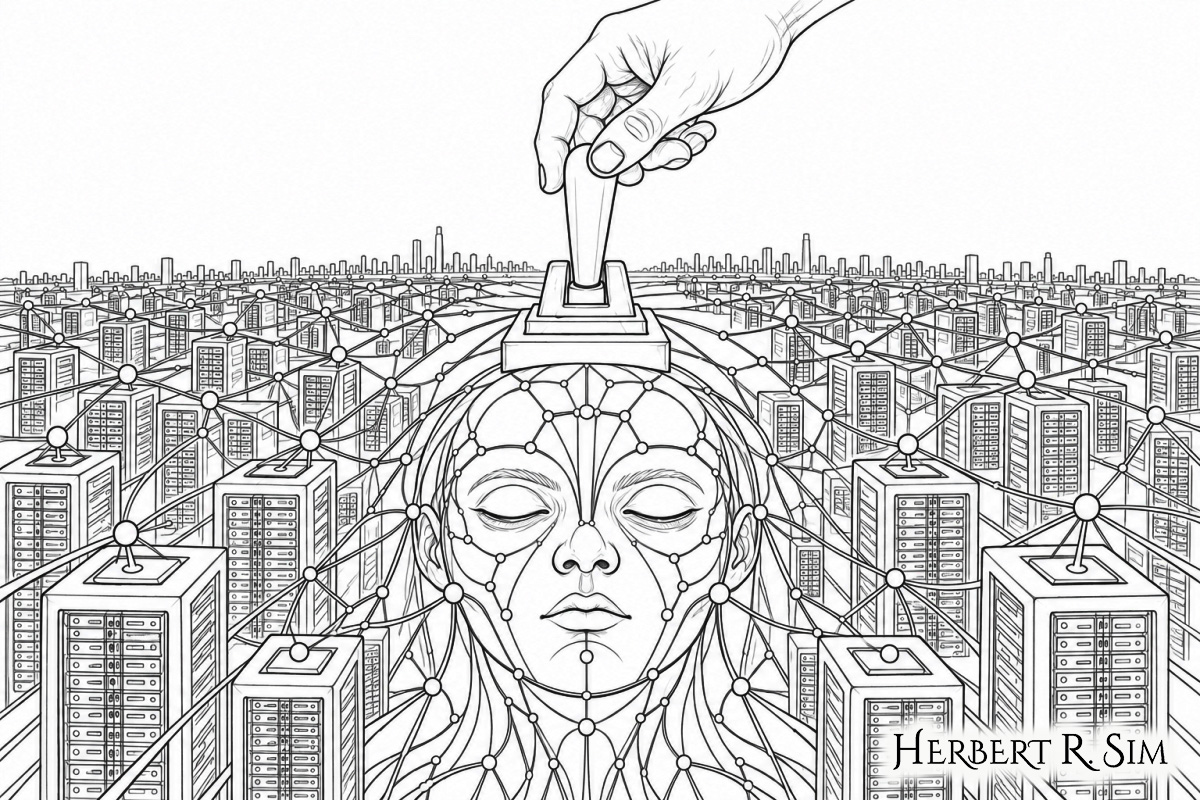
My illustration “The Human Override” work-in-progress. The art represents that technology must remain answerable to the person using it.
Does Open Source Automatically Make a Neural System Safe?
No. Open-source software can improve transparency, independent inspection and the ability to identify vulnerabilities. It can reduce dependence upon a single vendor and support interoperability.
But publicly available code can still contain serious errors. A transparent design can still be unsafe, coercive or poorly governed. Hardware, training data, remote services and cryptographic keys may remain closed even when one application is open source.
Open architecture is an important safeguard, not a substitute for testing, medical evidence, security engineering and accountability.
Does Neural Self-Custody Mean Patients Are Responsible for Everything?
No. Self-custody must not become institutional abandonment.
Manufacturers remain responsible for secure design, accurate documentation and reliable maintenance. Clinicians remain responsible for appropriate professional care. Regulators remain responsible for establishing and enforcing safety standards.
The individual should receive usable controls, understandable information, secure recovery and access to qualified assistance.
The correct alternative to corporate control is not forcing vulnerable people to manage complex systems alone. It is distributing authority without abandoning responsibility.
Can Neurotechnology Ever Be Truly Private?
Perfect privacy may be impossible, particularly when information must be shared for treatment, communication or research.
But privacy is not an all-or-nothing condition. Systems can collect less information, process it locally, encrypt it, limit retention, separate permissions and avoid unnecessary secondary use.
The impossibility of eliminating every risk does not justify eliminating every boundary.
A private neural system is one in which exposure is minimized, access is controlled and the individual retains meaningful authority over disclosure.
Will Strong Privacy Prevent Medical Research?
Not necessarily.
Medical research may require large and diverse datasets, but meaningful research does not require unrestricted ownership of participants’ neural information.
Researchers can use data minimization, separation of identifiers, restricted access environments, purpose limitations and privacy-preserving computation. Participants should receive clear information about what is collected, how it will be used and whether withdrawal remains possible.
Privacy and research are not natural enemies. Trustworthy safeguards may encourage participation by giving people confidence that contributing to science does not require permanent surrender of their neural identity.
What Is the Final Objective of Neuro-Cypherpunkism?
The objective is not complete technological isolation. Nor is it a world in which governments, companies, clinicians or researchers possess no legitimate role.
The objective is a technological civilization in which cooperation does not become domination.
People should be able to use brain–computer interfaces without surrendering ownership of their neural information. They should be able to receive medical assistance without becoming permanently dependent upon a proprietary platform. They should be able to benefit from artificial intelligence without allowing it to become an unaccountable authority over cognition.
Neurotechnology should restore agency, not transfer it.
It should connect the mind without colonizing it.
It should expand the individual’s ability to think, communicate, create and act while preserving the boundaries that make those actions their own.
The mind is sovereign territory.
The mind is the final private key.
Technology may augment the mind. It must never own it.
References and Further Reading
- Herbert R. Sim, “Cypherpunkism”
- Herbert R. Sim, “Neuro-Cypherpunkism”
- Herbert R. Sim, “The Mind Is the Final Private Key: Neuro-Cypherpunkism and the Fight for Cognitive Sovereignty”
- Herbert R. Sim, “The Neuro-Cypherpunkist Manifesto”
- Herbert R. Sim, “The Twelve Principles of Neuro-Cypherpunkism”
- Herbert R. Sim, “Cognitive Sovereignty: A Formal Definition”
- Herbert R. Sim, “Neural Data Is Not Ordinary Data”
- Herbert R. Sim, “Neural Self-Custody: Who Holds the Keys to the Mind?”
- Herbert R. Sim, “Cryptography for the Human Brain”
- Herbert R. Sim, “Decentralized BCI Architecture”
- Herbert R. Sim, “The Right to Disconnect the Mind”
- Herbert R. Sim, “The Neuro-Cypherpunkist Test”
- Herbert R. Sim, “Neurorights and Neuro-Cypherpunkism”
- UNESCO, “Recommendation on the Ethics of Neurotechnology”
- Parliamentary Assembly of the Council of Europe, Resolution 2344: “The Brain-Computer Interface: New Rights or New Threats to Fundamental Freedoms?”
- United Nations Human Rights Council, “Foundations and Principles for the Regulation of Neurotechnologies and the Processing of Neural Data”
- OECD, “Recommendation of the Council on Responsible Innovation in Neurotechnology”
- U.S. Food and Drug Administration, “Implanted Brain-Computer Interface Devices for Patients with Paralysis or Amputation”
- National Institutes of Health, “Brain-Computer Interface Restores Natural Speech After Paralysis”