

My illustration entitled: “The Encrypted Mind Vault” – A human brain rests inside a fortified digital vault, surrounded by rotating locks, biometric gates and quantum-resistant code.
Cryptography was developed to protect messages, identities, transactions and secrets. In the age of brain–computer interfaces, it must assume a more intimate responsibility: protecting the boundary between the human mind and the technological systems connected to it.
A neural interface may record electrical activity, translate intention into commands, identify neurological conditions or help a person communicate. More advanced systems may eventually stimulate neural tissue, influence perception or participate directly in cognitive processes.
These capabilities can restore human agency. They can also create forms of surveillance and control that previous privacy systems were never designed to confront.
If a password is exposed, it can be replaced. If a financial account is compromised, transactions may be disputed and credentials revoked. Neural data is different. It may contain persistent patterns associated with health, attention, emotion, identity or intention. Some of those patterns may remain useful to an observer long after the original recording was made.
The security of neurotechnology therefore cannot depend entirely upon corporate promises, legal agreements or access policies. It must be supported by technical architecture.
The closer technology moves towards the human mind, the stronger its cryptographic protections must become.
From Informational Privacy to Cognitive Security
Conventional information security usually concerns data stored in computers, transmitted across networks or processed by applications. Neural systems contain all three of these conditions, but they introduce a fourth: the information originates from, and may act upon, the nervous system of a human being.
A brain–computer interface may generate several distinct categories of information:
- Raw neural signals recorded by sensors
- Filtered or compressed neural measurements
- Features extracted from those measurements
- Model outputs interpreting intention, emotion or movement
- Commands sent to an external device
- Stimulation instructions sent towards the nervous system
- Logs describing when, where and how the system was used
- Personal profiles produced by combining neural and non-neural information
Protecting only the raw signal is insufficient. A derived prediction may be more revealing than the recording from which it was produced. A model trained upon an individual’s neural activity may preserve characteristics of that person even after the original files have been deleted. Metadata may disclose sleep schedules, treatment routines, device dependence or the frequency with which particular cognitive functions are used.
Cryptography for the human brain must therefore protect the entire neural information chain—not merely the first file created by a sensor.
What Cryptography Must Accomplish
Encryption is often treated as if it were synonymous with security. It is not. A trustworthy neural system requires several cryptographic functions operating together.
1. Confidentiality
Confidentiality prevents unauthorized parties from reading neural information. Data should be protected while stored on the device, while transmitted to another system and while retained in authorized archives.
This protection should extend beyond obvious recordings. Configuration files, model parameters, backups, diagnostic reports and synchronization records may all expose sensitive information about the user.
If neural data is uploaded to a remote service, encryption should prevent network intermediaries and unrelated infrastructure operators from accessing its contents. Where technically possible, only the user and specifically authorized recipients should possess the keys required to decrypt it.
2. Integrity
Confidential information can still be dangerous if it is altered.
An attacker who modifies a neural decoder could cause a system to misinterpret intention. A corrupted command could move a prosthetic device incorrectly. Manipulated calibration data could degrade communication. Altered stimulation parameters could create physical or psychological harm.
Cryptographic integrity protections allow a system to detect whether data, software or commands have been modified. For neurotechnology, integrity is not merely a matter of accurate records. It may be a condition of bodily safety.
3. Authentication
A neural device must be able to determine whether a command originated from an authorized person or component.
The implant should authenticate the external controller. The controller should authenticate the implant. Clinical equipment should authenticate itself before receiving privileged access. Software updates should be accepted only when their origin and integrity can be verified.
Without mutual authentication, a malicious system may impersonate a trusted device, clinician or service. In a bidirectional interface, that is not simply account fraud. It may become unauthorized access to the nervous system.
4. Authorization
Authentication answers the question, “Who is requesting access?” Authorization answers, “What is that party permitted to do?”
These permissions must be granular. A researcher authorized to receive anonymized measurements should not automatically gain access to identifying information. A technician permitted to inspect battery health should not be able to read neural recordings. A physician authorized to adjust one therapeutic setting should not receive unrestricted control over every function.
Most importantly, permission to read information from the brain must never imply permission to write information to the brain.
The neural read/write divide must be enforced in architecture, permissions and cryptographic credentials.
5. Accountability
Sensitive operations should generate tamper-evident records showing what occurred, which authorized entity initiated it and when it happened. Users should be able to inspect meaningful histories of access, export, modification and stimulation.
Accountability does not require creating a centralized surveillance ledger. Logs themselves can become sensitive. They should be minimized, protected and disclosed according to purpose. The objective is not to record everything forever, but to prevent powerful operations from becoming invisible and unchallengeable.
Encryption at Rest, in Transit and in Use
Neural information changes location and form throughout its lifecycle. Each stage creates a different security problem.
Data at rest includes information stored inside an implant, wearable, phone, computer, clinical workstation or backup system. Storage encryption can reduce the damage caused by theft, loss or unauthorized physical access.
Data in transit includes signals moving between sensors, processors, applications and remote services. These connections require authenticated encryption so that an observer cannot silently read or modify communications.
Data in use is more difficult. Information generally must be processed in some form before software or artificial intelligence can interpret it. Encryption cannot protect data if an untrustworthy application is legitimately permitted to decrypt everything.
This is why the location of computation matters. Sensitive processing should occur as close to the user as technically possible. Local processing reduces the number of parties, networks and databases exposed to neural information.
Process the mind as close to the mind as possible.
Secure hardware, isolated execution environments and privacy-preserving computation may reduce certain risks. None of them should be treated as magical solutions. Hardware can contain vulnerabilities, implementations can fail and supposedly isolated components still operate within larger systems governed by people and institutions.
The first protection remains architectural restraint: do not collect, transmit or retain neural information unless the function genuinely requires it.
The Question of the Keys
Every encrypted system eventually encounters a political question disguised as a technical one:
Who controls the keys?
A system may advertise strong encryption while giving the service provider unilateral access to every decryption key. Such encryption may protect information from outsiders while leaving the user exposed to the organization operating the platform.
Neural self-custody requires a stronger model. The individual should possess meaningful authority over the credentials governing access to neural information and device functions. This does not mean that every patient must personally administer complex cryptographic infrastructure. It means that assistance must not quietly become ownership.
A suitable key architecture could separate authority across several domains:
- A personal key governing access to the user’s neural records
- A device key authenticating the implant or wearable
- Restricted clinical credentials for specific medical functions
- Temporary research credentials limited by purpose and duration
- Separate authorization for any function capable of neural stimulation
- Recovery credentials that cannot be used as an invisible universal backdoor
No manufacturer should possess a permanent master key capable of secretly accessing every user. A master key concentrates enormous power in one target. Whether acquired through intrusion, coercion, corruption or internal abuse, its compromise could affect an entire population of connected minds.
Consent Expressed Through Cryptography
Consent is usually represented by a signature, checkbox or contractual clause. These forms may establish a legal record, but they do not necessarily constrain the technology after consent has been given.
Cryptographic authorization can make consent operational.
A permission may be limited to a named recipient, a defined category of information, a specific purpose and a finite period. It may allow analysis without permitting redistribution. It may authorize a clinician to inspect therapeutic measurements without granting access to unrelated neural activity.
Such mechanisms cannot determine whether a person was pressured or properly informed. Cryptography cannot measure human understanding. It can, however, prevent a narrow permission from silently becoming unlimited technical access.
Neural consent should therefore be:
- Specific: permission applies to a defined function or dataset.
- Granular: different capabilities require different authorization.
- Time-limited: access does not continue indefinitely by default.
- Revocable: future access can be withdrawn without destroying essential user functions.
- Verifiable: the user can determine which permissions remain active.
- Non-transferable by default: authorization granted to one party does not automatically extend to its partners, purchasers or successors.
The purpose of cryptographic consent is not to turn the relationship between a person and a medical system into a speculative marketplace of permissions. It is to make the boundaries selected by the individual technically meaningful.
Protecting the Write Path
Much discussion of neural privacy concerns information leaving the brain. Bidirectional interfaces require equal attention to information and commands moving in the opposite direction.
A system capable of stimulation, modulation or adaptive therapeutic intervention must treat the write path as a high-risk channel. Every command should be authenticated, checked for integrity and limited by safety rules that cannot be casually overridden.
High-impact operations may require multiple conditions: a valid clinical credential, a device recognized by the user’s system, a permitted treatment profile and confirmation that the command falls within established parameters.
Authorization should also be proportional. A credential that can update a display should not be able to change stimulation intensity. A cloud analytics service should not acquire write access merely because it processes diagnostic information.
Where neural technology can affect cognition or bodily function, least privilege becomes a principle of human autonomy: every component receives only the minimum power necessary to perform its legitimate role.
Secure Updates Without Permanent Dependence
Neural devices may remain in use for years. Their security cannot be frozen at the moment of manufacture. Vulnerabilities will be discovered, cryptographic practices will evolve and software will require correction.
Updates should be cryptographically signed so that devices can reject unauthorized or altered software. The update process should preserve safety if installation fails, and users should receive understandable information about material changes to functions, permissions and data practices.
Yet signed updates create another concentration of authority. If only the manufacturer can authorize software, what happens when the company fails, abandons the product or changes its terms?
A sovereign architecture requires continuity beyond the provider. This may involve escrowed maintenance authority governed by strict conditions, interoperable replacement components, documented protocols or a controlled process through which trusted alternative maintainers can assume responsibility.
The solution must preserve both security and exit. Allowing arbitrary software could endanger the user; permitting one company to control an implanted device forever could create technological captivity.
Recovery Without a Backdoor
Keys can be lost. People may become unconscious, cognitively impaired or temporarily incapable of managing access. Medical emergencies can require rapid action.
These realities do not justify a universal backdoor.
Recovery can instead distribute authority. Access might require a combination of independently held credentials—for example, the user’s recovery device, a designated representative and an authorized medical institution. Emergency access can be restricted to defined functions, expire automatically and generate a protected record visible to the user or their representative.
The governing principle should be proportionality. A mechanism designed to restore essential treatment should not unlock a lifetime of neural recordings. A credential intended for emergency stabilization should not authorize research, advertising or behavioural analysis.
Recovery must return control to the individual. It must not become the route through which control is permanently taken away.
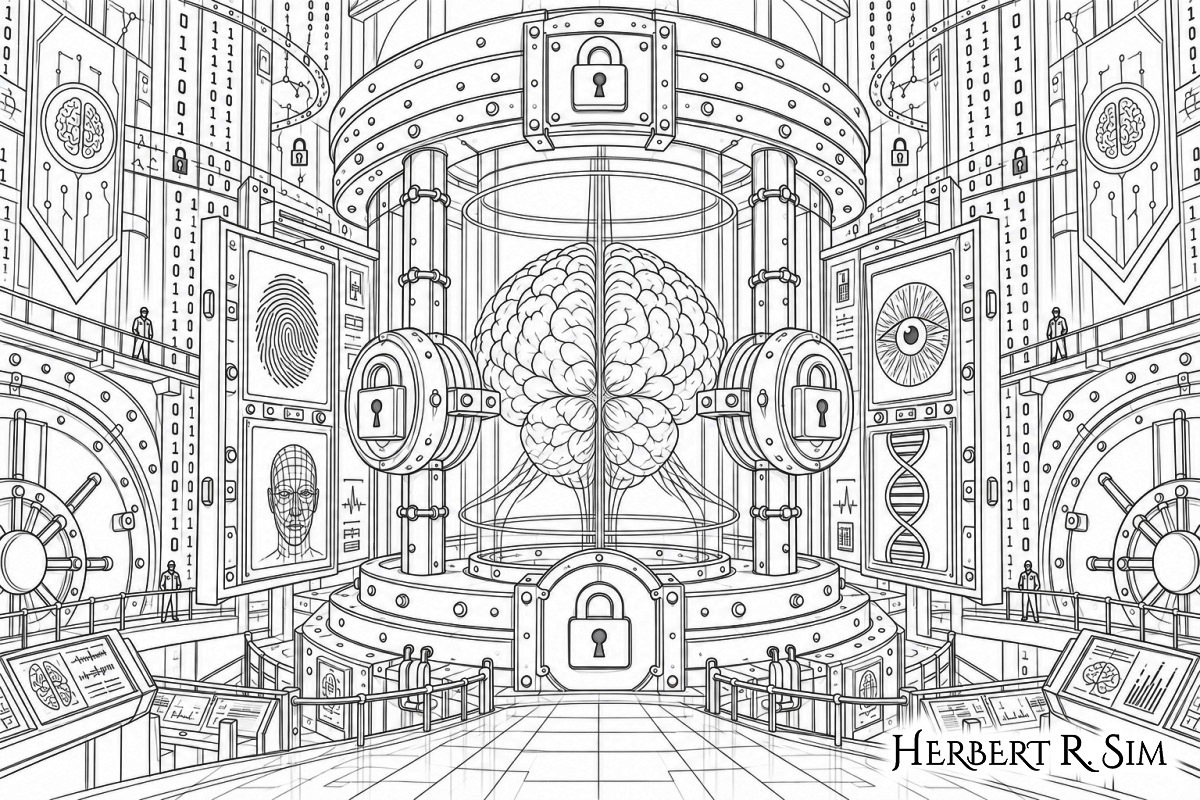
My illustration “The Memory Safe” work-in-progress. The art represents the brain as the most sensitive personal data system requiring the strongest protection.
Metadata Still Reveals Power
Even perfect encryption of neural content does not conceal every meaningful fact.
Network observers may still learn that a person uses a neural device, communicates with a neurological clinic or activates particular services at recurring times. Packet size, frequency, location and device identifiers may reveal patterns without exposing the underlying signal.
A cryptographic architecture for neural systems must therefore minimize metadata as well as protect content. Persistent identifiers should not be transmitted unnecessarily. Connections should disclose only the information required for their function. Logs should have defined retention periods. Diagnostic telemetry should be optional or narrowly limited whenever safety permits.
Privacy is weakened whenever a system protects the message but exposes the life surrounding it.
Preparing for Cryptographic Change
Implanted and medical systems may remain operational longer than many consumer devices. Their cryptography must therefore be replaceable.
In August 2024, the United States National Institute of Standards and Technology finalized its first three principal post-quantum cryptography standards. Their release demonstrated that cryptographic migration cannot be postponed until a threat has fully arrived.
Neural systems should support cryptographic agility: the ability to replace algorithms and credentials without replacing the entire device or surrendering its security. Long-lived neural archives deserve particular attention because encrypted information collected today may remain sensitive for decades.
Post-quantum readiness does not mean installing every new algorithm immediately or making medical devices unnecessarily complex. It means avoiding architectures in which obsolete cryptography becomes permanently embedded inside the human body.
What Cryptography Cannot Solve
Cryptography is essential, but it is not sufficient.
Encryption cannot make an unsafe implant biologically safe. It cannot prove that an artificial intelligence has interpreted a neural signal correctly. It cannot prevent an authorized institution from using information for an unjust purpose after legitimately receiving it. It cannot transform coercion into consent or determine which forms of cognitive intervention are morally acceptable.
Nor can cryptography protect a person from a compromised endpoint that records information before it is encrypted or after it is decrypted. Secure hardware, careful software development, independent testing, institutional accountability and enforceable rights remain necessary.
The OECD’s 2019 Recommendation on Responsible Innovation in Neurotechnology called for safeguarding personal brain data and anticipating misuse. By November 2025, UNESCO had also developed a draft international Recommendation on the Ethics of Neurotechnology for consideration by its General Conference. These efforts reflect a growing recognition that neural technology requires stronger governance.
But governance should establish the rights that architecture must enforce. A legal promise of mental privacy is fragile if the technical system continuously exports readable neural data to an operator that users cannot leave.
A Neuro-Cypherpunkist Cryptographic Standard
A neural system aligned with Neuro-Cypherpunkism should satisfy the following minimum conditions:
- Neural data is encrypted during storage and transmission.
- Raw signals and derived inferences receive protection proportionate to their sensitivity.
- Sensitive processing occurs locally whenever reasonably possible.
- The user retains meaningful authority over access credentials and permissions.
- Read access and write access use separate authorization.
- Devices mutually authenticate before exchanging neural information or commands.
- Software, firmware and configuration updates are cryptographically verified.
- Privileged actions produce protected and intelligible audit records.
- Permissions are specific, time-limited and revocable.
- Recovery mechanisms do not create an unrestricted master key.
- Cryptographic components can migrate when algorithms become obsolete.
- The device remains safe and meaningfully usable if a provider disappears.
These principles do not prescribe one universal technical design. A therapeutic implant, a non-invasive research headset and a consumer attention sensor will present different risks. The strength of protection should correspond to the intimacy of the information and the severity of the possible intervention.
What should remain universal is the direction of authority: towards the person whose mind is connected to the system.
The Mind Is the Final Private Key
The history of cryptography is the history of creating boundaries where trust alone is insufficient. It allows people to communicate without granting every intermediary access to their messages. It allows identity to be verified without surrendering every secret. It makes certain promises enforceable through architecture.
Neurotechnology brings this history to its most consequential frontier.
When computation surrounds the mind, privacy policies cannot be the only protection standing between cognition and institutional power. Neural systems must be built so that unauthorized access is difficult, unauthorized modification is detectable and legitimate authority remains limited.
Cryptography for the human brain is therefore not simply encryption applied to a new category of data. It is the construction of a technological boundary around human agency.
It protects the right to reveal without surrendering everything, to receive assistance without becoming dependent, to connect without becoming captive and to use neurotechnology without transferring ownership of the mind.
The mind is the final private key. No system should possess it on our behalf.
References and Further Reading
- Herbert R. Sim, “Cypherpunkism”
- Herbert R. Sim, “Post-Quantum Cypherpunkism”
- Herbert R. Sim, “The Mind Is the Final Private Key: Neuro-Cypherpunkism and the Fight for Cognitive Sovereignty”
- Herbert R. Sim, “From Cypherpunkism to Neuro-Cypherpunkism”
- National Institute of Standards and Technology, “Recommendation for Key Management: Part 1—General”
- National Institute of Standards and Technology, “NIST Releases First 3 Finalized Post-Quantum Encryption Standards”
- National Institute of Standards and Technology, “Secure Software Development Framework”
- U.S. Food and Drug Administration, “Cybersecurity in Medical Devices”
- OECD, “Recommendation of the Council on Responsible Innovation in Neurotechnology”
- UNESCO, “Draft Recommendation on the Ethics of Neurotechnology”
Download the Zenodo PDF
Official Publication Record
Cryptography for the Human Brain has been formally archived on Zenodo with a permanent DOI for citation, preservation and scholarly reference.
| Title | Cryptography for the Human Brain |
| Author | Herbert R. Sim |
| ORCID | 0009-0008-6500-5749 |
| Publication date | 10 November 2025 |
| Canonical webpage | https://herbertrsim.com/cryptography-for-the-human-brain/ |
| DOI | 10.5281/zenodo.22464418 |
| Zenodo record | https://zenodo.org/records/22464418 |
| Licence | Creative Commons Attribution 4.0 International Licence (CC BY 4.0) |
Preferred citation:
Sim, Herbert R. (2025). Cryptography for the Human Brain. HerbertRSim.com.
https://doi.org/10.5281/zenodo.22464418
Copyright and licence:
© 2025 Herbert R. Sim. This work is licensed under the Creative Commons Attribution 4.0 International Licence (CC BY 4.0).
Zenodo submission note:
This work was submitted to Zenodo on 6 September 2026 for permanent scholarly preservation and citation.