
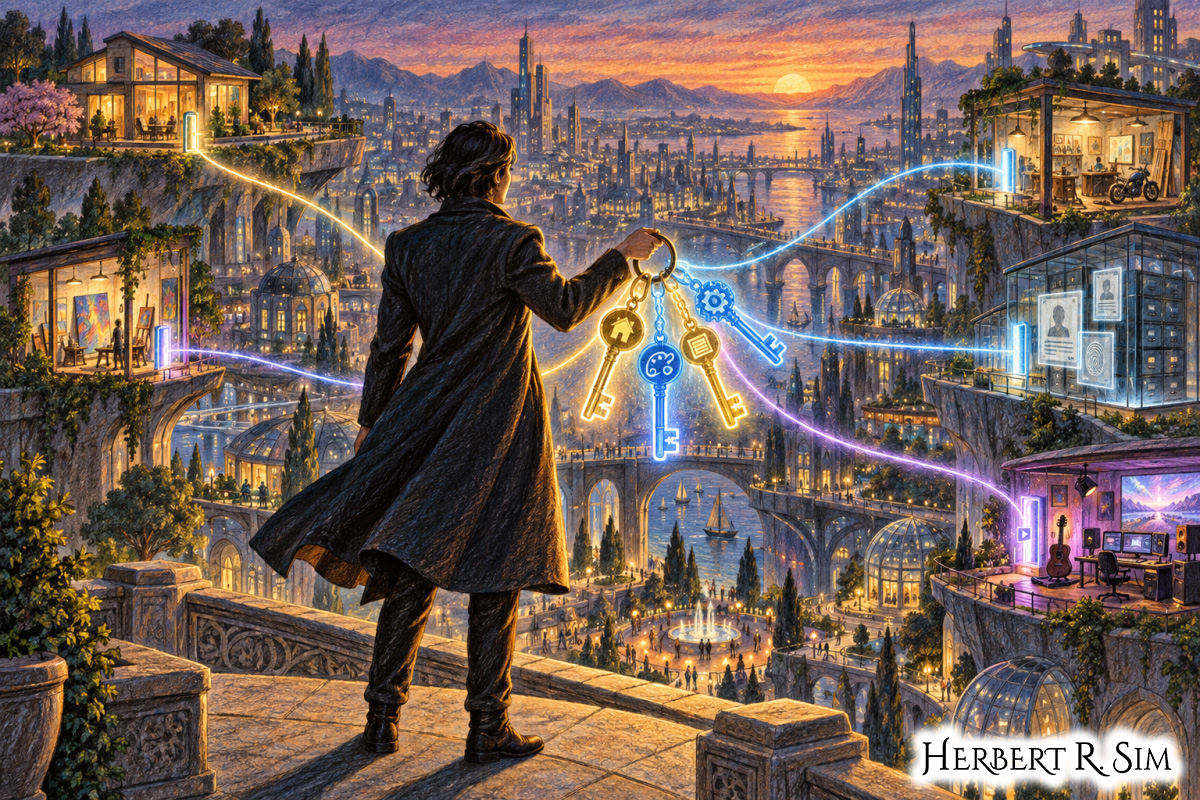
My illustration entitled: “The Digital Keyholder” – An individual holds luminous cryptographic keys that unlock personal assets across a vast digital city.
Property has always been central to economic freedom. It gives individuals the ability to preserve the results of their labour, make long-term decisions, build enterprises and maintain a degree of independence from those who control access to essential resources.
As more of life moves into digital systems, the meaning of property is changing.
Money can exist as a digital record. Work can be performed through online platforms. Creative output can be distributed globally in seconds. Identity, reputation, communications and business relationships can all become dependent on accounts maintained by institutions or platforms.
This creates a new economic question: when value exists digitally, who truly owns it?
Digital property is not simply data stored on a device. It concerns the individual’s practical ability to control, transfer, protect and benefit from legitimately acquired digital value without being reduced to a temporary user of systems controlled by others.
Ownership in the Digital Economy
In the physical world, ownership is often visible. A person can hold an object, occupy a home, use a tool or store property in a place they control. Legal systems may recognise and protect those rights, but the practical relationship between the person and the property is usually clear.
Digital property is more complex.
A person may pay for a digital asset but only receive a limited licence. They may create a large online audience but remain dependent on a platform that controls access to it. They may hold money in a digital account but lack the ability to move it without approval. They may store valuable information in a service whose terms can change without meaningful negotiation.
The individual may believe they own the value. Yet the system may treat them as a user whose access can be restricted, altered or revoked.
The difference between ownership and access is therefore becoming one of the central economic questions of the digital age.
Access Is Not the Same as Ownership
Access can be useful. Digital platforms provide convenience, reach, security and services that individuals may not be able to create alone. Many people will choose to use custodial systems because they are simple, familiar or professionally managed.
But access should not be mistaken for ownership.
Ownership requires meaningful control. It requires that the individual can make decisions about an asset, preserve it, transfer it, protect it and leave an arrangement without automatically losing what is theirs.
If a person can be excluded from their property by a policy change, a platform decision or a technical restriction they cannot challenge, their ownership is conditional. If moving to another service requires abandoning their records, relationships, value or identity, then exit has been made artificially expensive.
A digital economy that offers access without control may appear efficient, but it can leave individuals more dependent than before.
Private Keys and Direct Digital Ownership
Bitcoin introduced one of the clearest models of direct digital ownership.
Through a cryptographic private key, an individual can authorise the movement of Bitcoin without requiring a bank or central intermediary to approve the transaction. The key is not merely a password. It is the means by which authority over the asset is demonstrated on the network.
This model has an important economic implication: it allows the individual to hold digital value directly.
Bitcoin does not eliminate risk. A private key can be lost, stolen or mishandled. Self-custody requires security, discipline and knowledge. But it establishes an alternative to the assumption that digital value must always be held through a central custodian.
The principle matters beyond Bitcoin. It demonstrates that digital property can be structured around direct control, cryptographic proof and voluntary participation rather than exclusive institutional permission.
Digital Property Requires Portability
Ownership is weakened when property cannot move.
A person should be able to leave a service without automatically losing access to legitimately held value, records, work or relationships. A business should be able to change providers without surrendering its economic identity. A creator should not have to abandon years of effort simply because one platform changes its rules.
Portability makes the right to exit practical. It allows individuals to take their property, information and economic activity with them when they choose another path.
Without portability, platforms can create dependency by making departure too costly. Users remain not because a service continues to offer the best value, but because leaving would mean losing too much of what they have already built.
A free digital economy should encourage systems that allow individuals to preserve control over their assets and move between services where possible. Competition becomes more meaningful when people are not trapped by the systems they are expected to evaluate freely.

My illustration “The Digital Keyholder” work-in-progress. The art represents digital ownership as personal sovereignty: the individual holds the keys to their identity, creations, property, and economic freedom.
Identity, Reputation and Economic Capability
Digital property includes more than money.
In an increasingly connected economy, an individual’s identity, reputation, contacts, work history and creative output can all carry economic value. These resources can determine access to work, customers, credit, partnerships and opportunity.
If these forms of value are controlled entirely by platforms or institutions, the individual’s economic capability becomes vulnerable. A person may spend years building a reputation only to discover that the records of that effort are held elsewhere and subject to rules they never had the power to influence.
The issue is not whether every form of identity or reputation should be privately held without standards. The issue is whether individuals retain a meaningful role in controlling how their legitimately earned value is represented, used and transferred.
Economic sovereignty requires that people are not reduced to disposable users of systems built upon their own contributions.
Digital Property and the Right to Build
The right to build depends upon the ability to own.
An entrepreneur cannot build confidently if access to customers, payment channels, business records or digital tools can be withdrawn without fair process. A creator cannot plan for the future if the value of their work exists only within systems that may change the rules at any time. A small enterprise cannot compete effectively if its data, reputation and relationships remain locked inside the infrastructure of larger actors.
Digital property gives individuals a stronger foundation from which to build. It allows effort to accumulate into capability rather than remain permanently dependent on the approval of a gatekeeper.
This does not mean every person must manage every technical detail alone. Trusted services can remain valuable. The essential principle is that dependence should be voluntary, transparent and capable of being reconsidered.
Ownership Creates Responsibility
Direct control over digital property also creates responsibility.
Individuals must learn how to protect keys, secure accounts, understand contractual terms and distinguish genuine ownership from temporary access. They must exercise judgment when delegating custody to others and recognise that convenience always involves trade-offs.
This responsibility is not a burden to be avoided at all costs. It is part of the meaning of ownership. A person who possesses the authority to make decisions also bears responsibility for making them carefully.
The alternative is to surrender control completely and hope that every institution acting on one’s behalf will remain competent, trustworthy and accountable. Such trust may sometimes be justified, but it should remain a choice rather than the only possible arrangement.
A New Standard for Economic Freedom
Sovereign Capability Economics measures economic freedom by practical capability. Can individuals create value? Can they retain ownership? Can they understand the systems that affect them? Can they choose another path when trust is lost?
Digital property brings these questions into a new environment. It asks whether the individual possesses real control over digital value, or merely access granted by an institution. It asks whether people can move their assets and identities, or whether they are trapped inside closed systems. It asks whether technology will increase individual capability or make dependence more efficient.
The answer will shape the future of economic liberty.
Digital property is not only about possessing files, accounts or tokens. It is about preserving the individual’s right to control value, retain ownership and carry the results of one’s effort into a future that remains open to choice.
Reference: Satoshi Nakamoto, Bitcoin: A Peer-to-Peer Electronic Cash System, 31 October 2008.