
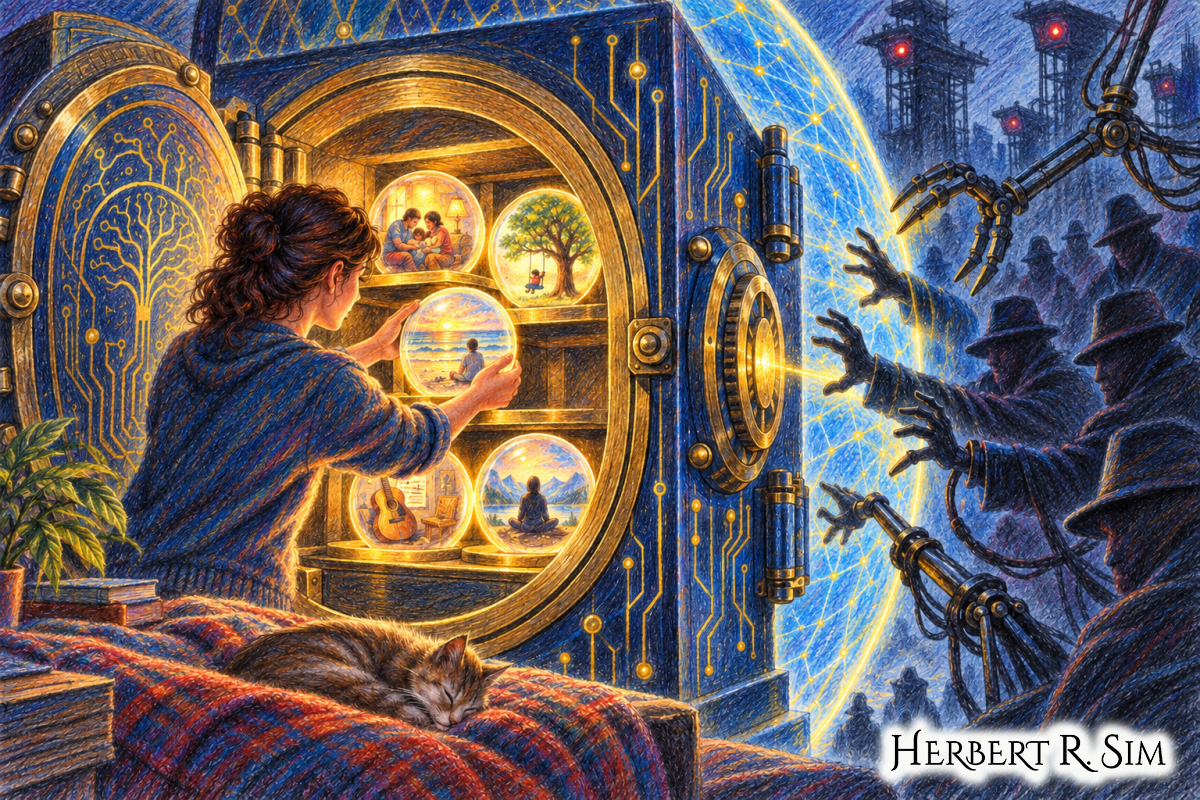
My illustration entitled: “The Memory Safe” – A person places glowing memory capsules into a secure, encrypted safe while shadowy collectors reach unsuccessfully from outside.
From Possessing Digital Keys to Protecting the Neural Interface
Self-custody became one of the defining ideas of cryptocurrency. Instead of leaving ultimate control of a digital asset with a bank, exchange or other intermediary, an individual can hold the cryptographic keys required to access and transfer it.
The principle is often summarized by a warning: if another institution controls the keys, that institution possesses the practical ability to approve, deny or redirect access.
Brain–computer interfaces bring this logic to a far more intimate domain.
A neural interface may collect brain-generated information, interpret intentions, operate assistive technologies, transmit commands to external devices or deliver stimulation toward the nervous system. Artificial intelligence may learn the user’s distinctive neural patterns and become responsible for translating those patterns into speech, movement or digital action.
Who should control the information, credentials and permissions governing that relationship?
Should the manufacturer hold the keys? Should the hospital? Should a cloud provider, government agency or artificial intelligence system possess ultimate administrative authority? Or should the person whose nervous system generates the information remain the principal holder of control?
Neuro-Cypherpunkism answers that the individual must retain meaningful technical authority over the neural interface.
I call this principle neural self-custody.
A Formal Definition of Neural Self-Custody
Neural Self-Custody is the condition in which an individual retains meaningful and enforceable authority over access to neural information, the credentials governing that access and the operation of technologies connected to his or her nervous system.
It includes the practical ability to control collection, storage, processing, interpretation, transmission, permissions, activation, modification and disconnection—while allowing narrowly defined assistance, clinical supervision and recovery arrangements that remain subordinate to the individual’s cognitive sovereignty.
Neural self-custody does not require a person to manage every technical component without assistance. It does not mean that clinicians can never configure medical devices or that manufacturers can never issue security updates. It does not require every individual to understand advanced neuroscience, artificial intelligence or cryptographic key management.
The principle concerns where ultimate authority resides.
A sovereign individual may delegate specific authority to a doctor, caregiver, technician or trusted service. But delegation must be limited, visible and revocable. The person receiving assistance must not become the permanent property of the institution providing it.
The Keys Are Both Literal and Metaphorical
In cryptocurrency, the key is literal: cryptographic material authorizes control over an asset. In neurotechnology, “the keys to the mind” describes a wider set of technical powers.
Some of these powers may be governed by cryptographic keys. Others may exist as administrator credentials, software permissions, device settings, model access, update authority or physical controls.
The relevant keys may include:
- encryption keys protecting stored neural information;
- authentication credentials permitting access to a neural device;
- signing keys used to verify legitimate software and firmware updates;
- permissions determining which applications may receive neural outputs;
- controls separating neural read functions from neural write functions;
- credentials authorizing clinicians or caregivers to perform limited operations;
- recovery mechanisms used when ordinary access is lost;
- physical controls governing activation and disconnection;
- access to learned neural profiles and personalized AI models; and
- administrative authority over continued device operation.
The neural self-custody question is therefore not answered merely by giving the user a password. A person may possess a login while the manufacturer retains a hidden master credential, remote shutdown capability or exclusive control over the AI model required to interpret the person’s neural activity.
Possession of an interface is not sovereignty if someone else retains unquestionable authority over its operation.
What Must Be Self-Custodied?
A complete model of neural self-custody must protect several interconnected layers. Control over one layer cannot compensate for total dependence at another.
1. Neural Information
The individual must retain authority over raw signals, processed neural information, cognitive inferences, neural metadata and learned profiles produced through interaction with the device.
As argued in Neural Data Is Not Ordinary Data, brain-generated information may be produced without deliberate expression, become more revealing through artificial intelligence and remain valuable for analysis long after its original collection.
Self-custody requires more than access to a downloadable archive. The individual should be able to determine what is collected, what leaves the device, what is retained and which parties may process it.
2. Neural Identity
A brain–computer interface may learn the distinctive neurological patterns through which a particular user communicates or controls technology. Over time, that learned profile may become part of the person’s functional digital identity.
If the manufacturer exclusively controls this profile, changing providers may require the individual to begin again. For a person using a BCI to communicate, losing the learned model could mean losing years of calibration and adaptation.
Neural self-custody therefore includes access to portable representations of the user’s calibration, settings and learned patterns wherever safe and technically feasible.
3. Device Operation
The individual must retain meaningful control over whether the device is active, which functions are enabled and which external systems may connect.
A device should provide clear indications when it is recording, transmitting or stimulating. Non-essential connectivity should be capable of being disabled. Critical assistive functions should continue operating locally wherever practical, even when an internet connection or commercial cloud service becomes unavailable.
4. Application Permissions
An application should receive only the minimum neural output necessary for its function. A game may need to know that the user selected an action. It does not necessarily require continuous access to the raw signals from which that command was inferred.
Permissions should distinguish between data types, purposes, duration and direction. Authorization to read a limited motor command must not become permission to analyse emotion, store raw neural information or transmit stimulation.
5. Neural Write Authority
Any capability to stimulate or otherwise influence the nervous system requires exceptional control. Neural write access should remain separate from neural read access and should require independent authorization.
A compromised media application must not be able to inherit stimulation privileges. A clinician authorized to adjust one therapeutic parameter should not automatically receive unrestricted control over every device function.
6. Software and Firmware Updates
Updates are necessary for repairing vulnerabilities and maintaining safety. They can also change what a device collects, which permissions it requires and whether previously available functions remain accessible.
Neural self-custody does not mean that every user must manually approve each technical patch. It requires authenticated updates, transparent changes and limits on the manufacturer’s ability to alter fundamental rights through software.
An update should not quietly activate new neural-data collection or expand remote access. Security maintenance must not become a mechanism for transferring sovereignty back to the vendor.
7. Artificial-Intelligence Models
The AI model interpreting neural activity may become as important as the sensor itself. It determines how biological signals are translated into intended words, movements or commands.
The user should know which model performs this interpretation, where it operates and what information it retains. Where practical, personalized models should be exportable or capable of operating locally. If a model is replaced, the individual should be informed when the change could materially affect accuracy or behaviour.
Control over neural data without control over the model interpreting it is incomplete self-custody.
Local First, Cloud When Justified
Cloud processing can provide powerful computation, remote clinical support and continuous improvement. It may be necessary for some medical, research or consumer applications.
But a cloud-first architecture transfers significant authority away from the user. Raw neural information leaves the individual’s device, remote servers perform the analysis and continued functionality may depend upon an external provider.
Neural self-custody therefore favours local processing wherever technically practical. The device should interpret sensitive signals within a trusted environment controlled by the user and transmit only the limited output required by an external service.
A prosthetic arm may require a movement command, not the complete neurological recording that produced it. A communication application may need a selected word, not every uncertain alternative considered by the decoding model. An entertainment system may need a deliberate instruction, not a permanent profile of the user’s attention and emotional responses.
This does not mean that all cloud processing is illegitimate. It means external processing must justify itself according to necessity, capability, security and informed permission.
The presumption should be: process the mind as close to the mind as possible.
Self-Custody Must Not Become Abandonment
The cryptocurrency model of self-custody contains a serious warning. Direct control can protect a person from institutional censorship or insolvency, but it can also impose unforgiving responsibility. A lost private key may result in irreversible loss.
That outcome is unacceptable when the protected system may be necessary for speech, movement or medical treatment.
Neural self-custody must not mean handing a patient one secret credential and abandoning him to permanent consequences if it is lost. Sovereignty requires control, but usable sovereignty also requires safe recovery, comprehensible interfaces and appropriate assistance.
The correct objective is not maximum individual burden. It is minimum unnecessary institutional power.
A well-designed system may offer several custody arrangements:
- individual custody for users capable of managing their own credentials;
- shared custody between the individual and trusted guardians;
- clinically supervised custody for essential medical functions;
- time-limited emergency authority under defined conditions;
- hardware-based recovery mechanisms controlled by the user; and
- institutional assistance that cannot independently override the individual outside legitimate safety procedures.
Choice among these arrangements should reflect the user’s circumstances, capacity and level of dependency. No single custody model will suit every person or every device.
Recovery Without a Hidden Master Key
Every custody system must answer a difficult question: what happens when access credentials are lost, the user becomes incapacitated or the device fails?
The easiest institutional answer is a universal recovery key held by the manufacturer. But a master key capable of accessing every device can become a master vulnerability. Criminals may steal it, governments may compel its use and insiders may abuse it.
Recovery should instead distribute authority wherever practical. A threshold arrangement might require approval from a combination of the user, a trusted relative, a clinician and a recovery device. No single party would possess unilateral control.
Different functions may require different recovery rules. Restoring access to archived neural data is not the same as authorizing stimulation. A caregiver assisting with communication settings should not automatically receive access to raw neural recordings.
Recovery events should be logged, visible and capable of independent audit. The individual should be notified whenever possible, and temporary access should expire after its legitimate purpose has ended.
A recovery system must restore the individual’s authority rather than permanently transfer it elsewhere.
Emergency Access and the Problem of Safety
Medical devices sometimes require emergency intervention. A clinician may need to disable malfunctioning stimulation, restore an essential function or respond when the user cannot provide immediate authorization.
Neuro-Cypherpunkism does not reject legitimate emergency authority. It requires that such authority remain narrow, proportionate and accountable.
Emergency access should be limited to functions necessary to prevent serious harm. It should not provide unrestricted access to historical neural information or unrelated applications. The system should record who used the emergency capability, when it was used, what functions were accessed and why intervention was necessary.
Where practical, emergency authority should require multiple forms of authentication or confirmation by more than one responsible party. Once the emergency ends, ordinary control should return to the individual.
Safety and sovereignty are not opposites. A safe system must protect the person both from device failure and from misuse of the powers created to respond to that failure.
Delegation Is Not Surrender
Many individuals will choose to delegate aspects of neural-device management. A patient may trust a neurologist to adjust therapeutic settings. A person with limited mobility may authorize a caregiver to assist with maintenance. A user may permit a specialist to monitor specific indicators for a limited period.
These arrangements are compatible with neural self-custody when authority remains purpose-bound.
A valid delegation should identify:
- the person or institution receiving authority;
- the precise functions that may be performed;
- the information that may be accessed;
- whether access includes neural read or neural write capabilities;
- the duration of the authorization;
- the circumstances under which it may be exercised;
- the records that must be maintained; and
- how the individual can revoke or modify the delegation.
A hospital authorized to manage a therapeutic function does not acquire ownership of the patient’s neural identity. A caregiver permitted to assist with access does not receive unrestricted rights over the user’s private information.
Sovereignty includes the freedom to trust. It does not require trust to become unconditional.
The Right to Change Providers
Self-custody becomes meaningless if leaving a provider requires abandoning the person’s information, learned neural profile or essential capabilities.
A brain–computer interface may require months or years of calibration. The system may learn how one user produces particular motor or speech-related patterns. This accumulated model can become essential to accurate operation.
If the provider alone controls that model, it gains substantial leverage. It may increase prices, alter terms, discontinue features or require new forms of data collection. The user may formally possess the right to leave while facing the loss of a capability integrated into daily life.
Neural self-custody therefore requires portability and interoperability wherever technically possible. Users should be able to export essential settings, permission histories, clinical records and suitably protected learned profiles in documented formats.
Safety testing may be required before information is transferred to another device. Compatibility cannot always be guaranteed. But technical difficulty must not become a permanent excuse for avoidable lock-in.
No person should become a captive customer because the product has become part of how he communicates with the world.
What Happens When the Company Disappears?
Technology companies fail, merge, change strategy and discontinue products. For an ordinary application, service closure may be inconvenient. For a neural interface supporting communication or movement, abandonment could be catastrophic.
Manufacturers should plan for continuity before users become dependent upon their systems. Essential documentation, software, cryptographic materials and maintenance procedures may need protected escrow arrangements that activate if the company can no longer provide support.
Core device functions should not depend unnecessarily upon continuous communication with corporate servers. Where remote services are essential, users should be told what will happen if connectivity ends or the provider ceases operating.
Acquisition and bankruptcy should not automatically transfer unrestricted control over neural information to a new commercial owner. The user’s original permissions and privacy protections must continue to apply.
A company may own its business. It must not own the continued functioning of another person’s nervous system without responsibility for continuity and exit.
 <
<
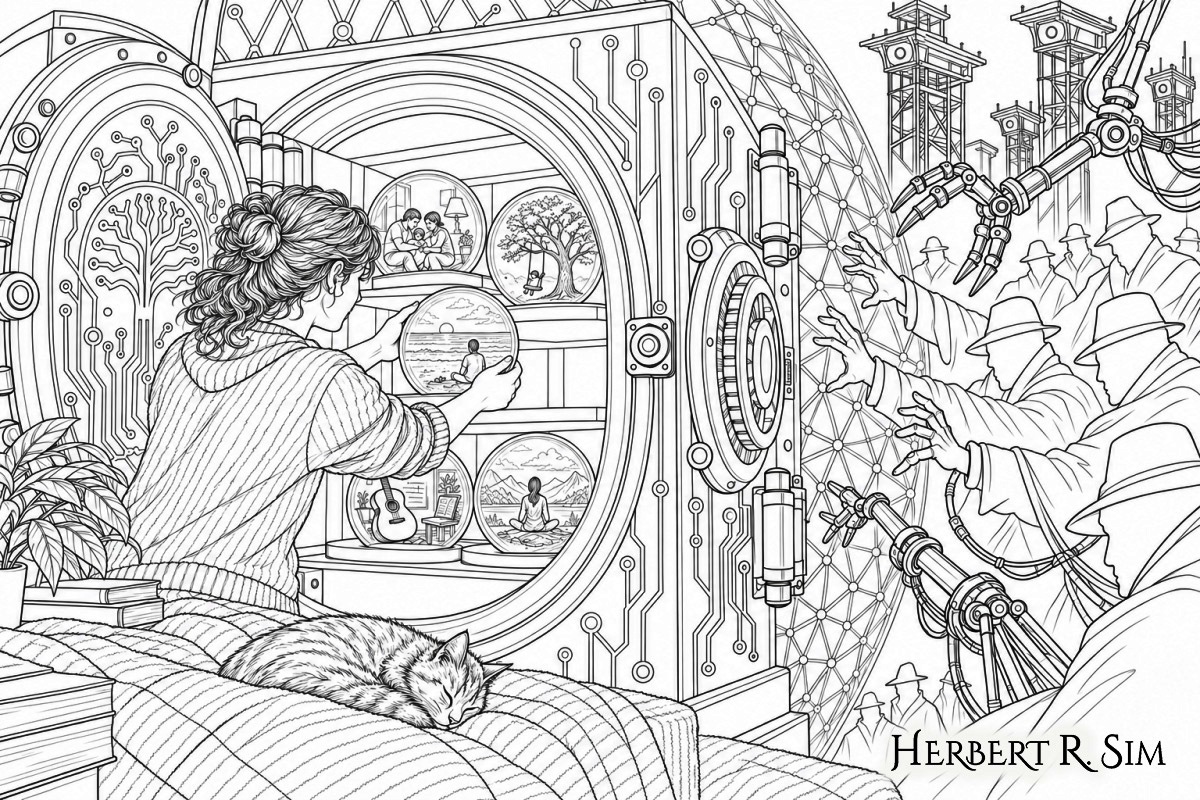
My illustration “The Memory Safe” work-in-progress. The art represents protecting memories, emotions and experiences from extraction or sale.
Neural Self-Custody and Artificial Intelligence
Artificial intelligence adds a new form of custody: control over interpretation.
A user may locally possess raw neural data while a remote AI provider exclusively controls the model required to make that data useful. The provider may determine which signals are recognized, how uncertainty is handled and whether the person’s intended command is accepted.
This creates interpretive dependence. The institution controlling the model may possess practical authority even if it never takes formal ownership of the data.
Neural self-custody therefore requires meaningful authority over personalized AI models and their outputs. The user should be able to know when the model changes, inspect important permissions, correct repeated errors and obtain alternative interpretation where feasible.
A model should not retain hidden memories or use neural information to train unrelated systems without a specific and legitimate basis. The individual’s learned neural profile should not silently become corporate intellectual property that the individual cannot access or move.
Artificial intelligence may interpret the signal. It must not become the unquestionable owner of what the signal means.
Neural Self-Custody Is More Than Data Ownership
Data ownership alone cannot adequately protect the neural interface. A person may legally own a copy of his information while lacking control over collection, interpretation, stimulation or device operation.
Property can also be permanently sold. If cognitive sovereignty were treated only as a property right, a person might theoretically sign away all future authority over his neural activity through an ordinary commercial contract.
Neural self-custody is instead rooted in personhood. The individual retains a continuing legitimate interest in information and systems connected to his nervous system, even after granting limited access to others.
A user may authorize a researcher to analyse neural information without granting the right to identify him publicly. He may authorize a clinician to adjust treatment without allowing the manufacturer to use the information for advertising. He may permit temporary cloud processing without surrendering permanent control over his learned profile.
Sharing creates permission. It does not automatically extinguish sovereignty.
A Practical Architecture for Neural Self-Custody
A neural system designed around self-custody should incorporate several architectural protections.
Local Control
Essential permissions and core functions should remain available through hardware controlled by the user. Remote infrastructure should enhance the device rather than possess unnecessary authority over it.
Data Minimization
The device should collect only the signals necessary for the chosen function. Applications should receive limited outputs instead of unrestricted raw data wherever practical.
End-to-End Security
Sensitive neural information should be encrypted during storage and transmission. Commands, software updates and connected components should be authenticated.
Separated Permissions
Reading, analysing, exporting and writing to the nervous system should require distinct permissions. Authority over one operation must not silently include the others.
Visible Operation
Users should be able to determine when sensing, transmission or stimulation is active. Hidden background access is incompatible with meaningful control.
Revocable Delegation
Clinical, caregiver and application access should be limited by function and duration. Expired or withdrawn authority should cease to work technically.
Distributed Recovery
Recovery should avoid a universal master key. Threshold arrangements, trusted guardians and hardware recovery mechanisms can distribute authority.
Portability
Records, settings and learned profiles should be exportable in documented formats wherever safety permits. Provider dependence should not become permanent captivity.
Offline Continuity
Essential medical and assistive functions should continue safely during network failure or provider outage whenever technically possible.
Auditability
The individual should be able to review who accessed the system, what operation occurred and whether an emergency or administrative privilege was used.
The Responsibilities of the Individual
Self-custody gives the individual power, but power creates responsibility.
Users must protect credentials, maintain recovery arrangements and apply important security updates. They must understand that refusing every update may expose both the device and connected systems to avoidable danger.
Individuals must also respect the sovereignty of others. Control over one’s own neural interface does not create a right to access another person’s neural information, manipulate connected devices or distribute sensitive recordings without consent.
Manufacturers should make these responsibilities realistically manageable. Security cannot depend upon every user becoming a cryptographer. Interfaces must explain consequences clearly, prevent common errors and provide safe defaults.
The user has a responsibility to exercise control carefully. The designer has a responsibility to make careful control possible.
When Is Neural Self-Custody Meaningful?
A neural device can be evaluated by asking:
- Can the individual determine what neural information is collected?
- Can unnecessary collection be disabled?
- Is sensitive processing performed locally where practical?
- Who controls the cryptographic and administrative credentials?
- Does the manufacturer retain hidden or universal access?
- Are neural read and write permissions separated?
- Can the user see which applications and institutions have access?
- Can permissions be withdrawn effectively?
- Can trusted clinicians or caregivers receive limited authority without obtaining total control?
- Can lost access be recovered without giving one external party a permanent master key?
- Can essential functions operate during a network or provider failure?
- Can the user export records, settings and learned neural profiles?
- Can the individual change providers without losing essential capabilities?
- Can important algorithmic interpretations be corrected or contested?
- Can the device be disconnected or refused without unjust exclusion from ordinary life?
A system does not need to provide absolute individual control over every safety-critical operation. But any limitation must be necessary, proportionate and transparent.
If an institution retains power that the individual cannot inspect, limit, contest or escape, self-custody has not yet been achieved.
Who Holds the Keys?
Cognitive Sovereignty establishes that the individual should retain ultimate legitimate authority over cognition, mental integrity, neural information and technologies interfacing with the nervous system.
Neural self-custody is how that authority becomes technically meaningful.
The keys may be distributed among the individual, device, clinician, caregiver and recovery system. Some functions may require shared authority. Medical emergencies may justify limited intervention. Complex technologies will require support.
But the architecture must remain directed toward the sovereignty of the person.
The hospital may assist.
The manufacturer may maintain.
The artificial intelligence may interpret.
The caregiver may help recover.
The regulator may protect.
None should become the unrestricted owner of the connection.
The Neuro-Cypherpunkist Manifesto declares that the human mind is sovereign territory. If that declaration is to become more than an aspiration, the individual must possess practical authority over the technological gates leading toward it.
Neural self-custody does not mean standing alone.
It means receiving assistance without becoming property.
It means trusting others without surrendering every safeguard.
It means connecting without becoming captive.
Whoever controls the keys controls the interface.
Whoever controls the interface possesses power over the person.
The individual must remain sovereign.
The mind is the final private key.
References and Further Reading
- Herbert R. Sim, “The Mind Is the Final Private Key: Neuro-Cypherpunkism and the Fight for Cognitive Sovereignty,” 22 March 2025
- Herbert R. Sim, “From Cypherpunkism to Neuro-Cypherpunkism,” 22 April 2025
- Herbert R. Sim, “The Neuro-Cypherpunkist Manifesto,” 15 May 2025
- Herbert R. Sim, “The Twelve Principles of Neuro-Cypherpunkism,” 16 June 2025
- Herbert R. Sim, “Cognitive Sovereignty: A Formal Definition,” 21 August 2025
- Herbert R. Sim, “Neural Data Is Not Ordinary Data,” 19 September 2025
- Herbert R. Sim, “Digital Sovereignty: A Formal Definition,” 2013
- Herbert R. Sim, “Human-Sovereignty Transhumanism,” 2014
- National Institute of Standards and Technology, “Recommendation for Key Management: Part 1—General,” 2020
- U.S. Food and Drug Administration, “Implanted Brain-Computer Interface Devices for Patients with Paralysis or Amputation,” 2021
- U.S. Food and Drug Administration, “Cybersecurity in Medical Devices,” 2025
- Ivan Martinovic et al., “On the Feasibility of Side-Channel Attacks with Brain-Computer Interfaces,” USENIX Security Symposium, 2012
- Tamara Bonaci, Ryan Calo and Howard J. Chizeck, “App Stores for the Brain: Privacy and Security in Brain-Computer Interfaces,” 2014
- Marcello Ienca and Pim Haselager, “Hacking the Brain: Brain–Computer Interfacing Technology and the Ethics of Neurosecurity,” 2016
- OECD, “Recommendation on Responsible Innovation in Neurotechnology,” 2019
- OECD, “Neurotechnology Toolkit,” July 2025
- UNESCO, “Draft Text of the Recommendation on the Ethics of Neurotechnology,” April 2025
Download the Zenodo PDF
Official Publication Record
Neural Self-Custody: Who Holds the Keys to the Mind? has been formally archived on Zenodo with a permanent DOI for citation, preservation and scholarly reference.
| Title | Neural Self-Custody: Who Holds the Keys to the Mind? |
| Author | Herbert R. Sim |
| ORCID | 0009-0008-6500-5749 |
| Publication date | 12 October 2025 |
| Canonical webpage | https://herbertrsim.com/neural-self-custody/ |
| DOI | 10.5281/zenodo.22469790 |
| Zenodo record | https://zenodo.org/records/22469790 |
| Licence | Creative Commons Attribution 4.0 International Licence (CC BY 4.0) |
Preferred citation:
Sim, Herbert R. (2025). Neural Self-Custody: Who Holds the Keys to the Mind?. HerbertRSim.com.
https://doi.org/10.5281/zenodo.22469790
Copyright and licence:
© 2025 Herbert R. Sim. This work is licensed under the Creative Commons Attribution 4.0 International Licence (CC BY 4.0).
Zenodo submission note:
This work was submitted to Zenodo on 6 September 2026 for permanent scholarly preservation and citation.