
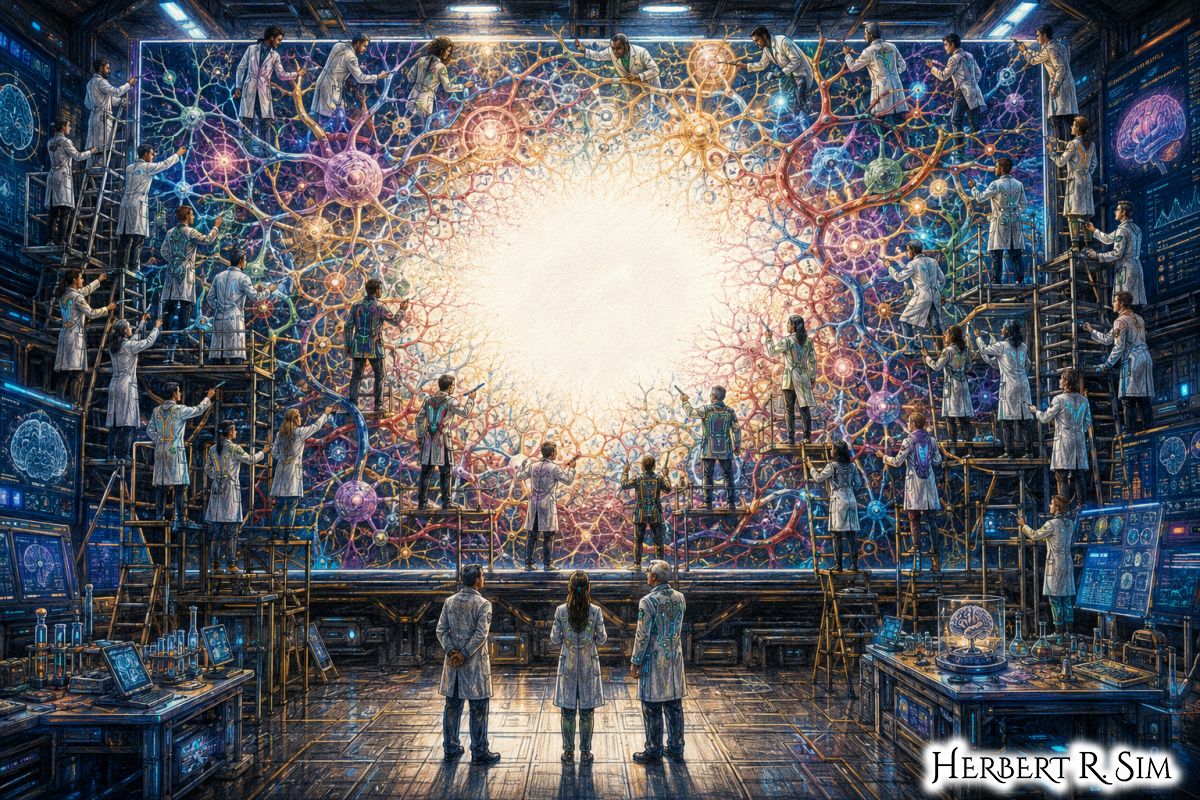
In my illustration above, I feature “The Unfinished Portrait of Consciousness” where scientists collectively draw on an interactive giant computer screen of the human mind. They complete neurons, blood vessels and electrical activity in extraordinary detail, but the centre of the canvas – representing consciousness – remains completely blank.
The most important frontier of the twenty-first century may be the three pounds of living tissue inside the human skull.
Earlier this year, the United States announced the BRAIN Initiative – Brain Research through Advancing Innovative Neurotechnologies – an attempt to observe how neural circuits operate. Its proposed “brain activity map” is not merely an anatomical atlas. The ambition is to follow signals through networks of cells and discover how electrical activity becomes perception, memory, emotion and action.
President Barack Obama has proposed approximately $100 million for the programme’s first year. Its stated purpose is medical: to illuminate neurological disorders and obtain a dynamic picture of the brain in action. Yet every technology capable of healing the mind may also be capable of monitoring, influencing or weaponising it.
Supporters believe neuroscience is ready for a coordinated effort on the scale of the Human Genome Project. Critics fear that money and publicity may precede clearly defined objectives. The involvement of the National Institutes of Health, National Science Foundation and the Pentagon’s Defense Advanced Research Projects Agency also gives the project both civilian and strategic dimensions.
The question is who will control the resulting knowledge – and whether it will liberate the individual or make the individual transparent to power.
A Map Is Not Yet a Mind
In August, I considered this problem in Artificial Intelligence and the Brain: Can Machines Think? A computer may imitate aspects of neural organisation, but modelling the brain’s operations does not necessarily explain consciousness itself.
Recording activity is not the same as understanding it. The Human Connectome Project has shown how easily researchers can accumulate immense quantities of information while struggling to explain the patterns. A map may show that two regions communicate, but not how consciousness emerges.
A sufficiently detailed brain map would also revive a question I raised in 2005: is consciousness copy-pasteable? Even if scientists reproduced every neural connection, memory and behavioural pattern, they would still need to determine whether they had preserved a person – or merely constructed an imitation.
Technically, the challenge is enormous. Functional magnetic resonance imaging observes broad changes in blood flow, while electrodes near individual neurons obtain precise electrical signals. What remains difficult is the territory between those extremes: observing huge populations of cells rapidly, accurately and preferably without opening the skull.
Unlike a genome, a brain changes as it learns, ages and encounters new experiences. Commentators have noted that the initiative was announced before its goals, timetables and cost estimates were settled, while independent laboratories already face funding pressure.
Large programmes can create standards and instruments too costly for one university. But technology must follow sound concepts. A detailed image of neural activity could still leave unanswered the ancient question of how matter produces mind. Critics have warned that neuroscience cannot be reduced to circuitry alone while ignoring changing biological organisation and the influence of glial cells.
Seeing the Invisible Brain
The tools emerging in 2013 are extraordinary. Stanford researchers have introduced CLARITY, a method that replaces opaque fats in preserved tissue with a transparent hydrogel. Scientists can examine molecular labels and long-range connections without cutting the brain into thousands of slices.
Nanotechnology may go further. Researchers are considering nanoscale wires, particles and sensors capable of detecting electrical or chemical changes near individual neurons, filling the observational gap between one cell and the averaged activity of millions.
The BigBrain project has produced a three-dimensional digital atlas from more than 7,400 thin sections of a preserved human brain. Its resolution approaches the cellular scale and may assist research into anatomy, disease and surgical targeting.
More speculative proposals imagine “neural dust”: tiny implanted sensors distributed through the brain to monitor activity and transmit data. Citizens are also joining the mapping effort. The online game EyeWire asks players to trace retinal neurons, turning reconstruction into a crowdsourced puzzle that had attracted more than 70,000 participants by August.
The BRAIN Initiative is therefore not one map, but a technological platform for reading the nervous system.
Freedom from the Prison of the Body
I explored this possibility as early as 2009 in Mind Over Matter: The Emergence of Mind-Controlled Technology, examining how EEG systems, BrainGate and brain-controlled prosthetics could translate intention into mechanical action.
The strongest moral argument is found among people who have lost movement.
In 2012, a woman paralysed by a brain-stem stroke used an implanted BrainGate sensor to control a robotic arm and lift coffee to her mouth – the first time she had served herself a drink in approximately fifteen years. An intention trapped inside the brain had crossed into the physical world.
Neural interfaces are also beginning to restore sensation. Experimental prosthetics have connected directly to nerves, allowing users to control artificial limbs while receiving tactile feedback. Researchers have also demonstrated brain-controlled robotic leg braces, creating an early foundation for systems that might help paralysed people walk.
This is the liberation of thought from an unresponsive body. The same principles could help people communicate, control wheelchairs or guide artificial limbs. But once a machine can translate intention into command, the channel does not have to remain one-way.
From Brain–Machine to Brain–Brain
In August, University of Washington researchers reported what they described as the first human brain-to-brain interface. One researcher’s electroencephalographic signal travelled through the internet and activated magnetic stimulation over another researcher’s motor cortex, causing the recipient’s finger to press a key. No sentence or memory was transferred. Yet one nervous system had triggered an action in another.
Experiments involving rats have gone further in one respect. Animals in separate locations, including laboratories on different continents, were linked so that neural signals from one rat could help another perform a simple task. Researchers described the possibility of connected brains sharing information.
The capabilities are crude, but the direction is profound. Communication has always depended on external symbols. Brain interfaces suggest that certain signals may someday bypass those symbols. For medicine, this may permit communication without movement. For society, what happens when a neural command enters the brain without conscious interpretation?
My illustration work-in-progress above.
The Brain as a Military Domain
Earlier this year, in Military Transhumanism: Super-Soldiers and Ethical Red Lines, I examined how brain–computer interfaces could move beyond therapeutic medicine into military communication, cognitive enhancement and the creation of integrated human-machine soldiers.
Defence agencies will not ignore technologies that can improve attention, accelerate reaction, control machines or disrupt cognition. Commentators have described the brain as a new domain of warfare, where brain–computer interfaces might eventually shape or coerce behaviour.
The danger is unlikely to arrive as a dramatic mind-control ray. It will come gradually and under respectable purposes. A soldier may accept monitoring to detect fatigue. An employee may wear a neural sensor for safety. A prisoner may be offered stimulation as rehabilitation. Each may appear voluntary while collectively normalising access to the brain.
Europe’s Human Brain Project officially began this month, combining neuroscience, computing, medical informatics, robotics and simulation across multiple platforms. Its leaders seek to integrate fragmented knowledge into a computational model and have received approximately €1 billion in European support, prompting talk of an international “brain race”. Competition may accelerate discovery while turning neural capability into strategic infrastructure.
The Last Private Territory
As I warned in my earlier examination of mind-controlled technology, the ability to interpret neural signals could produce not only medical liberation but also surveillance, privacy violations and the manipulation of human behaviour.
Present-day scanners are not mind readers. Public discussion often exaggerates modest correlations and turns colourful brain images into claims about morality, politics or personality. Newspapers have repeatedly stretched findings beyond what experiments establish. Critics also warn that grand brain projects could divert resources from smaller, hypothesis-driven laboratories.
Still, primitive decoding is already possible. Japanese researchers have used scans taken before waking subjects to predict broad categories appearing in their dreams, such as whether a person or object was present. This is far from recording a dream, but private mental content leaves patterns machines may learn to classify.
As accuracy improves, neural data could become more sensitive than fingerprints or DNA. A fingerprint identifies the body. Brain data may reveal pain, attention, fear, recognition, preference or intention. Employers could seek it. Insurers could price it. Courts could demand it. Governments could interpret refusal as suspicion.
Neuroscience is challenging legal ideas about free will and responsibility, with brain abnormalities entering arguments about criminal behaviour and punishment. Future courts may ask what neural pattern preceded an act, producing humane treatment for disorders – or reducing people to biological probabilities.
Freedom Requires Cognitive Liberty
As I argued in Without Equality, Human Enhancement Will Create a New Caste System, technologies designed to overcome biological limitations could create a new hierarchy between the augmented and the unaugmented. Neural enhancement may produce the same division – except that the advantage would be written directly into cognition.
The answer is not to stop brain research. Refusing knowledge merely surrenders discovery to institutions without public scrutiny. The answer is to establish cognitive liberty before neural technology becomes commonplace.
Every person should retain ownership of his or her neural data. Consent to record the brain must be informed, specific and revocable. Medical data must not quietly become employment, insurance, policing or advertising data. Devices capable of stimulating the nervous system should be independently audited, especially when used by militaries, schools, prisons or employers. No citizen should surrender mental privacy in exchange for education, work, healthcare or participation in society.
We must distinguish assistance from alteration. Restoring a paralysed person’s movement is not morally identical to modifying a healthy person’s judgement, loyalty or emotional state. Yet the same interface may eventually perform both functions. The line between therapy, enhancement and control will not be drawn by the machine. It will be drawn by law, culture and whoever owns the machine.
The BRAIN Initiative could free millions from neurological disease and physical confinement. It may give voice to those who cannot speak and movement to those who cannot move. It could deepen our understanding of memory, consciousness and identity.
But a civilisation able to read the brain will possess power no previous empire could command. The mind has always been humanity’s final sanctuary – the place where authority may influence but cannot directly enter. We should map it, heal it and connect it, but never permit it to become occupied territory.
In my earlier article on the idea of a “posthuman god”, I questioned what would happen when an enhanced mind or machine acquired capabilities so far beyond ordinary humanity that it could determine what others should think, value or become. A complete map of the brain could bring that philosophical danger closer to political reality.