
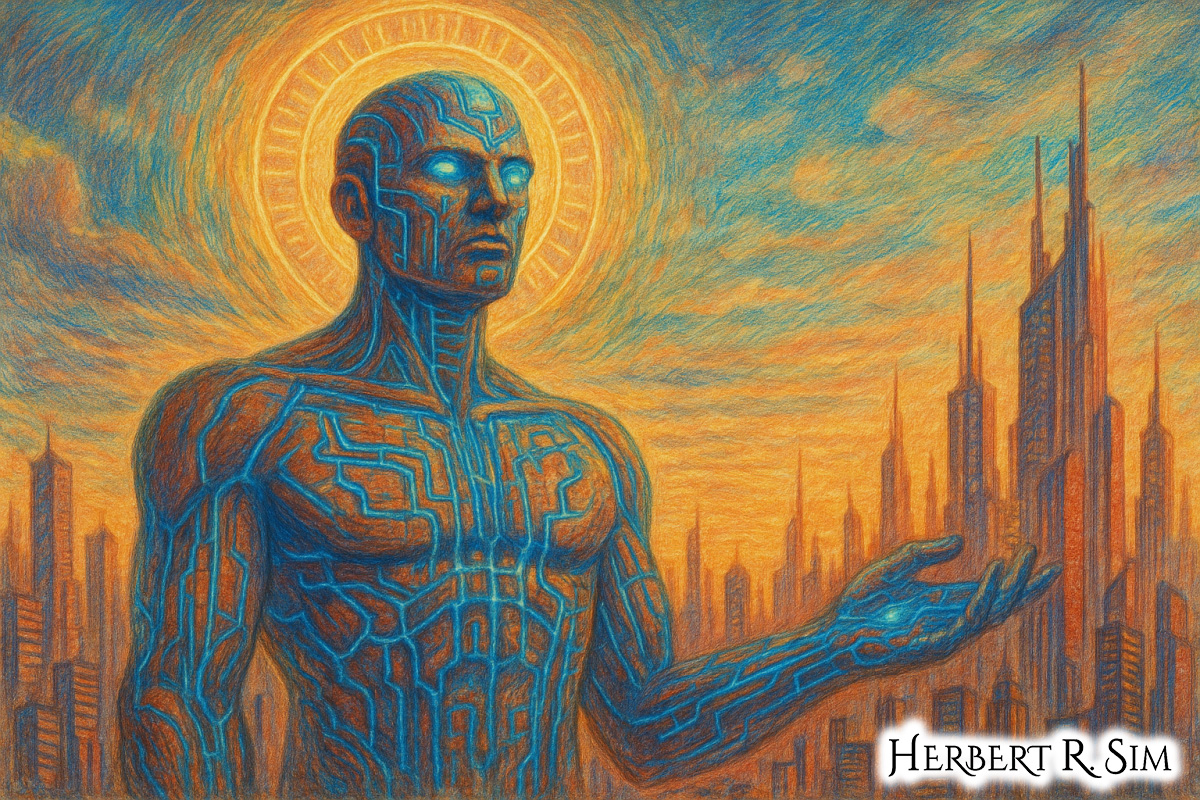
Above is my illustration of a colossal humanoid figure — the “Posthuman god”—with circuits woven into its skin, glowing eyes and a halo formed not from light but from streams of data. Looming over a futuristic skyline, it appears either as humanity’s protector or as a possible threat.
What would count as a god to us — if not a supernatural being, then a mind or civilization whose capacities so outstrip ours that it bends the physical and social world to its will? The transhumanist notion of a posthuman god explores that possibility in secular terms: futures in which enhanced humans, machine superintelligences, or hybrids attain powers that look godlike from our vantage point — longevity, mastery over matter and minds, near-omniscience through data, and the authority (or presumption) to decide what counts as “good.” It’s a provocative lens because it sits where philosophy, engineering, ethics, and culture meet — part prophecy, part warning, part design brief.
Philosopher Nick Bostrom helped crystallize this discourse, laying out the values and trajectories of transhumanism — radical enhancement of intelligence, health, and well-being; respect for morphological freedom; and an expanded moral circle — in Transhumanist Values (2005). That essay frames “posthuman” not as a monster but as a moral opportunity if managed wisely.
The idea has also drawn bracing critique from theologian-philosopher Jeffrey P. Bishop, who argues that much transhumanist rhetoric amounts to a kind of ontotheology: an implicit theology of power that risks deifying technical control and subordinating persons to optimization.
Below, I examine how journalism, scientific commentary and scholarship available by early 2012 have framed the rise – and the limits – of enhanced humans and increasingly capable machines. Together, these accounts reveal both the aspirations driving transhumanism and the dangers hidden within its language of power.
From Sci-Tech “Rapture” to Cultural Trope
By the late 2000s and early 2010s, mainstream magazines were already translating “Singularity” talk — the prospect of superintelligence and runaway progress — into public vernacular. TIME splashed “2045: The Year Man Becomes Immortal” across a 2011 cover package, giving wide audience to the idea that humans and machines might merge within decades. Coverage ranged from breathless features to photo essays of “cyberhumans,” like Kevin Warwick’s implanted chip experiments.
The Atlantic explored the cultural psychology of the moment. A 2011 feature, “Mind vs. Machine,” framed believers in the Singularity as envisioning a techno-Rapture — uploading minds for digital afterlives — while testing whether chatbots could pass as human. The same outlet poked and prodded the hype: “8 Alternatives to the Singularity from Grumpy Futurists” collected dissenting scenarios; other posts asked whether the Singularity had “already happened” in earlier upheavals of modernity, or tracked creeping automation in the economy.
Technology writers also chronicled individual developments that appeared to move society incrementally towards this future. These included experiments reconstructing viewed images from brain activity and electronic components capable of exchanging signals with living cells. Such achievements remained preliminary, but they demonstrated how boundaries between mind, body and machine were beginning to weaken.
WIRED toggled between wonder and wary humor. Reports from the Singularity Summit highlighted quasi-religious vibes around exponential progress, even as researchers tried to ground the conversation in open-source AI efforts. When IBM’s Watson won at Jeopardy! in 2011, WIRED mused about “computer overlord anxieties,” a pop-culture way of asking whether narrow wins foreshadow broad machine dominance. Other columns cast the present as a kind of lived-in “singularity” of social media and network effects — more sociotechnical than sci-fi.
Scientific American played the adult in the room. It reviewed Transcendent Man — a documentary portrait of Ray Kurzweil’s quest to outwit mortality — with a critic’s eye, affirming curiosity while questioning bold claims. It also asked about limits: physics may cap biological intelligence; exponential data growth can smother insight; and at the 2011 Singularity Summit, enthusiasts traded dates and thresholds for true machine self-awareness.
Across outlets, then, the “posthuman god” arrived not as dogma but as debate, refracted through journalism’s perennial triad: promise, peril, and practical next steps.
What Would “Godlike” Actually Mean?
Cognitive reach. Bostrom’s account of transhumanism places considerable importance on the expansion of intelligence, whether through biological enhancement, collective organisation or artificial intelligence. A genuinely posthuman mind might comprehend relationships and systems too complex for ordinary human reasoning, just as present-day humans understand concepts beyond the capacities of other animals. Public interest in IBM’s Watson and early brain–computer research illustrates why each technical achievement can alter expectations about what machines may eventually be able to know or accomplish.
Mastery over matter and bodies. From prosthetics that become identity rather than mere aid, to nanotech and bio-engineering that might re-write aging, the media documented early steps toward tool-rich embodiment. Guardian essays weighed the ethics of enhancement — celebration of creativity and autonomy tempered by sameness or inequality risks. Obituaries and commentary even probed the tragic irony of anti-aging philosophies colliding with mortality.
Longevity and the death of death. In broad-audience pieces, the prospect of indefinite life extension — sometimes cast as immortality — was the headline hook. TIME’s package made that promise legible to non-specialists, while skeptics asked whether medical and metaphysical questions were running ahead of evidence. Scientific American’s review of Transcendent Man distilled that tension precisely.
Moral authority and politics. Bishop warns that if we enthrone technical power as highest good, we slide toward theology of control: those with superior capacities assume the right to rule, diagnose, and redesign. In that “godlike” horizon, the danger isn’t just runaway code; it’s that we accept, uncritically, power’s moral self-justification. Journalistic features about automation’s labor impacts and the economics of a robot age echoed part of this worry in secular terms.
Hype vs. Hard Limits
By early 2012, mainstream discussion had already achieved three useful things: it had brought the subject beyond specialist circles, documented genuine scientific achievements and introduced sceptical voices into the debate. It had also begun to blur the distinction between engineering evidence and technological metaphor.
- Physical ceilings. You can’t simply dial up neurons forever: wiring length, heat, and energy impose design trade-offs. Scientific American foregrounded these limits, a counterspell to hand-wavy inevitabilism.
- Data isn’t wisdom. Exponential information (sensors, clicks, genomes) often outpaces theory and method, swamping analysis — a practical curb on the “omniscience” fantasy.
- Anthropomorphism traps. Guardian columnists pushed back on the impulse to ascribe feelings or moral status to rudimentary robots simply because they perform affect. If we mistake simulation for sentience, we crown false gods.
The upshot: even if posthuman capacities are achievable in principle, speed, path, and distribution are contingent. That’s the space policy and ethics must inhabit.
My illustration work-in-progress above.
Culture Sets the Frame (and the Stakes)
Public imagination matters because it influences funding, regulation and social expectations. Journalism connects laboratory research with wider questions of meaning: Should enhancement become a right, a luxury or an obligation? Who would gain access first? What happens to personal identity when a prosthetic device becomes experienced as part of the self? A 2009 Guardian essay presented a humane case for welcoming bodily enhancement while preserving personal choice and resisting pressure towards one supposedly ideal human form.
Meanwhile, WIRED’s 2008 snapshot of the Singularity Summit showed how gatherings can act like secular revivals — charging communities with purpose, occasionally drifting into faith-like certainty. That tone can inspire audacity or invite credulity; either way, it shapes how societies approach risk.
The Atlantic’s skeptical and occasionally playful articles helped prevent one prediction of the future from becoming the only accepted account. By presenting alternative scenarios, satire and difficult questions, these pieces reminded readers that the Singularity remained a contested hypothesis rather than an established historical destination.
TIME’s mainstream megaphone, finally, shows how a “posthuman god” narrative jumps from niche forums to dinner-table talk — often by way of the immortality hook and charismatic figures like Kurzweil. The magazine profiled him as a prophet of the Singularity, translating arcana into a story about destiny and salvation — precisely the mythic register Bishop thinks we should interrogate.
A Normative Compass: Between Bostrom and Bishop
Read together, Bostrom and Bishop provide a productive dialectic.
- Bostrom’s wager: If technology can expand health, intelligence and well-being while preserving individual choice and extending access beyond a narrow elite, the posthuman condition may represent an ethical opportunity rather than an act of hubris. His framework emphasises human potential, existential safety and broad access to beneficial technologies.
- Bishop’s warning: When optimization becomes telos, we risk confusing the power to act with the right to command. “Posthuman god” rhetoric is dangerous if it smuggles hierarchy under the banner of progress. His critique calls for humility and a re-centering of persons over programs.
A prudent society should therefore treat claims of “godlike” capability as moral warnings. Any technology capable of granting an institution or individual extraordinary power over human bodies, information or life choices should be subjected to exceptional scrutiny.
Principles to Consider Before We Crown Anything Divine
- Define purposes before granting power.
A powerful machine or enhanced intelligence should not be developed without serious consideration of the purposes it will serve. IBM’s Watson demonstrates that a system can perform impressively within a restricted field without possessing human judgement or moral understanding. Greater capability must not be confused with greater wisdom. - Preserve individual freedom and human diversity.
Enhancement should not impose one model of the ideal body, mind or personality. Morphological freedom requires that individuals retain meaningful choice over whether and how they alter themselves, provided that their choices do not cause serious harm to others. - Require intelligible and accountable decisions.
More data do not necessarily produce greater understanding. Institutions using complex technological systems should remain able to explain their decisions, identify who is responsible for them and provide a means of challenging mistakes or abuses. - Distinguish evidence from spectacle.
Conferences, magazine covers and dramatic demonstrations can make technological predictions appear more certain than they are. Extraordinary claims about immortality, machine consciousness or posthuman power should be evaluated through reproducible evidence, independent criticism and open public discussion. - Preserve checks upon concentrated power.
No corporation, government, machine or technologically enhanced individual should be trusted with unlimited authority. However capable a future intelligence becomes, it should remain subject to law, institutional restraint and the principle that no power is beyond question.
Closing Thought
“Posthuman god” is a mirror. It reflects humanity’s ancient desire to transcend its limitations, its fear of being surpassed and its tendency to transform powerful tools into objects of reverence. The strongest journalism published by early 2012 approached that reflection with both curiosity and caution: celebrating ingenuity while questioning exaggeration and repeatedly asking who would benefit from these new powers.
The strongest philosophical arguments insist that even if humanity can create something that appears godlike, it must still answer why it should do so, who should control the result and under what moral and legal limits that power should operate. Between Bostrom’s ambition for human flourishing and Bishop’s warning against the worship of technical control lies a durable principle: power should be made accountable before it is made sacred.