
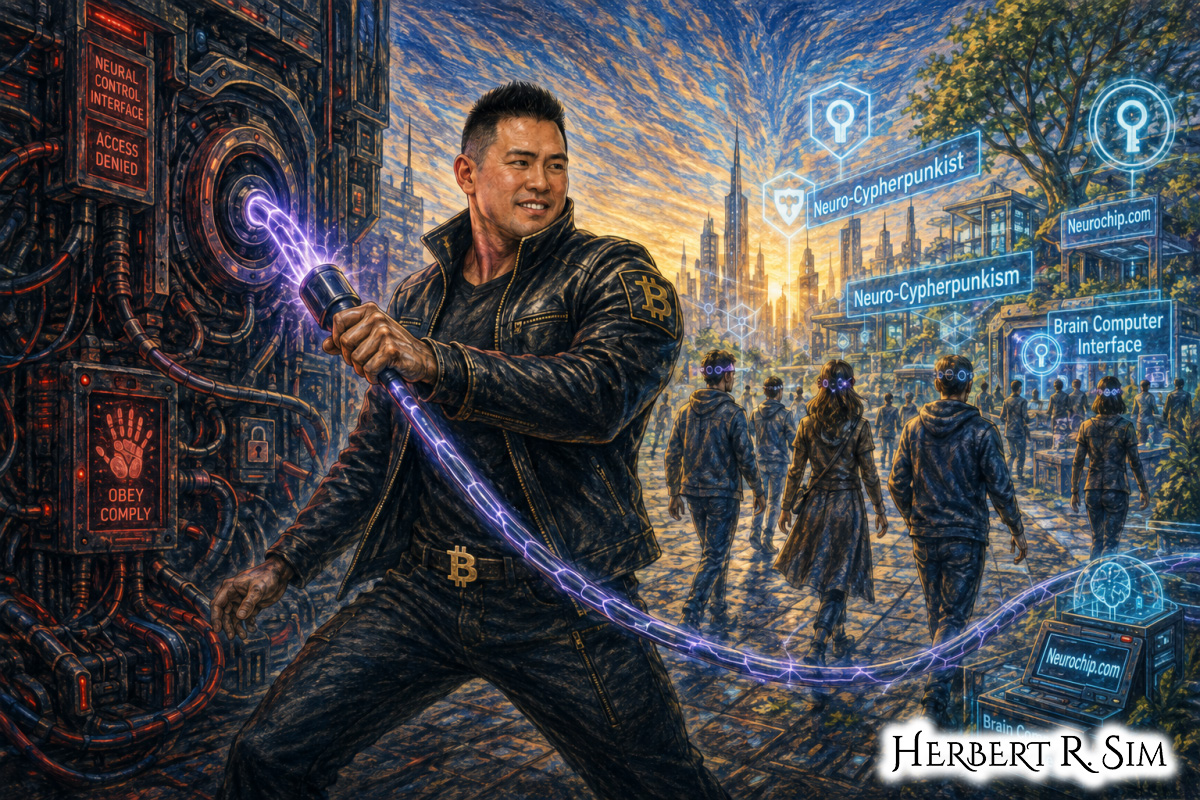
My illustration entitled: “The Right to Disconnect the Mind” – I remove a glowing neural cable from a coercive machine while citizens walk toward independent, self-owned BCI systems.
A Declaration of Cognitive Sovereignty in the Brain–Computer Interface Age
The first Cypherpunks defended privacy where human beings met the computer network. The Neuro-Cypherpunkist defends sovereignty where the computer network meets the human mind.
For decades, the struggle for digital freedom has concerned communications, identity, information, money and access to technological systems. Cryptography made it possible to protect messages. Decentralized networks reduced dependence upon central authorities. Open-source software allowed people to inspect and challenge the systems governing their digital lives. Bitcoin demonstrated that cryptographic self-custody could extend from information to digital value.
Brain–computer interfaces now bring this struggle to a more intimate frontier. Neurotechnology can record electrical activity from the nervous system, translate neural signals into commands and stimulate neural tissue. Artificial intelligence can help interpret these complex signals and transform them into movement, communication or interaction with machines.
These technologies may restore speech to people who cannot speak, movement to people who cannot move and independence to those whose physical capabilities have been diminished by injury or disease. In time, they may expand memory, perception, communication and intelligence. Their potential to improve human life is profound.
But every interface is also a point of power.
A system connected to the brain may collect information more intimate than a search history, financial record or private message. A device that interprets neural signals may become necessary for a person to communicate or control his own body. A system capable of stimulating the nervous system may possess the ability not merely to observe but to influence.
The closer technology moves to the mind, the stronger the protections surrounding the individual must become.
On 22 March 2025, I introduced Neuro-Cypherpunkism as a philosophy of privacy, decentralization and neural self-custody for the brain–computer interface age. On 22 April 2025, I explained why the development from Cypherpunkism to Neuro-Cypherpunkism is necessary as digital systems move toward the human nervous system.
This manifesto declares the position that follows.
I. The Human Mind Is Sovereign Territory
The human mind is not a platform, marketplace, institutional resource or unexplored territory available for technological occupation. It is the primary domain of personal identity, intention, memory, judgment and agency.
Political sovereignty concerns authority over territory. Digital sovereignty concerns authority over identity, information, communication and digital existence. Cognitive sovereignty concerns authority over the technological boundary surrounding the mind.
The individual must remain the principal authority over technologies that record, interpret or influence his neural activity. The ability to detect a signal does not create ownership of that signal. The ability to interpret neural activity does not create a right to exploit it. The ability to stimulate the nervous system does not create authority to modify it without permission.
The mind belongs to the person.
II. Neural Data Is Not Ordinary Data
Neural information originates from the biological processes through which a person perceives, intends, responds and acts. It may reveal patterns connected to movement, attention, emotion, recognition or other aspects of mental and physical life.
Neural signals are not transparent transcripts of thought. Their interpretation is probabilistic, contextual and dependent upon technology, training and circumstance. Claims that contemporary systems can simply “read the mind” should therefore be treated with caution.
But uncertainty does not make neural information harmless. An inaccurate inference about a person’s mental state may still influence employment, insurance, medical treatment, security decisions or access to services. As analytical capabilities improve, information collected for one purpose may reveal patterns never anticipated when consent was originally obtained.
Neural data must consequently receive protections appropriate to its origin and potential. It should not be treated as an ordinary stream of consumer telemetry merely because a commercial device can collect it.
Cognition is not a commodity simply because technology can measure it.
III. Neural Privacy Must Be the Default
Privacy is the ability of the individual to establish boundaries around the self. In the digital age, privacy is sovereignty because whoever controls access to information acquires power over the person represented by that information.
Neural privacy extends this boundary to information generated by the brain and nervous system. A Neuro-Cypherpunkist system must collect only the neural information required to perform the function deliberately requested by the user.
A device authorized to identify a motor command should not automatically analyse emotional responses. A headset permitted to measure attention for a specific task should not silently construct a permanent psychological profile. Medical neural information collected for treatment should not become advertising data, employment intelligence or a commercial asset without separate and meaningful consent.
The governing principle must be:
Collect only what is necessary. Process only what is authorized. Retain only what is required.
Neural privacy should not depend upon finding an obscure setting after surveillance has already begun. It must be the architectural default.
IV. Consent Must Be Specific, Informed and Revocable
Consent to neurotechnology cannot be reduced to a single acceptance button. The greater the intimacy and potential consequences of a technology, the more precise its permissions must become.
Consent to collect one category of neural information is not consent to collect every detectable signal. Consent to process information for medical treatment is not consent to sell it. Consent to operate a device today is not permanent permission to use neural information for purposes invented tomorrow.
Meaningful consent requires understandable explanations of what is collected, why it is collected, where it is processed, how long it is retained and who can access it. The individual must be able to withdraw authorization without suffering retaliation or losing access to unrelated records and essential services.
Consent obtained through dependency is not necessarily freedom. If employment, education, insurance or ordinary social participation becomes impossible without accepting neural monitoring, formal agreement may conceal practical coercion.
The Neuro-Cypherpunkist rejects consent that exists only in legal language while disappearing from technological reality.
V. Permission to Read Is Not Permission to Write
The distinction between receiving neural signals and transmitting influence into the nervous system must become foundational to neurotechnology.
A brain–computer interface that interprets intended movement reads information from the user. A system that electrically or magnetically stimulates neural activity writes influence in the opposite direction. These operations are not equivalent and must never be bundled together as if they represent one permission.
A person who authorizes a device to detect motor intention has not authorized it to alter mood, attention or behaviour. A patient who consents to monitoring has not necessarily consented to stimulation. A user who allows a system to read a limited neural command has not surrendered general access to his nervous system.
Neural write access carries a heightened capacity for physical and psychological harm. It must require separate authorization, stronger safeguards and greater accountability than ordinary data access.
Permission to read the brain must never imply permission to write to the brain.
VI. Neural Self-Custody Is a Fundamental Right
Cryptocurrency made self-custody widely understandable. The holder of a private key can exercise direct authority over a digital asset without requiring another institution to possess ultimate control.
Neuro-Cypherpunkism carries this principle into the cognitive domain.
Neural self-custody is the individual’s meaningful technical authority over access to neural information and over the operation of technologies connected to his nervous system. It includes control over permissions, storage, processing, transmission, activation and disconnection.
Where technically practical, raw neural information should be processed locally on hardware controlled by the user. A person should not require continuous authorization from a remote corporation to access information generated by his own brain. The essential operation of a medical or assistive neural device should not depend unnecessarily upon a subscription, proprietary cloud service or corporate server.
Recovery mechanisms may be necessary, especially when a device performs an essential medical function. But recovery must not become an excuse for invisible master access. Emergency capabilities should be narrowly designed, transparent, auditable and incapable of being silently transformed into universal administrative control.
The deeper technology becomes integrated with the person, the stronger the right to self-custody becomes.
VII. Cryptography Must Extend to the Nervous System
We encrypt financial transactions, communications, hard drives and digital identities. Information transmitted to or from the human nervous system deserves at least the same seriousness.
Cryptography is applied freedom because it prevents privacy from depending entirely upon promises. A company may promise not to inspect neural information. A government may promise to limit access. A hospital may promise to secure its records. But organizations change, databases are breached, political conditions deteriorate and systems created for one purpose acquire new functions.
Strong encryption, authentication, hardware security and narrowly defined access controls should be incorporated into neural systems from the beginning. Security must protect both confidentiality and integrity: unauthorized parties must be prevented from reading neural information and from issuing commands to a connected device.
The failure of an ordinary account may expose information. The failure of a neural interface may affect communication, movement, perception or bodily autonomy. Brain–computer interface security cannot therefore be treated as an optional feature added after commercialization.
If the brain becomes connected, the connection must be defended.
VIII. Neural Infrastructure Must Not Have a Single Master
The internet has shown how quickly convenient services can become unavoidable infrastructure. A small number of platforms now mediate communication, information discovery, commerce and identity. Humanity should not reproduce this concentration at the neural layer.
No government, corporation, military institution or artificial intelligence system should possess unrestricted control over the infrastructure through which large populations connect their nervous systems to machines.
A centralized neural platform could manufacture the interface, control its operating system, authorize applications, store neural information, change permissions remotely and decide which functions remain available. If users depended upon that system for communication, mobility or cognitive assistance, its operator would possess an extraordinary form of power.
Neural infrastructure should therefore support interoperability, inspectable interfaces, data portability and open technical standards wherever these can be implemented safely. Users should not become permanent tenants inside devices connected to their own bodies.
Decentralization is a check on power. In neurotechnology, it may become a defence against centralized authority over cognition itself.
IX. Every Person Has the Right to Disconnect
Connection must remain a choice.
Every person should possess the right to disable, remove or cease using a neural interface wherever medically and technically possible. Refusing neurotechnology should not result in exclusion from ordinary education, employment, public services or economic participation.
A society cannot claim that neural technology is voluntary if those who refuse it become unable to work, learn, communicate or authenticate themselves. That is not voluntary adoption. It is coercion concealed by technological convenience.
Some individuals may depend upon neural devices for communication, mobility or other essential functions. For them, the right to disconnect must include the right to change providers, operate essential functions offline where possible and migrate without losing access to their own capabilities.
A person should never be imprisoned within one technological ecosystem because the system has become connected to his nervous system.
The freedom to connect requires the freedom to disconnect.
X. Neurotechnology Must Never Become Compulsory
No government, employer, school, insurer or corporation should possess unrestricted authority to compel neural monitoring, stimulation or augmentation.
An employer should not demand access to neural information merely to measure attention or productivity. A school should not require children to expose neurological signals because monitoring promises improved performance. An insurer should not condition essential coverage upon continuous access to cognitive or emotional indicators. A citizen should not be required to adopt a brain–computer interface to exercise ordinary civil rights.
Military service, imprisonment, poverty or disability must not be used to erase cognitive rights. Individuals in dependent circumstances often possess the least practical ability to refuse. They therefore require stronger safeguards, not weaker ones.
There may be difficult medical circumstances involving emergency treatment, diminished capacity or therapeutic responsibility. Such cases require narrow ethical and legal consideration. They do not justify a general power to impose neurotechnology upon competent individuals.
Technological progress becomes technological domination when refusal ceases to be possible.
XI. Artificial Intelligence Must Serve the Individual
Artificial intelligence will be essential to many brain–computer interfaces because neural signals are complex, noisy and highly individual. AI may translate attempted speech, interpret intended movement, adapt prosthetic control and personalize assistive systems.
But an artificial intelligence positioned between the brain and the external world may become more than a tool. It may become the interpreter through which intention is converted into action.
The individual must retain authority over that relationship. An AI system must not secretly expand neural collection, alter permissions or determine when neural stimulation should occur outside narrowly defined emergency arrangements. Its important decisions should be inspectable, and the user should be able to correct, replace or disable it wherever possible.
Artificial intelligence may be more computationally capable than its user. Computational superiority does not create moral sovereignty.
The machine may interpret the signal. The human being must remain sovereign over the connection.
XII. Medical Restoration Must Not Become Commercial Exploitation
Many people who first receive advanced brain–computer interfaces will do so because they have lost the ability to speak, move or interact independently. Their reliance upon these systems may be profound.
Such dependency must never be exploited through predatory pricing, abandonment of essential devices, forced data extraction or unilateral withdrawal of functionality. A company that ceases operating should not leave patients without access to technology integrated into their bodies or necessary to their independence.
People receiving therapeutic neurotechnology should retain access to their clinical information, device records and necessary maintenance. Reasonable provisions for continuity, repair, migration and long-term support should be established before dependency is created.
Innovation deserves reward, and companies require sustainable business models. But the person cannot be treated as a disposable attachment to the product.
Technology designed to restore human agency must not replace one disability with another form of institutional dependence.
XIII. Open Knowledge Is Necessary for Cognitive Freedom
No society can exercise meaningful sovereignty over systems it is forbidden or unable to understand. Neurotechnology should not become the exclusive domain of corporations, military organizations or a small technical elite.
Researchers must be able to study the security, ethics and social consequences of brain–computer interfaces. Independent experts should be permitted to identify vulnerabilities without facing retaliation merely for exposing legitimate risks. Technical standards, important interfaces and security assumptions should be open to examination wherever disclosure would not create a greater danger.
Open knowledge does not require publishing personally identifiable neural information or releasing dangerous capabilities without responsibility. Privacy, research freedom and public safety must be considered together.
But secrecy should not become a shield behind which institutions exercise unchallengeable power over the nervous system. Cognitive sovereignty requires informed users, independent researchers and a public capable of understanding the technologies entering the human body.
XIV. Freedom Must Be Designed Before Dependence
Rights written into policies are important, but policies can change. Companies are acquired. Governments change. Terms of service are revised. Databases are breached, and technologies are repurposed.
Wherever possible, cognitive freedom should therefore be expressed through architecture. Local processing can reduce unnecessary transmission. Encryption can make unauthorized access more difficult. Interoperability can reduce dependence upon one provider. Physical controls can allow users to verify whether a device is active. Open standards can prevent one institution from owning an entire technological layer.
Law, ethics and regulation remain necessary. Architecture cannot resolve every conflict or prevent every abuse. Yet freedom that exists only as an institutional promise remains vulnerable to the institution that made it.
The architecture of neural technology is being created now. Once a centralized model becomes embedded in medicine, employment and everyday communication, replacing it may become extremely difficult.
Cognitive freedom must be designed before cognitive dependence becomes permanent.
XV. The Neuro-Cypherpunkist Accepts Responsibilities
The Neuro-Cypherpunkist claims rights over cognition while recognizing responsibilities toward other human beings.
We will not misuse neural information entrusted to us. We will not conceal avoidable risks from patients or users. We will not weaken security for commercial convenience. We will not describe speculation as scientific certainty or exploit fear through exaggerated claims of mind reading and cognitive control.
We will distinguish therapeutic assistance from coercive enhancement. We will respect the autonomy of people who choose neurotechnology and those who refuse it. We will design systems that account for disability, inequality and the vulnerability created when a person depends upon a device.
We will oppose unauthorized intrusion into neural systems, whether conducted by criminals, corporations, governments or individuals claiming to act in the name of freedom.
Privacy does not excuse harm. Decentralization does not eliminate accountability. Open knowledge does not remove the duty to handle dangerous capabilities responsibly. Self-custody does not absolve designers from making systems comprehensible and safe.
Cognitive sovereignty must protect the dignity and freedom of every person, not merely the technical power of the strongest.

My illustration “The Right to Disconnect the Mind” work-in-progress. The art represents that cognitive liberty requiring the practical ability to refuse, exit or disconnect.
The Neuro-Cypherpunkist Declaration
We declare that the human mind is sovereign territory.
We declare that neural information belongs fundamentally to the individual from whom it originates.
We declare that access to neural information must require specific, informed and revocable permission.
We declare that permission to read neural activity does not constitute permission to modify it.
We declare that neural systems must minimize collection and favour local processing wherever practical.
We declare that sensitive neural communications must be protected by strong cryptographic security.
We declare that individuals must retain meaningful control over their neural identity, information, permissions and connectivity.
We declare that no government, corporation, military institution or artificial intelligence should possess unrestricted authority over humanity’s neural infrastructure.
We declare that every person possesses the right to disconnect and the right to refuse non-essential neurotechnology.
We declare that artificial intelligence may assist human cognition but must never become its unaccountable gatekeeper.
We declare that brain–computer interfaces should restore and expand human agency rather than transfer that agency to the operator of the machine.
We declare that technology may become more intimate with humanity only if the protections surrounding human freedom become stronger alongside it.
The Final Private Key
There was a time when privacy meant closing a door. Later, it meant sealing a letter. In the digital age, it came to mean encrypting a message, protecting an identity and controlling a cryptographic key.
The next frontier lies closer.
When networks connect to the nervous system, privacy must extend to neural activity. When algorithms interpret intention, transparency must extend to the interpreter. When technology restores speech or movement, sovereignty must extend to the person who depends upon it. When machines gain the ability to influence cognition, consent must extend to every direction in which information and power can flow.
Cypherpunkism established that privacy, cryptography and decentralization are instruments of digital sovereignty. Neuro-Cypherpunkism extends those instruments to cognitive sovereignty.
We are not opposed to brain–computer interfaces.
We are opposed to ownership of the person through the interface.
We are not opposed to artificial intelligence interpreting neural signals.
We are opposed to artificial intelligence becoming sovereign over the human being whose signals it interprets.
We are not opposed to technological enhancement.
We are opposed to enhancement becoming a condition of citizenship, employment or human worth.
Develop the technology. Restore human capabilities. Explore cognition. Expand the possibilities of the human mind.
But build freedom into the architecture before the architecture becomes unavoidable.
Protect the signal.
Decentralize the interface.
Preserve the right to disconnect.
Keep the human sovereign.
The mind is the final private key.
Herbert R. Sim
15 May 2025
References and Further Reading
- Herbert R. Sim, “The Mind Is the Final Private Key: Neuro-Cypherpunkism and the Fight for Cognitive Sovereignty,” 22 March 2025
- Herbert R. Sim, “From Cypherpunkism to Neuro-Cypherpunkism,” 22 April 2025
- Herbert R. Sim, “Cypherpunkism: A Philosophy of Digital Sovereignty,” 2010
- Herbert R. Sim, “The Cypherpunkist Manifesto,” 2010
- Herbert R. Sim, “Digital Sovereignty: A Formal Definition,” 2013
- Herbert R. Sim, “Human-Sovereignty Transhumanism,” 2014
- Eric Hughes, “A Cypherpunk’s Manifesto,” 1993
- Ivan Martinovic et al., “On the Feasibility of Side-Channel Attacks with Brain-Computer Interfaces,” USENIX Security Symposium, 2012
- Tamara Bonaci, Ryan Calo and Howard J. Chizeck, “App Stores for the Brain: Privacy and Security in Brain-Computer Interfaces,” 2014
- Marcello Ienca and Pim Haselager, “Hacking the Brain: Brain–Computer Interfacing Technology and the Ethics of Neurosecurity,” 2016
- Marcello Ienca and Roberto Andorno, “Towards New Human Rights in the Age of Neuroscience and Neurotechnology,” 2017
- Rafael Yuste et al., “Four Ethical Priorities for Neurotechnologies and AI,” Nature, 2017
- OECD, “Recommendation on Responsible Innovation in Neurotechnology,” 2019
- Henri Lorach et al., “Walking Naturally After Spinal Cord Injury Using a Brain–Spine Interface,” Nature, 2023
- Francis R. Willett et al., “A High-Performance Speech Neuroprosthesis,” Nature, 2023
Download the Neuro-Cypherpunkist Manifesto
Official Publication Record
The Neuro-Cypherpunkist Manifesto has been formally archived on Zenodo with a permanent DOI for citation, preservation and scholarly reference.
| Title | The Neuro-Cypherpunkist Manifesto |
| Subtitle | A Declaration of Cognitive Sovereignty in the Brain-Computer Interface Age |
| Author | Herbert R. Sim |
| ORCID | 0009-0008-6500-5749 |
| Version | Version 1.0 | 15 May 2025 |
| Canonical webpage | https://herbertrsim.com/neuro-cypherpunkist-manifesto/ |
| DOI | 10.5281/zenodo.22375907 |
| Zenodo record | https://zenodo.org/records/22375907 |
| Licence | Creative Commons Attribution 4.0 International Licence (CC BY 4.0) |
Preferred citation:
Sim, Herbert R. (2025). The Neuro-Cypherpunkist Manifesto: A Declaration of Cognitive Sovereignty in the Brain-Computer Interface Age. HerbertRSim.com.
https://doi.org/10.5281/zenodo.22375907
Copyright and licence:
© 2025 Herbert R. Sim. This work is licensed under the Creative Commons Attribution 4.0 International Licence (CC BY 4.0).
Zenodo submission note:
This work was archived on Zenodo on 5 September 2026 for permanent scholarly preservation and citation.