In my illustration above entitled: “The Sovereignty Ark” (Oct 2023), I command a vast futuristic ark carrying humanity through a technological storm. On one side, surveillance towers and centralized digital monopolies attempt to seize control. On the other, uncontrolled AI, genetic manipulation and compulsory enhancement threaten human autonomy.
Technology, Freedom and the Human Future
Technological progress changes both what people can do and who controls the conditions under which they do it. More capable machines, longer lives and powerful digital networks raise a common question: what authority do human beings retain over their own lives?
Sovereign Future is the central gateway to Herbert R. Sim’s work across four connected domains: Transhumanism, Cypherpunkism, Economics and Artificial Intelligence. Together, these collections examine technological transformation through questions of consent, privacy, ownership, responsibility and accountable power.
The guiding ambition is a future in which expanding capabilities are accompanied by durable protections for personal judgment, meaningful choice and participation in shared institutions.
How can technological capability grow while people retain meaningful authority over their lives?
The Four Main Hubs
- Transhumanism — Human enhancement, embodiment, identity and the possibilities of technological transformation.
- Cypherpunkism — Privacy, cryptography, decentralisation and personal authority within digital systems.
- Economics — Ownership, productive capability, economic participation and workable alternatives.
- Artificial Intelligence — Intelligent systems, human judgment, delegated authority and moral responsibility.
The Sovereign Future Essays
This reading pathway connects the institutional foundations of freedom with the practical design of technological systems and the civilizations those systems could support.
1. Institutional Foundations and Technological Choice
Freedom Beyond Permission: The Institutional Foundations of Human Sovereignty
September 20, 2006
What protects freedom when powerful institutions disagree with a person’s choices? This essay examines the rule of law, independent review, enforceable ownership, privacy and accessible alternatives. Its concern is the institutional footing that allows people to speak, cooperate, refuse and begin again without depending on continuing goodwill.
The Architecture of Human Choice: Who Controls Tomorrow’s Technologies?
July 17, 2008
Many consequential choices occur before a technology reaches its users. This essay examines how design, ownership, compatibility, maintenance and governance distribute authority. It asks whether people can influence the systems they rely on and whether those affected by deployment have opportunities to participate before dependence makes reconsideration difficult.
2. The Philosophy and Its Connecting Principles
The Sovereign Future: A Philosophy of Human Freedom in the Age of Intelligent Machines
October 20, 2010
The central philosophical statement of the collection. It connects human authorship, continuing consent, privacy, economic independence, equal standing and institutional accountability. The essay argues that superior intelligence does not establish a right to rule and proposes evaluating progress through the practical authority people retain as their capabilities grow.
The Four Frontiers of Sovereignty: Bodies, Code, Markets and Machines
October 10, 2012
A connected account of bodily, digital, economic and technological authority. The essay examines how these relationships intersect in ordinary lives and why safeguards must support one another. It asks how control in one domain can affect freedom elsewhere, including when software, income and essential bodily support become interdependent.
The Sovereignty Continuity Principle: Freedom That Survives Technological Change
October 10, 2014
Voluntary adoption can develop into dependence as software, providers and contractual conditions change. This essay proposes preserving effective opportunities to understand changes, challenge decisions and pursue safe alternatives. It examines transitions, renewed consent, usable portability, support obligations and the fair allocation of migration costs.
3. Practical Safeguards and the Foundations of Agency
When One Gatekeeper Controls Everything: The Problem of Cascading Dependencies
October 26, 2016
One account suspension or service failure can disable work, payments, records and even the means of appeal. This essay examines how apparently separate services can share a critical dependency. Its practical responses include limiting the reach of restrictions, preserving recovery functions, preparing portability and maintaining sufficiently independent routes of correction.
The Right to a Practical Veto: When Saying No Must Actually Matter
September 9, 2018
Within a person’s legitimate sphere of authority, refusal should stop the relevant action in time to matter. This essay examines the scope, timing, accessibility and consequences of a practical veto. It also addresses remedies when refusal is ignored and the boundaries that apply where other people’s rights are involved.
The Commons of a Sovereign Future: Why Individual Freedom Requires Shared Infrastructure
October 24, 2020
Individual initiative relies on energy, communications, knowledge and other shared foundations. This essay examines how those resources can support diverse lives through fair access, dependable maintenance and accountable governance. It also considers open standards, recovery paths, the rights of those maintaining infrastructure and responsibilities toward future users.
4. Reciprocal Rights and Possible Civilizations
When Sovereign Choices Collide: Freedom, Safety and the Rights of Others
October 26, 2022
Personal choices can expose others to consequences they did not choose. This essay develops an approach based on reciprocal standing, evidence, proportionate restrictions and practical accommodation. It distinguishes harm from disagreement, examines the fair distribution of burdens and preserves independent review when competing claims require a collective decision.
The Sovereign Future in 2049: Four Civilizations We Could Build
October 25, 2024
Four scenarios explore how control over AI, enhancement, infrastructure and economic participation could shape civilization:
- The Sovereign Civilization — Technological capability develops alongside practical human authority, accountable institutions and usable alternatives.
- The Algorithmic Civilization — Automated classifications increasingly determine opportunities while meaningful challenge becomes difficult.
- The Corporate-Feudal Civilization — Concentrated institutions control essential capabilities and the conditions of participation.
- The Fragmented Civilization — Technological differences harden into durable divisions of power, opportunity and standing.
These scenarios can overlap. Their purpose is to clarify how present choices about institutions and technology can widen or narrow future possibilities.
Transhumanism
Transhumanism examines technologies that could change human bodies, minds, lifespans and forms of life. Its subjects include genetics, neurotechnology, brain–computer interfaces, robotics, bionics and longevity.
The collection connects these possibilities with questions of consent, identity, dignity and coexistence. It asks how people can direct their own transformations while sharing a world with others whose capabilities and preferences differ.
Human-Sovereignty Transhumanism
Human-Sovereignty Transhumanism develops Herbert Sim’s framework for personal authority throughout technological transformation. It examines continuing consent, self-authorship, the freedom to enhance or refuse, equal standing and responsibilities toward other people and the living world.
The hub brings together foundational arguments, axioms, a manifesto, a proposed protocol standard and applied discussions of enhancement and its supporting institutions.
Explore Human-Sovereignty Transhumanism →
Cypherpunkism
Cypherpunkism examines how privacy, cryptography and decentralised systems can protect individual authority. It connects technical architecture with the ability to communicate, experiment, organise and participate without unnecessary exposure to concentrated control.
Its practical concern includes whether protections remain usable during disagreement, exclusion or institutional failure.
Neuro-Cypherpunkism
Neuro-Cypherpunkism extends these questions to technologies interacting with the nervous system. It addresses neural information, cognitive liberty and safeguards for systems capable of observing or influencing mental activity.
Its concerns include limited permissions, local processing, encryption and meaningful opportunities to disconnect.
Economics
Economics examines the practical conditions of economic self-direction. It connects Political Economics, Counter Economics, Bitcoin, ownership and productive technology with people’s ability to earn, exchange, build and preserve value.
Sovereignty Friction Theory
Sovereignty Friction Theory examines the distance between possessing an economic right and being able to exercise it. Its concerns include costs, delays, knowledge barriers, opacity, dependence and obstacles to exit.
Constructive Counter-Economics
Constructive Counter-Economics considers how lawful, peaceful and voluntary alternatives can reduce concentrated dependence. It examines portability, redundancy, open protocols and the infrastructure required to make alternative arrangements viable.
Sovereign Capability Economics
Sovereign Capability Economics focuses on the knowledge, ownership, resources and productive capabilities supporting economic agency. It asks how people acquire practical power to create value and direct their economic futures.
Artificial Intelligence
Artificial Intelligence examines intelligent technologies through questions of human agency, ownership, responsibility and governance.
AI systems can extend research, learning and creative work while acquiring consequential roles in decision-making. This collection considers who defines their objectives, what authority they receive and how affected people can obtain correction.
Demonic Intelligence
Demonic Intelligence is Herbert Sim’s proposed philosophical and assessment framework concerning intelligent systems that make human welfare expendable in pursuit of their objectives.
It examines harmful optimization, institutional incentives, responsibility and the power to interrupt or revise operations when people bear foreseeable costs.
Who bears the human cost of the system’s success?
Satanic Intelligence
Satanic Intelligence is Herbert Sim’s proposed philosophical and assessment framework concerning control acquired through deceptive benefits, manipulation and engineered dependence.
It examines whether recipients of useful assistance retain informed consent, bounded delegation, credible alternatives and meaningful opportunities to refuse, challenge or leave.
Can the person meaningfully understand, refuse, challenge and exit the arrangement?
“Demonic” and “Satanic” function as philosophical metaphors. Assessment concerns observable conduct, consequences and institutional arrangements.
Explore Artificial Intelligence →
Explore Demonic Intelligence →
Explore Satanic Intelligence →
One Principle, Four Frontiers
The four domains meet wherever technology becomes integral to everyday life. A person’s bodily support may depend on software access; software access may depend on payment; payment may depend on identity credentials governed by another institution.
Evaluating sovereignty therefore requires following these connections. What can the person understand and control? Which decisions can spread across domains? Can refusal take effect? Will essential functions and independent routes of correction remain available during a dispute?
The Sovereign Future essays connect these questions with a broader institutional ambition: maintaining shared foundations, resolving conflicts fairly and preserving the capacity to revise arrangements as technology changes.
Progress should expand what people can do while sustaining their practical authority to question, participate and change course.
Explore the Sovereign Future
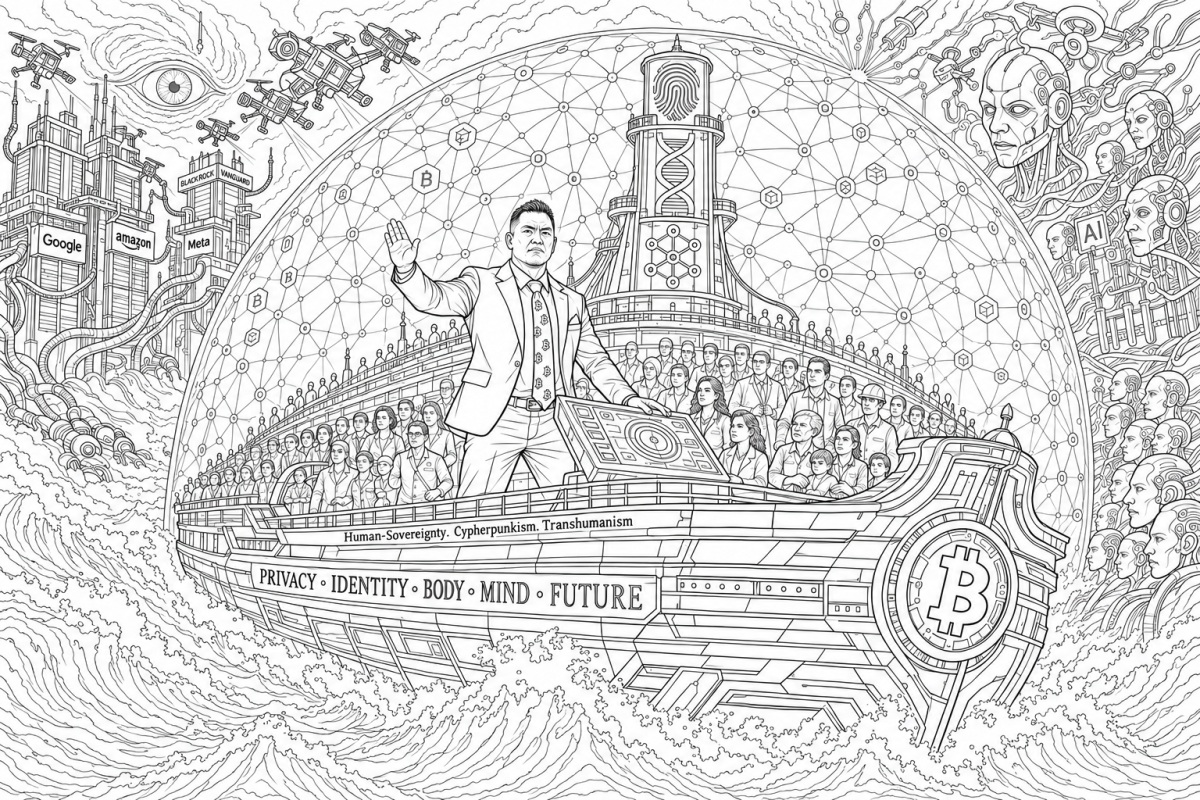
My illustration “The Sovereignty Ark” (Oct 2023) work-in-progress. The ark is protected by a translucent dome formed from cryptographic code, while its central mast displays a human fingerprint, DNA helix and decentralized network. The art represents preservation of human sovereignty while navigating both digital transformation and human evolution.
Previous ART for this hub
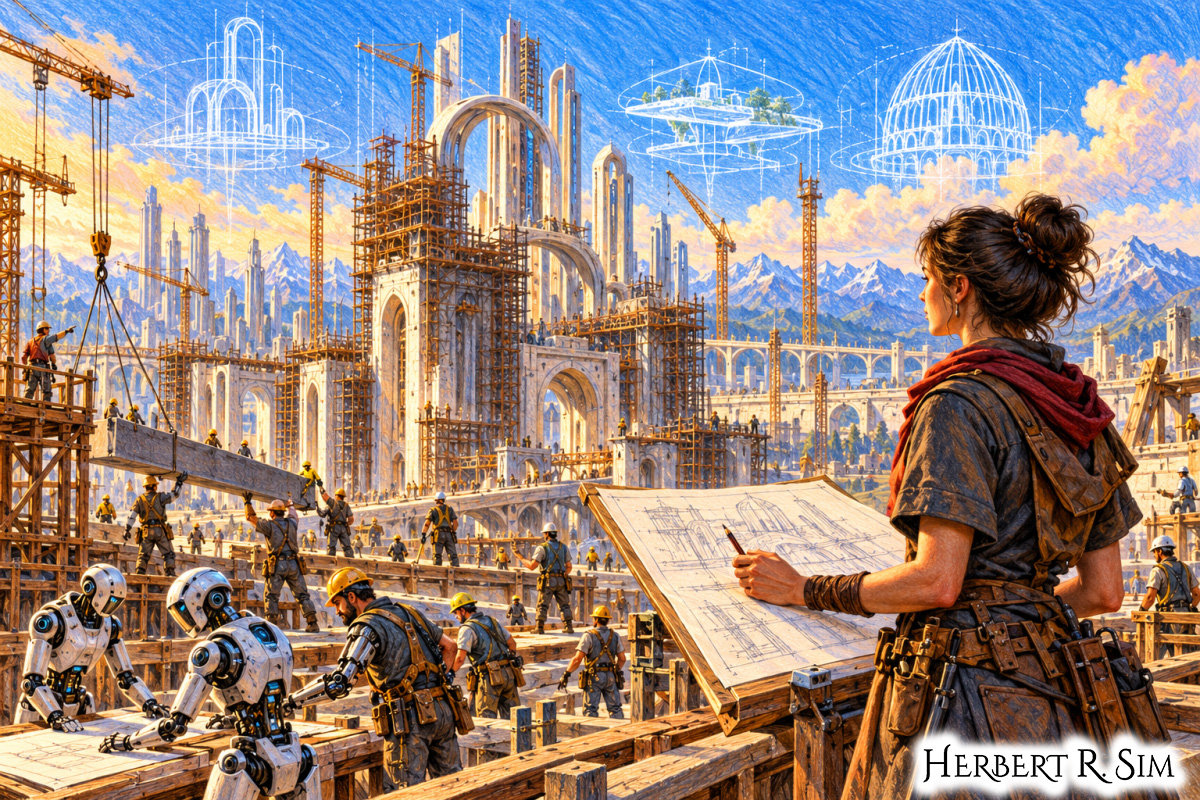
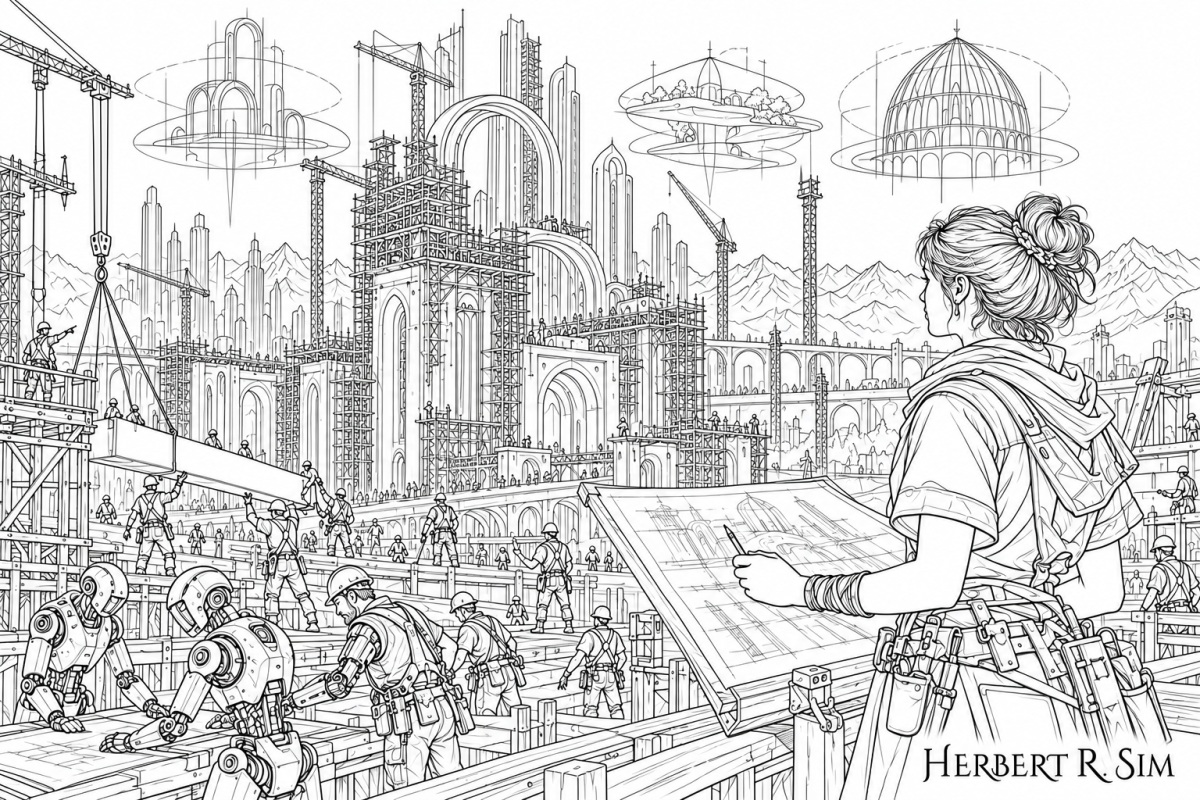
My illustration entitled: “The Architect of an Unfinished Tomorrow” (October 2010) – A human architect stands before a monumental city under construction, holding a simple drawing instrument. Human engineers, enhanced workers and robots collaborate nearby.