
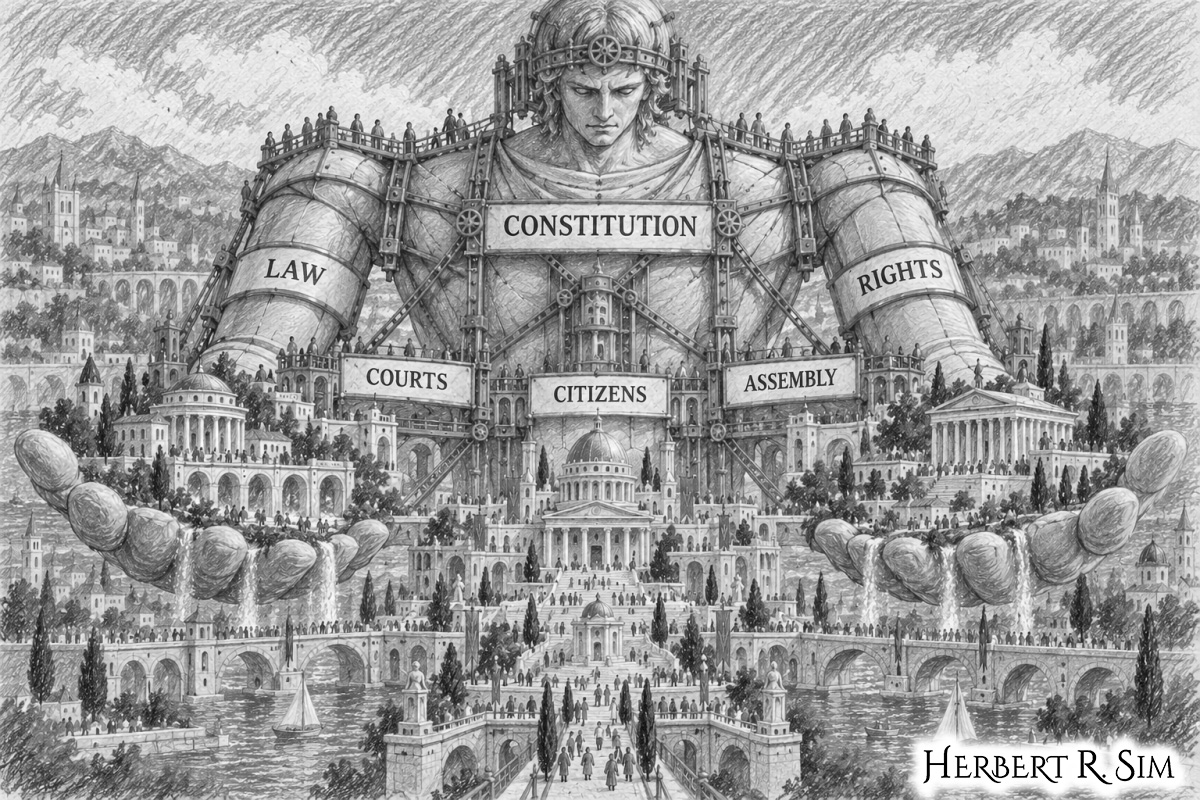
My illustration entitled: “The Charter That Binds the Colossus” – An immense mechanical figure represents institutional power, towering above a flourishing city. Articulated restraints connect its limbs to a great constitutional framework maintained by citizens, courts and independent assemblies. Its open hands support public infrastructure.
A person may be permitted to speak, work, own property and choose a way of life, yet remain deeply vulnerable to another’s discretion. An employer may tolerate disagreement until it becomes inconvenient. An official may approve an application without explaining the grounds for refusal. A service provider may welcome a customer while retaining the power to change the conditions of participation.
These arrangements can feel free while those exercising authority remain generous. Their weakness becomes visible when generosity ends.
I believe human sovereignty begins with a demanding question: what protects a person’s ability to direct their life when the institutions around them disagree with their choices?
The answer requires more than declarations of independence. It requires institutions that make freedom dependable, distribute authority and give ordinary people practical ways to resist arbitrary treatment.
When Permission Resembles Freedom
Permission and freedom sometimes produce the same immediate result. Both may allow someone to publish an opinion, establish a business or join an association. Their difference concerns the security of that opportunity.
Permission rests on an authority’s continuing willingness to allow an action. A protected freedom places obligations on that authority. It establishes boundaries that cannot legitimately be crossed simply because a decision maker becomes impatient, offended or personally hostile.
Consider a newspaper that operates because a minister chooses to overlook its criticism. Its journalists may publish boldly for years. Nevertheless, their position remains insecure if the minister can close the newspaper without reasons or independent review.
Freedom therefore includes protection against arbitrary interference, even when interference has not yet occurred. Living under a power that may intervene at will can encourage obedience long before anyone issues a command.
Sovereignty Within a Shared Society
Human sovereignty does not mean that each individual becomes a separate state or acquires immunity from obligations. People share streets, workplaces, resources and environments. Their actions affect one another. A workable account of freedom must explain how personal authority coexists with reciprocal duties.
My starting point is that people should possess a protected sphere in which they can form judgments, pursue purposes and revise commitments. Restrictions require justification, particularly where they affect expression, association, bodily integrity, livelihood or access to justice.
This position leaves considerable work for institutions. Courts resolve disputes. Public authorities protect against violence and fraud. Associations coordinate common projects. Markets connect people whose needs and abilities differ.
The question is whether these arrangements serve people under accountable rules, and whether those subject to their power can obtain protection when those rules fail.
Rules That Bind the Powerful
The first institutional foundation is the rule of law. Rules should be public, sufficiently clear and applied through procedures that constrain personal favour. People need reasonable confidence that similar conduct will receive similar treatment.
A written rule alone offers little security if officials can interpret it however they please. Protection requires independent judgment, opportunities to present evidence and remedies capable of changing an unlawful decision.
Imagine a small trader whose licence is withdrawn after criticism of a local authority. The trader’s freedom depends partly on whether an independent body can examine the withdrawal, require an explanation and provide timely relief.
Delay matters. A successful appeal delivered after the business has collapsed may establish a principle while leaving the injured person without a livelihood. Institutional protection must operate within the timescale of human need.
Power Must Remain Open to Challenge
The second foundation is contestability: the ability to question decisions and seek correction without depending entirely on the goodwill of the original decision maker.
This requires intelligible reasons. Someone cannot effectively challenge a refusal if they cannot discover what was refused, which rule applied or what evidence mattered. It also requires protection against retaliation.
Within a workplace, a grievance procedure loses credibility when complaints quietly destroy promotion prospects. Within public administration, an appeal becomes hollow when the same office controls the original decision, the evidence and the review.
Independent scrutiny need not make every decision slow or adversarial. Institutions can resolve routine matters simply while reserving stronger safeguards for consequential disputes. What matters is that authority encounters a credible possibility of correction.
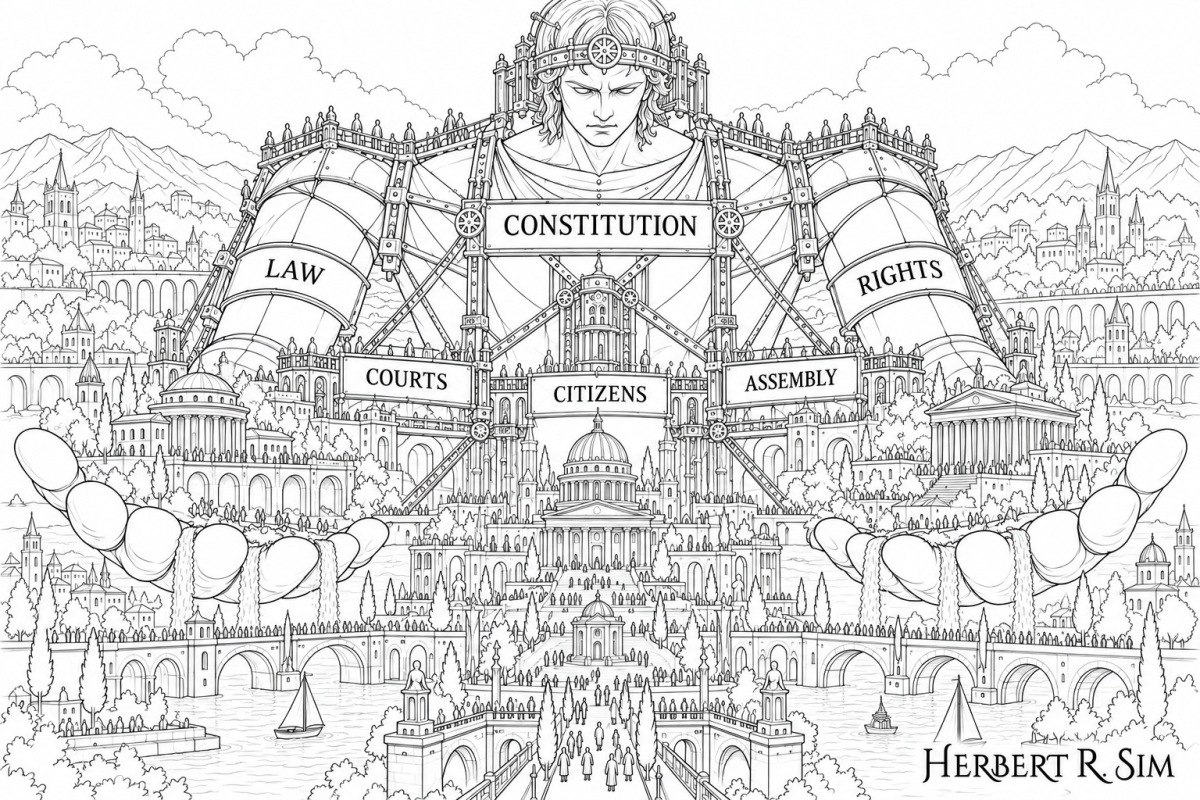
My illustration “The Charter That Binds the Colossus” work-in-progress. The art represents powerful institutions serving freedom when their authority has enforceable limits.
Ownership Needs Enforceable Substance
Property can give individuals a degree of independence from patrons, employers and political favour. Savings provide time to reconsider a job. Tools enable productive work. A secure home offers continuity when other relationships become unstable.
Yet ownership depends on institutions. A title is insecure where records can be altered through influence, contracts cannot be enforced or confiscation occurs without adequate process.
Nor should every form of property receive identical treatment. Land, personal possessions and claims over ideas raise different questions about scarcity, access and the interests of others. Protecting independence requires examining what particular rights enable and what burdens they impose.
The central concern is whether people can establish reliable claims, use resources productively and defend themselves against arbitrary dispossession. Ownership should create a basis for agency rather than merely a document recording dependence.
Alternatives Give Refusal Practical Meaning
A person’s ability to refuse an arrangement depends partly on what happens afterwards. Leaving an employer is easier when another employer can realistically hire them. Rejecting a supplier is easier when competing suppliers are available.
Competition therefore has a political significance alongside its economic benefits. It can limit the authority any single organisation exercises over a person’s daily life.
However, counting providers is insufficient. Several companies may impose similar restrictions, share the same bottleneck or exclude the same population. A nominal alternative may require unaffordable travel, qualifications or starting capital.
Institutions should make room for new entrants, cooperatives, independent professions and voluntary associations. People need opportunities to construct alternatives as well as select among established ones. Freedom becomes more resilient when dissatisfaction can produce a new organisation.
Departure Should Not Require Starting Again
Some dependence arises from the accumulated costs of participation. A customer may spend years organising business records around one supplier’s software. An employee may develop skills that another employer struggles to recognise.
These investments are valuable, but they can make departure unusually expensive. An organisation may gain bargaining power because the participant would lose much of what they have already built.
Open technical standards, usable copies of records and fair recognition of qualifications can reduce such dependence. In computing, the ability to read a document with another program may determine whether changing suppliers is feasible.
Departure will rarely be costless. Training, coordination and contractual commitments involve real expenditure. The institutional task is to distinguish unavoidable costs from obstacles maintained chiefly to prevent people from leaving.
Privacy Protects Independent Judgment
People need room to think before they explain themselves. They need opportunities to read unpopular arguments, seek advice, reconsider beliefs and communicate without exposing every uncertainty to an employer, official or commercial intermediary.
Privacy supports this room for judgment. Its loss can alter behaviour even when no explicit prohibition exists. A person who expects every conversation to be recorded may avoid questions that deserve examination.
Digital communications make institutional choices especially consequential. Encryption, limited collection, secure storage and clear restrictions on access can protect personal correspondence. Legal safeguards can establish responsibility when information is misused.
Technical protection and public accountability should reinforce each other. Individuals cannot personally inspect every system handling their information. They need dependable duties governing those who collect, retain and disclose it.
Freedom Requires Usable Means
Formal protections can remain inaccessible to people who lack time, knowledge or resources. Someone may possess a right to challenge a decision while being unable to understand the procedure or afford the journey required to attend a hearing.
Education, accessible information and affordable assistance therefore belong within the institutional discussion of freedom. They help people recognise their options and act on them.
This does not require prescribing a single desirable life. Assistance should widen the range of lives people can choose. A programme that supports someone only while they obey an official’s preferred personal choices may reproduce the dependence it claims to relieve.
Good institutions help people become capable participants, with sufficient security to disagree and sufficient knowledge to understand the consequences of doing so.
Building Institutions Worth Depending On
Complete independence is neither possible nor desirable. We depend on farmers, engineers, teachers, neighbours and countless people we will never meet. Cooperation makes a richer human life possible.
The challenge is to organise dependence so that it does not become a standing invitation to domination. Authority should have limits. Decisions should admit challenge. Essential opportunities should not disappear merely because someone displeases a powerful person.
We can assess an institution through practical questions. Are its rules understandable? Can affected people obtain reasons? Is review sufficiently independent? Can participants organise collectively? Are alternatives accessible? Does leaving preserve reasonable control over what they have earned and created?
These questions connect political liberty with everyday experience. They reveal whether freedom survives disagreement, hardship and changes of leadership.
A sovereign human life needs more than occasional permission to proceed. It needs a durable institutional footing from which a person can speak, cooperate, refuse, build and begin again.