

My illustration entitled: “The Permissionless Ledger” – An open ledger stretches across a city, with ordinary people independently recording, verifying and exchanging value.
Money is useful because it allows people to exchange value across time, distance and difference. It enables a person to convert effort into savings, savings into opportunity and opportunity into greater independence.
But conventional monetary systems usually require permission at critical points. A person needs an account, an intermediary, a payment network or an institution willing to accept their participation. In many cases, these systems provide valuable services. Yet they also retain the power to determine who may enter, remain and transact.
The question is not whether trust is necessary. Human cooperation always requires some degree of trust. The question is whether all economic activity must depend upon trust in a small number of gatekeepers.
Money without permission is the possibility of participating in an open monetary network without requiring prior approval from a central authority. It is not money without responsibility. It is money that gives the individual a greater capacity to hold value, transact voluntarily and choose how trust is established.
Permission Is a Form of Power
Permission can be useful. Rules can protect people from fraud, theft and coercion. Institutions can offer security, dispute resolution and convenient access to wider markets.
But permission also creates power.
When an institution can decide who may hold an account, move value, enter a market or remain connected to a network, it does more than provide a service. It shapes the practical conditions of economic participation.
This power may be exercised fairly. It may also be exercised without transparency, meaningful appeal or realistic alternatives. The individual may be told that participation is voluntary, while discovering that refusing the system means exclusion from ordinary economic life.
Economic freedom becomes conditional when access to money depends entirely on the continuing approval of institutions that cannot realistically be refused.
Open Networks Change the Structure of Trust
An open monetary network does not eliminate trust. It changes where trust is placed.
Instead of requiring individuals to trust a central institution to maintain records, authorise transfers and enforce rules, an open network can rely on publicly verifiable rules, cryptographic proof and distributed participation. People do not need to know or personally trust every participant. They need to be able to verify the system’s rules and protect their own authority over value.
Bitcoin is the most important example of this change.
Bitcoin allows individuals to participate in a global monetary network through open rules. Transactions are authorised through cryptographic keys, while the network verifies them through decentralised consensus. No central issuer determines who may hold Bitcoin or gives individual permission for each transaction.
This does not mean that Bitcoin is free from risk. It means that the risks and responsibilities are different. The individual must understand self-custody, security and the consequences of controlling private keys. But the individual also gains a new form of agency: the ability to hold and transfer value without relying exclusively on a conventional financial gatekeeper.
Trust Must Be Earned, Not Assumed
Institutional trust is valuable when it is earned through competence, transparency and accountability.
A bank, business or payment provider may offer genuine value because it provides security, support, convenience or expertise. Individuals should remain free to use services they trust.
The problem arises when trust becomes compulsory.
If every route to participation requires the same intermediary, then the individual has no practical choice about whom to trust. Trust is no longer a voluntary decision. It becomes a condition imposed by the structure of the system.
Open networks provide a counterbalance. They give individuals the option to verify, self-custody and transact through transparent rules. They make trust more competitive because institutions must continue to prove their value rather than assume that users have nowhere else to go.
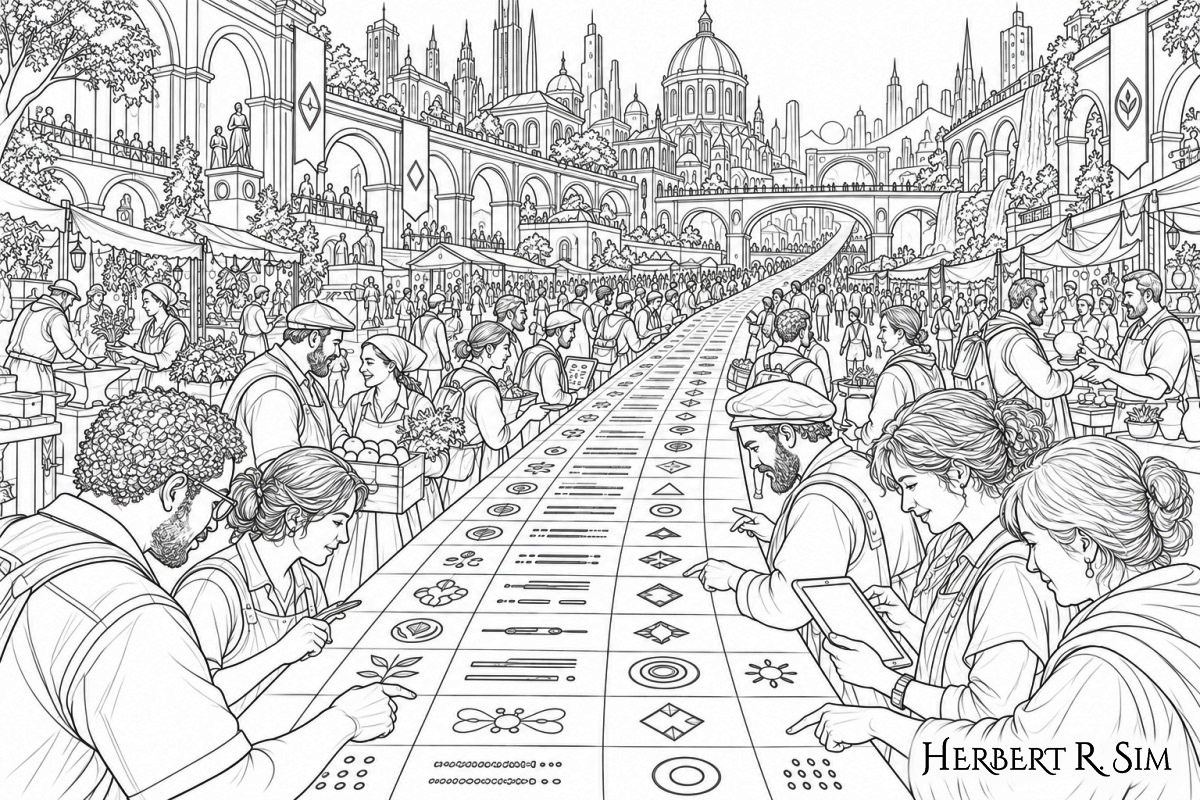
My illustration work-in-progress. The art represents a permissionless economy where people can independently record, verify and exchange value without a central gatekeeper.
Individual Agency Begins With Control
Agency is the ability to act deliberately and take responsibility for one’s actions.
In economic life, agency requires more than being allowed to use a system. It requires the practical ability to hold value, make choices, enter agreements and leave arrangements that no longer serve one’s interests.
Self-custody is an important expression of this agency. It allows an individual to hold digital value through private keys rather than only through an account administered by someone else. The individual assumes greater responsibility, but also retains greater control.
This does not mean every person must self-custody every asset. Many people may reasonably choose custodial services. The principle is that direct ownership should remain possible. Agency disappears when people have no option except dependence.
Networks Should Serve People, Not Capture Them
A network becomes powerful when participation in it becomes necessary for ordinary life.
Payment networks, digital platforms and financial institutions can create enormous benefits. They can also create dependency when they become the only practical route through which people may work, save, exchange or connect with others.
A healthy economic network should serve its participants without capturing them. It should provide value without making exit impossible. It should offer convenience without demanding surrender of ownership. It should protect against genuine harm without treating all independent action as a threat.
The strongest test is simple: if an individual loses confidence in the network, can they leave without losing the ability to participate in economic life?
If the answer is no, then the network possesses power that requires greater public scrutiny and stronger alternatives.
The Right to Exit Creates Accountability
The right to exit remains the essential protection against economic dependency.
Exit means that individuals can choose another provider, another network, another method of holding value or another means of exchange. It means that an institution cannot rely on coercive dependence to maintain participation.
When people can exit, institutions must earn trust. They must remain fair, reliable and responsive. When people cannot exit, institutions may impose conditions without fear of losing the people affected by them.
Bitcoin does not require anyone to abandon existing monetary systems. It creates an additional path. Its importance lies in the fact that it expands the individual’s ability to choose, and therefore expands the pressure on all monetary systems to remain accountable.
Money Without Permission Is Not Money Without Ethics
Open monetary networks do not remove ethical responsibility.
Individuals remain accountable for their conduct. Fraud, theft, coercion and deception remain wrong regardless of the technology used. Freedom to transact does not mean freedom to harm others.
But ethical responsibility should not be confused with the assumption that every peaceful transaction requires central permission. People should be able to cooperate voluntarily, exchange legitimate value and build lawful alternatives without first seeking approval from the institutions most threatened by those alternatives.
The proper purpose of economic rules is to protect people from genuine harm while preserving the ability of individuals to act, create and choose.
The Meaning of Monetary Freedom
Sovereign Capability Economics measures freedom through practical capacity. Can individuals create value? Can they retain ownership? Can they understand the systems that affect them? Can they choose another path when trust is lost?
Money without permission strengthens these capacities by creating an alternative to exclusive monetary dependence. It gives individuals a way to participate in an open network, hold value directly and establish trust through transparent rules rather than through compulsory reliance on a central authority.
The future of economic freedom will depend on whether people retain this ability. It will depend on whether monetary networks remain open, whether ownership remains meaningful and whether institutions must compete for trust rather than demand it by default.
Money without permission does not abolish trust. It restores choice over where trust is placed. Economic agency begins when individuals can hold value, transact peacefully and retain the right to choose another path.
Reference: Satoshi Nakamoto, Bitcoin: A Peer-to-Peer Electronic Cash System, 31 October 2008.