

My illustration entitled: “The Gatekeeper Network” – A vast city’s money, data, energy and trade routes converge at a central tower where a few gatekeepers control access, while independent paths remain visible at the edges.
Economic power is not held only by those who own the most money. It is also held by those who control the networks through which money, property, information, work and opportunity move.
A network can connect people, reduce cost and create new possibilities. It can allow a small business to reach a global market, a worker to find opportunity or an individual to transfer value across distance. But every network also raises a question of power: who sets the rules, who controls access and who can be excluded?
The architecture of economic power determines whether a network expands individual capability or concentrates control in the hands of gatekeepers.
Sovereign Capability Economics examines this architecture through a simple standard: individuals should be able to create value, retain ownership, gain knowledge, choose among meaningful alternatives and exit systems that no longer serve them.
Networks Shape Economic Life
Modern economic life is built on networks.
Payment networks connect buyers and sellers. Financial networks connect savings to investment. Commercial networks connect producers to customers. Communication networks connect information to decision-making. Digital networks increasingly connect people to employment, identity, trade and social participation.
Networks create value because they allow individuals to cooperate at scale. They reduce the cost of finding one another, exchanging information and entering into voluntary arrangements. A strong network can make opportunity more accessible and enable forms of enterprise that would otherwise be impossible.
But no network is neutral simply because it is useful. Its design determines where power is located.
If a network remains open, transparent and interoperable, individuals can participate, compare alternatives and build new services around it. If a network is closed, opaque and controlled by a small number of actors, participation becomes conditional upon their approval.
Gatekeepers Control the Conditions of Participation
A gatekeeper is any institution, platform or authority that can determine who may enter, remain or transact within an essential network.
Gatekeepers may perform legitimate functions. They can protect against fraud, maintain standards, provide security and coordinate complex systems. The existence of a gatekeeper is not itself the problem.
The problem arises when a gatekeeper becomes unavoidable.
When one institution has the power to decide who may hold value, access a market, receive payment, build a business or communicate with customers, its decisions affect more than individual transactions. It shapes the practical limits of economic freedom.
This power becomes more serious when the terms of participation are unclear, subject to change without consent or impossible to challenge. An individual may follow every rule and still face exclusion because the gatekeeper has the final authority to determine access.
Economic power is therefore not only the power to own resources. It is the power to control the routes through which other people must access resources.
Centralisation Creates Single Points of Failure
Centralised systems can be efficient. A single operator may coordinate services quickly, apply common standards and provide a simple experience for users.
Yet centralisation also creates a single point of failure.
When one institution controls a critical route, its mistakes, failures or abuses can affect everyone dependent on it. A change in policy can alter access for millions. A technical failure can interrupt commerce. A political decision can restrict the movement of value. A private decision can determine whether an individual may continue to participate in ordinary economic life.
The more essential the network, the greater the risk of allowing control to become concentrated in one place.
This does not mean that every centralised system must be dismantled. It means that essential systems should remain contestable. Individuals should have alternatives, and alternatives should be capable of emerging when existing systems fail to serve them fairly.
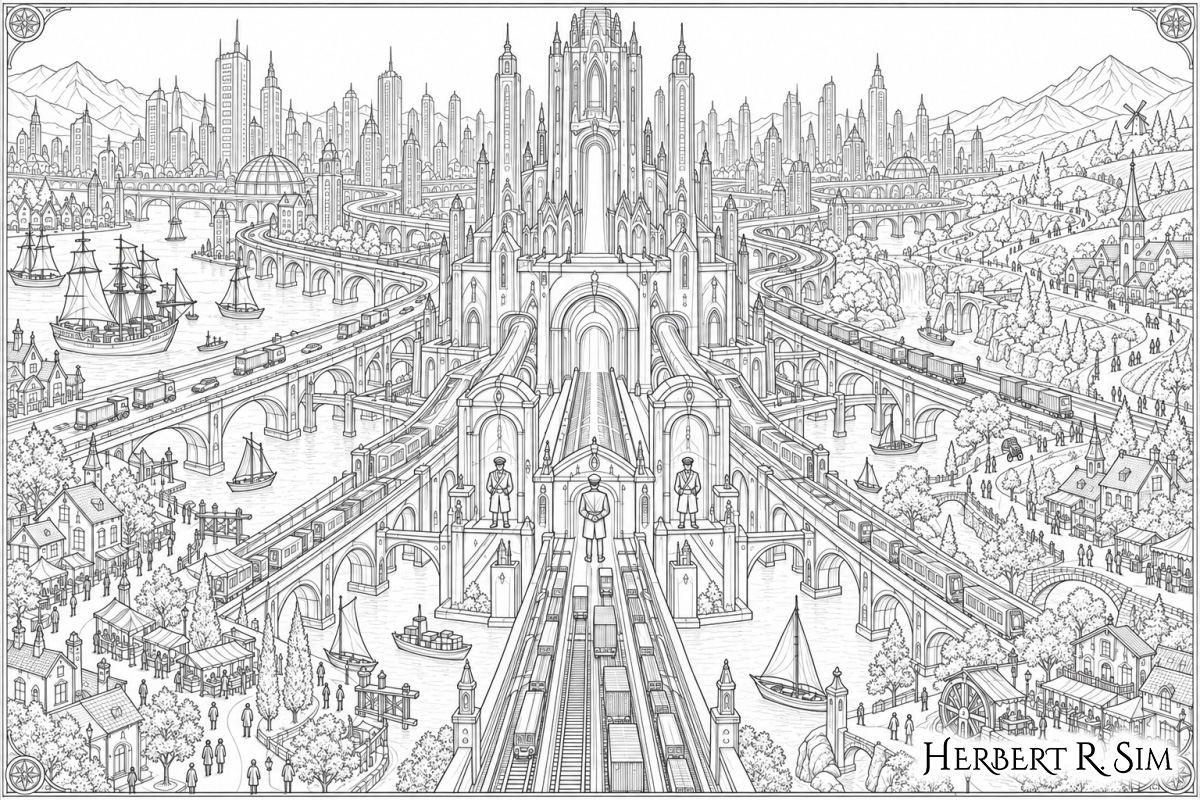
My illustration “The Gatekeeper Network” work-in-progress. The art represents how concentrated networks channel economic power through gatekeepers, while independent paths offer the freedom to exit.
Decentralised Networks Distribute Power
Decentralisation is not the absence of rules. It is the distribution of authority so that no single actor controls the entire system.
A decentralised network can allow participants to verify rules independently, interact directly and choose among different services without surrendering control over the underlying system. It can make a network more resilient because its continued operation does not depend entirely on one institution, one location or one decision-maker.
Bitcoin provides a practical example of this architecture. Its network allows participants to transfer value through shared rules and cryptographic verification, without relying on a central issuer to maintain the ledger or approve each transaction.
Bitcoin does not eliminate risk, disagreement or responsibility. It demonstrates, however, that money can be organised through a network in which participation is not controlled by a single gatekeeper.
Its importance lies in the alternative it creates. It shows that individuals can hold and move value through an open system, and that economic power can be distributed through technology rather than concentrated in an exclusive institutional centre.
The Right to Exit Is the Test of Freedom
The most important protection against unaccountable power is the right to exit.
Exit means more than closing an account or changing a provider. It means retaining the practical ability to leave an unfair system without losing the ability to participate in economic life. It means being able to preserve value, choose another network, build another enterprise or cooperate through another arrangement.
Without the right to exit, participation becomes increasingly compulsory. An individual may technically be allowed to refuse a system, but the consequences of refusal may be so severe that the choice is no longer meaningful.
The right to exit disciplines institutions. When people can leave, institutions must provide genuine value, maintain trust and remain responsive. When people cannot leave, institutions can impose conditions without having to earn confidence.
Economic liberty does not require that people leave every system. It requires that no system becomes so dominant that people have nowhere else to go.
Interoperability Protects Choice
Choice is stronger when systems can interact.
Interoperability allows people to move information, value and activity between different networks. It prevents an institution from trapping users merely because it controls the format, records or infrastructure on which participation depends.
A person should not have to surrender their entire economic history, relationships or property merely because they choose to leave one provider. A business should not be unable to compete because it cannot connect with the networks through which customers, payments or information flow.
Open standards and portable systems make it easier for alternatives to emerge. They reduce the cost of exit and make competition more meaningful. They also protect individuals from being treated as captive users rather than voluntary participants.
Where interoperability is absent, a network can turn into a closed economic territory. Where it is present, individuals retain greater capacity to choose.
Economic Power Must Remain Contestable
No institution should possess permanent and unquestionable control over the essential channels of economic life.
Governments, banks, corporations and digital platforms all have the capacity to serve people well. But they should remain accountable to the people affected by their decisions. Their power should be limited by transparency, competition, alternatives and the ability of individuals to exit.
This is not hostility to institutions. It is the basis of institutional legitimacy.
A trustworthy institution does not need to make departure impossible. It earns continued participation through fairness, competence and respect for those it serves. A confident network does not fear competition. It recognises that openness strengthens resilience and encourages innovation.
From Network Dependency to Economic Sovereignty
Sovereign Capability Economics is concerned with the practical capacity of individuals to direct their own lives. That capacity is weakened whenever essential networks become controlled by gatekeepers who cannot be questioned, challenged or left.
A person becomes more economically sovereign when able to create value independently, retain ownership over what is earned, understand the systems affecting them and choose among multiple paths for participation.
Networks should expand these capacities. They should connect people without making them captive. They should create opportunity without demanding permanent dependency. They should provide useful services without transforming access into a privilege.
The future of economic freedom will depend on how networks are designed: whether they remain open or closed, distributed or centralised, accountable or unchallengeable.
Economic power belongs not only to those who own value, but to those who control the routes through which value moves. Freedom survives when networks remain open, gatekeepers remain accountable and individuals retain the right to exit.
Reference: Satoshi Nakamoto, Bitcoin: A Peer-to-Peer Electronic Cash System, 31 October 2008.
Official Publication Record
The Architecture of Economic Power: Networks, Gatekeepers and Exit has been formally archived on Zenodo with a permanent DOI for citation, preservation and scholarly reference.
| Title | The Architecture of Economic Power: Networks, Gatekeepers and Exit |
| Author | Herbert R. Sim |
| ORCID | 0009-0008-6500-5749 |
| Publication date | 20 July 2016 |
| Canonical webpage | https://herbertrsim.com/architecture-economic-power/ |
| DOI | 10.5281/zenodo.22772544 |
| Zenodo record | https://zenodo.org/records/22772544 |
| Licence | Creative Commons Attribution 4.0 International Licence (CC BY 4.0) |
Preferred citation:
Sim, Herbert R. (2016). The Architecture of Economic Power: Networks, Gatekeepers and Exit. HerbertRSim.com.
https://doi.org/10.5281/zenodo.22772544
Copyright and licence:
© 2016 Herbert R. Sim. This work is licensed under the Creative Commons Attribution 4.0 International Licence (CC BY 4.0).
Zenodo submission note:
This work was submitted to Zenodo on 15 September 2026 for permanent scholarly preservation and citation.