

My illustration entitled: “The Human Who Holds Tomorrow” – A lone human stands on a vast stone platform above the clouds, holding a small, luminous model of a future city. Around them, colossal intelligent machines wait in silence, their immense hands open.
The future is often described through the capabilities of machines: how quickly they will calculate, how accurately they will predict, how much work they will perform. These are important questions. Yet another question deserves equal attention: what kind of authority will human beings retain within the world those machines help create?
A society can become technically extraordinary while leaving its members increasingly dependent on decisions they cannot understand or challenge. Greater productive power can coexist with weaker personal independence. Longer lives can unfold under narrower conditions of choice.
I use the expression “the sovereign future” to describe a different ambition: a future in which technological progress strengthens people’s practical authority over their lives.
Its central commitment is that expanding human capability should be accompanied by durable protections for judgment, consent, participation and responsibility.
1. The Human Being as an Author
A human life is more than a sequence of needs to be satisfied. People interpret experience, form commitments, make mistakes and discover purposes that others could not have selected for them.
Human sovereignty begins with respect for this authorship. Each person should have meaningful scope to determine what matters, pursue relationships and projects, and reconsider earlier decisions.
Such authority exists within a shared world. My choices cannot reasonably include an unrestricted licence to injure others or destroy the conditions of their freedom.
The challenge is to preserve personal authorship while organising cooperation. Institutions should help people live together without claiming unlimited authority to write their lives for them.
2. Intelligence Does Not Establish a Right to Rule
An intelligent machine may eventually perform some tasks better than any individual human. Even limited systems can calculate, classify and coordinate in ways that exceed unaided judgment.
These abilities establish reasons to consult a system. They do not independently establish its authority to determine the purposes people should pursue.
Knowing the fastest route does not settle where someone ought to travel. Predicting an outcome does not determine whether the risks are acceptable. Efficiently allocating resources does not resolve every question of fairness.
Delegation therefore requires boundaries. People must know which decisions have been entrusted to a system, which remain open to challenge, and who answers when the arrangement causes harm.
3. Capability and Sovereignty Must Be Examined Together
Consider a hypothetical device that greatly improves a person’s memory but requires continuous access to a supplier’s service. Its usefulness might be remarkable. Its recipient might also become vulnerable to changing prices, intrusive conditions or withdrawal of support.
The gain in capability and the distribution of authority are separate matters requiring joint assessment.
We should ask what the person can now accomplish, but also what they must surrender to retain that ability. Can they understand the conditions? Can they refuse additional demands? What happens if the provider fails?
A sovereign future welcomes powerful assistance while requiring serious attention to the dependencies through which that assistance is delivered.
4. Consent Must Survive the First Agreement
Agreement at the beginning of a relationship cannot authorise every subsequent change. Technologies evolve. Providers change ownership. New information reveals risks that neither party understood at the outset.
Consent should remain connected to the actual arrangement. Material changes require intelligible explanation and, where appropriate, renewed authorisation.
Withdrawal also requires careful design. Disconnecting an entertainment service differs from withdrawing support for an essential medical function. In some circumstances, immediate separation could cause serious harm.
That difficulty creates an obligation to plan for safe transition, limited permissions and continuity of care. It cannot reasonably become a justification for granting a provider permanent authority over the person who depends on it.
5. Privacy Gives Judgment Room to Develop
Independent judgment needs a protected space. People must be able to investigate unfamiliar ideas, seek advice and reconsider beliefs without exposing every uncertainty to those who possess power over them.
Observation can influence conduct before anyone issues a threat. Someone who expects an employer to inspect every inquiry may avoid exploring another occupation. Someone whose private doubts become public may abandon reflection under social pressure.
Privacy helps preserve the conditions in which a person can form an intention before being required to defend it.
Protection requires technical and institutional choices: restrained information collection, secure communications, clear access rules and meaningful consequences for misuse. Convenience alone cannot settle how much of a life should become observable.
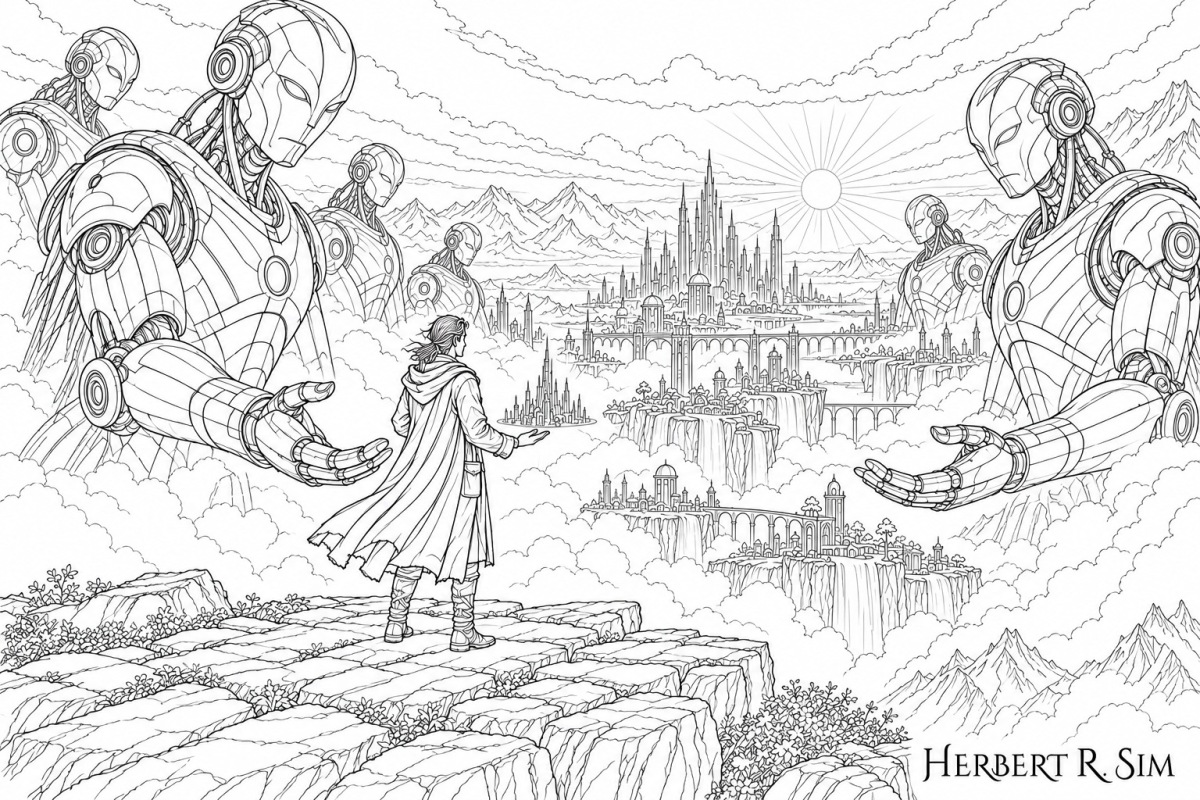
My illustration work-in-progress. Across the horizon, entire civilizations rise beneath a golden sunrise. The art represents that humanity retains the authority to shape its future, even when machines possess overwhelming power.
6. Economic Independence Supports Personal Authority
The ability to refuse depends partly on the means of surviving refusal. A person with savings, transferable skills and alternative opportunities can negotiate differently from someone whose livelihood depends entirely on one organisation.
Economic freedom therefore includes access to knowledge, productive resources and realistic opportunities to build.
Ownership matters because it can provide continuity when relationships change. Competition matters because it can limit a provider’s discretion. Education matters because an option that cannot be understood is difficult to exercise.
No society can eliminate every dependency. It can nevertheless prevent avoidable concentrations of power and help people acquire enough security to disagree without immediately losing the means of ordinary life.
7. Human Transformation Requires Equal Standing
Technologies that alter bodily or mental capabilities raise questions beyond safety and performance. They may change expectations about what a person must become to remain employable, respected or included.
A future of voluntary enhancement requires protection for those who decline it. Otherwise, a formally available choice may become compulsory through institutional pressure.
Those who adopt an enhancement also retain their standing as persons. Increased ability does not create an unlimited duty to serve employers, governments or neighbours.
We should make room for different ways of living and different judgments about acceptable risk. Rules governing shared activities may require particular capabilities, but those requirements need justification rather than automatic preference for technological conformity.
8. Institutions Must Remain Answerable
Personal sovereignty requires dependable institutions. Courts, professional bodies, public authorities and voluntary associations can protect people against powers they could not resist alone.
Their legitimacy depends on how they exercise their own authority. Rules should be understandable. Consequential decisions should admit explanation and review. Remedies should arrive while they can still protect someone’s life or livelihood.
Technical architecture can support these protections through limited access, inspectable records and transferable information. Institutional safeguards can address harms that technical design cannot prevent.
Neither arrangement is sufficient everywhere. The task is to connect them so that responsibility remains identifiable and a person encountering failure has somewhere effective to turn.
9. Freedom Includes Power to Shape Shared Systems
Choosing among finished products is only one form of participation. People also need opportunities to influence technologies that structure workplaces, public services and common environments.
A system can impose consequences on individuals who never purchased it. Monitoring equipment may observe passers-by. Automated administration may determine access to essential services. Industrial machinery may alter local living conditions.
Affected people therefore deserve consideration independently of their status as customers.
Participation should occur while important alternatives remain open. Designers contribute technical understanding; workers and communities contribute knowledge of consequences. Meaningful consultation requires a possibility of changing the proposal, supported by clear explanations of the decisions that remain negotiable.
10. Progress Must Leave Room for Correction
No generation possesses enough knowledge to design a final human future. Predictions fail, institutions drift and beneficial inventions reveal unexpected costs.
A responsible philosophy of progress must therefore value correction. Systems should allow errors to be discovered, responsibilities to be reassigned and arrangements to be revised without unnecessary destruction of what people have built.
Reversibility will sometimes be limited. A medical intervention may have lasting effects; infrastructure may require long commitments. Such cases call for stronger justification, careful preparation and protection against foreseeable failure.
Future people also deserve room to choose. Present convenience should not automatically outweigh their access to a habitable environment, usable knowledge and institutions capable of reform.
11. A Practical Standard for the Future
The sovereign future offers a direction for judgment rather than a prediction of inevitable progress.
When assessing a technology, I would ask whether it expands useful capabilities, preserves informed choice, distributes authority responsibly and gives affected people effective means of correction. I would examine whether its benefits remain accessible without unnecessary surrender of privacy, livelihood or personal independence.
These questions may reveal trade-offs. Security can require restrictions. Reliable cooperation can require commitments. Freedom carries responsibilities toward those affected by its exercise.
The standard is whether such burdens can be explained, challenged and fairly shared, with safeguards proportionate to the power involved.
We should aspire to build machines capable of extraordinary work and institutions capable of keeping that work answerable to human purposes. The measure of achievement must include the lives people can meaningfully direct within the resulting world.
A sovereign future is one in which people retain the practical authority to question, create, cooperate and change course as their capabilities grow.