

My illustration entitled: “The Four Colossi and the Human Charter” – Four immense figures surround a sunlit public square: a living biological giant, a translucent figure of encrypted light, a colossus assembled from bridges and marketplaces, and an articulated mechanical titan.
Arguments about freedom are often separated into different conversations. Medical ethics concerns the body. Computer security concerns information. Economics concerns ownership and exchange. Artificial intelligence concerns the growing capabilities of machines.
Yet a person lives through all these relationships at once. The patient is also a worker. The programmer is also a customer. The owner of a sophisticated device may depend on software, finance and professional support supplied by others.
I propose examining these relationships through four frontiers of sovereignty: bodies, code, markets and machines. Each concerns a different means through which people act. Together, they reveal how technological progress can expand our abilities while redistributing authority over our lives.
The central question is whether people retain meaningful influence over the conditions of their participation as these frontiers become increasingly connected.
The First Frontier: Authority Over the Body
The body is where many promises of progress become personal. Medicine can relieve suffering, restore movement and extend life. Prosthetic and other assistive technologies can open possibilities previously unavailable to their users.
These benefits deserve enthusiasm. They also require attention to who decides what happens to the person receiving them.
Bodily sovereignty begins with informed and voluntary consent. Someone considering an intervention needs understandable information about its purpose, risks, limitations and foreseeable demands. Consent becomes weaker when uncertainty is concealed or refusal attracts unrelated penalties.
Authority must also continue after an intervention. A person may need maintenance, adjustment or help responding to an unexpected effect. Their dependence should create responsibilities for providers, particularly where withdrawing support would threaten essential functioning.
We must also protect people who decline technological alteration. A workplace or public institution should justify any requirement that effectively makes an intervention compulsory. The availability of an enhancement does not establish that everyone ought to adopt it.
The guiding concern is the person’s continuing standing as someone entitled to participate in decisions about their own embodied life.
The Second Frontier: Authority Within Code
Code structures the environments through which people communicate, organise information and increasingly conduct ordinary affairs. It determines which actions are possible, which require approval and which leave a record.
A written policy may promise that users control their documents. The software may nevertheless prevent those documents from being opened elsewhere. An account may offer extensive personal settings while giving its operator unrestricted access to intimate information.
Digital sovereignty therefore requires examining how a system works alongside what its terms announce.
Encryption can protect communications against unauthorised access. Open standards can help people move between tools. Usable copies of records can preserve work when a service closes or changes direction.
These protections require judgment. Security measures can become difficult to use, and openness alone cannot guarantee reliable operation. People need tools suited to their abilities and circumstances.
The important question is whether technical arrangements give users dependable control over consequential choices, with assistance and remedies available when individual expertise is insufficient.
The Third Frontier: Authority in Markets
Markets influence sovereignty because resources shape the choices a person can realistically exercise. Savings provide time to leave an unsuitable job. Productive tools support independent work. Access to customers allows a small enterprise to survive without a powerful patron.
Formal permission to trade offers limited independence if entry requires resources available only to established organisations. Likewise, an apparent choice of suppliers may provide little protection when every supplier depends on the same exclusive infrastructure.
Economic sovereignty concerns the practical ability to earn, preserve resources, negotiate and pursue alternatives.
Competition can constrain institutional discretion, but effective competition requires opportunities to enter and reasonable possibilities of switching. Cooperative enterprises and voluntary associations may also give people influence they could not exercise individually.
Property rights contribute by securing claims against arbitrary interference. Their application must remain attentive to other people’s rights and shared resources.
The objective is a distribution of economic opportunities that gives ordinary people sufficient independence to question arrangements, seek improvement and build something different.
The Fourth Frontier: Authority Over Machines
Machines extend action. An automated system can sort applications, allocate tasks or recommend a course of action. More capable systems may increasingly assist decisions that once required extensive human judgment.
Delegating work changes where authority operates. Someone selects the objective, determines acceptable errors and decides which consequences the system should consider.
A scheduling program instructed to maximise output might overlook fatigue. A screening process designed to identify suspicious applications might impose serious burdens on people incorrectly selected.
The system’s consistency cannot settle whether those burdens are justified. Responsibility remains with the people and organisations designing, purchasing and operating it.
Machine sovereignty, in this discussion, means preserving accountable human authority over the deployment and consequences of machines. It requires defined permissions, appropriate review and practical ways to interrupt harmful operation.
Human oversight must have substance. A reviewer needs enough information, time and authority to disagree. Merely placing a person beside an automated process does not ensure that anyone can correct it.
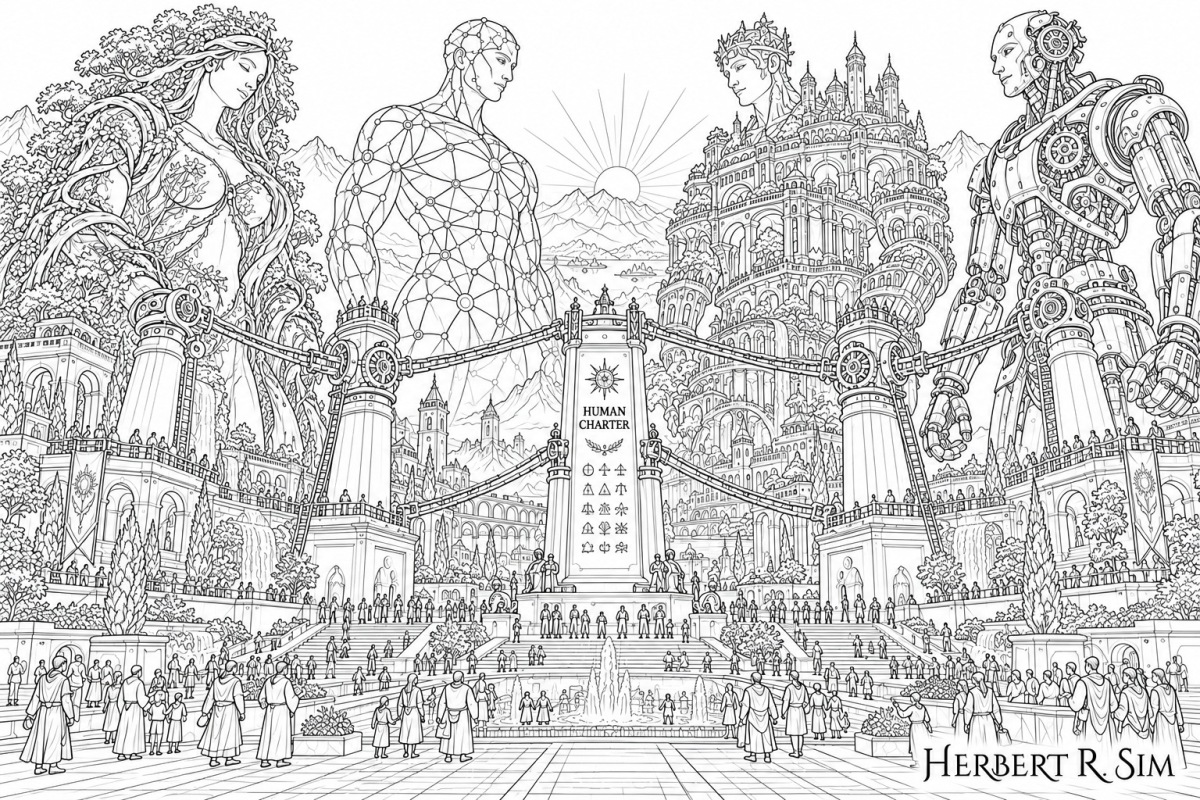
My illustration “The Four Colossi and the Human Charter” work-in-progress. Their powers connect to visible constitutional mechanisms maintained by citizens below. Open pathways run between all four. The art represents that every form of concentrated power needs enforceable limits and public accountability.
Where the Frontiers Meet
Consider a hypothetical worker who uses a powered prosthetic limb. The device improves mobility and supports employment. Its operation depends on proprietary software, specialist maintenance and an instalment contract.
One arrangement now crosses all four frontiers.
The bodily question concerns safety, consent and access to essential support. The question of code concerns access to settings, records and compatible software. The market question concerns affordability, servicing options and bargaining power. The machine question concerns how automated adjustments affect movement and who can correct unsafe behaviour.
Protecting only one relationship leaves important vulnerabilities unresolved. Ownership of the physical device offers little comfort if its essential software becomes unavailable. Strong privacy provisions cannot compensate for an unaffordable maintenance monopoly.
Equally, expanding access without ensuring safe support may expose recipients to preventable harm.
The example demonstrates why sovereignty requires a connected assessment. The freedom created at one frontier can depend on arrangements established at another. A person experiences the whole relationship, even when institutions divide responsibility into separate departments.
Safeguards Must Support One Another
This connection suggests a principle: protections should be assessed for how they work together.
Consent requires enough information to understand an arrangement. Information requires conditions under which people can ask questions without intimidation. Refusal requires alternatives or protection against disproportionate retaliation. Alternatives require resources, compatible systems and permission to build.
No single safeguard can carry this entire burden.
Transparency, for example, may reveal an unfair condition without giving anyone the power to change it. Portability may provide transferable records without an accessible provider willing to receive them. A complaints procedure may exist while essential support remains suspended.
Effective protection requires identifying what must happen for a right to become usable. Who explains the problem? Who can authorise correction? What resources keep the person secure while a dispute is resolved?
These questions move evaluation from reassuring promises to arrangements that can withstand disagreement and failure.
Shared Institutions and Legitimate Limits
Human sovereignty develops through cooperation. Individuals rely on professional knowledge, public infrastructure, enforceable agreements and the work of strangers. Dependence is an ordinary feature of social life.
The concern is how power operates within that dependence.
Some restrictions are justified. Medical equipment may require qualified maintenance. Financial services need safeguards against fraud. Industrial machines must operate within rules protecting workers and neighbours.
Restrictions should have identifiable purposes and remain open to examination. Their burdens should be proportionate, and less restrictive approaches should receive serious consideration.
Authority should also be distributed carefully. A supplier assessing the safety of a competing repair service has a commercial interest in the answer. Independent standards and review can help distinguish genuine protection from exclusion.
Public institutions need equivalent scrutiny. Their protective role depends on accessible procedures, accountable decisions and remedies capable of helping affected people.
The four frontiers call for institutions strong enough to uphold rights and sufficiently constrained to remain answerable for their own power.
A Connected Direction for Progress
The purpose of these four frontiers is to make technological judgment more complete. We should examine what a development enables, the dependencies it creates, the authority it distributes and the remedies available when something goes wrong.
People affected by deployment should have opportunities to contribute before important choices become difficult to reverse. Their experience may reveal consequences that technical specifications and commercial negotiations omit.
We should also preserve room for future revision. Reliable support, transferable knowledge and institutional accountability can help people retain useful capabilities while changing unsatisfactory arrangements.
A sovereign future depends on this continuing ability to shape the systems through which we live. Progress should give people greater scope to act, alongside dependable protections when the interests of users, providers and authorities diverge.
Across bodies, code, markets and machines, human sovereignty asks whether expanding power remains answerable to the people whose lives it changes.