
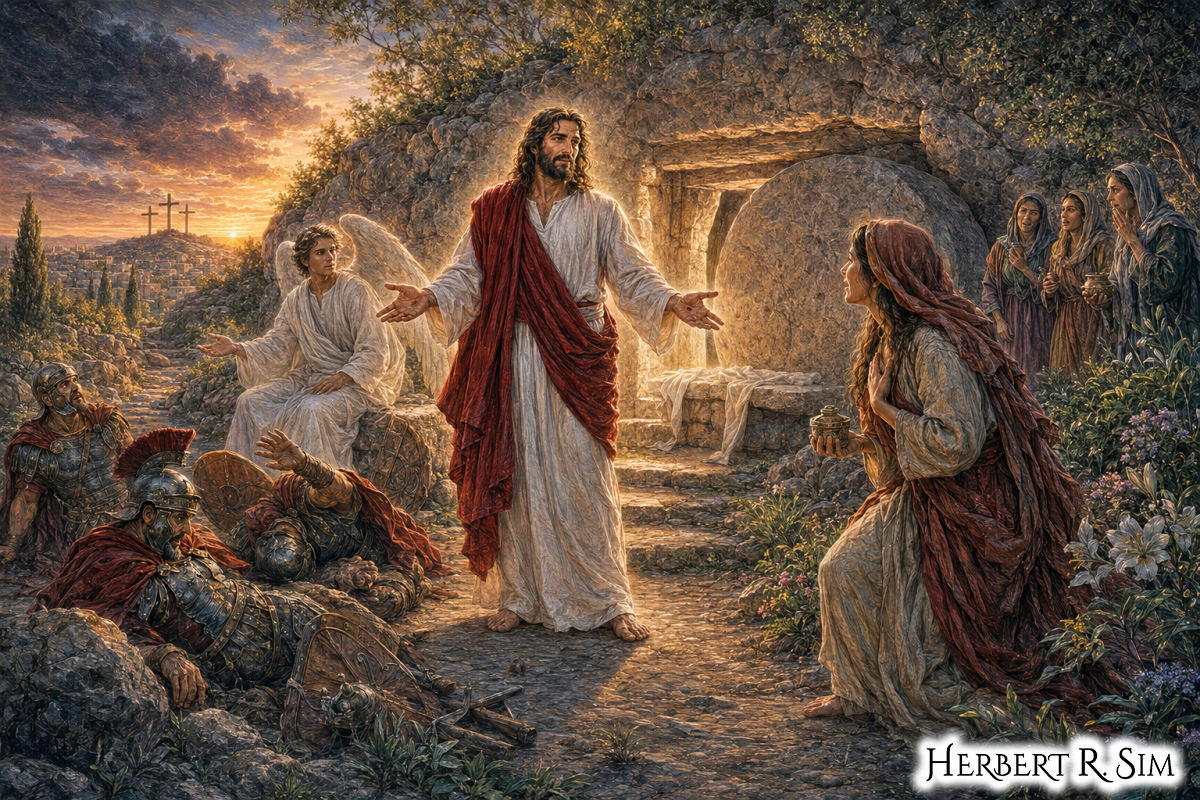
In my illustration above, I feature the resurrected Jesus Christ standing outside the empty tomb at sunrise. He is clothed in a radiant white robe with a deep red sash, while the wounds in His hands remain visible.
The enormous stone has been rolled away. An angel sits beside the entrance as brilliant light pours from within the tomb, illuminating the abandoned linen burial cloths. Mary Magdalene approaches in astonishment, while Roman guards lie overwhelmed upon the ground.
Behind Jesus, the darkness of Golgotha gives way to the first light of a new creation. Humanity had always entered the grave and remained there. Jesus Christ entered the grave—and came out alive.
After the Crucifixion of Jesus Christ, Joseph of Arimathaea received permission from Pontius Pilate to take down His body. Nicodemus brought spices, and together they wrapped Jesus in linen before placing Him inside a new tomb cut into the rock.
A great stone was rolled across the entrance.
The chief priests and Pharisees remembered that Jesus had said He would rise again after three days. Fearing that His disciples might steal the body and claim a resurrection, they asked Pilate to secure the tomb. A guard was stationed there, and the stone was sealed.
Every visible fact pointed toward finality.
Jesus had been publicly executed.
His death had been confirmed.
His body had been wrapped and buried.
The tomb had been closed, sealed and guarded.
His followers went into hiding. The disciples who had promised to remain loyal were frightened, confused and grieving. The One they believed to be the Messiah appeared to have been defeated by the same powers that had destroyed countless others.
Saturday passed in silence.
But the silence of the tomb was not the end of the story.
“He Is Not Here: For He Is Risen”
The discovery of the empty tomb is recorded in Matthew 28, Mark 16, Luke 24 and John 20.
Very early on the first day of the week, women came to the tomb carrying spices they had prepared for the body of Jesus. They were not expecting a resurrection. Their concern was practical: who would move the heavy stone for them?
Instead, they found the stone already rolled away.
Matthew describes a great earthquake and an angel of the Lord descending from Heaven. His appearance was like lightning, and the guards trembled before him and became like dead men.
The angel told the women:
“Fear not ye: for I know that ye seek Jesus, which was crucified. He is not here: for he is risen, as he said.”
The stone was not rolled away because the risen Christ needed assistance escaping from the tomb. The One who had conquered death was not imprisoned by a rock.
The entrance was opened so that the witnesses could see that the tomb was empty.
The angel invited them to inspect the place where the Lord had lain. The body was gone, but the burial place remained.
The empty tomb was not an abstract spiritual message.
It was a physical absence demanding an explanation.
The Women Who Came to Mourn Became the First Witnesses
The first people sent to announce the Resurrection were women who had come expecting to care for a dead body.
This detail is significant. The Gospel writers do not place a king, high priest, Roman governor or celebrated scholar at the entrance of the tomb. They place faithful women there—Mary Magdalene among them.
The women had remained near Jesus during His crucifixion when many disciples fled. They observed where His body was buried. Then, at the earliest opportunity after the Sabbath, they returned.
They came carrying burial spices.
They left carrying the greatest announcement in history.
“He is risen from the dead.”
Their testimony was initially met with disbelief. Luke records that the apostles considered the report to be like idle tales.
The disciples were not people psychologically prepared to believe anything comforting. They did not hear the words “empty tomb” and immediately celebrate. They doubted, investigated and struggled to understand.
The Resurrection confronted their unbelief before it transformed their lives.
Peter and John Run to the Tomb
When Mary Magdalene reported that the stone had been moved, Peter and John ran toward the burial place.
John arrived first and looked inside. He saw the linen cloths lying there but initially did not enter. Peter then arrived and went directly into the tomb.
The linen burial cloths remained, and the cloth that had covered the head of Jesus was lying separately.
John entered, saw and believed.
If robbers had taken the body, it would make little sense for them to unwrap it carefully inside a guarded tomb. If frightened disciples had somehow overpowered the Roman guard, broken the seal and stolen the body, they would have been manufacturing a lie for which they later accepted persecution and death.
The Gospels do record that the religious authorities circulated the claim that the disciples stole the body while the guards slept. But sleeping guards could not have witnessed who moved the stone or removed the body.
The empty tomb alone does not contain the entire Christian case for the Resurrection. A missing body can produce many theories.
The decisive development was that Jesus Himself began appearing alive.
“Mary”
Mary Magdalene remained outside the tomb weeping.
When she looked inside, she saw two angels where the body of Jesus had been. They asked why she was crying. She answered that someone had taken away her Lord and that she did not know where they had placed Him.
Mary then turned and saw Jesus standing nearby, but she did not recognise Him. Believing Him to be the gardener, she asked whether He had moved the body.
Jesus spoke one word:
“Mary.”
She recognised Him when He called her by name.
The moment is deeply personal. The Resurrection is an event of cosmic importance, yet the risen Christ first reveals Himself to a grieving woman by speaking her name.
Mary answered, “Rabboni”—Master.
Jesus then sent her to tell the disciples that He was alive. Mary Magdalene, who had come to mourn at a grave, became the first person recorded in John’s Gospel to announce:
“I have seen the Lord.”
The Christian message begins not with an idea that survived Jesus, but with witnesses claiming that they encountered Jesus Himself.
Not a Ghost, Clone or Digital Copy
Christianity does not merely claim that the teachings of Jesus lived on after His death.
It does not say that His followers preserved His personality through stories, reconstructed His voice or created a symbolic version of Him in their memories.
The claim is far greater and much more difficult:
The crucified Jesus physically rose from the dead.
When He later appeared to the disciples, they initially believed they were seeing a spirit. Jesus responded by showing them His hands and feet.
“Behold my hands and my feet, that it is I myself: handle me, and see; for a spirit hath not flesh and bones, as ye see me have.”
He then ate food in their presence.
The risen body of Jesus was transformed and glorified, no longer subject to death. Yet it remained connected to the body placed inside the tomb. The wounds in His hands and side could still be seen.
This continuity becomes especially clear in my earlier illustration, Jesus’ Special Resurrection Appearance for Doubting Thomas. Thomas was invited to examine the wounds left by the crucifixion. The One standing before him was not a substitute body pretending to be Jesus.
He was the same Jesus who had been crucified.
The Resurrection was not the creation of a clone. A clone would be another organism sharing the same genetic information.
It was not a hologram. A hologram can reproduce an appearance but possesses no living body.
It was not an artificial-intelligence simulation trained on the words of Jesus. A simulation may imitate a personality, but imitation is not resurrection.
It was not a mind upload. The Gospels do not describe the consciousness of Jesus being transferred into a different container while His corpse remained inside the tomb.
The tomb was empty.
Resurrection Is Greater Than Resuscitation
Jesus had previously raised people from the dead, including Jairus’ daughter, the widow’s son at Nain and Lazarus.
Those miracles restored ordinary mortal life. Lazarus came out of his tomb still wrapped in grave clothes. He returned to his family, but he would eventually face death again.
The Resurrection of Jesus was different.
He did not return merely to continue His previous biological life for a few more years. He rose into a transformed existence over which death no longer had authority.
The Apostle Paul writes in Romans 6:9:
“Christ being raised from the dead dieth no more; death hath no more dominion over him.”
Jesus therefore did not postpone death.
He passed through it and broke its dominion.
Lazarus was restored to mortal life.
Jesus rose to immortal life.
That is why the New Testament calls Christ the “firstfruits” of those who have died. His Resurrection is presented as the beginning of a greater harvest—the future bodily resurrection of those who belong to Him.
If Christ Is Not Risen
The Apostle Paul does not treat the Resurrection as an optional addition to Christianity.
He writes in 1 Corinthians 15:
“If Christ be not risen, then is our preaching vain, and your faith is also vain.”
He goes further: if Jesus remained dead, Christians are still in their sins, those who died believing in Christ have perished, and Christian hope is reduced to this present life.
Christianity therefore stands or falls with the Resurrection.
If the tomb contained the body of Jesus, the Cross would remain the death of another rejected teacher. His claims would be defeated by the grave.
But if Jesus rose, then His identity, teaching and promises must be confronted.
The Resurrection declares that the Cross was accepted, death was defeated and Jesus is who He claimed to be.
Paul lists appearances to Peter, the Twelve and more than five hundred people at one time, many of whom were still alive when he wrote. He also refers to his own encounter with the risen Christ.
The disciples changed from frightened men hiding behind locked doors into public witnesses willing to suffer for the proclamation that Jesus was alive.
Their transformation does not, by itself, force every skeptic to believe. People have died for ideas that were false. But there is an important difference between dying for something one mistakenly believes and knowingly suffering for an event one personally invented.
The apostles claimed not merely to possess a philosophy.
They claimed to have seen the risen Jesus.
Humanity’s Attempt to Manufacture Immortality
The modern world remains haunted by the same enemy confronted at the empty tomb.
Humanity now searches for immortality through genetic engineering, cellular rejuvenation, artificial organs, cryonics, cloning, brain–computer interfaces and artificial intelligence.
These technologies may achieve extraordinary medical benefits. They may heal disease, restore movement, extend healthy life and preserve memories. Christians should not reject every attempt to reduce suffering simply because technology is involved.
But extending life is not the same as conquering death.
A person who lives for 150 years still dies.
A body preserved inside a cryonic chamber remains dependent upon the hope that future science can repair and revive it.
A clone shares genetic information but is not the resurrection of the person who died.
An artificial-intelligence avatar may reproduce someone’s face, voice, memories and mannerisms. It may persuade grieving relatives that part of the person remains present. But a convincing digital imitation does not prove that the deceased individual has returned.
A theoretical mind upload raises the same question. Even if a machine could perfectly copy the information contained in a human brain, would the person awaken inside that machine—or would the machine merely believe that it was the person?
Transhumanism attempts to prolong human existence or transfer its patterns.
The Gospel announces the resurrection of the person.
As explored in my earlier article, Beyond Transhumanism, Posthumanism: Why Only Christ Conquers Death, science may delay some causes of death and alleviate enormous suffering. But no technology has emptied a grave in the manner Christianity claims for Jesus Christ.
Humanity attempts to escape death without leaving the present order.
Jesus inaugurates a new order in which death no longer rules.
The Firstfruits of a New Creation
The Resurrection is not only proof that Jesus survived death. It is the beginning of God’s promise to renew creation.
Paul describes Christ as the “firstfruits” of those who sleep. In an agricultural harvest, the firstfruits are the beginning and guarantee of what follows.
Jesus rises first.
Those who belong to Him will follow.
Christian hope is therefore not that believers become disembodied ghosts floating eternally away from creation. It is that God raises the dead and transforms mortal bodies into incorruptible ones.
The risen Christ is the pattern of that future.
He is recognisably Himself. He speaks, walks, eats and can be touched. Yet locked doors cannot confine Him, distance does not prevent His appearance and death can never claim Him again.
The wounds remain, but they no longer represent defeat.
They have become signs of victory.
This Resurrection hope eventually reaches its fulfilment in the promise of the New Jerusalem, where death, sorrow, crying and pain are removed. I explored that final biblical vision in Beyond Human Immortality: The New Jerusalem and the End of Death.
The empty tomb is therefore not an isolated miracle.
It is the opening scene of the new creation.
“Why Seek Ye the Living Among the Dead?”
The angels asked the women:
“Why seek ye the living among the dead?”
They had entered the burial place searching for someone who was no longer there.
Humanity continues searching among the dead for the secret of eternal life. We examine ageing cells, preserve bodies, map brains and build increasingly convincing digital replicas. Some of these efforts may produce valuable medicine and knowledge.
But the Christian answer to death is not located inside a laboratory, server or frozen chamber.
It is located in a Person who walked out of His tomb.
The empty tomb announces that death is no longer an unbroken prison. Someone has passed through its gates and returned with authority over it.
Jesus says in Revelation 1:18:
“I am he that liveth, and was dead; and, behold, I am alive for evermore.”
Christianity does not deny the reality of death.
It declares that death has been defeated.
Final Word: The Day Death Lost Its Dominion
On Friday, Jesus was crucified.
His enemies celebrated.
His disciples scattered.
His body was sealed inside a tomb.
On Saturday, everything was silent.
But on the first day of the week, the stone was rolled away.
The burial cloths remained.
The tomb was empty.
And Jesus Christ was alive.
The Resurrection transformed the meaning of the Cross. What appeared to be defeat became victory. What appeared to be abandonment became the fulfilment of God’s plan. What appeared to be the end became the beginning of a new creation.
Humanity dreams of defeating death by extending life.
Jesus defeated death by entering it and rising again.
Humanity dreams of preserving the information of the mind.
Jesus promises the resurrection of the whole person.
Humanity dreams of creating an immortal copy.
The Gospel presents the living Christ Himself.
The central declaration of Christianity is not merely that the teachings of Jesus remain relevant or that His followers kept His memory alive.
It is this:
“He is not here: for he is risen.”
The grave could not hold Him.
The stone could not imprison Him.
The Roman seal could not prevent Him.
Death could not master Him.
The empty tomb stands as Christianity’s answer to the oldest fear of humanity.
Jesus Christ is risen.
And because He lives, death will not have the final word.