
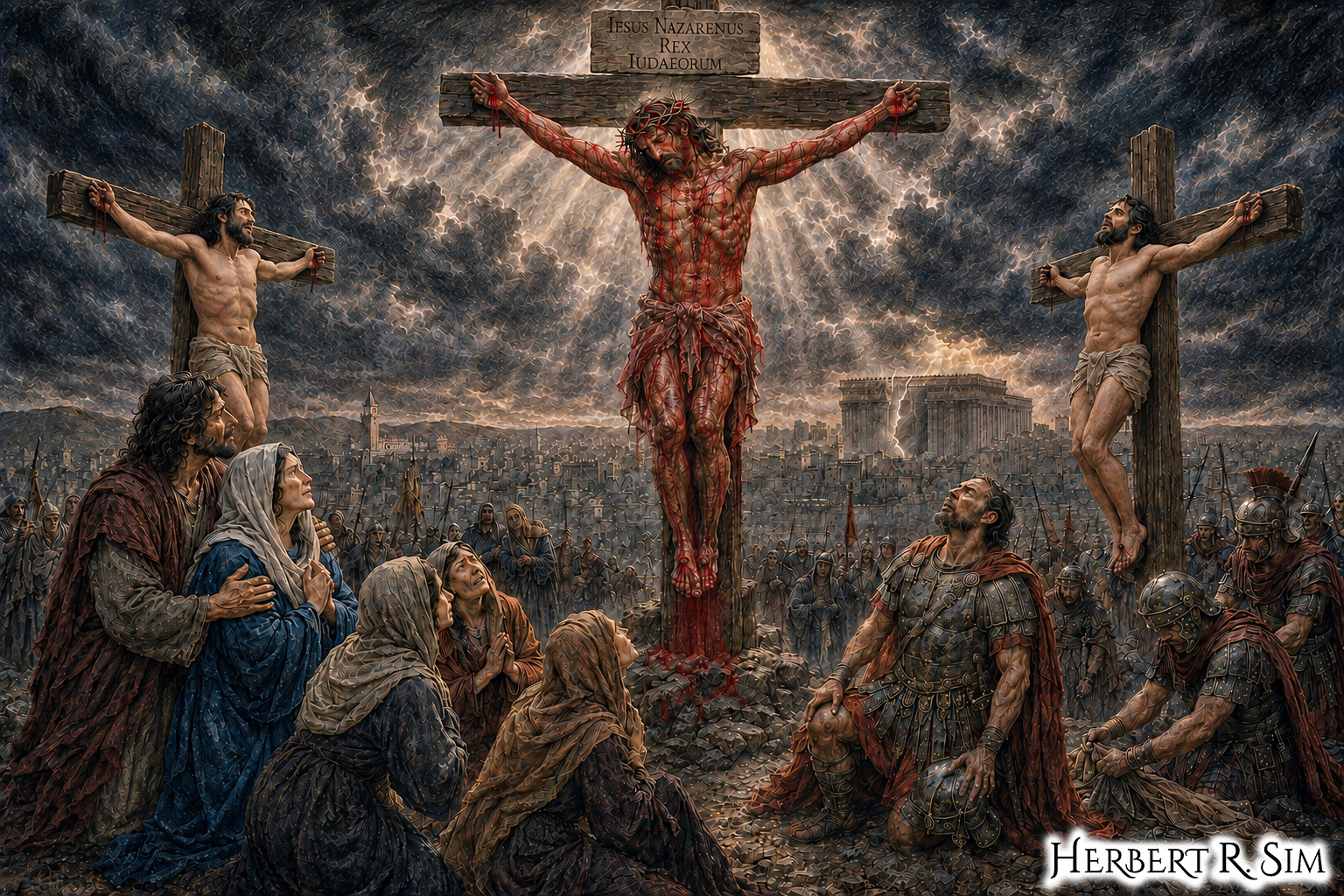
In my illustration above, I feature Jesus Christ crucified at Golgotha between two criminals. A crown of thorns remains upon His head, while a sign above Him declares, “Jesus of Nazareth, the King of the Jews.”
The sky has turned unnaturally dark. Mary, the mother of Jesus, stands below the Cross with the Apostle John and several faithful women. Roman soldiers gather nearby, while one centurion looks upward in astonishment. In the distance, the veil inside the Temple tears from top to bottom as divine light breaks through the darkness.
To the world, this appears to be the defeat of Jesus Christ. But the Cross is where His mission is completed.
After Jesus’ arrest in the Garden of Gethsemane, He was taken before the religious authorities, falsely accused, mocked and brought before the Roman governor Pontius Pilate.
Pilate repeatedly found no fault worthy of death in Him. Yet political pressure and the demands of the crowd prevailed. Barabbas, a prisoner associated with rebellion and murder, was released. Jesus was handed over to be scourged and crucified.
The innocent man was condemned.
The guilty man walked free.
In that exchange, Barabbas became a living picture of what the Cross would mean for humanity. The condemned sinner was released because Jesus took his place.
Roman soldiers stripped Jesus, placed a scarlet or purple robe upon Him and forced a crown of thorns onto His head. They put a reed in His hand, bowed mockingly and cried, “Hail, King of the Jews!” They struck Him, spat upon Him and turned the signs of kingship into instruments of humiliation.
Jesus was then made to carry His Cross toward Golgotha, as depicted in my earlier illustration, Jesus Christ Carrying the Cross. Weakened by the scourging, He was assisted by Simon of Cyrene.
The King who had entered Jerusalem over a road of palm branches now walked out of the city beneath the weight of a Roman Cross.
Golgotha: The Place of the Skull
The crucifixion of Jesus is recorded in Matthew 27, Mark 15, Luke 23 and John 19.
The place was called Golgotha in Aramaic and Calvary in Latin—both referring to the Place of the Skull.
Crucifixion was designed not only to kill, but to humiliate. Victims were displayed publicly as warnings against resisting Rome. The condemned person suffered exposure, thirst, exhaustion and agonising difficulty breathing while spectators watched.
Jesus was crucified between two criminals as though He were one of them. The One who had healed the sick, fed the hungry, welcomed children and raised the dead was numbered among transgressors.
The soldiers divided His garments and cast lots for His clothing. Hundreds of years earlier, Psalm 22 had described enemies surrounding the sufferer, mocking him and dividing his garments by lot.
The Cross therefore did not take God by surprise.
What appeared to be chaos was unfolding within the purpose revealed through Scripture.
The King of the Jews
Pilate ordered a title to be placed above Jesus:
“JESUS OF NAZARETH THE KING OF THE JEWS.”
John records that it was written in Hebrew, Greek and Latin, allowing the people gathered in Jerusalem to read it. The chief priests objected and asked Pilate to change the wording to say that Jesus merely claimed to be King of the Jews.
Pilate refused.
“What I have written I have written.”
The sign was intended to identify the accusation against Jesus and perhaps mock the people whose king Rome had crucified. Yet it proclaimed a truth greater than Pilate understood.
Jesus was King.
Not because Rome placed the title above His head, but because no earthly authority could remove the identity God had given Him.
His throne did not resemble the throne expected by the world. There was no palace, golden crown or army standing beneath Him.
His crown was made of thorns.
His royal robe had been torn away.
His throne was the Cross.
The rulers believed they were publicly disproving His kingship. In reality, the Cross revealed the nature of His Kingdom: sacrificial love, perfect obedience and victory achieved through self-giving.
“Father, Forgive Them”
The people passing Golgotha mocked Jesus. Religious leaders challenged Him to save Himself if He truly was the Messiah. Soldiers also ridiculed Him, and even one of the criminals joined the insults.
Jesus had healed others. Now they demanded that He come down from the Cross.
He possessed the power to do so.
But if Jesus saved Himself from the Cross, He would not save humanity through the Cross.
Instead of calling down judgment upon His tormentors, Jesus prayed:
“Father, forgive them; for they know not what they do.”
The nails had been driven into Him, yet forgiveness remained upon His lips.
This prayer does not declare that cruelty, injustice and murder are unimportant. It reveals that the mercy of Christ reaches even toward those responsible for His suffering.
The Cross confronts the human instinct for revenge. Jesus did not answer hatred with hatred. He absorbed violence without allowing violence to transform Him into the image of His persecutors.
The soldiers beneath Him saw another condemned man.
Jesus looked upon them as people still in need of forgiveness.
The Criminal Who Saw a King
Two criminals were crucified beside Jesus. One demanded that Christ save Himself and them. The other recognised his own guilt and rebuked him.
He then turned toward Jesus and said:
“Lord, remember me when thou comest into thy kingdom.”
The request was extraordinary.
Jesus did not look like a king. He was bleeding, mocked and dying. His disciples had scattered, and His enemies appeared victorious. Yet this condemned criminal saw beyond the humiliation and recognised a Kingdom still to come.
Jesus answered:
“Verily I say unto thee, To day shalt thou be with me in paradise.”
The man had no time to rebuild his life, perform great works or earn a religious reputation. He could only acknowledge his guilt and place his faith in Christ.
Grace reached him during the final hours of his life.
The first person to receive assurance from the crucified King was not a powerful ruler, celebrated priest or respected scholar.
He was a dying criminal who knew he needed mercy.
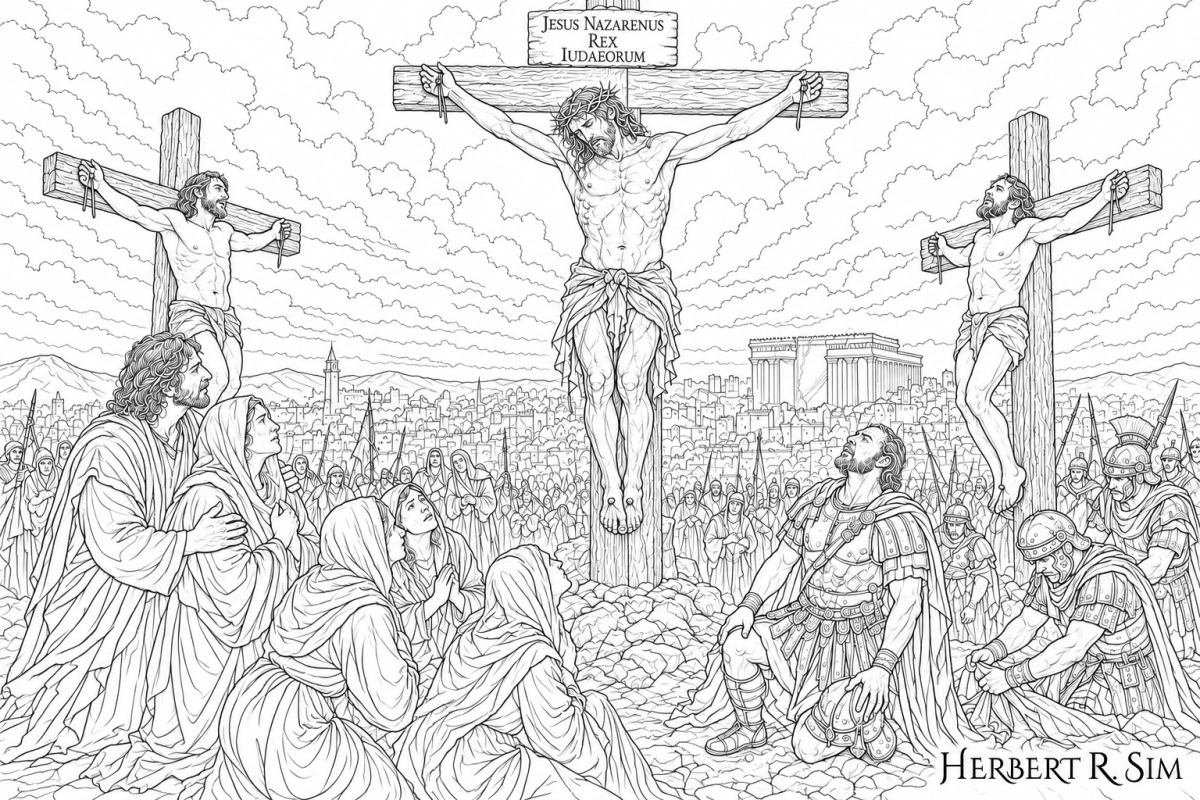
My illustration work-in-progress above.
“Behold Thy Son”
Near the Cross stood Mary, the mother of Jesus.
Decades earlier, when Jesus was still an infant, Simeon had warned Mary that a sword would pierce through her own soul. At Golgotha, she watched the child she had carried and raised suffer a public execution.
Jesus saw her standing beside the disciple whom He loved, traditionally understood to be John.
He said to Mary, “Woman, behold thy son,” and to the disciple, “Behold thy mother.” From that hour, John took her into his own home.
Even while enduring the Cross, Jesus remained concerned for His mother.
His suffering did not make Him indifferent to the suffering of another person. In the middle of an event affecting the salvation of the world, He still saw one grieving woman standing beneath Him.
The Cross reveals love on both the cosmic and personal level.
Christ was bearing the sins of humanity, yet He did not overlook the needs of His family.
Darkness Over the Land
From the sixth hour until the ninth hour—from approximately noon until three in the afternoon—darkness covered the land.
This was the brightest part of the day, yet creation itself appeared to enter mourning.
The darkness reflected the judgment and spiritual weight of what was taking place. Jesus, the Light of the World, hung upon the Cross while the land was covered in shadow.
He cried out:
“My God, my God, why hast thou forsaken me?”
These words open Psalm 22. Jesus was not speaking randomly in His agony. He was directing attention toward a prophetic psalm that begins with abandonment but ends in vindication and the proclamation of God’s righteousness to future generations.
The cry also reveals the terrible depth of the Cross.
Jesus was not experiencing only physical death. He was bearing sin and its judgment. The sinless One entered the darkness that belonged to sinners.
The Apostle Paul would later write:
“For he hath made him to be sin for us, who knew no sin; that we might be made the righteousness of God in him.”
The Cross shows both the seriousness of sin and the extent of God’s love.
If reconciliation required nothing, the Cross would not have been necessary.
If humanity were beyond redemption, Christ would not have gone there.
“I Thirst”
Jesus said, “I thirst.”
The statement is brief, but it reveals His genuine humanity. The Son of God did not merely appear to suffer. His body had been scourged, exposed to the sun and deprived of water. Crucifixion produced extreme thirst.
John also explains that Jesus spoke so the Scripture might be fulfilled. Psalm 69:21 says:
“In my thirst they gave me vinegar to drink.”
A vessel of sour wine was nearby. A sponge was filled, placed upon hyssop and lifted to His mouth.
The One who had offered living water to the woman at the well now experienced thirst.
The One through whom the waters were created allowed Himself to become dehydrated upon a Cross.
He entered fully into human suffering so that humanity could receive eternal life through Him.
“It Is Finished”
After receiving the sour wine, Jesus declared:
“It is finished.”
In Greek, the word is tetelestai: completed, accomplished, brought to its intended conclusion.
Jesus did not say, “I am finished.”
He announced that the work He came to perform had been completed.
The prophecies had been fulfilled.
The obedient life had been lived.
The cup accepted in Gethsemane had been consumed.
The sacrifice for sin had been offered.
Nothing remained to be added by another sacrifice. Humanity could not improve upon the work of Christ through wealth, status, intelligence or religious performance.
The Cross was not the failure of His mission.
It was its completion.
Jesus then cried with a loud voice:
“Father, into thy hands I commend my spirit.”
He bowed His head and gave up His spirit.
Even in death, the Gospels present Jesus as acting willingly. His life was not ultimately taken from Him; He laid it down.
The Veil Was Torn
At the moment Jesus died, the veil of the Temple was torn in two from top to bottom.
The veil separated the Holy of Holies from the rest of the sanctuary. It represented the boundary between sinful humanity and the holy presence of God. Only the high priest could pass beyond it, and only at the appointed time with sacrificial blood.
Its tearing from top to bottom signified an act initiated by God.
Through the sacrifice of Christ, the barrier had been opened.
Access to God would no longer depend upon one earthly high priest entering one physical sanctuary on one day of the year. Jesus had become the perfect High Priest and the final sacrifice.
Matthew also records that the earth shook and rocks split. Tombs opened. The death of Jesus was not presented as the quiet disappearance of an unsuccessful teacher.
Creation responded.
The Roman centurion and those guarding Jesus became afraid. Having witnessed the earthquake and the manner of His death, the centurion declared:
“Truly this was the Son of God.”
The religious leaders had rejected Him. His disciples had fled. Yet a Roman soldier standing at the site of execution recognised that the man on the central Cross was unlike any other.
The Lamb of God
The death of Jesus took place during Passover, when Israel remembered its deliverance from slavery in Egypt. In the original Passover, the blood of a lamb marked the homes of God’s people and protected them from judgment.
John the Baptist had identified Jesus at the beginning of His ministry with the words:
“Behold the Lamb of God, which taketh away the sin of the world.”
At the Cross, the meaning of that declaration became visible.
Jesus was not merely another victim of Roman cruelty, although the injustice committed against Him was real. He was the willing sacrifice toward which the Passover pointed.
Isaiah had prophesied of a servant who would be wounded for our transgressions, bruised for our iniquities and led like a lamb to the slaughter.
“The chastisement of our peace was upon him; and with his stripes we are healed.”
Christianity does not teach that God ignored sin. It teaches that Christ bore its consequence.
Justice and mercy met at the Cross.
Final Word: The Cross as Victory
To the disciples watching from a distance, everything appeared lost.
Jesus was dead.
His body would be removed from the Cross, wrapped in linen and placed inside a borrowed tomb. A stone would be rolled across the entrance, and Roman guards would secure it.
The religious authorities believed the threat had been eliminated.
Rome had completed another execution.
Satan appeared to have won.
But the Cross was not Satan’s triumph over Christ.
It was Christ’s triumph over sin.
Jesus did not conquer by climbing down from the Cross. He conquered by remaining upon it until the work was complete.
He answered mockery with forgiveness.
He answered guilt with grace.
He answered abandonment with obedience.
He answered sin with sacrifice.
The Cross reveals the terrible price of redemption, but it also reveals how far God was willing to go to redeem humanity.
The final words were not, “It is over.”
They were, “It is finished.”
The sacrifice was complete.
The debt of sin had been answered.
The way into the presence of God had been opened.
And although the body of Jesus Christ was placed inside a sealed tomb, death had not received the final word.
Sunday was coming.