
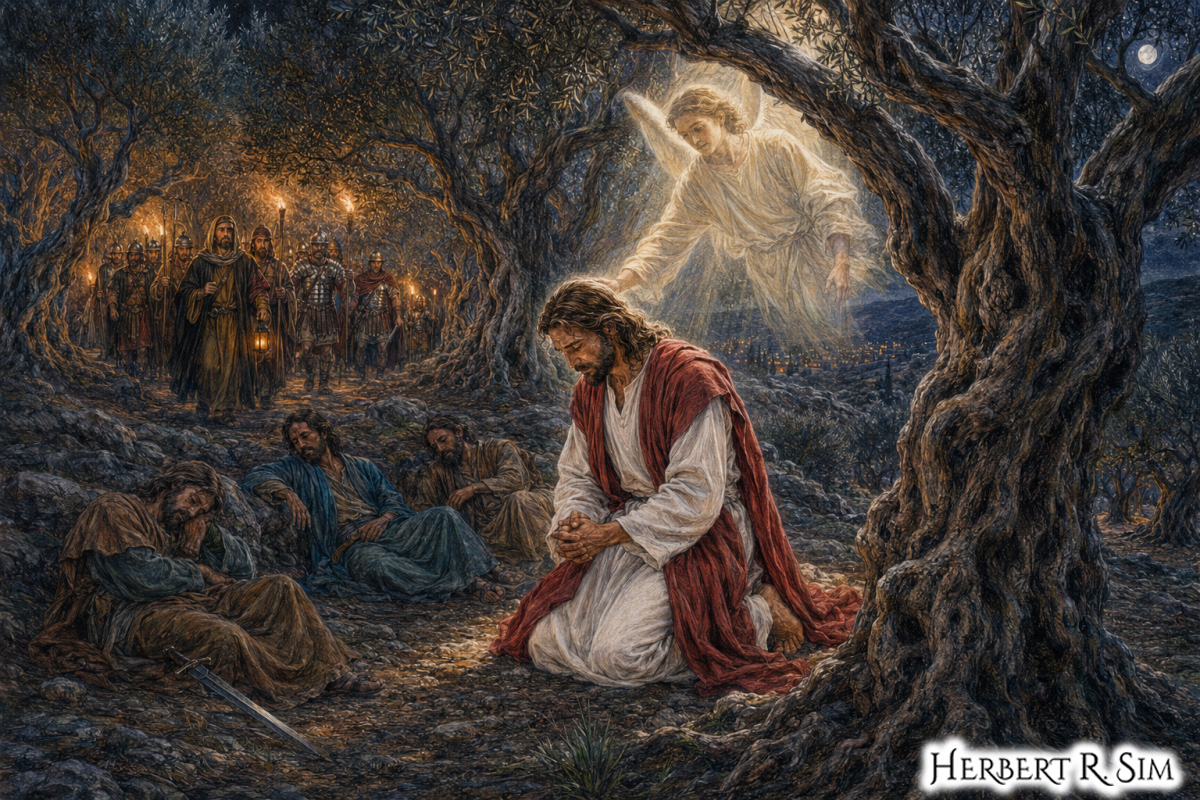
In my illustration above, I feature Jesus Christ praying alone in the Garden of Gethsemane beneath the ancient olive trees. His face is filled with sorrow as He kneels before God, while Peter, James and John sleep a short distance behind Him.
An angel descends through a beam of heavenly light to strengthen Jesus. Beyond the trees, Judas Iscariot approaches with armed soldiers carrying torches, swords and clubs. Peter’s sword lies near his sleeping hand, foreshadowing the violence that Jesus will soon refuse.
The darkness is closing around Him. Yet before Jesus is arrested by men, He has already surrendered Himself to the will of His Father.
After sharing the Last Supper with His disciples, Jesus crossed the Kidron Valley and entered a garden at the foot of the Mount of Olives. The place was called Gethsemane.
The events that followed are recorded in Matthew 26:36–56, Mark 14:32–52, Luke 22:39–53 and John 18:1–12.
Judas knew the location because Jesus had often gathered there with His disciples. What had been a place of prayer and fellowship became the setting for betrayal.
Jesus knew Judas was coming.
He knew soldiers were approaching.
He knew the trials, scourging and crucifixion that awaited Him.
He could have left the garden before they arrived. He could have hidden elsewhere in Jerusalem or escaped into the surrounding countryside. Instead, He remained.
Gethsemane was not where Jesus lost control of events.
It was where He willingly submitted to what must come next.
“My Soul Is Exceeding Sorrowful”
Jesus told most of the disciples to remain near the garden’s entrance. He then took Peter, James and John farther inside and began to experience profound sorrow and distress.
He told them:
“My soul is exceeding sorrowful, even unto death: tarry ye here, and watch with me.”
The Gospels do not present Jesus as emotionally untouched by the suffering ahead. He did not walk toward the Cross pretending that pain, abandonment and death were insignificant.
He was fully divine, but He was also fully human.
Jesus knew what crucifixion involved. He understood the physical agony of scourging, nails driven through flesh, slow suffocation and public humiliation. He knew His disciples would abandon Him. Peter would deny Him. The authorities would mock Him, and the crowds would watch Him die between criminals.
Yet His anguish went deeper than fear of physical pain.
Jesus, who knew no sin, was preparing to bear the burden of sin. The One who had lived in perfect fellowship with the Father was approaching the terrible darkness expressed upon the Cross in the words, “My God, my God, why hast thou forsaken me?”
The weight of what lay ahead pressed upon Him in the garden.
The name Gethsemane is commonly understood as “oil press.” Olives were crushed there so that their oil could flow. The symbolism is striking: in this garden, Jesus was placed beneath an unimaginable spiritual pressure before His blood would be poured out at Calvary.
He asked His closest disciples for one thing—to remain awake and watch with Him.
But they fell asleep.
The Cup Before Him
Jesus went a short distance beyond the disciples, fell upon His face and prayed:
“O my Father, if it be possible, let this cup pass from me: nevertheless not as I will, but as thou wilt.”
The “cup” appears throughout Scripture as an image of suffering, judgment and divine wrath. Jesus was not asking whether He could avoid an unfortunate accident. He was confronting the purpose for which He had come.
His prayer reveals the genuine horror of what He faced.
It also reveals perfect obedience.
Jesus did not say that suffering was good in itself. He did not desire pain for the sake of pain. He asked whether the cup could pass from Him—but He placed the Father’s will above His own human desire to escape suffering.
“Not as I will, but as thou wilt.”
These words represent one of the greatest acts of submission recorded in the Bible.
In the Garden of Eden, humanity rejected God’s command and chose its own will. Adam’s disobedience opened the door to sin and death.
In the Garden of Gethsemane, Jesus submitted His will to the Father. His obedience would lead Him toward death—and through death, toward the redemption of humanity.
The first garden witnessed rebellion.
The second garden witnessed surrender.
Adam reached for what God had forbidden.
Jesus accepted the cup the Father had placed before Him.
Sweat Like Great Drops of Blood
Luke records that an angel appeared from Heaven and strengthened Jesus. Even with this divine strengthening, His agony intensified.
Luke writes:
“And being in an agony he prayed more earnestly: and his sweat was as it were great drops of blood falling down to the ground.”
The passage does not say that Jesus merely recited a calm ceremonial prayer. His whole being was engaged in the struggle. He prayed with such intensity that His sweat fell like great drops of blood.
Some have attempted to explain the description through a rare medical condition associated with extreme distress. Whether Luke intended a literal medical diagnosis or a vivid comparison, the meaning is unmistakable: Jesus experienced overwhelming anguish.
He prayed three times.
Each time, He returned to find His disciples asleep.
Peter had confidently declared that he would never abandon Jesus. Yet he could not remain awake for a single hour. The man who believed himself ready to die with Christ was not prepared even to watch and pray with Him.
Jesus warned:
“Watch and pray, that ye enter not into temptation: the spirit indeed is willing, but the flesh is weak.”
This warning was not only about physical sleep. A spiritual crisis was approaching, and the disciples were unprepared because they did not recognise the seriousness of the hour.
Within moments, they would face armed soldiers, the arrest of their Master and the apparent collapse of everything they believed would happen.
Prayer prepared Jesus to stand.
The absence of prayer left the disciples ready to scatter.
Betrayed With a Kiss
The silence of the garden was broken by the arrival of torches, weapons and armed men. Judas led a group sent by the chief priests and elders.
The betrayal had been carefully arranged. Judas gave the soldiers a sign:
“Whomsoever I shall kiss, that same is he: hold him fast.”
A kiss was normally an expression of friendship, loyalty and respect. Judas transformed it into an instrument of betrayal.
He approached Jesus and said, “Hail, master,” before kissing Him.
Jesus replied:
“Friend, wherefore art thou come?”
Jesus knew Judas had already agreed to betray Him for thirty pieces of silver. He had identified the betrayer during the Last Supper. He knew the meaning of the kiss before Judas touched Him.
Yet He still addressed Judas as “friend.”
The darkness of Judas’ action becomes greater because he was not betraying a stranger. He had travelled with Jesus, heard His teaching, witnessed His miracles and shared meals with Him. His betrayal came from within the circle of disciples.
It is possible to stand close to Jesus physically, speak religious words and appear to belong among His followers while the heart has already turned away.
Judas used the appearance of devotion to conceal an act of treachery.
But Jesus was not deceived.
“I Am He”
John records another extraordinary detail.
Jesus stepped forward and asked the approaching men, “Whom seek ye?”
They answered, “Jesus of Nazareth.”
Jesus said, “I am he.”
At His words, the armed group drew backward and fell to the ground.
The soldiers arrived as though they were hunting a dangerous fugitive. Instead, Jesus came forward to meet them. He did not wait to be discovered and did not attempt to disguise Himself among the disciples.
The moment reveals who truly possessed authority in the garden.
Jesus was surrounded, but He was not powerless.
He was being arrested, but He was not being taken against His will.
After identifying Himself, Jesus asked that His disciples be allowed to leave. Even as His own suffering began, He protected those who had failed to remain awake with Him.
He had already said that no man could take His life from Him. He would lay it down voluntarily.
The ropes placed around His hands did not create His surrender.
His surrender had already occurred in prayer.
Peter’s Sword and the Way of Christ
When the soldiers moved to seize Jesus, Peter drew a sword and struck the servant of the high priest, cutting off his right ear. John identifies the servant as Malchus.
Peter may have believed that he was finally proving his courage. He had failed to watch, but now he was ready to fight.
Jesus immediately stopped him.
“Put up again thy sword into his place: for all they that take the sword shall perish with the sword.”
Jesus then healed the injured man.
The final miracle He performed before His crucifixion was an act of mercy toward someone who had come to arrest Him.
Peter responded to danger by drawing blood.
Jesus responded by restoring what Peter had damaged.
Christ explained that He could ask His Father for more than twelve legions of angels. The armies of Heaven were available to Him. If His purpose had been self-preservation, no human force could have held Him.
But if Jesus escaped the arrest, how would the Scriptures be fulfilled?
The Cross required Him to refuse the path of violent resistance.
Jesus did not need Peter’s sword. He possessed the authority to call angels, silence storms, cast out demons, heal the sick and raise the dead. His decision not to use that power for His own escape was not weakness.
It was obedience.
“Then All the Disciples Forsook Him”
Jesus confronted the arresting party and asked why they had come with swords and clubs as though He were a thief. He had taught publicly in the Temple, yet they had not arrested Him there.
They chose darkness because their actions could not withstand the light.
Luke records Jesus saying:
“This is your hour, and the power of darkness.”
The religious authorities believed their plan was succeeding. Judas had delivered Jesus into their hands. The soldiers had surrounded Him. His disciples were frightened and confused.
Then the disciples fled.
Jesus was left alone with His captors.
The same men who had promised loyalty abandoned Him when following became dangerous. Their courage disappeared when the Kingdom of God no longer looked victorious according to human expectations.
But even their abandonment fulfilled what Jesus had already foretold.
The Shepherd would be struck, and the sheep would scatter.
The apparent victory of darkness had begun. Jesus would be bound, questioned, falsely accused, mocked and condemned.
Yet the darkness was operating within limits established by God. The arrest did not interrupt the plan of salvation. It moved that plan toward its fulfilment.
Final Word: The Victory Before the Cross
The victory of Jesus Christ did not begin when the stone rolled away from the tomb.
Before Calvary, there was Gethsemane.
Before the nails, there was the cup.
Before Jesus surrendered His body to the soldiers, He surrendered His will to the Father.
Gethsemane shows us that obedience is not the absence of anguish. Courage is not pretending that suffering does not hurt. Faithfulness means continuing to obey God even when the cost is fully understood.
Jesus did not face death without sorrow.
He faced sorrow without turning away.
He could have escaped the garden.
He remained.
He could have called armies of angels.
He refused.
He could have allowed Peter’s sword to begin a rebellion.
He healed the wounded man instead.
The soldiers believed they were taking Jesus to the Cross.
In reality, Jesus had already chosen the Cross.
The decisive words were spoken before Judas arrived, before the ropes were placed upon Him and before the first accusation was made:
“Not my will, but thine, be done.”
Humanity’s salvation moved forward through that surrender.
The King who rode willingly into Jerusalem now walked willingly into captivity.
And the road from Gethsemane led directly toward Calvary.