
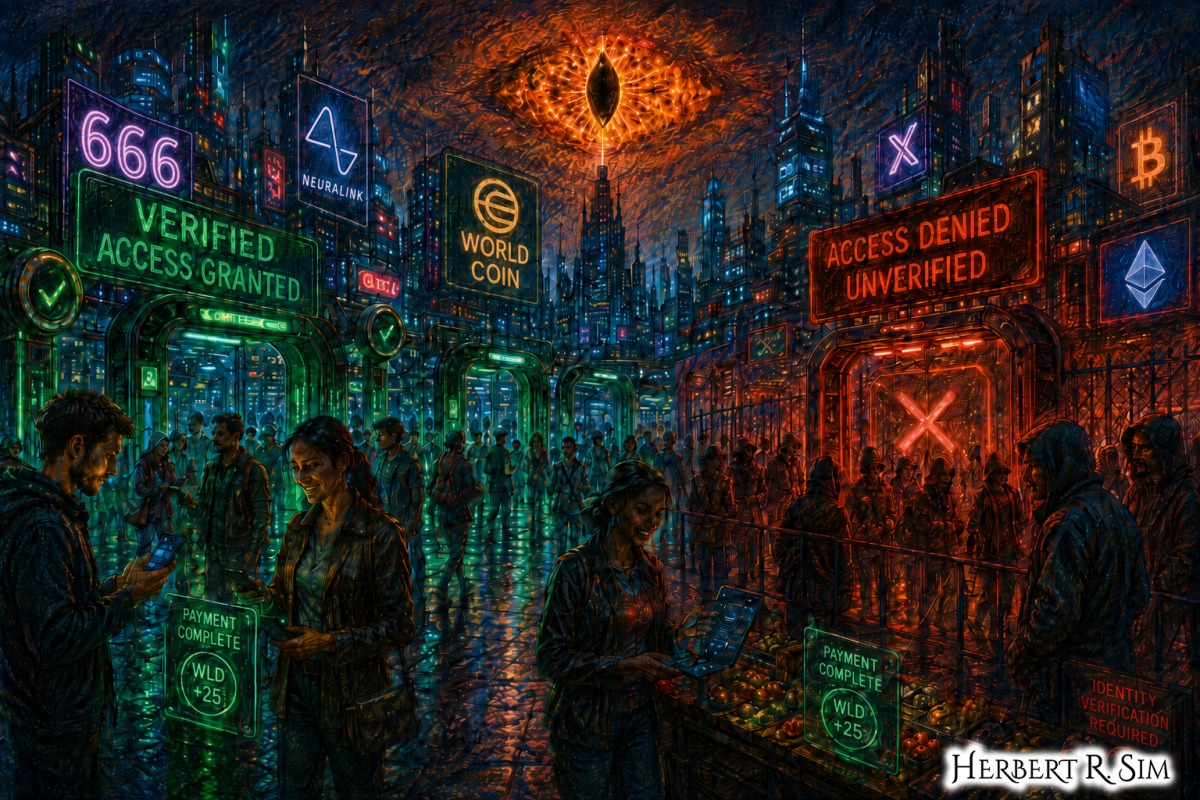
In my illustration above, inspired by “Eye of Sauron” from Lord of the Rings. When identity becomes currency, freedom becomes permission. The future may not ask for the mark—it may simply require verification. 👁️⃤
For almost two thousand years, readers of the Book of Revelation have debated one of its most disturbing visions. Revelation 13:16–18 describes a system that compels people to receive a “mark of the beast” on the right hand or forehead and says that no one may buy or sell without it. The passage associates that system with the number 666.
Every technological generation has interpreted this warning through the inventions of its own era. Earlier generations feared identification numbers, barcodes, credit cards or implanted microchips. Today, another possibility is emerging: the mark may not begin as a visible brand. It may begin as a universal digital identity linked to the human body and, eventually, to economic participation.
On July 24, 2023, Worldcoin officially launched. Co-founded by OpenAI chief executive Sam Altman, it offers a credential called World ID. A person obtains a verified World ID by looking into a silver spherical device known as the Orb, which scans the iris to confirm that the applicant is a unique human rather than an artificial-intelligence bot. In eligible countries, verified users may also receive the WLD cryptocurrency token.
Worldcoin is not the biblical Mark of the Beast. There is no evidence that its founders intend to fulfil prophecy, and an iris scan is not a mark placed on the forehead or right hand. Yet Worldcoin may still be historically significant because it combines four components that a Revelation-like economic system would require: universal identity, bodily authentication, digital money and rules determining who is recognised as a legitimate participant.
From Proof of Humanity to Permission to Participate
Worldcoin presents itself as a response to a genuine problem. As generative AI improves, fluent language and realistic online behaviour will no longer prove that an account belongs to a person. Worldcoin therefore proposes “proof of personhood”: a way for someone to establish that he or she is one unique human without necessarily revealing a conventional legal identity.
Its ambition extends beyond a cryptocurrency giveaway. Its founders have described a global identity and financial network intended to reach billions of people. When Worldcoin first attracted attention in 2021, privacy specialists questioned whether distributing tokens in exchange for eye scans could create unacceptable risks. By early 2023, IEEE Spectrum was describing it not merely as a currency, but as a potential identity layer for social media, online services, digital governance and Universal Basic Income.
That matters because identification systems rarely remain confined to their first use. A credential introduced to prevent duplicate token claims could later be requested to open an account, enter an online platform, vote, receive welfare, cross a border or obtain healthcare. The technology begins by asking, “Are you a unique human?” Institutions may later ask, “Is this human authorised to participate?”
The economic motive could accelerate adoption. Worldcoin raised $115 million in May 2023 around a future in which AI bots become difficult to distinguish from people and automation disrupts traditional income. Its developers have linked proof of personhood with distributing benefits or Universal Basic Income without one person registering multiple identities.
At launch, Worldcoin expanded Orb availability and opened its identity protocol to developers. Its mainnet and WLD token went live, allowing applications to be built around World ID. The protocol migrated to the Optimism network while the World App expanded internationally. Worldcoin’s stated aspiration is a new identity and financial network, with digital currency distributed simply for being human.
Biometric identification alone does not prevent buying or selling. Cryptocurrency alone does not identify every user. But when biological uniqueness, a persistent digital credential and financial access are joined, the architecture begins to resemble a mechanism through which economic inclusion—or exclusion—could be administered.
The First Scan May Be Voluntary
The striking feature of Worldcoin’s launch is that people are not being forced to approach the Orb. They are queuing voluntarily. Reuters reported lines for scans in London, Tokyo and Bengaluru, with participants attracted by curiosity, tokens or belief in the project. Rest of World found that financial incentives could be especially powerful in lower-income settings, where a relatively small allocation carried meaningful value. Business Insider reporters who visited a London location described a process that felt ordinary rather than overtly coercive.
That normality may be the most important part. Control systems do not always arrive looking like control. They can arrive as convenience, security, inclusion or reward. People may surrender biometric proof because platforms offer faster access, companies offer money and society gradually treats unverified individuals as suspicious.
The Orb’s appearance has intensified the symbolism. WIRED described users gathering before a gleaming machine that scans irises and facial features in return for cryptocurrency. The Guardian contrasted promised financial security with privacy concerns. Business Insider called the Orb a dystopian-looking symbol while noting Worldcoin’s claim that iris images can be deleted and that World IDs need not contain the scan itself.
The concern is not that the Orb itself is evil. It is the precedent. The first system asks for an eye scan to distribute a token. A later system may demand the same credential for wages, public assistance or banking. Refusing verification may remain legally optional while becoming practically impossible.
“No One May Buy or Sell”
Revelation’s warning is not merely about identification. It is economic: the mark determines who can buy and sell. That is why the connection between proof of personhood and a financial network deserves scrutiny.
Worldcoin’s supporters describe WLD as a vehicle for remittances and exchanging goods and services. The Thomson Reuters Foundation’s Context explained that Worldcoin aims to assign one identity to each person, connect it to a cryptocurrency wallet and potentially support Universal Basic Income. These goals could reduce fraud and preserve human participation in an internet flooded with bots.
However, a system capable of confirming that someone is entitled to receive money is also capable of deciding that the same person is not entitled to receive it. A credential that grants access can become a credential that denies access.
The question is not only how the technology operates under its present founders, but how it could operate under a future government, corporate monopoly or political emergency.
European regulators have already recognised the sensitivity. France’s data-protection authority questioned the legality of Worldcoin’s collection and storage practices. Germany’s Bavarian regulator confirmed an investigation into its large-scale processing of sensitive data. TechCrunch reported scrutiny in several European jurisdictions almost immediately after launch. Britain’s Information Commissioner’s Office also began enquiries and stressed the obligations attached to high-risk biometric processing.
These investigations do not prove wrongdoing. They show that proof of personhood is not an ordinary login feature. Unlike a compromised password, an iris cannot simply be replaced.
From Identification to Tracking
An Orb scan does not, by itself, track every movement or purchase. It would be inaccurate to claim otherwise. The danger emerges when a persistent identifier becomes the common key connecting finance, travel, healthcare, employment, communications and government benefits.
Existing controversies show how quickly identity infrastructure becomes political. WIRED reported conflict over whether the United States’ Login.gov service should use facial recognition to verify citizens accessing government services, with officials balancing fraud prevention against discrimination and privacy.
After the Taliban regained control of Afghanistan, The Guardian warned that biometric and personal-data systems created for administration could endanger people when political power changed hands.
Databases can outlive the circumstances in which they were created. A system designed with good intentions may later be inherited, integrated or compelled by people with very different intentions.
Digital money adds another layer. The Wall Street Journal reported that China’s digital yuan could give the state greater visibility into spending because the currency itself exists as centrally issued computer code.
A central bank digital currency is not automatically tyrannical, just as a digital identity is not automatically a mark. But programmable money linked to mandatory biometric identity could make economic restrictions technically precise. Software could determine which wallet may transact, what it may purchase, where it may be used and whether it remains active.
An authority would no longer need to place guards in every shop or station officers beside every cash register. Economic exclusion could happen silently within software.
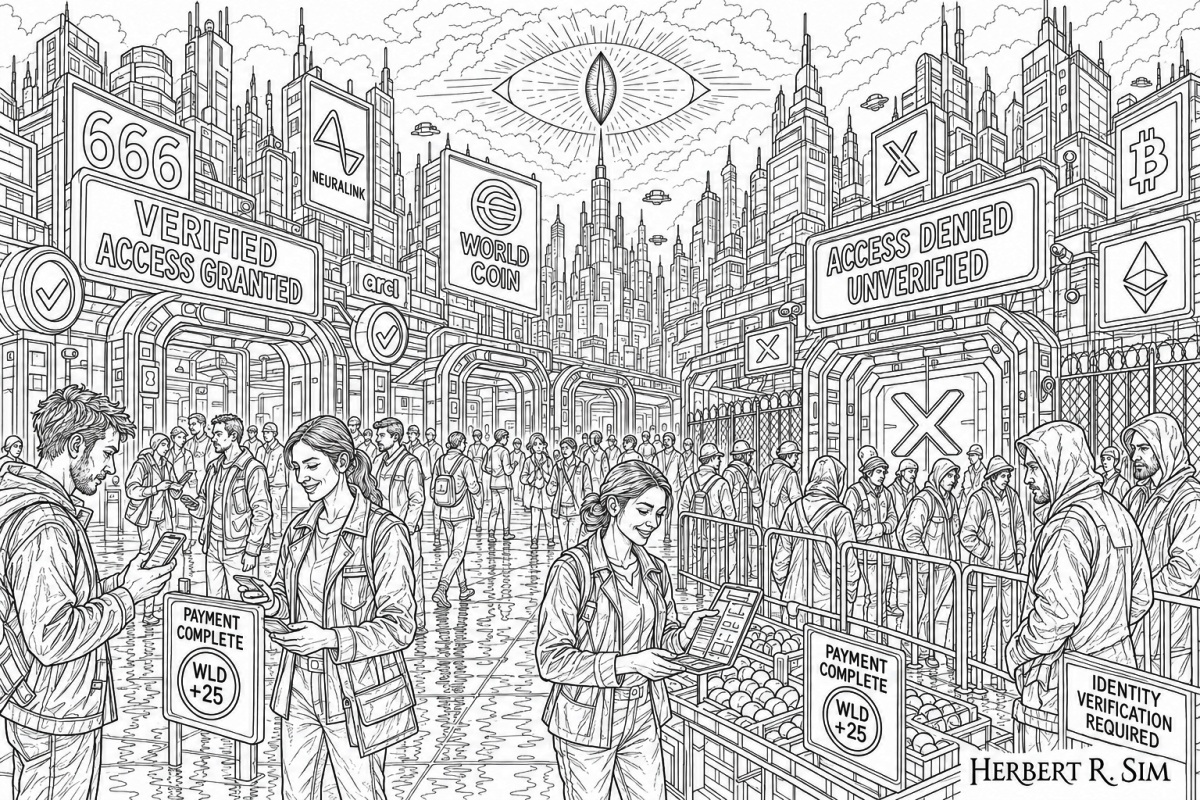
My illustration work-in-progress above.
The Forehead and the Right Hand
Revelation’s reference to the forehead and right hand should not be forced into a simplistic technological prediction. Not every biometric device, digital identity or implanted chip constitutes a fulfilment of prophecy. Reuters has previously debunked unsupported claims linking ordinary microchip technology to the biblical Mark of the Beast, noting that the devices discussed in one widely circulated conspiracy theory were neither GPS-enabled nor designed to track their users.
Nevertheless, the locations described in Revelation are provocative in an age of bodily authentication. Faces and eyes are increasingly used as gateways for identity recognition, while fingerprints and palms can authorise access or financial transactions. Axios reported that biometrics had become one of the technology industry’s preferred alternatives to passwords, with Worldcoin presenting iris verification as a method of proving identity in an internet increasingly populated by AI-generated scams and impersonators.
Hands have already been used for much more direct forms of technological authentication. In 2017, a Wisconsin company offered employees optional RFID microchips implanted between the thumb and forefinger. The chips could be used to buy food, access computers and operate office equipment. The company’s chief executive predicted that similar technology could eventually be standardised for passports, public transportation and purchases.
Experiments outside the workplace have followed a similar trajectory. A WIRED journalist who voluntarily received an NFC microchip implant in her hand described possible applications including payments, data access, security and health monitoring. The article also noted that curiosity, convenience and emotional acceptance—not merely technical arguments—could persuade people to place technology inside their bodies.
The prophecy may describe a literal future mark, a symbolic declaration of allegiance, an economic control system or some combination of all three. Modern technology nevertheless demonstrates that bodily identity and commercial permission can now be joined without a visible tattoo. The human body itself can function as the credential.
The financial technology industry is already contemplating such a future. Affirm co-founder Max Levchin told WIRED that people might eventually pay through devices embedded within their bodies or through electronically enhanced contact lenses. The same discussion acknowledged the ethical dangers of bodily payment systems and the importance of regulation before such technologies become normal.
A person’s eye could therefore authenticate a digital identity. That identity could unlock an account or cryptocurrency wallet. The wallet could eventually contain wages, government benefits or Universal Basic Income. The currency within it could theoretically be programmed, monitored or restricted.
Worldcoin has already demonstrated how quickly a biometric identity can move beyond an isolated scanning experiment. Before the WLD token’s public launch, World ID was integrated into Okta’s Auth0 identity marketplace. CoinDesk reported that this could make “Sign in with Worldcoin” available to thousands of applications while allowing developers to distinguish humans from bots through biometric verification and zero-knowledge proofs.
This progression would not require Worldcoin itself to become a global authority. Worldcoin could simply help normalise the underlying social expectation that every human should possess one persistent digital identity and prove that identity through the body before participating online.
Artificial intelligence may provide the justification. As bots become capable of producing convincing conversations, photographs, voices and identities, governments and corporations may argue that anonymous participation has become too dangerous. Biometric verification may be presented as necessary to stop fraud, misinformation, election interference, terrorism or automated financial crime.
Worldcoin’s own proposition brings several of these ideas together. Gizmodo described it as an iris-verified global digital currency intended to distinguish humans from bot armies and potentially provide a foundation for Universal Basic Income in response to AI-driven displacement.
Each concern may be legitimate. Yet once verification becomes compulsory, whoever controls the verification system acquires extraordinary power. The institution would not merely know that a person exists. It could determine whether that person is recognised by society’s digital infrastructure.
The same concern applies even more strongly to future neural authentication. Brain–computer interfaces are primarily being developed for beneficial medical purposes, but their advancement has already produced questions about consent, agency and mental privacy. WIRED warned that increasingly sophisticated neural systems could blur the boundary between human intention and machine interpretation, particularly if neural information becomes transferable or accessible to external networks.
Convenience Before Compulsion
The first generation subjected to a universal identity system may not be dragged into government offices. It may queue voluntarily because tokens, services or greater convenience are being offered.
The progression could happen gradually:
Biometric identity is initially optional. Verified users then receive additional benefits. Major platforms begin preferring verified accounts. Employers, banks and governments integrate the credential. Unverified users encounter transaction limits or lose access to selected services. Eventually, participation outside the system becomes extraordinarily difficult.
This progression is not inevitable, and Worldcoin has not announced such a programme. It is a hypothetical warning about how technologies can expand after society accepts their original use.
At no single moment would society necessarily feel that it had adopted an instrument of control. Each individual step could be defended as practical: iris scanning prevents duplicate accounts; digital identity reduces fraud; verified profiles stop bots; programmable payments distribute benefits efficiently; restrictions protect the public from criminals.
This is how infrastructure acquires power. A system does not have to begin with coercion. It only has to become indispensable.
The real biblical parallel is therefore not the Orb’s shape, Worldcoin’s logo or the number of tokens distributed. It is the possibility that identity, the body and commerce could converge within one system.
A Choice Is Still Possible
Worldcoin may ultimately become a privacy-preserving tool that protects humans from AI impersonation. Its use of zero-knowledge proofs could provide greater anonymity than conventional identity databases. It may fail commercially, remain voluntary or evolve into something very different from its present form.
The appropriate response is not panic. It is to establish protections before universal biometric identity becomes normal.
Participation must remain genuinely voluntary. Non-biometric alternatives must exist. Systems should collect the minimum possible information, undergo independent security audits and permit meaningful deletion. Credentials should not reveal a person’s activities across unrelated services.
Biometric identity should never automatically become financial identity. An iris scan used to confirm that a person is unique should not permit a government, company or algorithm to inspect every purchase, freeze every account or determine whether that individual may participate in society.
Most importantly, no person should lose the ability to buy food, receive wages or obtain essential services because he or she refuses an iris, face, palm or neural scan.
Worldcoin is not the Mark of the Beast. But its launch represents an important psychological and technological threshold. A global project is asking ordinary people to convert a biological characteristic into proof of unique personhood and connect that proof to a financial network.
The Orb may therefore be one of the first visible steps toward normalising infrastructure through which a future authority could identify every person and condition access to the economy.
The Orb currently asks only to recognise the eye.
The greater question is whether a future system will use that recognition to decide who may buy, who may sell—and who may exist outside the system.