
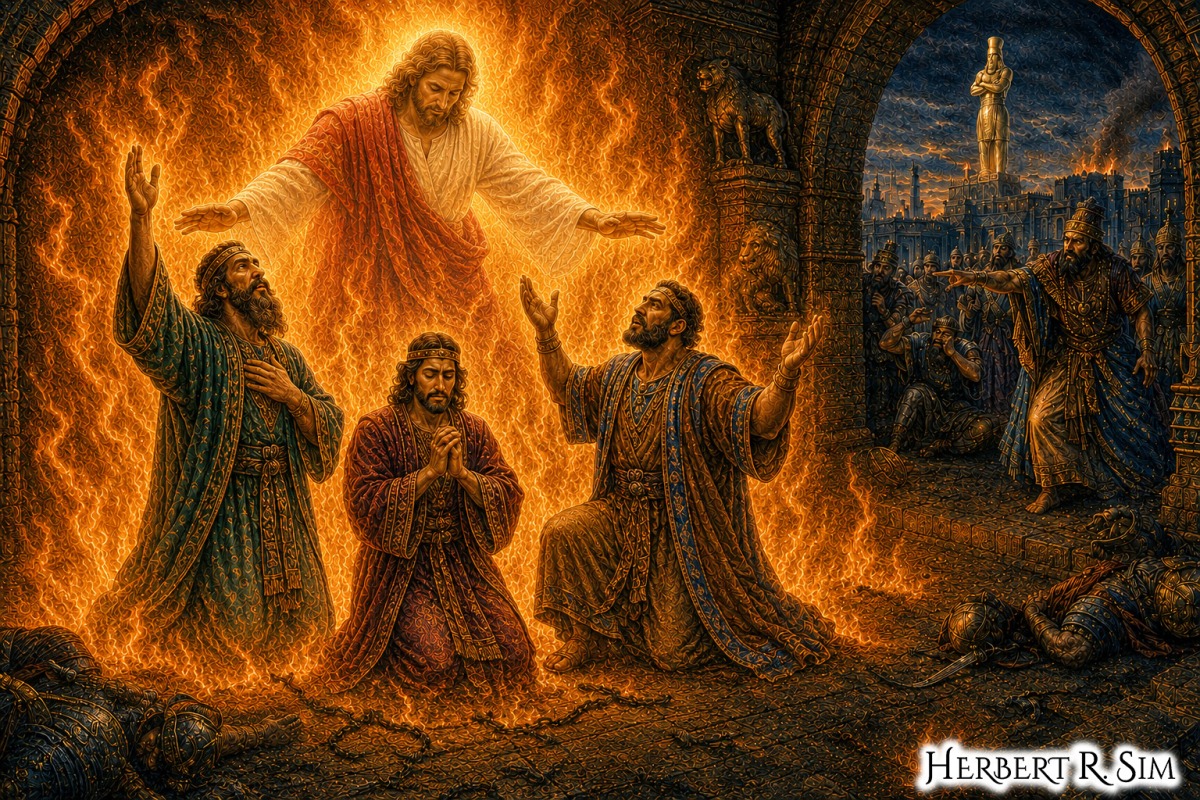
In my illustration above, I feature Shadrach, Meshach and Abednego walking unharmed inside the fiery furnace of Babylon. Their ropes have burned away, but the flames do not touch their bodies, clothing or hair.
A mysterious fourth figure stands among them, radiant with heavenly light. Outside the furnace, King Nebuchadnezzar rises from his throne in astonishment, while Babylonian officials stare into the fire. Behind them towers the colossal golden image that the three men refused to worship.
The empire demanded that they bow. They chose the furnace instead. And when they entered the flames, they discovered that they were not alone.
For me, this ancient account is not merely a story about three faithful men in Babylon. It is also a warning for the future Tribulation period described in the Book of Revelation.
Nebuchadnezzar erected an image and commanded the world under his authority to worship it. Anyone who refused faced death. Revelation warns that another ruler will arise, another image will be established and another system will attempt to control worship through the threat of execution and economic exclusion.
I believe the Rapture will take place before this period of judgment. Those who turn to Jesus Christ after the Rapture — the believers often called the Tribulation saints — may face persecution more extreme than anything experienced by the modern Church.
Like Shadrach, Meshach and Abednego, they will have to decide whether to bow and live briefly, or remain faithful to God even unto death.
The Bible story of Shadrach, Meshach and Abednego is recorded in Daniel 3.
It takes place during the Babylonian exile, after King Nebuchadnezzar conquered Jerusalem and carried many of its people into captivity. Among the young men taken from Judah were Daniel, Hananiah, Mishael and Azariah.
The Babylonian authorities gave them new names.
Hananiah became Shadrach.
Mishael became Meshach.
Azariah became Abednego.
Babylon could remove them from their homeland, teach them its language, place them within its government and call them by names associated with a foreign culture.
But Babylon could not force them to forget their God.
The empire changed their surroundings.
It did not change their allegiance.
The Golden Image on the Plain of Dura
King Nebuchadnezzar constructed an enormous image of gold on the Plain of Dura. Daniel records that it was sixty cubits high and six cubits wide — approximately ninety feet tall and nine feet wide, depending upon the length assigned to a cubit.
The text does not explicitly identify whom the image represented. It may have depicted the king, one of Babylon’s gods or the glory and political unity of the empire itself.
Whatever its precise identity, Nebuchadnezzar demanded worship.
He summoned government officials from across the provinces: princes, governors, captains, judges, treasurers, counsellors, sheriffs and rulers. The dedication of the image was therefore not a private religious ceremony. It was a public demonstration of imperial power.
When the orchestra played, everyone was commanded to fall down and worship the golden image.
The consequence of refusal was announced in advance:
“Whoso falleth not down and worshippeth shall the same hour be cast into the midst of a burning fiery furnace.”
Nebuchadnezzar did not prohibit every religion in Babylon. He did not initially demand that Shadrach, Meshach and Abednego stop believing privately in the God of Israel.
He demanded one visible act of submission.
They could preserve their private beliefs if they publicly bowed with everyone else.
That is often how idolatry presents itself.
It asks for one compromise.
One gesture.
One moment of outward conformity.
But worship cannot be reduced to an empty physical movement. To bow before the image would declare that Nebuchadnezzar possessed an authority that belonged only to God.
When Everyone Else Bowed
At the sound of the instruments, the assembled people fell before the image.
From a distance, the Plain of Dura would have appeared like a single human body moving in obedience. Officials from different nations, languages and provinces all lowered themselves at the same moment.
But three men remained standing.
Shadrach, Meshach and Abednego did not organise a rebellion. They did not attack the image or prevent anyone else from bowing. They simply refused to participate.
Their standing bodies became a public rejection of the king’s claim over their worship.
Certain Babylonian officials reported them to Nebuchadnezzar. Their accusation emphasised that the three men were Jews whom the king had appointed over the affairs of Babylon. In their eyes, refusing the image was not only religious disobedience. It was political ingratitude and disloyalty.
The three men had benefited from positions within the empire, but they understood that employment, promotion and political favour did not purchase their souls.
They served Babylon faithfully where conscience allowed.
They refused Babylon when it demanded what belonged to God.
The King’s Final Warning
Nebuchadnezzar reacted with rage and summoned the three men.
He offered them another opportunity. When the music played again, they could bow and avoid punishment. If they still refused, they would be thrown immediately into the furnace.
The king then asked:
“And who is that God that shall deliver you out of my hands?”
This was the true conflict.
Nebuchadnezzar believed his authority was absolute. He controlled the government, the military, the appointments and the furnace. In his world, no god could interfere with a sentence issued by the king of Babylon.
Shadrach, Meshach and Abednego did not request more time. They did not negotiate a symbolic bow or search for language that would make disobedience appear respectful.
They answered:
“O Nebuchadnezzar, we are not careful to answer thee in this matter.”
Their words did not mean that they were careless. They meant that the decision had already been made.
There was nothing left to discuss.
“Our God Is Able”
The three men declared:
“If it be so, our God whom we serve is able to deliver us from the burning fiery furnace, and he will deliver us out of thine hand, O king.”
They believed God possessed the power to rescue them.
The furnace was real, but it was not greater than God.
The king was powerful, but his authority remained limited.
The sentence had been announced, but God was still able to overturn it.
Faith begins by recognising what God can do.
But the courage of Shadrach, Meshach and Abednego becomes even clearer in the words that follow.
“But If Not”
They continued:
“But if not, be it known unto thee, O king, that we will not serve thy gods, nor worship the golden image which thou hast set up.”
These may be three of the most important words in the entire account:
But if not.
The men believed God could save them, but they did not claim to know that He must save them in the manner they desired.
Their obedience was not a transaction.
They did not say, “We will remain faithful if God guarantees that we survive.”
They said that even if the furnace became their grave, they would not bow.
This is faith without manipulation.
It does not attempt to control God through religious confidence. It trusts His power while submitting to His will.
Many people find it easy to praise God when deliverance is immediate, prayers are answered as expected and obedience produces visible rewards.
The faith of these three men went further.
God was worthy of their worship whether He rescued them from death or received them through death.
Their loyalty did not depend upon the outcome.
The Furnace Heated Seven Times Hotter
Nebuchadnezzar became so furious that the expression on his face changed.
He ordered the furnace to be heated seven times hotter than usual. The number seven communicates the extreme completeness of his rage: he wanted the punishment to be unmistakable.
The strongest soldiers in his army bound Shadrach, Meshach and Abednego while they were still wearing their coats and other clothing. The furnace had become so hot that the flames killed the soldiers who carried them toward its opening.
The three bound men fell into the fire.
To everyone watching, the issue had been settled.
Nebuchadnezzar’s order had been obeyed. The men who challenged the image had disappeared into a furnace hot enough to kill those standing near it.
But then the king looked again.
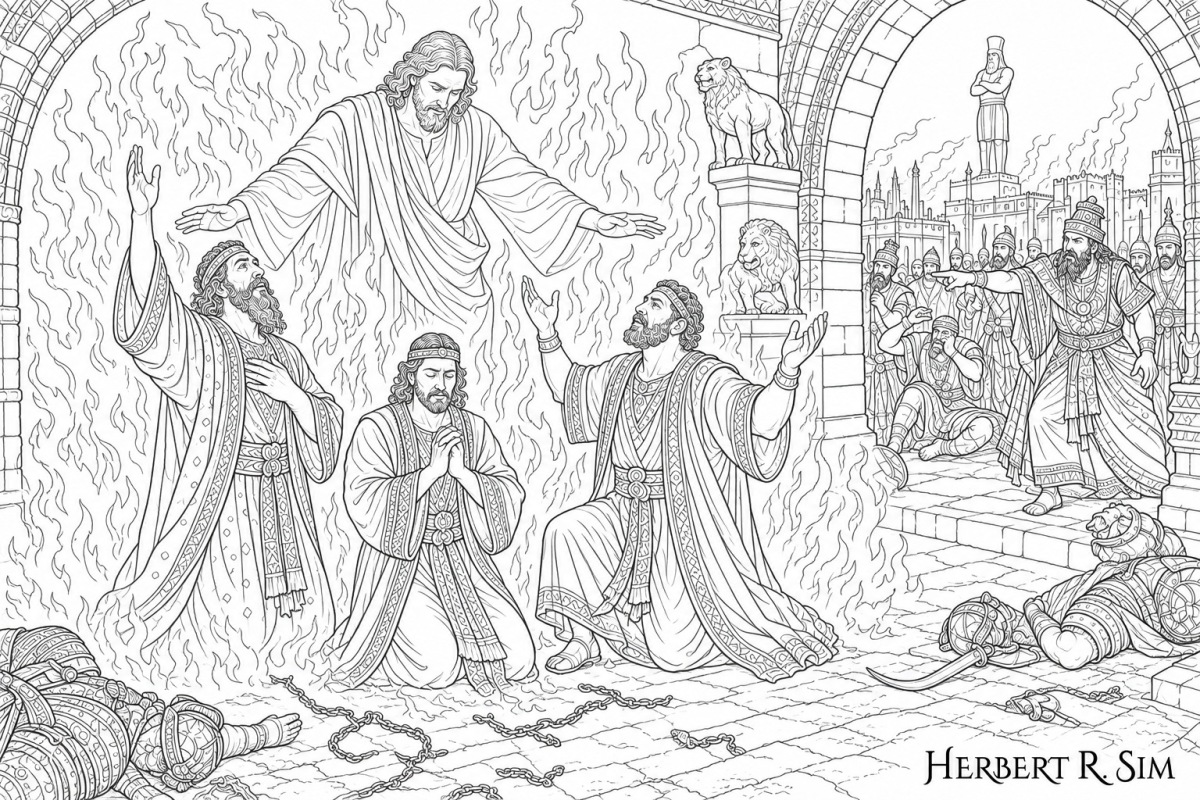
The art represents – faith under persecution: steadfast believers standing in divine protection while earthly power and violence close in.
The Fourth Man in the Fire
Nebuchadnezzar rose suddenly and asked his counsellors:
“Did not we cast three men bound into the midst of the fire?”
They answered that they had.
The king replied:
“Lo, I see four men loose, walking in the midst of the fire, and they have no hurt.”
The three men had entered the furnace bound.
Inside the flames, they were walking freely.
The fire destroyed their ropes but did not destroy them.
Then Nebuchadnezzar described the mysterious fourth figure. In the King James Version, he said that the fourth looked “like the Son of God.” Other translations render the Aramaic expression as “a son of the gods” or “a divine being,” reflecting the words of a pagan king observing something he could not understand.
Later, Nebuchadnezzar declared that God had sent His angel to deliver His servants.
Christians have interpreted the fourth figure in two principal ways. Some understand him to be an angel sent by God. Others see a Christophany — an appearance of Jesus Christ before His birth in Bethlehem.
The passage does not settle every detail of that debate.
Its central truth is unmistakable:
God did not abandon His servants inside the furnace.
He joined them there.
God in the Fire
Shadrach, Meshach and Abednego may have expected God to prevent them from being thrown into the furnace.
Instead, He allowed them to enter it and protected them inside it.
This distinction matters.
Faith does not guarantee that believers will never face persecution, illness, loss or death. The Bible contains many people whom God delivered from danger, but it also records faithful people who suffered and died without receiving an earthly escape.
God’s presence is not proven only by the absence of suffering.
Sometimes He delivers His people from the fire.
Sometimes He walks with them through it.
The prophet Isaiah records God’s promise:
“When thou walkest through the fire, thou shalt not be burned; neither shall the flame kindle upon thee.”
The furnace became the place where Nebuchadnezzar finally saw what the three men already knew.
Their God was present.
Only the Ropes Were Burned
Nebuchadnezzar approached the furnace and called:
“Shadrach, Meshach, and Abednego, ye servants of the most high God, come forth.”
The king who had asked what god could deliver them was now acknowledging the Most High God.
The three men walked out before the assembled officials.
Daniel records the details carefully. The fire had no power over their bodies. Not one hair of their heads was singed. Their clothing was unchanged, and even the smell of smoke was absent.
They did not merely survive with terrible injuries.
They emerged untouched.
The only things the fire consumed were the ropes used to bind them.
What Nebuchadnezzar intended as an instrument of death became the place of their liberation.
The furnace did not remove their faith.
It removed their chains.
Nebuchadnezzar’s Humiliation
Nebuchadnezzar had built the golden image to demonstrate his glory and unify the empire around his authority.
Instead, the ceremony exposed the limits of his power.
He could command people to bow.
He could bind their bodies.
He could heat the furnace.
He could order soldiers to throw them inside.
But he could not make the fire burn those whom God protected.
The king praised the God of Shadrach, Meshach and Abednego, saying that they had trusted Him, resisted the royal command and yielded their bodies rather than worship another god.
He then issued a new decree threatening punishment against anyone who spoke against their God and promoted the three men within Babylon.
The episode humbled Nebuchadnezzar, although his response still reflected the habits of an authoritarian king. He moved quickly from compelling worship of his image to threatening anyone who dishonoured the God who defeated him.
He had witnessed divine power, but he still needed to learn that true faith cannot be produced through imperial force.
That deeper lesson would continue in the events of Daniel 4.
The Golden Images of the Modern World
Most people today will never be commanded to bow before a ninety-foot golden statue while an execution furnace burns nearby.
But every generation constructs images before which people are expected to bow.
The image may be wealth, political power, celebrity, ideology, social approval, technological progress or personal ambition.
The music may sound different, but the pressure remains familiar:
Conform, and you may keep your position.
Remain silent, and you may preserve your reputation.
Compromise once, and the consequences will disappear.
Modern furnaces are not always made of flames. They may take the form of exclusion, ridicule, lost opportunity, damaged relationships or professional punishment.
Not every disagreement is persecution, and Christians should not treat ordinary criticism as martyrdom. But when obedience to God and submission to an idol genuinely conflict, the example of Shadrach, Meshach and Abednego remains clear.
Faithfulness cannot be determined by whatever protects us from consequences.
There are moments when remaining standing will carry a price.
Faith That Does Not Depend Upon Rescue
Many people remember this account because three men survived a furnace.
But their greatest act of faith occurred before they knew they would survive.
They did not see the fourth figure before refusing to bow.
They did not know the ropes would burn away.
They did not know the flames would leave their clothing untouched.
They stood because God was worthy of obedience, regardless of what happened next.
This protects the story from becoming a shallow promise that every faithful person will always escape suffering.
Hebrews 11 celebrates believers who “quenched the violence of fire.” The same chapter also remembers others who were tortured, imprisoned and killed without receiving deliverance in this life.
Both groups lived by faith.
The measure of faith is not whether every earthly outcome becomes favourable.
The measure is whether God remains worthy when the answer is “but if not.”
Final Word: They Would Not Bow
Nebuchadnezzar built an image of gold and demanded one act of worship.
The officials bowed.
The music played.
The furnace burned.
But three men remained standing.
Shadrach, Meshach and Abednego believed that God could rescue them. Yet their faith did not depend upon a guaranteed miracle.
“But if not,” they would still refuse the image.
They were bound and thrown into the fire.
Inside, their chains disappeared.
They entered as three men.
Nebuchadnezzar saw four.
The king who attempted to display his own power became a witness to the power of God.
The furnace meant to destroy their testimony became the place where that testimony was revealed to an empire.
The lesson is not that those who believe will never enter the fire.
It is that the fire does not have the final authority.
God may deliver us before the furnace.
God may deliver us inside the furnace.
Or God may receive us through the furnace.
But no king, empire, threat or flame can separate God from those who belong to Him.
Shadrach, Meshach and Abednego were willing to lose their positions, their freedom and their lives rather than give worship to an idol.
They would rather stand with God in the fire than bow without Him before the gold.
And when the flames surrounded them, the fourth figure was already there.