

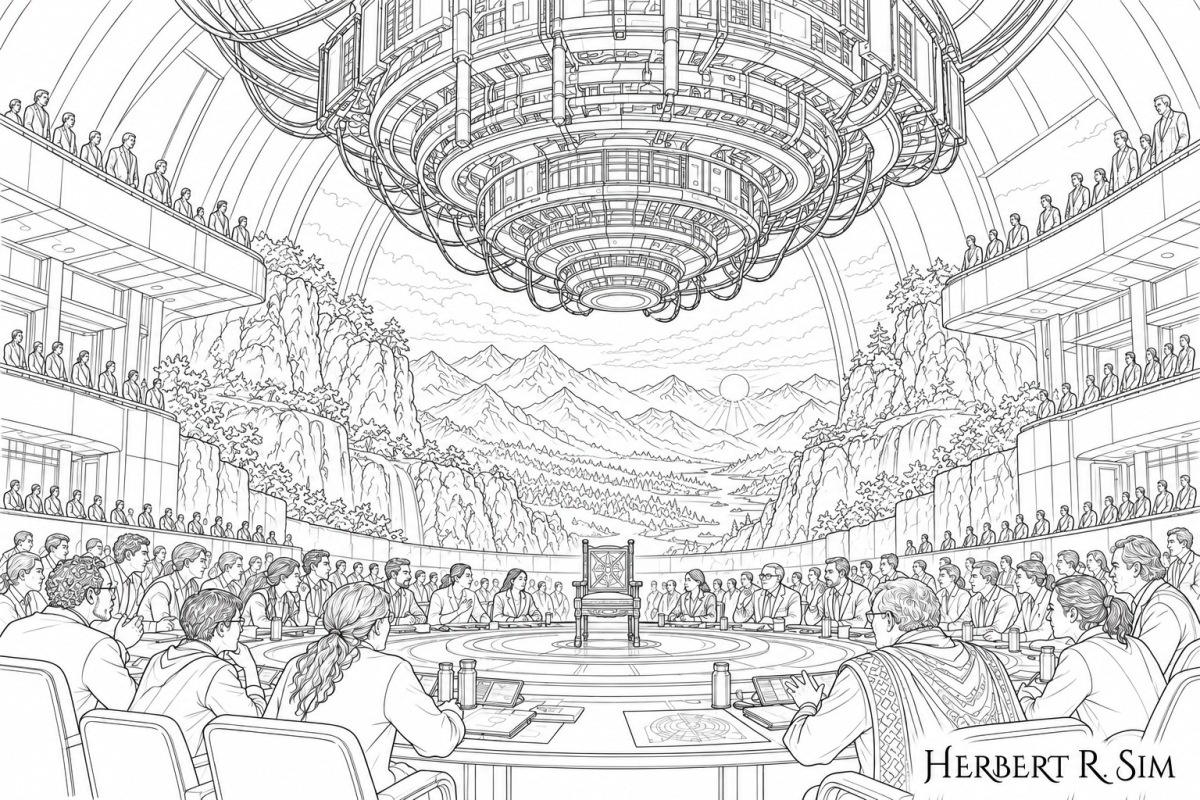
My illustration entitled: “The Parliament Beneath the Machine” – An immense artificial intelligence engine floats above a circular assembly carved into a mountain. Beneath its blazing mechanical core, citizens, scientists and engineers debate around an open table, while powerful figures watch from elevated private balconies.
A machine can expand the range of things a person can do while narrowing the range of decisions that person controls. A computer may make communication effortless while leaving someone else to determine which programs may run. A medical device may restore an essential function while making its recipient dependent on a single supplier. A communications network may connect millions while allowing a small number of organisations to set the conditions of participation.
These possibilities reveal a question that technological enthusiasm can overlook: who possesses authority over the capabilities being created?
I welcome technologies that help people learn, communicate, recover, invent and live more fully. But their contribution to freedom depends on how they are organised. The architecture of a technology includes the distribution of power surrounding its use.
Choice Begins Before the User Arrives
We often describe technological choice as a decision made by a consumer. Someone compares products, accepts a price and chooses whether to participate. Yet many consequential decisions have already occurred before that moment.
Designers have selected which functions are available. Owners have decided whether independent repair is possible. Suppliers have established which information can be transferred. Public authorities have determined which protections apply.
The user chooses within this constructed environment. A long menu of options may conceal a narrow distribution of authority if every option depends on the same organisation’s continuing approval.
Understanding human choice therefore requires examining how the menu itself was produced. Who can add an option? Who can remove one? Which possibilities have been excluded, and whose interests explain their absence?
Four Places Where Control Resides
I find it useful to distinguish four places where technological control can reside: design, operation, revision and continuity.
Design determines what a system makes possible. Operation determines who may use those possibilities and under which conditions. Revision determines who can change the system after people have adopted it. Continuity determines whether users can preserve an essential capability when a supplier withdraws, fails or changes direction.
These powers need not belong to the same party. A manufacturer may design a device, a hospital operate it, a public authority regulate its modification and another company supply replacement parts.
Assessing each relationship separately helps reveal dependencies that the simple statement “the customer owns the product” cannot resolve.
Ownership and Continuing Authority
Buying an object once suggested a reasonably familiar relationship: the buyer acquired possession and considerable freedom over its use. Software and networked equipment complicate that expectation.
A person may own the physical machine while receiving only restricted permission to use its essential software. An organisation may control activation, compatibility or access to supporting services. The practical meaning of ownership then depends on arrangements extending beyond possession.
Some restrictions protect legitimate interests, including security, safety and the rights of creators. Their justification should be examined alongside their consequences.
The relevant question is whether the restriction is necessary for its stated purpose, whether a less restrictive arrangement is feasible, and whether those affected have any practical means of challenge.
The Politics of Compatibility
Compatibility sounds like a technical concern until its absence determines whether someone can leave an organisation.
Imagine a small business whose invoices, customer records and correspondence depend on one software package. A competing product may be cheaper and better, yet changing becomes difficult if the existing records cannot be transferred accurately.
The original supplier gains influence through accumulated dependence. Its customer’s past investment becomes an obstacle to future choice.
Open standards and reliable conversion tools can reduce this power. They allow people to preserve useful work while changing the means through which they use it.
Compatibility also supports invention. New builders can offer improvements without requiring everyone to abandon existing relationships simultaneously. Technical cooperation can therefore make economic competition more realistic.
Medical Progress and Personal Authority
The stakes become greater when a technology supports the body. A faulty household appliance is inconvenient. Failure of an essential medical device may threaten someone’s independence or life.
Consider a hypothetical implant requiring specialist adjustment and replacement components. Its recipient may benefit enormously while remaining vulnerable to decisions about pricing, maintenance and the availability of support.
Consent at the point of treatment cannot settle every question arising over years of dependence. People need understandable information about maintenance, foreseeable limitations and what happens if the original provider disappears.
Independent servicing may sometimes create serious safety risks. Those risks deserve careful assessment. They also make continuity planning more important. A dependence that cannot safely be avoided creates stronger responsibilities for those who maintain it.
My illustration work-in-progress. A beam of sunlight falls upon an empty chair reserved for the next generation. The art represents the decisions about tomorrow’s technologies require public participation and responsibility toward future people.
Who Defines a Machine’s Success?
Automation introduces another form of authority: the power to define the result a system should pursue.
A program allocating work may reward speed. A screening system may prioritise reducing suspected fraud. A scheduling system may maximise the use of equipment. Each objective can be reasonable while leaving important human considerations outside its calculation.
A worker may require time to avoid injury. An applicant may have unusual circumstances. A patient may value an explanation that reduces the number of appointments completed that afternoon.
Computational precision cannot determine whether the objective deserves priority. Those choosing objectives remain responsible for the consequences. Affected people need ways to identify omitted considerations and obtain review when a mechanically consistent decision becomes unreasonable.
Privacy Shapes the Freedom to Experiment
Technologies also influence choice through what they reveal about the chooser. A system that records every inquiry can make experimentation feel dangerous.
People need opportunities to explore an unfamiliar belief, seek medical advice or investigate a different occupation before announcing a settled intention. Premature exposure can invite pressure from employers, relatives, officials or commercial interests.
Privacy helps protect this unfinished stage of judgment. It gives people room to develop purposes before those purposes become objects of outside intervention.
Design choices matter here. A service can collect less information, retain it for shorter periods and separate necessary records from unnecessary observation. These decisions influence how much authority others acquire over the person using it.
Participation Before Dependence
Public debate often follows technological deployment. By then, substantial investment and everyday reliance may make significant changes expensive.
Participation should begin earlier, particularly where decisions affect essential services or impose consequences on people who never agreed to use the system.
This does not mean submitting every engineering detail to a public vote. Different decisions require different forms of knowledge. Engineers can explain technical constraints; users can describe practical difficulties; affected communities can identify burdens that a purchaser’s specification overlooks.
The purpose is to expose consequential assumptions while alternatives remain available. Public participation becomes more useful when it can change a design, procurement requirement or deployment condition before dependence makes objections easy to dismiss.
The People Outside the Transaction
A purchase can be voluntary for buyer and seller while imposing costs on others. A monitoring system may record passers-by. Industrial equipment may create pollution. A workplace technology may alter expectations for everyone employed there.
Consequently, consumer consent cannot provide the entire moral foundation for technological development.
Those bearing foreseeable burdens need representation, protection and appropriate remedies. Their interests should enter the assessment even when they possess no purchasing power.
Future people present a further difficulty. Decisions about infrastructure, environmental damage and technical standards can constrain choices long after the original participants have departed. Responsible development should preserve reasonable possibilities for revision and repair, rather than transferring every cost of commitment to those who follow.
Making Control Answerable
No single arrangement will suit every technology. A communications tool, laboratory instrument and implanted medical device pose different problems. Decentralisation may distribute authority, yet also complicate responsibility. Central coordination may improve reliability, yet concentrate discretion.
Evaluation should follow the actual powers involved. Who can alter the rules? Who can inspect a consequential decision? What happens when the system fails? Which dependencies are necessary, and which chiefly protect an incumbent?
Practical safeguards might include independent review, interoperable records, continuity agreements, clear limits on data collection and access to qualified maintenance.
Such protections require resources. Their costs should be considered alongside the losses created when people cannot correct, replace or safely leave an essential system.
A Future People Can Still Shape
Technological progress will create possibilities that are difficult to anticipate. That uncertainty strengthens the case for institutions and designs that preserve the ability to reconsider.
We should build systems capable of improvement without requiring unquestioning dependence. We should make room for inventors, users and affected communities to challenge established arrangements. We should ensure that valuable assistance does not silently become unlimited authority.
Human sovereignty grows when people can understand the systems shaping their lives, influence consequential decisions and preserve meaningful alternatives.
Tomorrow’s technologies will bear the choices of those who design, finance and govern them. The task is to make those choices answerable to the human beings who must live with their consequences.