

My illustration entitled: “The Architecture of Capability” – A monumental city built from pillars representing money, property, knowledge, energy, technology and free exchange—showing that freedom rests on practical capacity, not abstract promises.
Economic freedom is often measured by income, consumption, employment or national output. These measures are important, but they are incomplete. They do not answer the more fundamental question: what practical capacity does an individual possess to direct his or her own life?
A person may earn an income yet remain unable to preserve its value. They may have access to markets yet be unable to participate without the approval of intermediaries. They may possess legal rights while lacking the knowledge, property, tools or alternatives needed to exercise those rights in practice.
Sovereign Capability Economics begins with this principle: prosperity should be judged not only by what an individual receives, but by what an individual is genuinely capable of owning, choosing, building and becoming.
It is an economic framework concerned with the conditions that make freedom practical. It asks whether a system expands an individual’s capacity to acquire knowledge, preserve value, own property, exchange voluntarily, create independent work and retain the ability to leave arrangements that no longer serve them.
Money matters because it enables action. Ownership matters because it protects independence. Knowledge matters because it enlarges choice. The right to exit matters because no freedom is secure when participation in a single system becomes unavoidable.
Freedom Must Be Practical
A free society cannot be defined solely by the permissions it grants. Freedom must also be measured by the capacity people possess to act without excessive dependence on political, financial or institutional authority.
The right to own property has limited meaning if property can be arbitrarily diluted, restricted or made inaccessible. The right to trade has limited meaning if trade can occur only through a narrow group of gatekeepers. The right to work has limited meaning if an individual cannot build, compete or create without barriers that only the powerful can overcome.
Economic liberty therefore requires more than formal access. It requires practical capability.
An economically capable individual can preserve the value created by labour, make informed choices, enter into voluntary exchange, develop useful skills, build productive assets and seek alternatives when one path is closed. Such an individual is not free from responsibility. Rather, responsibility and freedom are connected: the ability to make choices must be accompanied by accountability for their consequences.
The purpose of a healthy economic order is not to remove all risk from life. It is to ensure that individuals are not made permanently dependent on institutions whose decisions they cannot influence and whose services they cannot realistically refuse.
Capability Is the Measure of Economic Freedom
Wealth is useful, but wealth alone is not sovereignty. A person may possess money while remaining dependent on others to hold it, transfer it, invest it or authorise its use. A person may possess qualifications while being unable to apply them freely. A person may have access to information while lacking the ability to understand, verify or act upon it.
Sovereign Capability Economics therefore asks whether individuals possess the practical capacity to:
- hold and preserve the value created by their labour;
- own property and productive assets directly;
- acquire knowledge and develop independent judgment;
- choose between competing systems and providers;
- build enterprises, networks and voluntary arrangements; and
- exit unfair or unaccountable economic relationships.
These capacities reinforce one another. Knowledge without ownership can leave an individual unable to benefit from what they know. Ownership without choice can become illusory. Money without the ability to preserve or transfer it remains conditional. Choice without knowledge may become manipulation rather than liberty.
A society becomes more prosperous when more people possess these capabilities. It becomes less free when they are concentrated in the hands of a small number of institutions.
Ownership Is the Foundation of Independence
Ownership is more than possession. It is the ability to make decisions about something one has legitimately earned, created, acquired or been entrusted to protect.
Without ownership, individuals become permanent users of systems designed by others. They may be permitted to participate, but cannot determine the terms of participation. They may create value, but cannot reliably retain it. They may rely on services, but cannot leave them without losing access to essential parts of ordinary economic life.
This condition is dependence.
Dependence is not always harmful. People cooperate, delegate and use trusted services because specialisation can improve daily life. Banks, companies and governments can provide useful functions. The problem arises when convenience becomes compulsion, and when individuals no longer possess viable alternatives.
Sovereign Capability Economics does not demand that every person act alone. It demands that individuals retain meaningful choices over the property, tools and systems on which their lives depend.
The strongest institutions are not those that make exit impossible. They are those that continue to earn trust even when people remain free to leave.
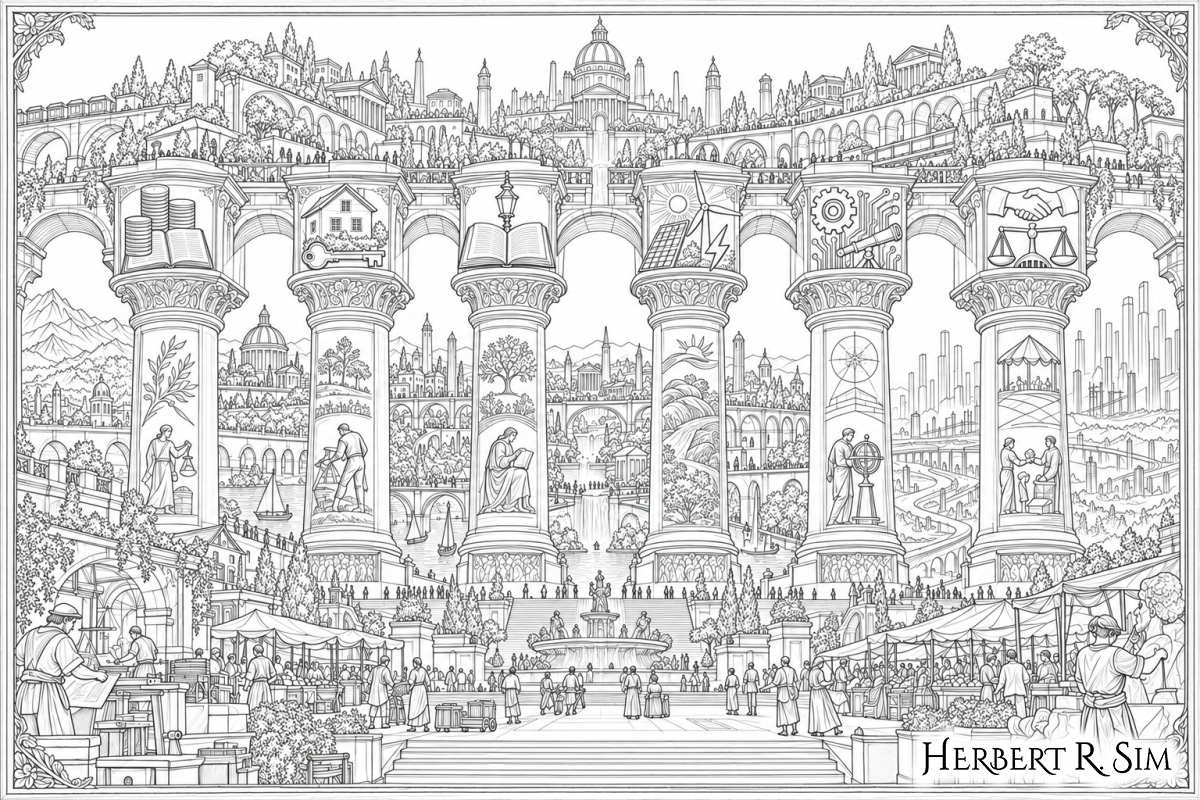
My illustration “The Architecture of Capability” work-in-progress. The art represents a society where money, property, knowledge, energy, technology and free exchange form the practical foundations of personal freedom.
Knowledge Is Productive Capital
Economic independence is not built only through money. It is also built through knowledge.
Skills, education, judgment, creativity and the ability to understand changing conditions are forms of productive capital. They enable individuals to create value beyond a single employer, institution or economic cycle.
A person who can learn, adapt and build possesses a form of wealth that cannot be easily reduced to a number on a balance sheet. This does not diminish the importance of financial capital. It explains why financial capital should serve human capability rather than replace it.
Economic systems should encourage education, enterprise, experimentation and access to knowledge. They should not reserve opportunity only for those already connected to inherited capital, institutional power or privileged information.
When knowledge is widely available and individuals are free to apply it, innovation becomes more competitive, more resilient and more widely distributed. When knowledge is concentrated and access is restricted, economic power follows the same path.
The Right to Exit Preserves Liberty
The most important test of an economic system is whether an individual can refuse it.
A person may be told that participation is voluntary. But if refusing a system means losing access to money, employment, trade, property or ordinary social participation, then that choice is severely weakened. Permission without a practical alternative is not full economic liberty.
The right to exit is therefore essential. It is the ability to choose another provider, form another enterprise, use another exchange mechanism, preserve value through another system or cooperate with others through voluntary networks.
The right to exit does not excuse fraud, theft or coercion. It does not reject legitimate rules that protect property, contracts and peaceful exchange. It means that rules should protect people from harm without turning ordinary economic participation into a privilege granted only by concentrated authorities.
When people can exit, institutions must remain accountable. When people cannot exit, institutions can demand compliance without earning confidence.
Bitcoin and the Expansion of Monetary Choice
The emergence of Bitcoin offers an important example of how technology can expand economic capability.
In 2008, Satoshi Nakamoto proposed a peer-to-peer electronic cash system that would allow value to be transferred without requiring a trusted central intermediary to maintain the record of transactions. Bitcoin’s network, launched in 2009, demonstrated that digital ownership and transfer could be organised through cryptographic proof and distributed consensus.
Bitcoin does not eliminate the need for judgment, responsibility or economic institutions. It does, however, introduce a significant alternative: an individual may hold value through cryptographic keys rather than relying exclusively on a conventional custodial account.
This is not merely a technical innovation. It is an expansion of monetary choice.
For the first time, a globally accessible monetary network showed that people could participate through open rules, verify transactions independently and transfer value across distance without requiring prior approval from a central issuer. Its significance lies not in replacing every existing system, but in proving that alternatives can be built.
Bitcoin represents a practical expression of Counter Economics: peaceful, voluntary and decentralised architecture that reduces unnecessary dependence on a single monetary authority.
Economic Systems Must Serve Human Development
An economy should not be judged only by the wealth it concentrates. It should also be judged by the capability it distributes.
Does it enable people to become more competent, independent and resilient? Does it reward productive contribution? Does it leave room for small enterprise, voluntary cooperation and new ideas? Does it allow people to retain the value they create? Does it preserve the ability to choose another path?
If the answer is no, then apparent prosperity may conceal a deeper dependence. People may consume more while controlling less. They may gain convenience while losing ownership. They may be included in an economic system while becoming increasingly unable to live outside it.
Sovereign Capability Economics rejects the idea that individuals should be treated merely as consumers, workers or managed units within a larger institutional machine. Every person should have the opportunity to become a capable economic actor: able to learn, own, build, exchange and direct the course of their own life.
A Manifesto for Economic Sovereignty
The future of economics should not be limited to questions of growth, output and administration. It must also confront the question of individual sovereignty.
The task is not to destroy institutions, but to ensure that institutions remain accountable, contestable and subordinate to the freedom of the people they serve. The task is not to eliminate cooperation, but to preserve its voluntary character. The task is not to reject technology, but to use technology to expand human capability rather than deepen dependence.
Political Economics identifies how money and institutions shape freedom. Counter Economics explores voluntary alternatives when concentrated power narrows that freedom. Sovereign Capability Economics establishes the wider principle: economic progress is meaningful only when it increases the individual’s practical capacity to own value, acquire knowledge, build independently and retain the right to choose.
Money enables action. Ownership protects independence. Knowledge enlarges possibility. Choice preserves liberty. The capacity to be free is the true foundation of economic sovereignty.
Reference: Satoshi Nakamoto, Bitcoin: A Peer-to-Peer Electronic Cash System, 31 October 2008.
Official Publication Record
The Sovereign Capability Economics Manifesto: Money, Ownership and the Capacity to Be Free
has been formally archived on Zenodo with a permanent DOI for citation,
preservation and scholarly reference.
| Title | The Sovereign Capability Economics Manifesto: Money, Ownership and the Capacity to Be Free |
| Author | Herbert R. Sim |
| ORCID | 0009-0008-6500-5749 |
| Publication date | 20 April 2012 |
| Canonical webpage | https://herbertrsim.com/sovereign-capability-economics-manifesto/ |
| DOI | 10.5281/zenodo.22767457 |
| Zenodo record | https://zenodo.org/records/22767457 |
| Copyright | © 2012 Herbert R. Sim. All rights reserved. |
Preferred citation:
Sim, Herbert R. (2012). The Sovereign Capability Economics Manifesto: Money, Ownership and the Capacity to Be Free. HerbertRSim.com.
https://doi.org/10.5281/zenodo.22767457
Zenodo submission note:
This work was deposited on Zenodo for permanent scholarly preservation, citation and public reference.