
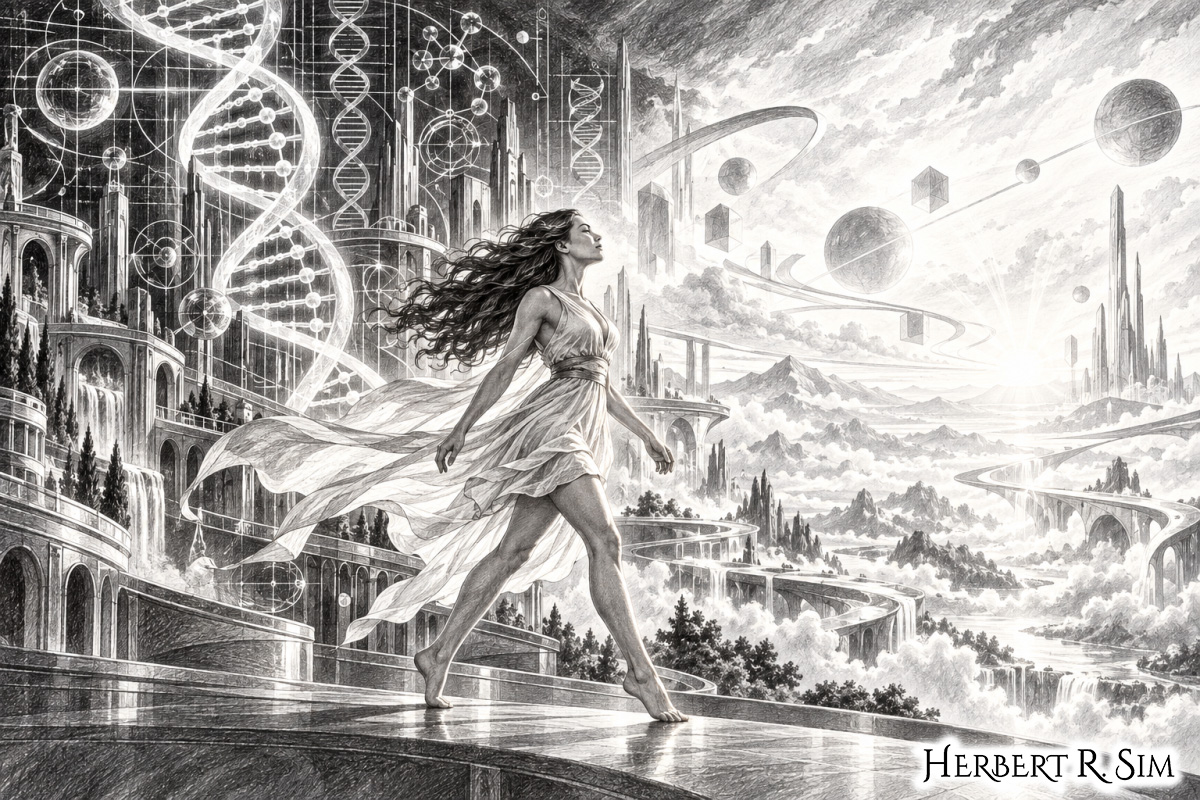
My illustration entitled: “Freedom From the Blueprint” — A female figure, in flowing short dress, steps beyond a glowing genetic diagram and toward a horizon of limitless shapes.
Technology has begun to loosen humanity’s oldest biological constraints. One of the most profound questions is whether gender must remain one of them.
For most of human history, gender has been treated as an inescapable fact of biology. It has shaped reproduction, family roles, work, inheritance, clothing, law, expectation and identity. Even where societies have challenged traditional roles, the physical realities of sex and reproduction have remained powerful forces in how people are classified and understood.
But technology is changing the terms of the discussion. Contraception has already separated sexuality from reproduction. Fertility medicine has made conception possible in circumstances once thought impossible. Hormonal treatments, surgery, genetics, prosthetics and emerging reproductive technologies are steadily weakening the assumption that biology must dictate destiny.
Postgenderism is the philosophical exploration of what may happen when gender becomes less biologically compulsory. It asks whether humanity could—or should—reach a future in which reproductive roles, physical sex characteristics and social expectations no longer determine a person’s opportunities or identity.
This is not a prediction that gender will disappear tomorrow. Nor is it a call to erase the identities people cherish. It is an invitation to think seriously about freedom. If technology can reduce suffering and expand human choice, can it also free people from biological limitations that have too often become social limitations?
The future of humanity should not be decided by biology alone, nor by technology alone, but by the freedom of individuals to define their own lives.
What is postgenderism?
Postgenderism is often misunderstood as a denial that men and women exist, or as a demand that everyone become the same. It is neither. At its core, postgenderism questions whether biological sex and inherited gender roles should remain compulsory organising principles of human life.
A postgender future could take many forms. Some people may continue to identify strongly with existing genders. Others may choose combinations of physical traits, identities and social roles that do not fit traditional categories. Reproduction may become increasingly independent from the female body through advances in artificial gestation, genetic medicine or other technologies not yet fully developed. Work, family and citizenship may become less tied to assumptions about who is expected to care, provide, lead or reproduce.
The central idea is not uniformity. It is optionality. A person should have more freedom to define themselves than biology, custom or government presently allows.
Postgenderism therefore belongs within the broader conversation about transhumanism. Transhumanism asks how science and technology can help humanity overcome disease, disability, limitation and unnecessary suffering. Postgenderism asks whether gender itself may become more flexible as humanity gains greater authority over biology.
Biology has never been the whole story
Human beings are biological creatures, but they have never been governed by biology alone. Language, culture, law, technology and moral imagination have always changed the meaning of physical limitations. We build homes because we are not satisfied with the climate. We develop medicine because we are not satisfied with disease. We create tools because we are not satisfied with the limits of muscle and memory.
Gender is similar. Biology may influence the body, but societies assign meanings to bodies. They decide which occupations are “natural,” which emotions are acceptable, which forms of appearance are rewarded, and who bears the burden of care. Many of these rules have been presented as inevitable even when they are simply traditions preserved by power.
Technology has already exposed the instability of these assumptions. Women can control fertility. Men can become primary caregivers. People can alter aspects of their appearance and physiology. Reproductive medicine can allow families to form in ways that older social systems did not anticipate. The connection between biology and social destiny is no longer absolute.
Postgenderism carries this trajectory further. It asks: if gender roles are not fixed, must the biological categories behind them remain fixed in their social meaning? Or can humanity build a future in which no one is assigned a narrower life because of the body they were born with?
Reproduction and the end of compulsory roles
Reproduction is perhaps the deepest reason gender has carried social power. Pregnancy, childbirth and breastfeeding have historically placed unequal physical demands on women. Societies have often transformed these facts into rules about dependence, work, sexuality, authority and belonging.
Technological change does not make pregnancy less meaningful for those who choose it. But it may make reproduction less compulsory as a defining social role. Assisted reproduction has already created alternatives for people facing infertility and for families that do not conform to traditional expectations. Future breakthroughs may further separate genetic parenthood, gestation and social parenthood.
If reproduction becomes less dependent on one sex, the consequences could be profound. Caregiving may become a shared human responsibility rather than an assumed female duty. Economic participation may become less affected by biological expectations. Family structures may be chosen according to commitment and care rather than restricted by a single reproductive model.
Yet this possibility must be approached with humility. Technology must not turn reproduction into an industrial system in which children, parents or gestational labour are treated as products. Freedom from compulsory biology must not become submission to corporate biology. Any future reproductive technology should protect consent, health, dignity and the welfare of children.
Identity cannot be engineered by force
Postgenderism is valuable only if it expands freedom. It becomes dangerous if it is transformed into a demand that people abandon identities they genuinely value. The point is not to replace one orthodoxy with another.
Some people find deep meaning in being male or female. Some find meaning in traditions, communities and expressions of gender that have shaped their lives. Others experience existing categories as restrictive, inaccurate or painful. A humane future must make room for both realities.
No government, corporation, ideology or technological elite should decide what identity a person must possess. Just as no one should be forced into a traditional gender role, no one should be forced out of one. The ethical standard is voluntary self-definition.
This is where postgenderism must remain distinct from social engineering. Technology can offer options, but it must not dictate choices. A society that celebrates freedom while pressuring everyone to alter themselves has merely changed the form of conformity.
The liberation of humanity cannot mean exchanging biological determinism for technological determinism.
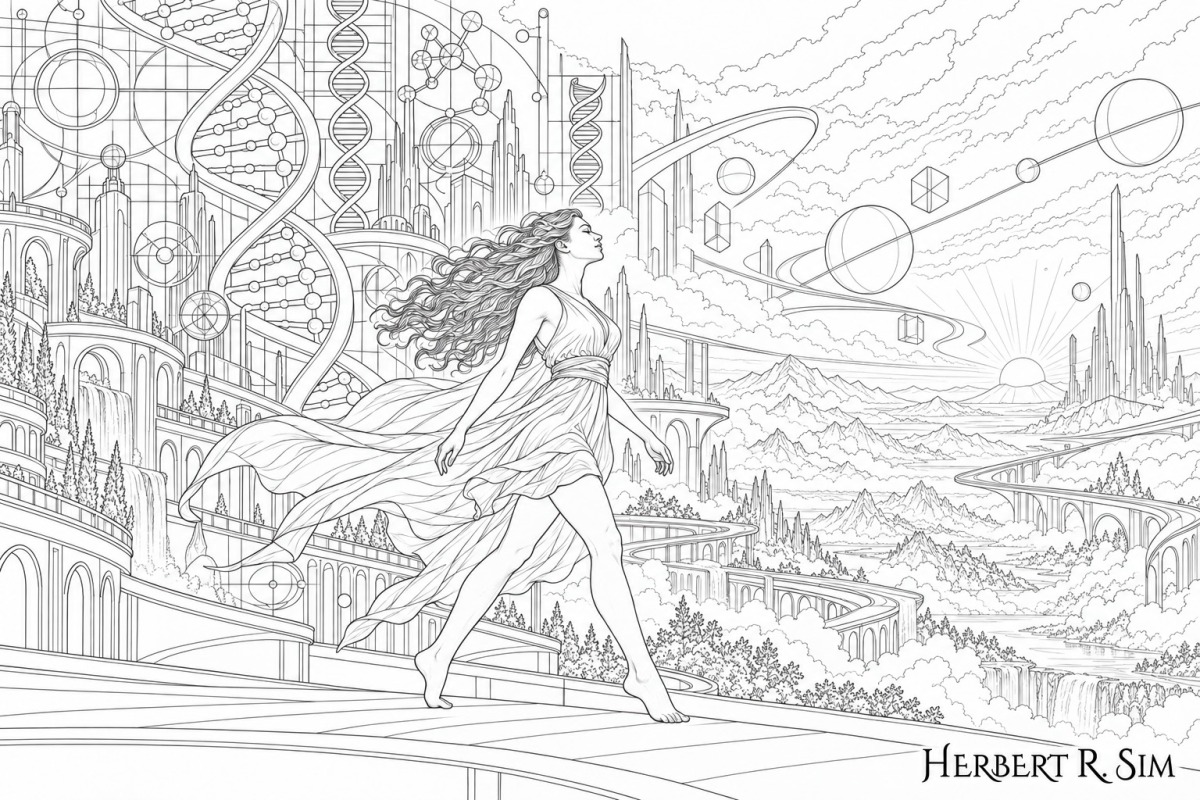
My illustration “Freedom From the Blueprint” work-in-progress. The art represents the freedom to inherit a biology without being confined by it—technology should expand self-authorship, not impose a new blueprint.
The risk of a new genetic marketplace
Any discussion of technological freedom must confront inequality. If advanced genetic, hormonal, reproductive or bodily-modification technologies become available only to the wealthy, postgenderism could create a new hierarchy rather than greater liberation.
The affluent may gain the ability to choose appearance, reproductive timing, health traits or bodily characteristics, while others are left with limited options and greater social pressure. Markets could begin to reward particular bodies or identities. Employers, insurers and governments might seek to classify people according to biological data. Instead of freeing humanity from old categories, technology could create more detailed and invasive ones.
That is why access, privacy and non-discrimination matter. A person’s genetic information, reproductive choices and bodily characteristics must not become tools for exclusion. Technology should reduce arbitrary limitations, not create a new caste system between those who can afford self-transformation and those who cannot.
The postgender question is therefore also an economic and political question. Who owns the technologies of transformation? Who decides how they are used? Who benefits? And who is protected when markets find a way to profit from the most intimate parts of human life?
Beyond gender roles, not beyond human dignity
Critics may fear that postgenderism will make human life colder, more artificial or less meaningful. It is a reasonable concern. Human difference, embodiment, family and intimacy matter. Technology should not be treated as an automatic improvement simply because it is new.
But dignity does not require that people remain trapped by inherited constraints. A person’s worth should not depend on fertility, physical strength, sexual role, conformity to appearance, or obedience to a social script assigned at birth. Human dignity is strengthened when people can form their own identities, relationships and futures.
The goal is not to make humanity less human. It is to make humanity more free to be human in diverse ways. If technology can relieve an individual from suffering caused by unwanted bodily conditions or social constraint, that may be a humane use of progress. If it enables greater understanding, care and equality, it should be explored responsibly.
But there must be limits. Human beings must not become experiments without consent. Children must not be designed according to passing fashion. The vulnerable must not be pressured to modify themselves to satisfy social expectations. And no one should be treated as inferior for choosing to remain as they are.
A future of plural identities
The most promising postgender future is not one in which gender disappears by decree. It is one in which it loses its power to confine. It is a future in which a person can be masculine, feminine, both, neither or something not yet named without losing rights, opportunity or dignity.
Technology may help create this freedom by expanding control over reproduction, physiology and appearance. But technology alone cannot create equality. Laws, culture and institutions must also learn to recognise the individual before the category. They must defend people from discrimination, coercion and exploitation.
A free future will not ask whether everyone has become the same. It will ask whether every person has gained greater authority over the life they wish to live.
Can technology free humanity?
Technology can create conditions for greater freedom, but it cannot deliver freedom automatically. It may weaken the connection between biology and destiny. It may expand reproductive choice. It may enable people to alter bodies that do not reflect who they are. It may reduce the social force of inherited gender roles.
Yet every power to transform also creates a power to control. The same technologies that could liberate people may be used to classify, market, regulate or redesign them without their consent. The question is therefore not simply whether humanity can move beyond biological gender. It is whether we can do so while preserving individual choice, diversity and dignity.
Postgenderism offers a bold thought experiment for the future: a humanity in which biological gender no longer determines possibility. Its value lies not in abolishing identity, but in defending the freedom to shape it.
The future should not belong to those who demand that everyone remain the same, nor to those who demand that everyone transform. It should belong to individuals who are free to decide for themselves.
“`