

My illustration entitled: “One Mind, Fifty Machines” – A lone transhuman stands on a towering platform, directing an expansive formation of robots, drones and construction machines through luminous neural connections. Below, the machines build a magnificent city.
Imagine a rescue coordinator directing a network of flying cameras, ground vehicles and mechanical lifting devices after an earthquake. One instruction sends machines into several damaged buildings. Information returns through a single display. The coordinator appears to command an extraordinary extension of human perception and action.
Then three machines encounter unexpected obstacles, two reports contradict each other and another vehicle requests permission to enter an occupied space. Every decision is urgent. The coordinator can issue commands, but cannot understand every developing situation before the machines act.
Who is meaningfully in control?
This hypothetical problem belongs within Human Sovereignty Transhumanism. Enhancement can extend a person’s reach far beyond the body while leaving attention and judgment unable to follow. The result may be impressive authority in appearance and dangerously limited authority in practice.
Command Is Not the Same as Oversight
Giving an instruction is one part of control. Understanding how it is interpreted, recognising when circumstances change and intervening effectively are others.
A person might direct a hundred machines toward an objective without being able to supervise the choices through which they pursue it. The network must then perform much of the selection, interpretation and coordination independently.
Such delegation can be useful. Human activity already depends on dividing tasks and trusting systems whose every movement we do not inspect.
The problem arises when institutions describe delegated autonomy as continuous human supervision. A name on a control panel cannot establish that someone understands consequential events or has a practical opportunity to redirect them.
Human presence becomes an illusion of control when responsibility exceeds the person’s actual capacity to influence outcomes.
Connecting More Does Not Mean Understanding More
Future interfaces might make it easier to select machines, communicate intentions or receive information. A neural connection could conceivably become another channel alongside speech, gestures and visual displays.
These possibilities should not be confused with unlimited comprehension. Sending an instruction quickly does not demonstrate that its sender can evaluate every consequence quickly.
Nor does receiving more information necessarily improve judgment. A display can present more events than anyone can examine. A summary can simplify complexity while concealing the uncertainty that matters most.
Human enhancement therefore requires an assessment of the relationship between expanded reach and available understanding. Otherwise, the enhanced person may become the ceremonial commander of decisions effectively shaped elsewhere.
A Limit on Delegation
I propose that delegation remain bounded by what can be responsibly governed.
This does not mean that a person must understand every calculation or watch every movement. It means that the authorised activity must fit within conditions whose purposes, consequences and limits can be assessed adequately.
There can be no universal number of machines that one person should supervise. Ten predictable devices performing reversible tasks may demand less attention than two systems operating amid unfamiliar hazards.
The relevant factors include complexity, uncertainty, speed, possible harm and the time available for intervention.
Delegation becomes excessive when foreseeable demands for judgment exceed the available capacity to respond, while the system continues acting as though meaningful supervision remains intact.
Define the Boundary Before Operation
A network should receive a defined scope of autonomous action before deployment.
That scope should specify permitted purposes, operating conditions and actions requiring renewed human authorization. It should also identify circumstances in which the system must restrict activity, request assistance or move toward a safer condition.
In our rescue example, a machine might be permitted to photograph accessible corridors independently while requiring specific approval before taking an action that could endanger occupants.
Permission to pursue an objective should not silently authorize every available means of achieving it.
The boundaries must apply to the network’s combined behaviour. Individually permitted actions can interact to produce a consequence that no person considered or intended when authorizing them separately.
Oversight Must Survive the Difficult Moment
A demonstration under calm conditions cannot establish that oversight will remain meaningful during simultaneous failures.
Evaluation should examine what happens when several systems demand attention together, information is incomplete or communication deteriorates. The important question is whether the arrangement remains governable when ordinary assumptions fail.
Adding more warnings does not resolve an impossible workload. An operator cannot exercise judgment merely because every machine has delivered a notification.
Design should reduce unnecessary demands, communicate uncertainty clearly and provide enough time for consequential choices. Where those conditions cannot be maintained, the permitted activity should narrow.
The person should also be able to decline additional machines or request assistance without being treated as an obstacle to technological progress.
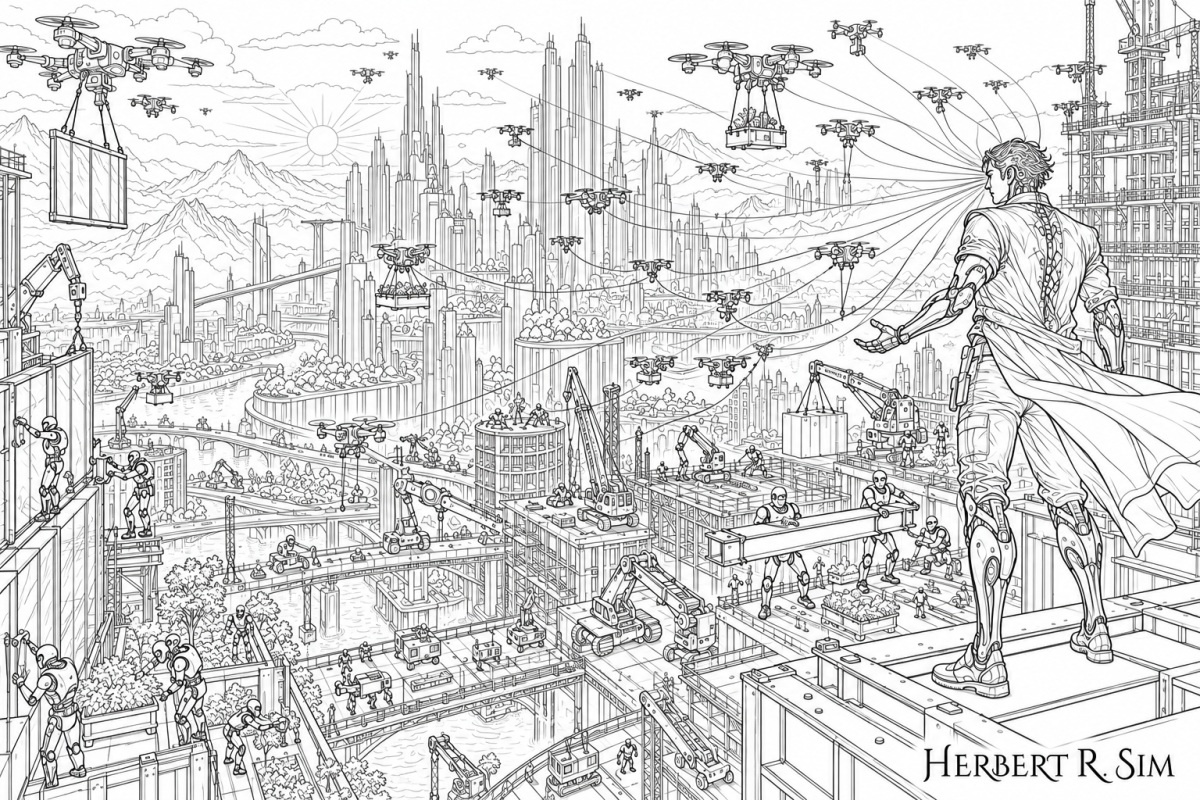
My illustration “One Mind, Fifty Machines” work-in-progress. The art showcases a single human mind gains extraordinary reach.
A Stop Button Is Not Sufficient
An emergency stop may be important, but its presence cannot carry the whole ethical argument.
The operator must recognise a reason to stop, reach the relevant control and act before the consequence becomes irreversible. The signal must reach the machines, and the resulting response must itself be reasonably safe.
These conditions cannot simply be assumed.
Some networks may need selective interruption, allowing one activity to pause without disabling unrelated essential functions. Others may require predefined responses when communication is lost.
There is no single safe response suitable for every system. What matters is that the institution demonstrates a workable intervention arrangement rather than treating a visible button as proof of effective human authority.
When Waiting for a Human Is Impossible
The strongest objection is that some useful machine actions must occur faster than a person can respond. Requiring individual approval for everything could make the system ineffective or even dangerous.
This objection supports carefully bounded autonomy.
If immediate supervision is impracticable, responsibility shifts toward prior decisions about permissible behaviour, operating conditions and safeguards. Institutions must explain what the system may do without further permission and why that scope is justified.
Where a consequential decision cannot be supervised meaningfully, the answer may involve redesigning the task, reducing autonomy, increasing staffing or withholding deployment.
Efficiency does not justify describing an absent capacity as present. Sometimes acknowledging that humans cannot supervise a proposed arrangement is the beginning of responsible design.
Responsibility Cannot End at the Operator
After harm occurs, an organisation may point to the individual who issued the initial instruction. Yet responsibility cannot be settled solely by locating the last human command.
Designers determine available functions and limitations. Providers influence reliability and communication. Deploying institutions decide staffing, operating conditions and acceptable demands. Operators make choices within those arrangements.
Responsibility should reflect each party’s knowledge, authority and contribution to foreseeable risk.
An operator should answer for decisions genuinely within their control. They should not become a convenient recipient of blame for supervising a workload that the institution made impossible.
Equally, invoking machine autonomy should not excuse those who authorised its use. Delegating action does not make institutional responsibility disappear.
Protecting People Beyond the Commander
Human sovereignty cannot concern only the person directing the machines. It must also include the people affected by their actions.
A commander may experience expanded agency while nearby workers, residents or patients encounter decisions they cannot understand or challenge.
The network’s purposes and restrictions should therefore account for those people too. Relevant safeguards might include limits on information collection, ways to raise concerns and identifiable institutions responsible for investigating harm.
Operational records should support explanation and accountability without becoming an excuse for unnecessary surveillance.
The ethical achievement is not simply giving one person greater power. It is arranging that power so the agency and dignity of others remain protected.
Return to the rescue coordinator facing several urgent requests. A responsible arrangement would already distinguish routine movement from decisions requiring fresh authorization. It would identify which activities could wait, which needed another qualified person and which should cease if supervision became unavailable. The organisation would retain responsibility for providing that additional capacity. Afterward, records could show whether the problem arose from an unreasonable instruction, an unexpected malfunction or an assignment that exceeded the team’s resources. This approach cannot eliminate uncertainty. It can prevent uncertainty from being hidden behind the reassuring image of one person holding a controller. The decisive test is whether the network remains within justified limits when its human supervisor becomes busy, confused or temporarily unreachable. If those limits depend on constant attention that nobody can supply, the design has borrowed authority from an imaginary operator rather than supported the capabilities of a real person.
Before One Person Commands an Army
These questions become especially grave if machine networks acquire military roles. A future operator might direct multiple reconnaissance, transport and other robotic systems through a common interface.
Long before celebrating that expanded reach, we should ask whether the operator can understand consequential choices, distinguish uncertainty from confidence and intervene effectively.
Where human life is at stake, nominal command cannot substitute for accountable judgment. Institutional ambition must remain answerable to the actual capacities of the person placed at the centre.
Human Sovereignty Transhumanism should insist that expanded machine power come with explicit delegation limits, credible intervention arrangements and responsibility that survives the breakdown of supervision.
One mind may reach through many machines. Its authority remains meaningful only where understanding, boundaries and accountability can reach with it.