

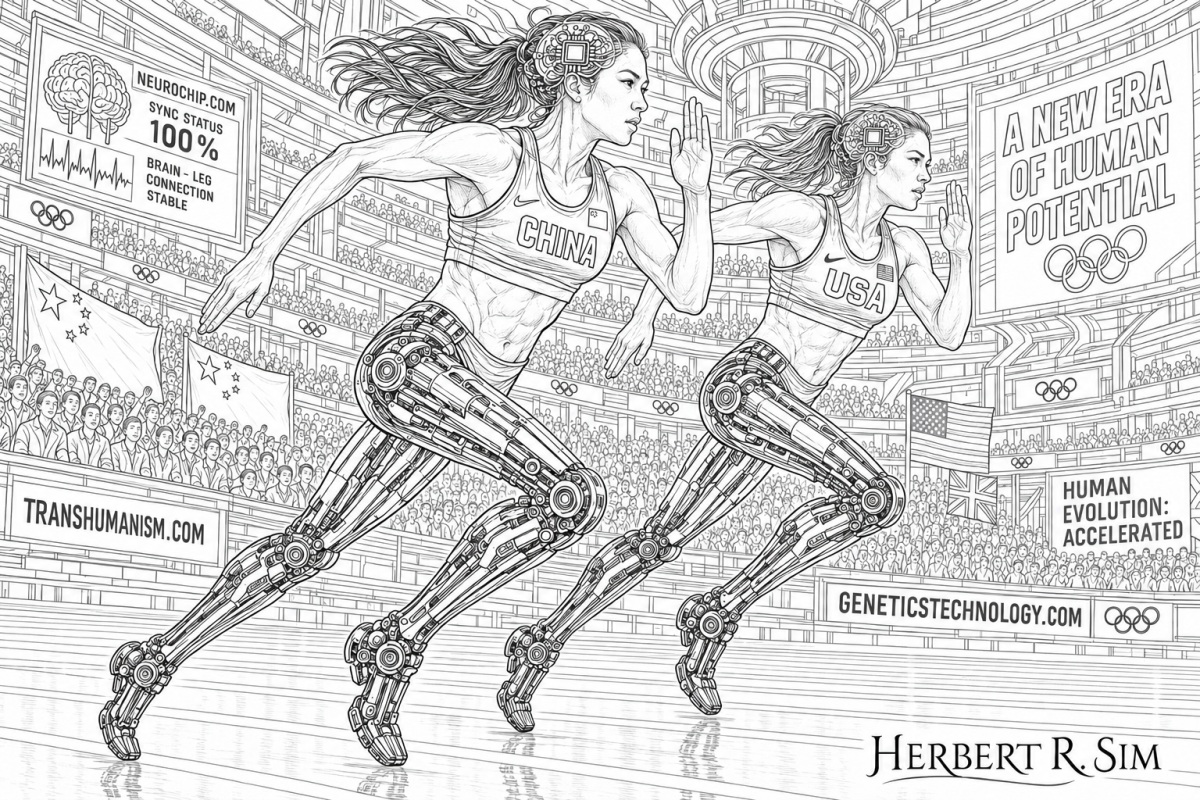
My illustration above showcasing that Neurochip will be used to sync the human brain to bionic limbs, to the efficiency level of 100% that can even be used to compete at the Olympics.
Artificial intelligence changed the world by teaching machines to learn from data. Brain-computer interfaces (BCI), aim at something more intimate: teaching machines to interface with human neural signals directly. That difference is fundamental. AI observes what people produce—text, images, speech, behavior, code, purchases, and clicks. BCI tries to interpret the electrical activity that precedes action itself: the signals of movement, intention, communication, attention, and, eventually, identity. Reuters reported Neuralink’s first human implant in January 2024, a milestone that turned BCI from a specialist neurotechnology story into a mass-market technology narrative.
The Next Interface Is Not a Screen
BCI is not simply the next gadget category after smartphones and wearables. It is a new interface layer between the nervous system and machines. A keyboard translates finger movement into symbols. A voice assistant translates speech into commands. A BCI attempts to translate brain activity into machine-readable instructions. WIRED’s March 2024 coverage of Neuralink’s first human subject showed this shift clearly: Noland Arbaugh, paralyzed from the shoulders down, demonstrated control of a computer interface using a brain implant.
The distinction between AI and BCI can be put plainly: AI was about machines learning; BCI is about machines connecting. AI models learn patterns from large datasets and produce predictions or outputs. BCIs capture neural signals, decode them, and send commands to external systems. In medical use, those systems may be cursors, keyboards, robotic arms, prosthetics, wheelchairs, communication tools, or smart home devices. Synchron’s BCI work, including the use of Amazon Alexa through an implanted interface, shows how a neural signal can become a command in a domestic environment.
This is why BCI feels more consequential than another wave of software. It moves computation closer to the biological source of human action. The mainframe lived in institutions; the PC sat on desks; the smartphone moved into pockets; wearables touched the body. BCI reaches toward the nervous system. The Economist has long framed brain-machine integration as a frontier in which brains and machines may be made to work together, not merely communicate through conventional devices.
The stakes are rising because BCI is converging with AI, robotics, vehicles, drones, and advanced electronics. A brain signal by itself is noisy. AI is needed to decode it. A decoded command by itself is inert. Robots, vehicles, drones, prosthetics, displays, and software systems are needed to act on it. The future is therefore not just “brain chips.” It is a full human-machine stack: neural sensors, AI decoders, computing infrastructure, secure operating systems, and physical machines that respond to intention. Reuters has reported that Neuralink’s first implant was placed in a brain region associated with movement intention, with the initial goal of cursor or keyboard control.
That medical starting point is crucial. The most legitimate first use case is restoration: helping people with paralysis, ALS, stroke, limb loss, or other neurological conditions regain communication and control. Scientific American reported in 2026 on brain implants enabling paralyzed people to type at speeds approaching ordinary texting, demonstrating that BCI progress is not limited to one company or one celebrity founder.
From Machine Learning to Mind-Machine Coupling
AI made machines probabilistic. Instead of following only explicit instructions, systems learned from examples and generalized from data. This transformed search, translation, image recognition, drug discovery, robotics, coding, customer service, and creative work. But AI still usually depends on externalized human behavior. A person types a prompt, speaks a command, uploads an image, or generates a trail of digital activity.
BCI shifts the interface upstream. It asks whether machines can detect intention before it becomes muscular action. For someone who cannot move, that difference is profound. The body may be unable to execute a command, but the neural signal of intended movement may still exist. A BCI can attempt to capture that signal and route it around the damaged pathway. That is why many early BCI trials focus on people with paralysis: the use case is ethically urgent, clinically measurable, and technologically clear.
In that sense, BCI is not “mind reading” in the science-fiction sense. Current systems do not decode a person’s full private inner life. They usually map specific neural patterns to specific intended actions, such as moving a cursor, selecting letters, or controlling a device. But as AI decoding improves, the boundary will become more sensitive. Today’s systems may decode movement. Future systems may decode attempted speech, attention states, emotional signals, visual imagery, or cognitive intent with greater resolution.
This is where BCI begins to touch identity. AI raises questions about labor, authorship, misinformation, surveillance, and economic displacement. BCI raises those questions plus deeper ones about agency, consent, autonomy, and neural privacy. If a machine can respond to intention, who verifies that the intention was real? If neural data reveals fatigue, disease risk, emotional arousal, or cognitive state, who owns that data? If a brain-controlled device fails, who is responsible: the user, the algorithm, the manufacturer, the surgeon, or the platform?
The New Human-Machine Stack
The future BCI ecosystem will not be defined by implants alone. It will be defined by integration. A BCI that controls only a cursor is already life-changing for some users, but the broader opportunity is to connect neural signals to multiple machine environments. That includes computers, phones, smart homes, robotic limbs, industrial robots, vehicles, drones, wheelchairs, exoskeletons, and humanoid robots.
In practical terms, the brain becomes an input channel. AI becomes the interpreter. Machines become the actuators. A person may intend to move a cursor, select a word, open a door, steer a wheelchair, manipulate a robotic arm, pilot a drone, or command a vehicle. The interface could be invasive, implanted into or near brain tissue; semi-invasive, placed on the brain surface or within blood vessels; or non-invasive, using external sensors such as EEG, ultrasound, or optical techniques.
Each approach has trade-offs. Invasive systems may capture richer signals but require surgery and long-term biocompatibility. Non-invasive systems are safer and easier to scale but usually have lower signal quality. Semi-invasive approaches try to split the difference. Synchron’s stent-like approach, which avoids open-skull surgery, has attracted attention precisely because it suggests a more scalable route for some clinical applications.
The platform that wins may not be the most dramatic one. It may be the one that balances bandwidth, safety, cost, reliability, user training, regulatory approval, and integration with everyday devices. That is why the field includes multiple competitors: Neuralink, Synchron, Blackrock Neurotech, Paradromics, Precision Neuroscience, and a growing number of Chinese start-ups. Forbes has described BCI as an emerging market involving a broad ecosystem rather than a one-company race.
My illustration work-in-progress above.
China Turns BCI Into Industrial Policy
China has recognized BCI as a strategic technology, not merely a medical niche. Beijing has elevated brain-computer interfaces into the category of future industries, placing them alongside advanced sectors such as AI, quantum technology, embodied intelligence, 6G, and nuclear fusion. Reuters reported in March 2026 that China could see widespread BCI use within three to five years, citing state support, expanding clinical trials, and an estimated domestic market reaching $809 million by 2027.
This is not a passive research agenda. China is using industrial policy. Central ministries, municipal governments, hospitals, universities, investors, and companies are being aligned around a national objective: build a domestic BCI ecosystem that can rival U.S. competitors such as Neuralink. TechCrunch reported in February 2026 that China’s BCI sector is moving rapidly from research toward commercialization, helped by policy support, clinical activity, and investor interest.
Municipal governments are particularly important. Shanghai and Beijing have both released ambitious action plans to become global players in BCI by 2030. South China Morning Post reported that these city-level plans include applications for paralysis, blindness, stroke, and related neurological conditions.
The Financial Times has also reported that Beijing is backing brain-implant efforts to rival Neuralink, with investment and looser regulatory conditions helping Chinese groups accelerate trials. This mirrors China’s playbook in electric vehicles, batteries, solar panels, drones, and telecommunications: identify a strategic sector, mobilize funding, support domestic champions, create procurement channels, and use scale to compress development timelines.
China’s momentum is already producing concrete signs. Reuters reported in March 2026 that China approved the commercial launch of a BCI medical device designed to help patients with spinal cord injury regain hand-grasping function through a minimally invasive system and glove. Reuters also reported that Beijing-backed NeuCyber Neurotech had received 200 million yuan, or about $29 million, in government funding and planned to expand human trials.
The U.S. Still Leads, But the Race Has Changed
The United States remains central to BCI development. Neuralink has the most public visibility, Synchron has a differentiated minimally invasive strategy, and other U.S. companies have deep technical histories. The Wall Street Journal reported Neuralink’s first patient demonstration in March 2024, when Arbaugh showed cursor control and gaming ability through the implant.
But U.S. leadership is not guaranteed. The BCI race is not only about scientific breakthroughs; it is about manufacturing, clinical recruitment, regulation, capital markets, reimbursement, data governance, and public trust. A technology that must be surgically implanted and maintained over years cannot scale like a mobile app. It needs neurosurgeons, hospitals, device approvals, patient follow-up, cybersecurity, software updates, and long-term liability frameworks.
This gives state-backed systems an advantage in coordination, but it can also create risks. Faster trials and strong government direction may accelerate commercialization, yet they also raise questions about patient consent, data governance, military applications, and privacy. Western companies face slower regulatory pathways, but that friction can also protect patients and establish standards that build trust.
The Ethical Frontier: Intention, Privacy, and Autonomy
BCI forces society to update its concept of privacy. Ordinary data privacy concerns what people say, buy, watch, or search. Neural privacy concerns signals generated by the brain itself. Even if current systems decode narrow motor intentions, future systems could reveal more about cognitive state, emotion, attention, or disease risk.
There is also a platform-dependency problem. If a person relies on a BCI to communicate, study, work, or control their environment, the company providing the system becomes part of that person’s functional autonomy. What happens if the company fails, changes business models, loses regulatory approval, drops support for an old implant, or suffers a breach? The risk is not just losing a device. It may mean losing a channel of communication.
Enhancement will complicate the debate further. Medical restoration is morally compelling. Helping a paralyzed person type, speak, grasp, or control a wheelchair is easy to defend. But once the same systems improve speed, coordination, attention, or machine control, non-medical users will want access. Military, industrial, gaming, transportation, and robotics applications will follow. A pilot controlling drones by neural command, a worker operating robotic machinery by intention, or a driver connected to a vehicle through attention-monitoring systems are not far-fetched scenarios.
The core question is agency. BCI can restore agency to people whose bodies no longer execute their intentions. But it can also expose intention to platforms, employers, states, insurers, and attackers. The same technology that gives a person independence could become a system of monitoring or coercion if poorly governed.
Why BCI Comes After AI
BCI comes after AI because AI supplies the decoding engine. Neural signals are complex, variable, and noisy. To make them useful, systems must learn each user’s patterns, adapt in real time, distinguish intention from noise, and translate signals into reliable commands. That is a machine-learning problem. Without AI, BCI remains crude. With AI, it becomes adaptive.
The sequence is logical. First, machines learned from human-created data. Next, machines will learn from human neural activity. Then they will act through robotic and digital systems. The result is not a single product but a new interface paradigm: intention-to-action computing.
The danger is hype. BCI will not make everyone telepathic in the near future. It will not instantly merge human minds with superintelligent machines. It will not eliminate disease or disability overnight. The field still faces major obstacles: surgical risk, signal degradation, immune response, regulatory scrutiny, cost, training time, device durability, ethics, and cybersecurity.
But the direction is clear. AI made machines more intelligent. BCI aims to make them more intimate. AI learned from the traces of human thought. BCI will try to connect with thought’s electrical beginnings. If the first digital revolution put computers on desks, and the mobile revolution put them in hands, the neural revolution seeks to connect them to intention itself.
The next great technology race is therefore not just about smarter machines. It is about who controls the interface between human minds and machine action. That interface could restore independence to millions. It could also become the most sensitive technological platform ever built. After AI comes BCI—and the target is no longer just information. It is the human brain.