

In my illustration above: featuring ‘Cypherpunk Girl‘ in a futuristic Cyberpunk city, where she is checking on her brain computer interface (BCI) dashboard’s subscription services and products.
By the time historians write the first serious accounts of the 21st century’s technological transformation, they may not describe it as the “AI revolution”. They may call it something more unsettling: the moment cognition itself became infrastructure.
That phrase — cognitive infrastructure — is already creeping into policy language. The World Economic Forum recently argued that AI is no longer just a tool but a “critical cognitive layer” shaping how humans think, decide, and act . This is not automation in the traditional sense. It is augmentation — an expansion of human intelligence through systems that increasingly feel less like software and more like extensions of the mind.
And that shift raises a deceptively simple question: who owns upgraded intelligence?
The Quiet Emergence of Cognitive Capitalism
For decades, economists treated labor, capital, and technology as separable inputs. But the post-human economy dissolves that boundary. When intelligence itself becomes augmentable — boosted through AI copilots, neural interfaces, or algorithmic assistants — it ceases to be purely human labor. It becomes something closer to capital.
Consultancies like McKinsey & Company are already reframing “brain capital” as a measurable economic asset, arguing that cognitive skills and brain health are now core drivers of productivity and growth . That framing is revealing. It suggests that cognition is no longer just a personal attribute; it is an investable, optimizable resource.
But capital is rarely neutral. It is owned, traded, and accumulated.
The implications are profound. If your ability to think, analyze, or create is partly dependent on proprietary AI systems, then your intelligence is no longer entirely yours. It is, at least in part, leased.
Subscription Minds: The Rise of SaaS Intelligence
The clearest signal of this shift is economic, not philosophical: intelligence is being sold as a subscription.
Consumer data suggests most households paying for generative AI tools now spend around $20 per month for access to enhanced capabilities. At the high end, premium tiers for advanced AI systems have reached $200 or more per month, targeting professionals who rely on these tools for income-generating work.
This is not incidental pricing. It mirrors the logic of Software-as-a-Service (SaaS), where recurring revenue replaces ownership. Companies like OpenAI explicitly operate on freemium subscription models, offering basic intelligence for free while monetizing enhanced cognitive capabilities through paid tiers .
The result is what might be called “SaaS brain layers”.
Instead of buying software, users subscribe to cognition itself — writing assistance, reasoning support, coding ability, even decision-making heuristics. The more you pay, the sharper your augmented intelligence becomes.
This is not merely a convenience upgrade. It is a structural shift in inequality.
If intelligence becomes subscription-based, then cognitive advantage — once tied to education or experience — becomes tied to purchasing power. The gap between a $20-per-month thinker and a $200-per-month thinker may soon resemble the gap between a bicycle and a jet.
Ownership Wars: Data, Thought, and Intellectual Property
The question of ownership becomes even more contentious when we ask: what powers these systems?
AI models are trained on vast datasets — much of it scraped from the internet, including journalism, art, and code. This has triggered a wave of legal and economic conflict. The The New York Times has both sued AI companies for unauthorized use of its content and simultaneously entered licensing deals with firms like Amazon to monetize its data for AI training .
This dual strategy — litigation and licensing — reveals a deeper truth: data is the new cognitive substrate.
Whoever owns the data owns the training ground for intelligence. And whoever owns the models owns the interface through which that intelligence is accessed.
In this emerging ecosystem, individuals contribute data — through writing, browsing, and interacting — but corporations capture the value. Critics have gone so far as to argue that AI systems are built on “unauthorized use of copyrighted content”, diverting revenue away from creators .
This is not just a copyright dispute. It is a struggle over cognitive ownership.
If your thoughts train the system, and the system shapes your future thoughts, where does authorship end and platform control begin?
Labor Beyond Automation: The Post-Work Paradox
Much of the public discourse still frames AI as a labor issue: jobs lost, jobs created, productivity gains. But that framing is already outdated.
Early data suggests that, so far, AI has not caused massive labor displacement across the economy . But focusing on job counts misses the deeper transformation.
The real disruption is not that humans are being replaced. It is that the nature of human contribution is being redefined.
In the post-human economy, value shifts from doing work to orchestrating intelligence — knowing how to prompt, interpret, and collaborate with AI systems. This creates a new kind of labor: augmented cognition labor.
But here’s the paradox: the more powerful the augmentation, the less individually attributable the output becomes.
If a lawyer uses AI to draft a contract, who produced the legal reasoning? If a programmer relies on AI-generated code, who owns the intellectual labor? If a journalist co-writes with an algorithm, who holds authorship?
These are not hypothetical questions. They are already reshaping industries.
Even within companies, AI is being treated less as a tool and more as a core component of workforce capability. Executives at firms like Miro argue that spending on AI tools should be considered part of employee development budgets — essential to maintaining competitive intelligence .
In other words, access to AI is becoming a prerequisite for participation in the modern economy.
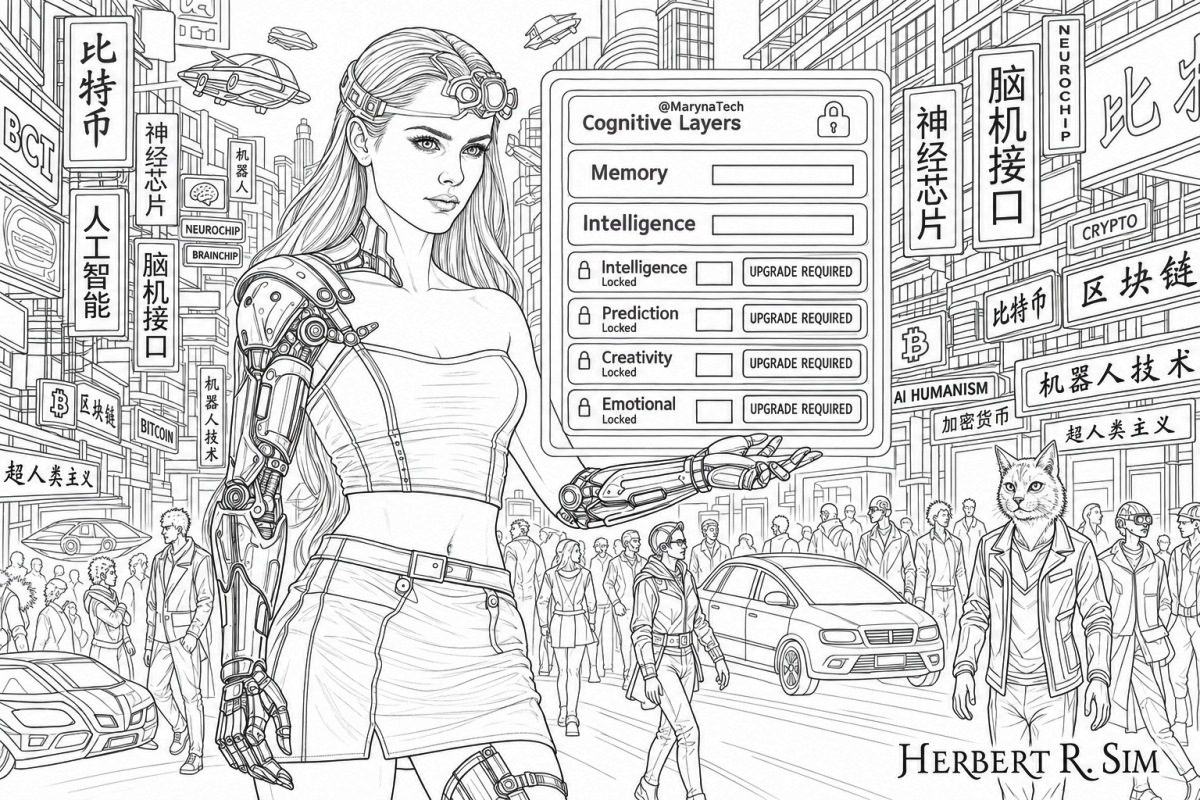
My illustration work-in-progress above.
Cognitive Offloading and the Fragility of Thought
There is another, less discussed consequence: the erosion of unaugmented cognition.
As AI systems take over tasks like memory recall, analysis, and even decision-making, humans increasingly “offload” cognitive effort. Researchers warn that this can weaken critical thinking and intellectual engagement over time.
The World Economic Forum has similarly cautioned that reliance on AI could undermine “intellectual stamina” and democratic resilience .
This introduces a new dimension to ownership: dependency.
If your cognitive performance depends on proprietary systems, then losing access — through cost, policy changes, or platform shutdowns — could mean losing part of your functional intelligence.
This is not science fiction. It is the logical endpoint of subscription cognition.
The Platformization of Thought
To understand where this is heading, it helps to look at how digital platforms evolved.
First, platforms owned distribution (social media). Then they owned attention (algorithmic feeds). Now they are beginning to own cognition itself.
AI systems are becoming the interface through which we interpret the world. Search engines are evolving into “answer engines”, reducing the need to visit original sources and potentially cutting publisher traffic by as much as 43% .
Companies like Perplexity AI are building systems that synthesize information into direct answers, effectively inserting themselves between users and knowledge.
This is platformization at a deeper level. It is not just about controlling access to information. It is about controlling how information is processed and understood.
In such a world, owning the platform means owning the cognitive pathway.
Beyond AI: The Next Layer of Disruption
It is tempting to think of this transformation as an extension of AI. But that framing may be too narrow.
The real disruption lies in the convergence of technologies: AI, neurotechnology, augmented reality, and human-machine interfaces. Together, they point toward a future where cognition is continuously enhanced, mediated, and monetized.
Consulting firms describe this as a “human-machine hybrid economy”, where augmentation technologies expand cognitive performance beyond natural limits .
Some technologists go further, predicting that cognitive labor itself may become economically irrelevant as AI systems surpass human capabilities.
If that happens, the question of ownership becomes existential.
Not just who owns the tools — but who owns the value generated by intelligence itself.
Reclaiming Agency in a Leased Mind Economy
So where does this leave us?
The post-human economy is not inevitable in its current form. It is being shaped, in real time, by policy decisions, business models, and cultural norms.
There are alternative paths.
Some propose cooperative ownership models for AI systems, where users share in the value created by the intelligence they help train . Others advocate for stricter data rights, ensuring individuals retain control over how their information is used.
But these solutions face a fundamental challenge: convenience.
Subscription intelligence is easy, powerful, and increasingly indispensable. Resisting it requires not just regulation, but a rethinking of what it means to own one’s mind.
The Final Question
The post-human economy will not be defined by robots replacing workers. It will be defined by something subtler: the integration of intelligence into systems that are owned, priced, and controlled.
In that world, the most important economic question may no longer be “Who owns the means of production?” but rather:
Who owns the means of thinking?
Because once intelligence itself becomes a service, the line between user and product begins to blur.
And the most valuable asset you possess — your mind — may no longer be entirely yours.