
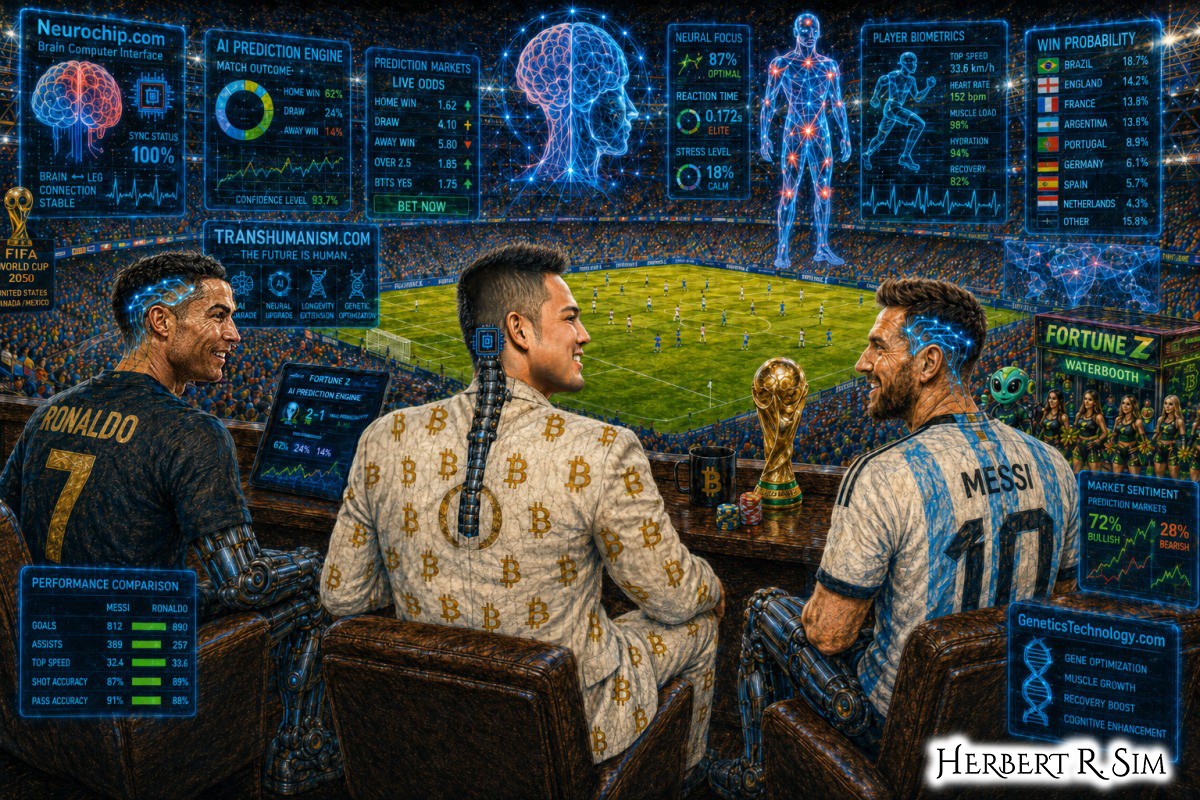
In my latest illustration is my vision of World Cup 2050, where the future is Transhumanism – athletes embracing brain computer interface, bionics limbs, and even genetics editing and modifications.
The FIFA World Cup has always been more than football. It is nationalism, spectacle, commerce, identity, myth and pressure compressed into ninety minutes. But the 2026 edition marks something different. It is not simply the biggest World Cup in history, expanding to 48 teams and 104 matches across the United States, Canada and Mexico. It is also becoming a live demonstration of the next stage of human-machine civilization.
For me, the World Cup is no longer only a tournament of nations. It is a preview of the transhuman future: where athletes optimize the body, fans gamble through algorithms, casinos evolve into prediction engines, and the line between human instinct and machine intelligence begins to blur.
This article follows from the earlier article: “After AI Comes BCI: Why the Next Tech Revolution Targets the Human Brain”, which argued that the next great technology race will not merely be about smarter machines, but about who controls the interface between human minds and machine action. The World Cup now offers a public arena where that thesis becomes easier to see.
The Human Body Is Becoming a Performance Platform
The old language of sport was simple: talent, discipline, teamwork and luck. Those words still matter. But elite sport is now surrounded by biometric data, sleep tracking, recovery science, video analytics, nutrition protocols, cognitive training and machine learning.
Modern footballers do not merely train; they are measured. Their sprint load, fatigue, hydration, injury risk, acceleration, passing networks and tactical tendencies are translated into data. Coaches increasingly operate like systems engineers. The body becomes a platform. The athlete becomes a biological machine under constant optimization.
This is already visible beyond football. At the Paris Olympics, WIRED reported how Omega’s Swiss Timing used AI and computer vision to map athlete performance and enrich how events are measured and understood. Google DeepMind’s TacticAI has also shown how artificial intelligence can analyze football corner kicks, predict outcomes and suggest tactical adjustments. These are not futuristic fantasies. They are early signals of sport’s data-saturated present.
For me, this is where transhumanism enters the stadium. Transhumanism does not always arrive as a dramatic brain implant or robotic limb. It often begins quietly: a sensor, a model, a predictive dashboard, a recovery protocol, a neural feedback loop. The footballer of the future may still look fully human, but his preparation will be shaped by machine intelligence.
From Physical Doping to Cognitive Enhancement
Sport has long policed the body. Steroids, blood doping and banned substances were the great ethical battlegrounds of twentieth-century competition. But the next frontier may not be muscle. It may be cognition.
If a player uses neurofeedback to improve focus before penalties, is that training or enhancement? If an athlete uses brain stimulation to accelerate recovery or sharpen reaction time, is that medical support or cognitive doping? If artificial intelligence identifies a player’s mental fatigue before he consciously feels it, who is really making the substitution: the coach, the machine or the body’s data?
The rise of brain-computer interface technology makes these questions harder to avoid. Reuters reported in 2024 that Neuralink’s first human patient could control a computer mouse through thought. The Wall Street Journal reported that Neuralink’s first patient demonstrated cursor control and chess play through a brain implant. WIRED later covered Synchron’s work combining BCI with Nvidia AI and Apple Vision Pro to help a paralyzed person control digital and physical environments. The Verge has also reported how a Neuralink user with ALS adapted his mind-controlled computer with a webcam to gain more agency in daily life.
These are medical stories first. They should be treated with seriousness and respect. But medical restoration often precedes human enhancement. The technology that restores agency to someone with paralysis may eventually influence gaming, industrial work, military systems and sport.
The World Cup, as the planet’s most watched sporting event, becomes the perfect stage for society to ask: what happens when the human body is no longer the natural limit?
Fans Are Becoming Algorithmic Gamblers
The transhuman World Cup is not only about players. It is also about fans.
For decades, fans predicted matches through loyalty, superstition, memory and instinct. Today, prediction is becoming a market behavior. Fans compare odds, follow AI forecasts, study player data, trade outcomes and place increasingly complex wagers through mobile platforms.
Reuters reported that total World Cup wagers in 2026 were forecast to exceed $50 billion globally, up from $35 billion for the 2022 edition. AP reported that betting among Brazilians more than tripled during the tournament, according to a fintech study. Forbes has tracked where FIFA rankings and World Cup betting markets disagree, showing how sportsbooks and prediction markets can produce different views of team strength.
This matters because the fan is no longer merely watching the game. The fan is participating in an algorithmic economy around the game. Betting apps, crypto platforms, odds feeds, social media narratives and AI forecasts all compete to shape perception before kickoff.
The result is a new kind of spectator: emotional, financialized and data-driven. He cheers, but also hedges. He believes, but also calculates. He watches the striker, the odds board and the prediction model at the same time.
Casinos Are Becoming Prediction Engines
The casino of the past was built around tables, dice, cards, wheels and slots. The casino of the future is increasingly built around live data, odds engines, sports markets, crypto wallets, AI systems and personalized risk interfaces.
Sports betting and casino entertainment are converging with fintech. Prediction markets are challenging the legal and cultural boundaries between trading, gambling and forecasting. Reuters reported that U.S. derivatives regulators have been mapping rules for prediction markets tied to sports scores, tournament advancement and similar data. Le Monde described prediction markets as a controversial but fast-growing form of online betting promoted around the 2026 World Cup. WIRED Middle East similarly reported that World Cup prediction markets are changing what betting looks like and how regulators define it.
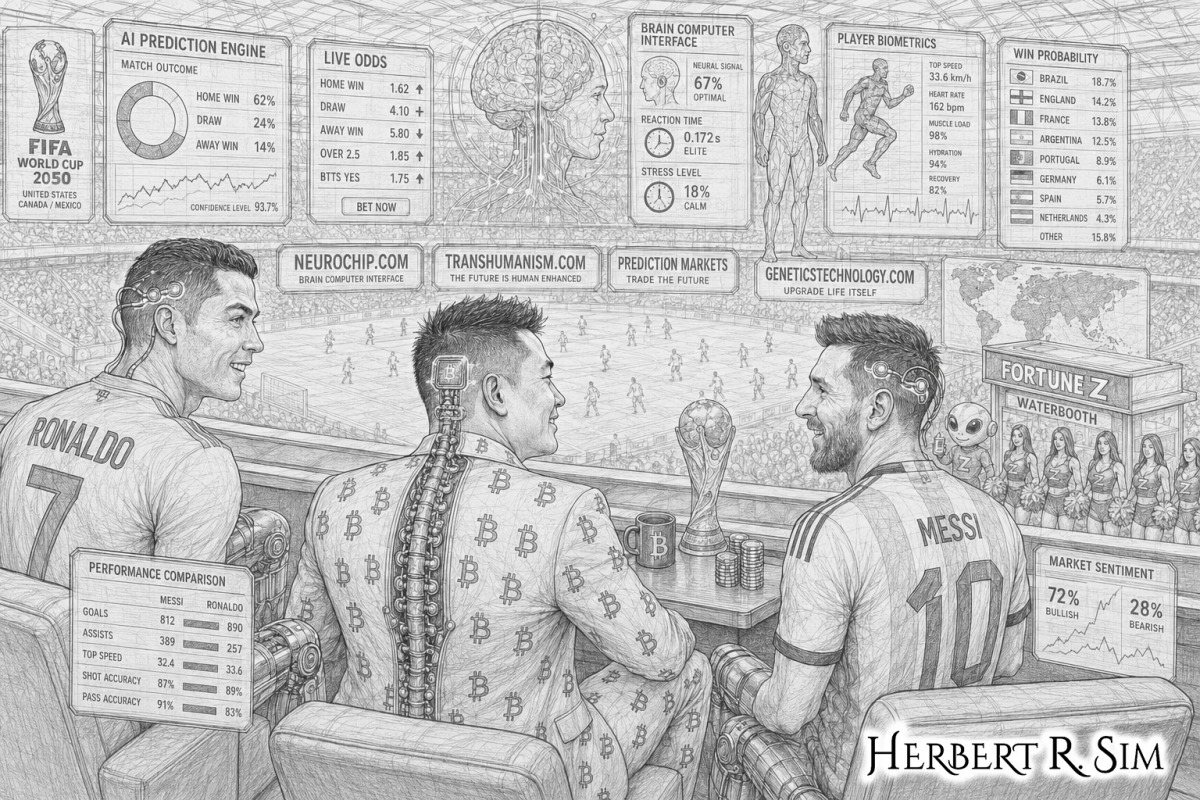
My art in progress, I sketch in my vision of the future – prediction markets where the money is, drives the entire ideology of transcending humanity forward.
This is where crypto casinos and sports-betting platforms become relevant to Sim’s broader thesis. They are not merely gambling venues. They are interfaces for risk, probability, identity and reward. In a digital casino, the machine does not simply host the game. It models the player, prices the odds, monitors behavior and reacts in real time.
For brands in the crypto casino space, the opportunity is clear: sport is becoming more interactive, global and financialized. But the ethical challenge is equally clear. When entertainment becomes prediction, and prediction becomes gambling, the platform has extraordinary power over human attention.
The House Edge Is Becoming Algorithmic
The deeper issue is not whether people bet on football. They always have. The deeper issue is that the modern betting environment is computational.
The Wall Street Journal has reported on how same-game parlays and long-shot sports bets have surged in popularity, often relying on complex algorithms and simulations to price highly customized wagers. Another WSJ report described sports-betting traders using mathematical models and simulations to manage odds and risk. Forbes has described AI as transforming sports gambling through data-driven prediction. Reuters has warned more broadly about the rise of gambling, gamification and app-based speculative behavior.
The pattern is obvious. The fan may believe he is betting against uncertainty. In reality, he is often betting against a machine-built system designed to understand probability better than he does.
This does not make betting illegitimate. Risk is part of human culture. Markets, sport, business and life all involve uncertainty. But it does mean the future casino is less like a room of chance and more like a behavioral prediction engine.
The World Cup as a Transhuman Mirror
This is why the World Cup matters to transhumanism. It reveals the same convergence I have written about across artificial intelligence, brain-computer interfaces, crypto, economics and human enhancement.
On the pitch, athletes are optimized through science and data. In the stands and on phones, fans are turned into real-time forecasters. In the casino layer, betting platforms become algorithmic interpreters of probability. In the medical and neurotechnology world, BCI points toward a future where intention itself can become an input.
The World Cup therefore becomes a mirror of civilization’s next interface. Human emotion is measured by machines. Human performance is enhanced by science. Human prediction is monetized through digital markets. Human instinct is increasingly surrounded by artificial intelligence.
The tournament still belongs to the players, the fans and the nations. But around them is a growing machine layer that sees, prices, predicts and optimizes.
The Ethical Question
For Sim, the correct response is not blind celebration or moral panic. It is recognition.
Technology will continue entering sport because competition rewards advantage. Betting will continue entering fandom because uncertainty creates markets. AI will continue entering casinos because prediction creates profit. BCI will continue advancing because restoring human agency is one of the most powerful medical missions of the century.
But society must decide where the boundaries are. Should athletes be allowed to use cognitive enhancement tools? Should neural data receive stronger privacy protection than ordinary biometric data? Should betting platforms be required to explain how algorithmic odds and promotions are designed? Should prediction markets around sport be treated as financial instruments, gambling products or something new?
The World Cup forces these questions into public view because it is global, emotional and commercial at unmatched scale.
The Future of Football Will Still Be Human — But Not Merely Human
The 2026 FIFA World Cup may be remembered for goals, upsets, stars and national drama. But its deeper significance may be technological. It is showing how sport becomes a convergence point for transhumanism, artificial intelligence, crypto gambling, prediction markets and neurotechnology.
Football remains beautifully human because it is unpredictable. A deflection, a red card, a penalty miss or a moment of genius can destroy the cleanest model. That is why people watch.
But the world around football is changing. The body is optimized. The fan is quantified. The bet is algorithmic. The casino is becoming a prediction engine. The brain is becoming the next interface.
The future of the World Cup may still be human. But it will not be merely human.