

My illustration entitled: “The Four Pillars” – Four monumental pillars engraved with Value, Ownership, Knowledge, and Choice supporting an open civic marketplace.
Economic freedom is not secured merely by income, employment or access to consumption. It is secured when individuals possess the practical capability to create value, retain ownership, acquire knowledge and make meaningful choices.
These four foundations—Value, Ownership, Knowledge and Choice—form the basis of Sovereign Capability Economics. Together, they determine whether an individual is able to build an independent life or remains permanently dependent on institutions, employers, intermediaries and systems controlled by others.
A society may appear prosperous while its people possess little control over the conditions of their participation. People may earn money without being able to preserve it. They may have access to information without the ability to understand it. They may be offered choices without a realistic ability to refuse. They may create value while ownership of that value is retained elsewhere.
Economic progress must therefore be measured by more than output. It must be measured by whether individuals become more capable of directing their own futures.
First Foundation: Value
Value is the starting point of economic life.
Every durable economy depends on the creation of value: work that solves a problem, a service that improves life, knowledge that produces a new possibility, an invention that lowers cost or an enterprise that brings people together through voluntary exchange.
But value is not limited to money. It includes skill, effort, time, reputation, creativity, reliability and the capacity to contribute something useful to others.
An individual becomes more economically capable when able to create value beyond a single institution’s approval. A person who can learn, produce, adapt and solve problems possesses a foundation for independence. Their economic future is not entirely dependent on a single employer, a single marketplace or a single source of permission.
A healthy economic system should reward productive contribution rather than merely protect established privilege. It should create room for people to turn ability into opportunity, and opportunity into a sustainable source of value.
When people are prevented from creating or exchanging value through excessive barriers, the loss is not theirs alone. Society loses innovation, competition, resilience and the new solutions that independent minds are capable of producing.
Second Foundation: Ownership
Value without ownership is incomplete.
A person may work, create or contribute, yet remain unable to retain the results of their labour. Their savings may be exposed to decisions they did not make. Their property may depend upon terms they cannot negotiate. Their work may enrich an institution while leaving them with little ability to build a lasting independent base.
Ownership provides continuity between effort and future security. It allows an individual to preserve what has been earned, make long-term decisions, accept responsibility and build something that can endure beyond immediate need.
Ownership is not simply a legal abstraction. It is practical control. It includes the ability to hold, transfer, improve, protect and use legitimately acquired property without arbitrary interference.
This is why monetary ownership matters. Money is stored effort. It allows people to carry the value of their work across time and distance. If individuals cannot meaningfully hold or transfer value, their independence becomes conditional upon the systems through which that value must pass.
The emergence of Bitcoin demonstrates an important new possibility. It shows that digital value can be held and transferred through cryptographic proof, rather than relying entirely on a trusted central intermediary. Bitcoin does not remove the need for responsibility or prudent judgment, but it expands the range of ownership models available to the individual.
A society that protects ownership protects the individual’s ability to plan. A society that weakens ownership weakens the connection between personal effort and personal independence.
Third Foundation: Knowledge
Knowledge is productive capital.
It allows individuals to understand the systems that affect them, assess risks, recognise opportunity, develop skills and make decisions that are not merely reactions to circumstance.
Without knowledge, people can be offered choices while remaining vulnerable to manipulation. They may sign agreements they do not understand, place savings in systems they cannot assess or depend on institutions whose incentives remain hidden from them.
Economic capability requires more than access to information. It requires the ability to learn, question, compare and apply judgment.
Education should therefore be understood as an economic instrument of freedom. It gives people the capacity to create value independently, to recognise unfair arrangements and to build alternatives when existing systems fail them.
Open knowledge, technological literacy and practical skills are especially important because they reduce the distance between the individual and the systems that shape daily life. The more people understand how money, property, contracts and technology operate, the less easily they can be excluded from decisions made in their name.
Knowledge does not guarantee wisdom. But without knowledge, economic independence is difficult to achieve and even harder to preserve.
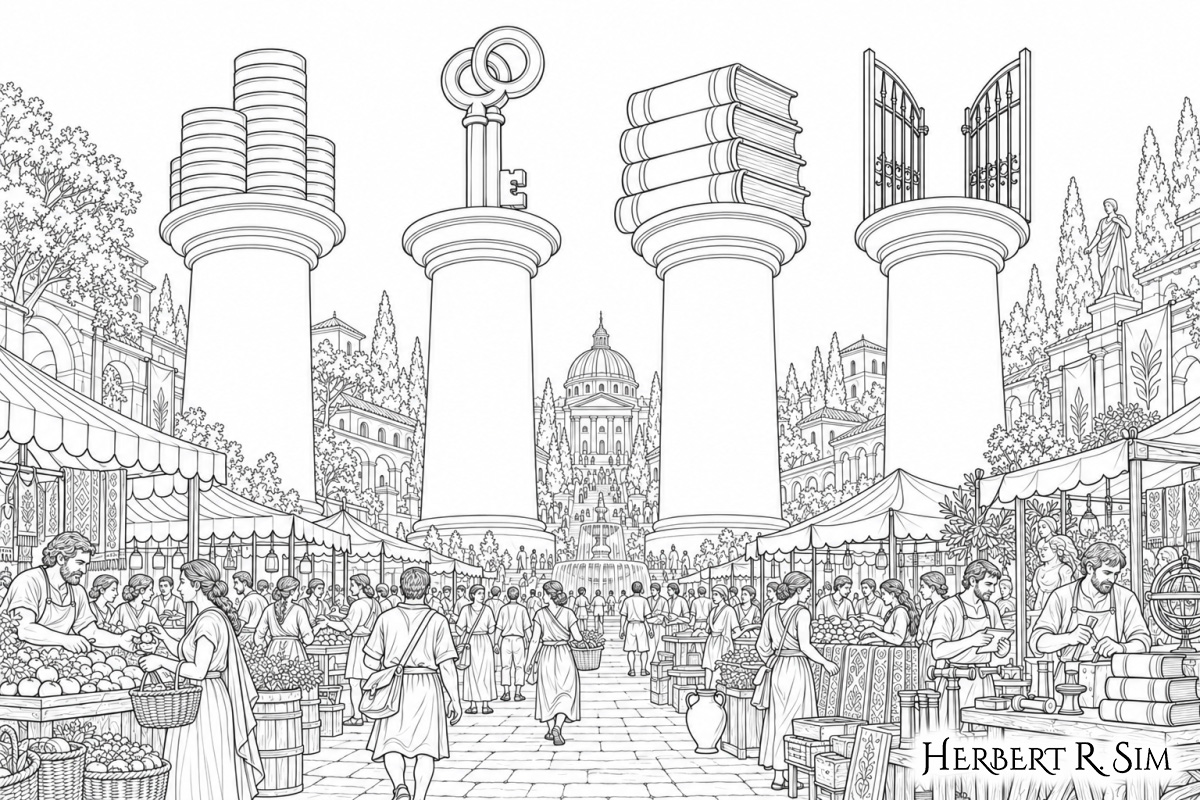
My illustration “The Four Pillars” work-in-progress. The art shows that economic freedom rests on four practical capabilities: creating value, owning property, gaining knowledge, and choosing one’s path.
Fourth Foundation: Choice
Choice is the final test of economic freedom.
A person may create value, own property and possess knowledge, yet remain unfree if every important path is controlled by a single authority. Choice requires alternatives. It requires competition, voluntary association and the practical ability to leave an arrangement that no longer serves the individual.
This is the economic right to exit.
The right to exit means that an individual can choose another provider, another employer, another marketplace, another method of exchange or another way to organise productive activity. It does not mean freedom from responsibility. It means that responsibility remains connected to voluntary agreement rather than permanent dependency.
When people can exit, institutions must earn trust. They must provide better service, clear terms and genuine value. When people cannot exit, institutions can demand compliance without being accountable for the consequences.
Choice protects against the concentration of power. It prevents any one institution from becoming the unavoidable condition for participation in economic life.
The Four Foundations Work Together
Value, Ownership, Knowledge and Choice cannot be separated.
Value without ownership leaves the individual unable to retain the results of productive effort. Ownership without knowledge leaves the individual vulnerable to deception and dependence. Knowledge without choice can become mere observation of a system one cannot change. Choice without the ability to create value offers no sustainable path to independence.
Together, these foundations transform economic liberty from an abstract promise into a practical condition.
An individual who can create value, hold what is earned, understand the systems affecting them and choose among meaningful alternatives possesses a stronger basis for economic sovereignty. Such a person is better able to withstand institutional failure, adapt to changing conditions and direct the course of their own life.
From Dependency to Capability
The central question of Sovereign Capability Economics is not whether institutions should exist. Institutions can coordinate activity, provide useful services and support cooperation at scale.
The question is whether institutions increase individual capability or replace it with permanent dependency.
A system that enables people to create, own, learn and choose strengthens society from the ground up. It produces capable individuals who can cooperate voluntarily, build enterprises, challenge poor systems and create solutions to new problems.
A system that centralises value, weakens ownership, restricts knowledge and removes alternatives may produce short-term order, but it reduces the individual to a dependent participant. It makes freedom conditional upon continued approval from those who control the essential channels of economic life.
Economic sovereignty is not isolation. It is the ability to participate in society without surrendering the capacity to direct one’s own future.
The Foundation of a Free Economy
The purpose of economic progress should be to increase the number of people who can stand independently, cooperate voluntarily and create a better future through their own judgment and effort.
This requires more than growth. It requires systems that protect the relationship between work and value, value and ownership, ownership and choice.
Political Economics identifies the ways in which money and institutions shape individual freedom. Counter Economics explores voluntary alternatives when concentrated power restricts that freedom. Sovereign Capability Economics establishes the wider standard by which an economy should be judged: does it increase the individual’s capability to create value, own what is earned, gain knowledge and choose a path freely?
Value creates possibility. Ownership protects independence. Knowledge develops judgment. Choice preserves liberty. Together, they form the foundations of economic capability.
Reference: Satoshi Nakamoto, Bitcoin: A Peer-to-Peer Electronic Cash System, 31 October 2008.
Official Publication Record
The Four Foundations of Economic Capability: Value, Ownership, Knowledge and Choice
has been formally archived on Zenodo with a permanent DOI for citation,
preservation and scholarly reference.
| Title | The Four Foundations of Economic Capability: Value, Ownership, Knowledge and Choice |
| Author | Herbert R. Sim |
| ORCID | 0009-0008-6500-5749 |
| Publication date | 20 June 2013 |
| Canonical webpage | https://herbertrsim.com/four-foundations-economic-capability/ |
| DOI | 10.5281/zenodo.22768795 |
| Zenodo record | https://zenodo.org/records/22768795 |
| Copyright | © 2013 Herbert R. Sim. All rights reserved. |
Preferred citation:
Sim, Herbert R. (2013). The Four Foundations of Economic Capability: Value, Ownership, Knowledge and Choice. HerbertRSim.com.
https://doi.org/10.5281/zenodo.22768795
Zenodo submission note:
This work was deposited on Zenodo for permanent scholarly preservation, citation and public reference.