
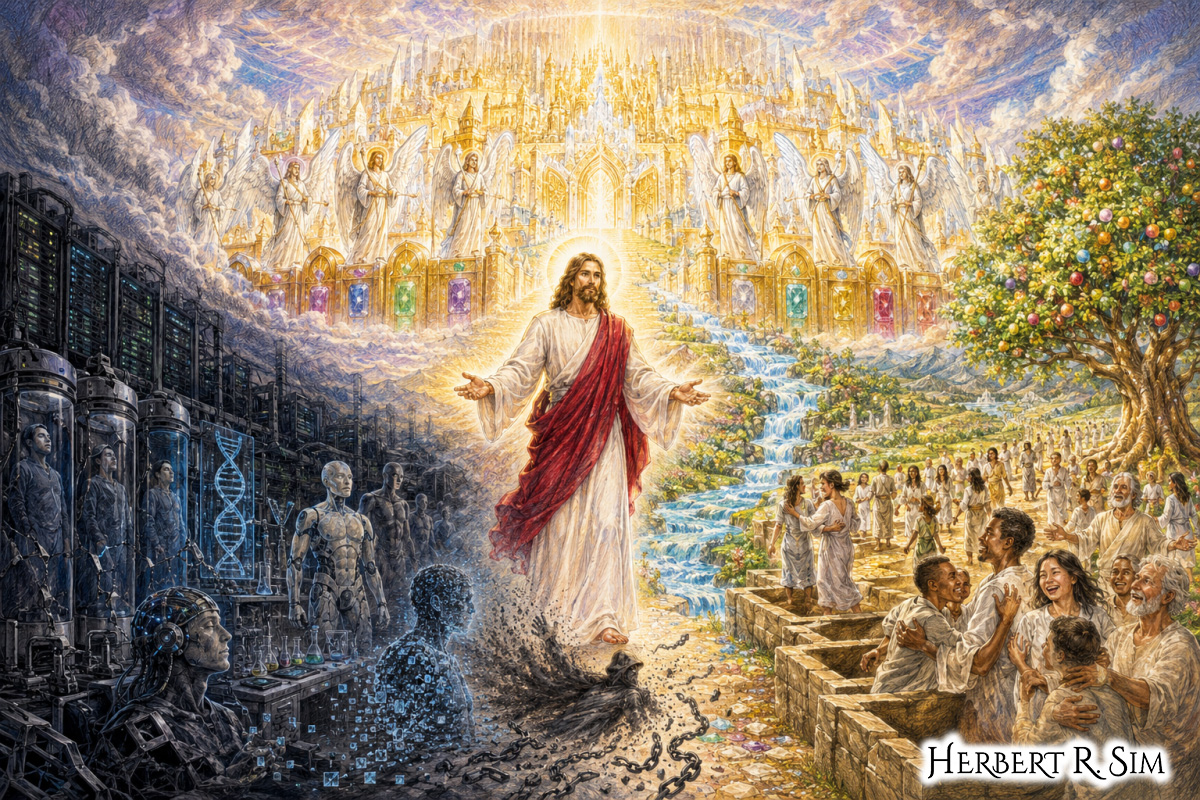
In my illustration above, I depict humanity’s attempt to manufacture immortality being eclipsed by the New Jerusalem—where Jesus Christ does not merely extend human life, but destroys death itself.
The Holy City shines like a gigantic jewel. Its twelve gates are guarded by twelve angels, while its foundations glow with precious stones. Beneath the city, the technologies through which mankind attempted to defeat death—cryonic chambers, artificial bodies, genetic laboratories, neural implants and digital consciousness—fade into darkness.
Humanity tried to manufacture immortality.
God offers something far greater: resurrection, restoration and eternal life in His presence.
For as long as human beings have understood death, we have attempted to escape it.
Ancient emperors searched for elixirs of immortality. Alchemists sought substances capable of preserving the body. Modern scientists investigate genetic editing, cellular rejuvenation, organ replacement, cryonics and artificial intelligence. Transhumanists speculate that consciousness could one day be uploaded into a computer, allowing a digital version of a person to continue after the biological body dies.
Technology may extend our lives. It may replace failing organs, repair damaged genes and slow some processes associated with ageing. Brain–computer interfaces may eventually preserve memories, restore lost abilities or connect the human mind directly to artificial intelligence.
These achievements may relieve tremendous suffering. Christians should not automatically reject medicine or technology. Healing the sick, restoring movement and extending healthy life can all be acts of mercy.
But extending life is not the same as conquering death.
A person who lives for 150 years still dies. A frozen body is not a resurrected body. A machine containing someone’s memories may imitate that individual, but imitation is not necessarily personal continuity. A digital copy that speaks with your voice is not proof that your soul has entered the machine.
Human immortality promises more time within the present world.
The Bible promises an entirely new world.
“Behold, I Make All Things New”
The final chapters of the Bible do not end with mankind escaping into a computer simulation or abandoning Earth aboard spaceships.
They end with Heaven coming down.
In Revelation 21, the Apostle John sees “a new heaven and a new earth.” He then witnesses the Holy City—the New Jerusalem—descending from God out of Heaven, prepared like a bride adorned for her husband.
A great voice declares:
“Behold, the tabernacle of God is with men, and he will dwell with them.”
This is the centre of Christian hope. God and humanity are no longer separated. The curse introduced through sin has been removed. Creation is not merely repaired; it is renewed.
God promises to wipe away every tear. There will be no more death, sorrow, crying or pain, because the former things have passed away.
That promise goes far beyond immortality.
Imagine being forced to live forever in our present world—with war, disease, loneliness, betrayal, injustice and grief continuing without end. Endless biological existence in a fallen world could eventually become a curse rather than a blessing.
The New Jerusalem does not offer endless continuation of the old order. It announces the end of the old order.
God does not merely extend the human lifespan.
He removes death itself.
The Last Enemy Is Destroyed
The Apostle Paul calls death “the last enemy” in 1 Corinthians 15.
Death is not portrayed as a natural friend of humanity. It is an enemy that entered a creation originally declared good. Every funeral, every grave and every grieving family testifies that something is wrong with the present condition of the world.
Revelation shows the final destruction of this enemy.
In Revelation 20, Death and Hades are thrown into the lake of fire. By the time the New Jerusalem appears, death is no longer waiting outside the city. It has been judged and removed.
This victory does not originate with human technology. It originates with the resurrection of Jesus Christ.
Jesus did not avoid death by preserving His biological body indefinitely. He entered death, passed through it and rose again. His resurrection was not a mind upload, a clone or a computer-generated reconstruction. The tomb was empty.
Christianity therefore makes a much greater claim than transhumanism.
Transhumanism says humanity must become more than human to escape death.
The Gospel says God became human to defeat death.
Jesus Christ is described as the “firstfruits” of the resurrection. His resurrection is the beginning of what will eventually happen to those who belong to Him. Paul writes that the corruptible body will be raised incorruptible and the mortal will put on immortality.
This is not the abandonment of the body. It is the transformation of the body.
Christian hope is not that we become ghosts inside machines. It is that God raises the dead.
The City Mankind Could Never Build
Humanity has always attempted to build its own version of Heaven.
At the Tower of Babel, mankind constructed upward, seeking to reach the heavens and make a name for itself. The New Jerusalem presents the opposite movement.
Babel rises from Earth through human ambition.
The New Jerusalem descends from Heaven through divine grace.
The difference is important. The Holy City is not the final achievement of civilisation. It is the gift of God.
Today, governments and technology corporations compete to build increasingly intelligent cities. Sensors can monitor traffic. Algorithms can distribute resources. Facial recognition can identify residents. Artificial intelligence may regulate transportation, security, energy and public services.
Future cities may be technologically magnificent. But no algorithm can remove sin from the human heart. No surveillance network can produce perfect righteousness. No artificial intelligence can resurrect the dead or wipe away every tear.
The New Jerusalem is the ultimate city, but it is not governed by artificial intelligence. It is ruled by God.
It does not require the sun or moon to illuminate it because the glory of God gives it light, and the Lamb—Jesus Christ—is its lamp.
It has no need for a temple because God and the Lamb dwell directly among the people.
It does not depend upon a biometric identity system to decide who has permission to exist. Its citizens are known by God and written in the Lamb’s Book of Life.
It is not secured by reading every iris, tracking every transaction or accessing every human brain.
Nothing impure enters—not because the population is under total technological surveillance, but because creation itself has been redeemed.
Twelve Gates, Twelve Foundations and One Redeemed Humanity
John describes the New Jerusalem with extraordinary visual detail.
The city has twelve gates, with the names of the twelve tribes of Israel written upon them. It has twelve foundations bearing the names of the twelve apostles of Jesus Christ. The number twelve appears repeatedly, symbolising the completeness of God’s people.
Each gate is formed from a single pearl. The foundations are decorated with precious stones. The street is described as pure gold, transparent like glass. The city’s measurements are so immense that its length, width and height are equal.
Whether every measurement should be interpreted literally or symbolically has been debated for centuries. But the theological message is clear: this is a city of unimaginable glory, order, security and permanence.
Its gates are never shut.
The nations walk by its light, and the kings of the Earth bring their glory into it. The New Jerusalem is not presented as a tiny shelter for a frightened remnant. It stands at the centre of a renewed creation.
Human empires divide people according to wealth, citizenship, race and power. Technological enhancement could create another division—between the biologically upgraded and the unmodified, between those who can afford life extension and those left to age naturally.
The New Jerusalem overturns this hierarchy.
Eternal life cannot be purchased by billionaires, inherited through superior genetics or unlocked by a neural implant.
In Revelation 21:6, God says:
“I will give unto him that is athirst of the fountain of the water of life freely.”
Freely.
The greatest gift in existence is not sold to the highest bidder. It is given by God.
The River and the Tree of Life
The Bible begins with humanity losing access to the Tree of Life.
After Adam and Eve disobey God, they are expelled from the Garden of Eden. Cherubim and a flaming sword guard the way to the tree so that fallen humanity cannot take from it and live forever in its corrupted condition.
In Revelation 22, the Tree of Life appears again.
A pure river of the water of life flows from the throne of God and of the Lamb. The Tree of Life grows beside the river, producing twelve kinds of fruit. Its leaves are described as being “for the healing of the nations.”
Genesis records paradise lost.
Revelation reveals paradise restored.
But the restored creation is greater than Eden. Humanity does not merely return to a garden. The garden has expanded into a city, and the presence of God fills everything.
The Bible’s story has moved from a garden, through a fallen world, toward a garden-city where civilisation and creation are finally reconciled.
There is no more curse.
There is no more night.
The servants of God see His face.
This may be one of the most astonishing promises in the entire Bible. Throughout Scripture, the unfiltered glory of God is beyond fallen humanity’s capacity to endure. Yet in the New Jerusalem, the redeemed see His face and bear His name.
Technology attempts to increase what the human eye can see and what the human brain can comprehend.
Resurrection prepares humanity to stand before God Himself.
Immortality Without God Is Not Salvation
The modern pursuit of immortality often assumes that death is humanity’s only fundamental problem.
If ageing could be reversed, organs replaced and consciousness preserved, perhaps mankind could finally save itself.
But according to Christianity, death is not the only problem. Sin, judgment and separation from God are deeper problems. Making a fallen person biologically immortal would not automatically make that person righteous, loving or free.
A tyrant with an indefinite lifespan remains a tyrant.
A criminal mind uploaded into a machine remains morally corrupted.
An immortal civilisation without God could perpetuate evil forever.
The New Jerusalem therefore cannot be separated from the judgment that precedes it. Revelation does not teach that every road automatically ends inside the Holy City. It speaks of the Lamb’s Book of Life and warns that nothing defiled or false enters.
This is uncomfortable in an age that wants eternal life without repentance and Heaven without God.
Christian immortality is not an entitlement produced by technological progress. It is a gift made possible through Jesus Christ.
The Cross comes before the crown.
Resurrection comes through the One who first entered the grave.
A New Heaven and a New Earth
Christian hope is sometimes misunderstood as an escape from the physical world.
But Revelation does not end with believers floating eternally among clouds. It describes a renewed Heaven and Earth, a city, a river, trees, nations, activity, worship and the presence of God.
Paul writes in Romans 8 that creation itself groans while awaiting liberation from corruption. The biblical promise is therefore cosmic. Humanity is redeemed, but creation also participates in this renewal.
The New Jerusalem represents the joining of Heaven and Earth.
What sin separated, God reunites.
What death destroyed, God raises.
What human pride corrupted, God restores.
This is why the Christian vision of the future is greater than the transhumanist vision. Transhumanism attempts to redesign human beings so they can survive within the universe as it presently exists.
God promises to renew both humanity and creation.
The future does not belong to disembodied minds trapped within servers. It belongs to resurrected people living in a restored creation under the reign of Jesus Christ.
Final Word: Beyond Human Immortality
Science may extend life.
Genetic technology may prevent disease.
Artificial organs may replace damaged ones.
Brain–computer interfaces may restore speech, memory and movement.
Cryonics may preserve the body in hope of a future cure.
Artificial intelligence may reproduce someone’s voice, appearance and personality with astonishing accuracy.
These technologies may accomplish extraordinary things. But they cannot fulfil the final promise of Revelation.
They cannot make all things new.
They cannot erase every act of evil from history.
They cannot reconcile humanity with God.
They cannot raise every believer from the grave, remove the curse from creation and permanently destroy death.
Only Jesus Christ makes that promise.
The New Jerusalem is not mankind’s escape from Earth. It is God’s arrival among a redeemed humanity. It is not a monument to human progress, but the completion of God’s plan.
Humanity dreams of uploading the mind.
God promises the resurrection of the person.
Humanity dreams of extending life.
God promises life without death.
Humanity dreams of building the perfect city.
God sends the New Jerusalem down from Heaven.
And when the Holy City finally descends, the greatest announcement will not be that mankind has achieved immortality.
It will be that death is no more.