
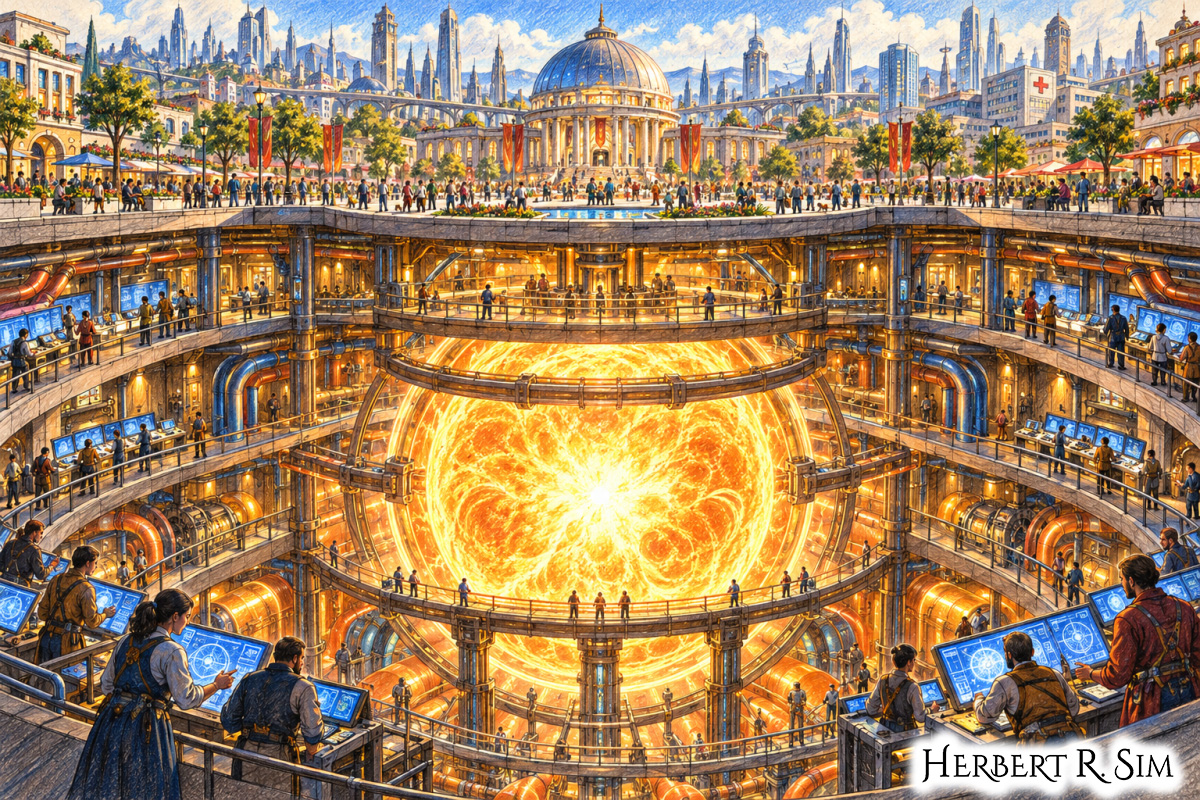
My illustration entitled: “The Sun Beneath the Public Square” – Beneath a magnificent civic square, a colossal artificial sun powers an entire civilization. A cutaway reveals citizens and engineers maintaining its machinery, while above them homes, hospitals and independent businesses glow across the landscape. Several public control stations surround its core.
A person working independently still needs electricity. An entrepreneur challenging an established industry still needs communications, transport and dependable rules. Someone seeking medical autonomy still relies on knowledge, trained professionals and systems capable of delivering care.
These dependencies reveal something important about human sovereignty: the practical ability to direct a life rests partly on resources no individual could reasonably produce alone.
The independent person stands within a world built and maintained through cooperation. Individual initiative draws strength from that world when its essential foundations remain accessible and accountable.
I call these foundations the commons of a sovereign future: shared resources, systems and bodies of knowledge governed so that people can pursue different purposes without becoming unnecessarily subject to arbitrary control.
The challenge is to sustain the infrastructure of freedom while placing enforceable limits on those who administer it.
What Makes Infrastructure Relevant to Freedom?
Infrastructure shapes which choices are usable. A legal right to establish a business means less where reliable power is unavailable. Freedom to communicate becomes difficult to exercise without an accessible network. Educational opportunities depend partly on the ability to obtain books, instruction and a suitable place to learn.
These conditions influence whether people can convert intentions into action.
Infrastructure also distributes bargaining power. Where access depends on one provider’s unexplained discretion, that provider can acquire influence over activities far beyond the service itself.
Its governance therefore belongs within a philosophy of sovereignty. We must examine availability, reliability and the conditions attached to participation. The capacity of a system matters alongside the authority exercised through it.
A Commons Requires Rules and Responsibilities
The word “commons” can suggest unrestricted access to a resource that nobody maintains. That arrangement may quickly fail, especially where use creates congestion, depletion or significant costs.
A functioning commons requires boundaries, maintenance and ways to resolve disputes. Some resources can be shared widely at little additional cost, while others require careful allocation.
Knowledge can often be copied without depriving its previous reader. A water supply, hospital bed or electricity network faces different physical constraints.
The relevant rules must reflect those differences.
In this essay, a commons describes a governed foundation for shared agency. It does not require every resource to have the same owner, funding arrangement or access policy. Public institutions, cooperatives, voluntary associations and private providers can each contribute under appropriate obligations.
Access Should Not Depend on Agreement About Everything
Shared infrastructure becomes a source of domination when its operators demand conformity unrelated to its legitimate purpose.
A water service should not depend on approval of a customer’s lawful political opinions. Access to an essential communications channel should not become an informal reward for personal loyalty.
Common infrastructure supports sovereignty when people with different convictions can use it under intelligible and fairly applied conditions.
Conduct still matters. Threats, fraud, damage and interference with other users can justify restrictions. The important question is whether a restriction addresses a relevant harm or extends control into unrelated areas of life.
Rules should identify the distinction, and affected people should have access to review. Essential participation needs protection against personal favour and arbitrary exclusion.
Shared Knowledge Makes Independence Possible
People become less dependent on authority when they can understand and question the systems around them.
Libraries, accessible research, educational materials and technical documentation can help an individual investigate a medical choice, repair equipment or establish an enterprise.
Their contribution extends beyond delivering information. They widen the range of people capable of evaluating claims and developing alternatives.
Access alone is insufficient. Materials need to be understandable, discoverable and accompanied by opportunities to learn. A document available in principle may remain unusable to someone without the necessary language, equipment or background.
Supporting knowledge also requires resources. Writers, teachers, researchers and maintainers need sustainable arrangements. A sovereign future should expand learning while taking seriously the work required to produce and preserve dependable knowledge.
Open Standards Connect Independent Builders
Shared standards allow different organisations to cooperate without requiring a single organisation to control every participant.
When records and communications can move between compatible systems, people can change suppliers while retaining more of what they have built. New entrants can offer improvements without first replacing an entire network.
This makes technical compatibility a foundation for practical choice.
A standard, however, can become another gatekeeper if participation in its governance is inaccessible or implementation depends on restrictive conditions.
Its value should be assessed through actual usability: who can implement it, how changes are decided and whether smaller participants can raise concerns.
Documentation and testing require maintenance. The freedom enabled by a shared technical language depends on continued care for that language and fair processes for its development.

My illustration “The Sun Beneath the Public Square” work-in-progress. Several public control stations surround its core. The art represents that shared energy infrastructure enables personal agency when its governance remains accountable.
Keeping the Foundations in Working Order
A commons cannot survive on declarations of openness. Networks need repairs. Public records need preservation. Shared software needs people who investigate faults and maintain compatibility.
When benefits are widely distributed, each participant may prefer someone else to bear these costs. Neglected maintenance then threatens everyone’s practical independence.
Possible responses include membership contributions, public funding, service charges and cooperative ownership. Different arrangements suit different resources.
Funding should reflect both sustainability and access. A fee can support reliable provision while excluding those who most need the service. Subsidies can widen participation while creating opportunities for political favour.
These tensions require transparent budgets, clear obligations and review. The governing question is how to finance dependable infrastructure without making access or maintenance dependent on unaccountable discretion.
Those Who Maintain the Commons Also Have Rights
Shared benefit cannot justify treating maintainers as an inexhaustible resource.
A volunteer programmer may support software used by thousands. A clinician may provide essential care. A technician may keep a community network operating. Their importance does not erase their need for rest, compensation, safety or a life beyond service.
A sovereign commons must respect the agency of contributors alongside that of users.
This requires realistic commitments and plans for succession. Institutions should avoid depending indefinitely on unpaid effort that nobody has agreed to continue.
Where continuity is essential, responsibility should be distributed and funded. Users deserve dependable support, while maintainers deserve arrangements that acknowledge limits. Durable cooperation requires obligations that people can reasonably understand, fulfil and revise.
Accountability Beyond the Name of the Owner
Ownership labels cannot settle whether infrastructure protects freedom.
A publicly owned system may operate through opaque decisions. A cooperative may allow a small group to dominate meetings. A private provider may offer useful safeguards while retaining excessive power over essential access.
Assessment should follow the powers actually exercised.
Who can change the conditions? Who can challenge a suspension? Are decisions explained? Can affected people influence priorities? Does an independent body have authority to correct abuse?
Participation should be workable for people with limited time and resources. Publishing lengthy consultation documents does little if only established organisations can interpret them.
Governance earns legitimacy through accountable practice. Its structure should make it possible to identify responsibility, contest decisions and improve arrangements without requiring personal access to influential administrators.
Shared Systems Need Alternatives and Recovery Paths
Common infrastructure can create concentrated vulnerability. A single failure may interrupt work, communication and access to essential services at once.
Reliability therefore requires attention to recovery and appropriate alternatives.
Some functions may need backup capacity. Others may benefit from independent providers, transferable records or temporary arrangements that preserve essential access during a dispute.
Complete duplication is rarely practical. Preparation should reflect the severity of foreseeable disruption and the needs of people least able to absorb it.
A useful test asks whether those affected can still obtain help when the ordinary system fails. Recovery procedures should avoid depending entirely on the disabled service. Shared infrastructure supports sovereignty more securely when it includes credible ways to restore participation and correct mistakes.
Future Users Belong in Present Decisions
Infrastructure lasts beyond individual contracts and political terms. Choices about energy, land, information systems and maintenance can shape opportunities for people who had no voice in their creation.
Responsible stewardship should account for those future users.
This includes preserving knowledge needed for repair, avoiding unnecessary technical dependence and considering environmental burdens alongside immediate benefits.
Present users may prefer low prices achieved by postponing maintenance. Administrators may favour visible expansion over less visible upkeep. Both choices can transfer substantial costs forward.
Longer planning horizons and clear reporting can make those transfers easier to examine. Future people deserve foundations they can maintain and adapt, with sufficient room to reconsider the priorities inherited from earlier generations.
Shared Foundations for Different Lives
The commons of a sovereign future should enable people to pursue a wide range of projects. Reliable energy can support a hospital, a small workshop or a household. Shared knowledge can help someone cooperate with an institution or challenge its conclusions.
This plurality is central to the argument. Common provision strengthens sovereignty when it expands usable possibilities while remaining accountable to those who depend on it.
The task is to build institutions that maintain shared resources, protect fair access and constrain the authority exercised through essential systems.
Individual freedom becomes more durable when the foundations supporting it are dependable, open to challenge and sustained through fair cooperation.