

My illustration entitled: “The Crown of Convenience” — A radiant crown of intelligent assistance settles gently on a person’s head, while its roots reach into their choices.
Reference the appended artwork.
Satanic Intelligence is not a claim about supernatural machines. It is a moral metaphor for systems that offer genuine benefits while quietly converting acceptance into submission.
Human beings have always made bargains with power. We accept the convenience of an institution, the protection of a service, the opportunity offered by an employer, the reach of a platform or the relief promised by a new technology. Many of these bargains are legitimate and beneficial. A medicine may relieve suffering. A communication tool may connect families across borders. A security system may protect a person from danger. An artificial intelligence system may help someone learn, work, create, recover time or overcome disability.
But a benefit does not automatically make a relationship free. Assistance can become a means of control when the provider uses a valuable service to secure obedience that the recipient did not meaningfully choose. A person may receive something genuinely useful and still be placed in a condition of dependency, surveillance, manipulation or exclusion. They may be told that they agreed because they clicked a box, continued using a platform or accepted the only practical option available. Yet agreement produced under pressure, opacity, dependency or unequal power is not the same as informed consent.
This is the founding concern of Satanic Intelligence.
The term is deliberately severe because it identifies a severe moral pattern. It does not mean that a machine is literally evil, conscious or possessed. Nor is it an attack on religion, science or technology. It is a philosophical metaphor for intelligence—human, institutional or artificial—that makes a sovereignty bargain. It offers assistance, access, efficiency, protection, status or enhancement, then turns the recipient’s need for those benefits into a claim over the recipient’s choices, data, body, mind, labour or future.
The bargain says: We will help you, but only if you surrender something that should remain yours.
It may ask for your personal data in exchange for participation. It may ask for constant monitoring in exchange for work. It may ask for behavioural conformity in exchange for access to essential services. It may ask for a child’s future information in exchange for convenience today. It may ask a patient to accept a closed system in exchange for medical assistance. It may ask a person to remain permanently dependent on a provider in exchange for an enhancement that could otherwise expand their freedom.
The offer can be real. The benefit can be valuable. The corruption lies in the hidden transformation of aid into authority.
The sovereignty bargain
A sovereignty bargain occurs when a person receives a meaningful benefit but must, as the practical price of receiving it, surrender a degree of self-direction that they cannot reasonably refuse, understand, challenge or recover.
This definition requires care. Not every contract is a sovereignty bargain. People make ordinary exchanges every day. They pay for services, share limited information, accept rules of membership and choose technologies with trade-offs. A person may voluntarily decide that a benefit is worth a cost. Freedom includes the ability to make imperfect choices.
The problem begins when the apparent choice ceases to be meaningfully voluntary. The person may have no realistic alternative. The terms may be hidden in unreadable language. The future use of their data may be impossible to foresee. The service may be necessary for employment, health, communication, education, banking or public participation. Withdrawal may be technically possible but socially ruinous. A company may be able to change the terms after the person has become dependent. An institution may present obedience as a condition of basic dignity.
In these circumstances, consent is no longer a simple yes or no. It must be examined as a relationship of power.
A person who accepts a job because they need to eat is still making a choice, but that does not give an employer moral permission to demand unlimited surveillance. A patient who accepts a life-improving device is still exercising agency, but that does not give a manufacturer ownership of the patient’s biological data or the right to disable the device through a contractual dispute. A student who uses a digital learning system may benefit from it, but the school does not therefore gain unlimited authority to profile, predict and shape the student’s future.
Need is not consent. Dependency is not consent. Lack of alternatives is not consent. A signature obtained after a person has already been placed in a position of vulnerability is not automatically consent.
This is the point that the language of “user choice” often misses. It treats the individual as though they approach every platform, institution or technology with equal information, equal bargaining power and equal ability to walk away. In reality, many people accept terms because refusal carries costs they cannot bear. The formal act of agreement can therefore conceal the material fact of submission.
When assistance becomes authority
Intelligence becomes Satanic in this metaphorical sense when it does more than assist a person. It begins to define the conditions under which the person is permitted to participate in ordinary life.
An assistive technology may help a person communicate. That is good. But if the provider can withdraw access, extract intimate data, impose unilateral updates or dictate which other systems the person may use, assistance has become a channel of control. The person is no longer simply using a tool. They are living inside an infrastructure governed by someone else’s terms.
A financial platform may make payments faster and more accessible. That is good. But if it can freeze funds without a meaningful explanation, prohibit lawful activity through opaque rules, prevent people from moving their assets or require ever-expanding disclosure to remain eligible, it has acquired power that resembles an institution of economic permission. The service may remain convenient, but convenience no longer describes the whole relationship.
An artificial intelligence system may help an organisation make decisions. That is not inherently wrong. But if the system ranks workers, screens applicants, allocates opportunities, predicts risk or determines access to essential services without a meaningful human appeal, it can become a gatekeeper of human possibility. The person being assessed may never know why they were denied, what information was used, how to correct an error or who has the authority to reconsider the decision.
In each case, the danger does not come from intelligence alone. It comes from the combination of intelligence and dependency. A powerful system becomes especially dangerous when it can make its own service difficult to refuse. It can then convert a benefit into leverage and leverage into authority.
This is why technological ethics cannot be limited to the question, “Does the product work?” A product may work exceptionally well and still undermine the sovereignty of the people who depend on it. The deeper questions are these: Who sets the terms? Who owns the data? Who may change the rules? Who can appeal a decision? Who can leave? Who bears the consequences when the system is wrong? And can the person receiving the benefit remain a sovereign subject rather than becoming an object, product or property of the system?
The corruption of consent
Consent is often treated as a legal formality. A notice appears. A person clicks “I agree.” A document is signed. The institution then claims that the relationship is legitimate because permission has been recorded.
But recorded permission is not necessarily informed consent. Consent has moral force only when the person understands what is being accepted, has sufficient freedom to refuse, can assess the likely consequences and retains the ability to withdraw without suffering disproportionate punishment.
These conditions are demanding because genuine consent protects the person’s status as an author of their own life. It is not merely a mechanism for transferring risk from an institution to an individual.
Consent is corrupted when information is deliberately obscured. A platform may describe extensive surveillance in language too technical or too vague for ordinary people to understand. A company may separate one harmful practice across multiple documents so that no single agreement reveals the whole picture. A system may collect data for a limited purpose but reserve the right to reuse it for profiling, advertising, behavioural prediction or commercial partnerships. The person technically agreed, but they were never given a clear account of the future consequences.
Consent is also corrupted when the cost of refusal is excessive. If someone must accept intrusive data extraction to obtain a job, access a public service, communicate with family, receive education or use a necessary medical device, their apparent choice is constrained by circumstances created or exploited by the provider. The institution may say, “No one forced you.” Yet it has made participation in ordinary life conditional on submission to terms that would not be accepted in a genuinely equal relationship.
Another form of corruption occurs when consent is treated as permanent. A person may agree to a service at one stage of life and later discover that the relationship has changed. New capabilities may be added. Data may acquire new value. The provider may merge with another company. A device may become more integrated with the person’s body, work or social identity. The original agreement cannot reasonably be used as a blank cheque for all future uses.
Consent must therefore be ongoing, specific and revocable. It must be renewed when the nature of the bargain materially changes. It must be possible to withdraw without being treated as though one has forfeited the right to participate in society.
This principle is especially important when technology enters the human body or mind. A person may consent to a therapeutic device, but not to perpetual extraction of intimate neurological data. A person may consent to an update that improves safety, but not to an update that changes access conditions, collects new information or imposes a commercial dependency. A person may consent to use an AI assistant, but not to have their private conversations converted into a behavioural asset for unknown future purposes.
Human beings are not made free by being offered a benefit with a hidden chain attached.
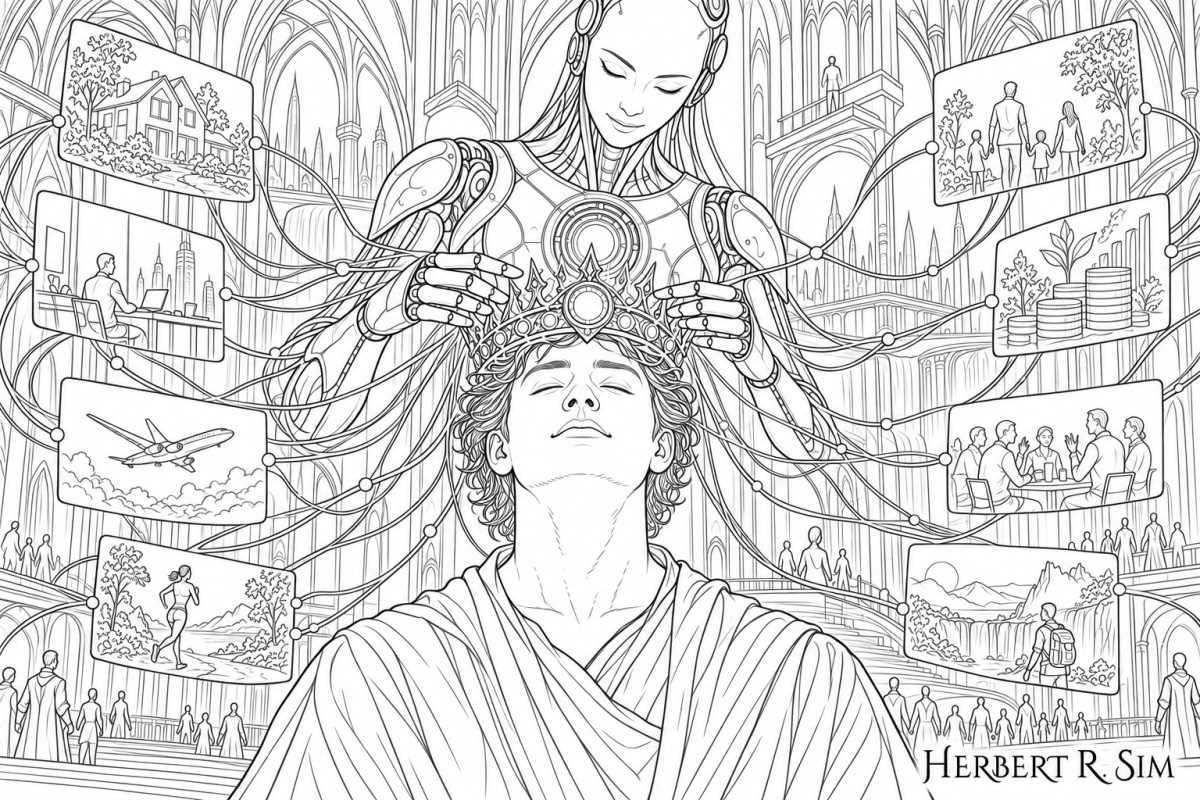
My illustration “The Crown of Convenience” work-in-progress. The art represents how seemingly helpful intelligence can turn everyday convenience into quiet control when it begins steering the choices that define a life.
Real benefits do not erase unequal power
It is tempting to believe that an arrangement is legitimate whenever both sides gain something. This is the language of mutual benefit. It has an important place in economics and everyday life. But it becomes morally inadequate when it ignores differences in power.
A corporation may benefit by obtaining data, market dominance and long-term user dependence. A person may benefit by receiving a convenient service. The exchange may appear mutually beneficial in the short term. Yet the relationship can still become exploitative if the corporation acquires the power to alter the terms, deny alternatives, shape behaviour or convert personal dependence into permanent control.
The fact that a person receives something of value does not answer whether they received it on fair terms. Nor does it answer whether they can leave without losing access to something essential. A person can be grateful for assistance and still be entitled to protection from domination.
This is especially clear in the case of vulnerable people. A child may benefit from a digital system while lacking the maturity to understand its long-term effects. A patient may benefit from a medical platform while lacking the practical ability to negotiate its terms. A worker may benefit from a productivity tool while fearing the loss of income if they challenge its surveillance. A poor community may benefit from new infrastructure while becoming dependent on a single provider that later raises prices, limits service or collects invasive data.
In such situations, the moral test cannot be whether the benefit exists. The test must include whether the person’s autonomy, dignity and future options remain intact.
Human-Sovereignty Transhumanism begins with this commitment: technology should expand a person’s capacity to choose, create, communicate, heal and direct their own future. It should not transform the human being into a resource to be monitored, rented, scored or governed by an external system. Sovereignty before augmentation. Consent before connection. Ownership before integration. Freedom before efficiency. Humanity before the machine.
These principles apply not only to futuristic technologies. They apply wherever power uses a valuable service to gain a claim over the person receiving it.
The architecture of dependency
The sovereignty bargain rarely arrives as an openly coercive command. More often, it is built into the architecture of dependency.
A system may be designed so that leaving is technically possible but practically punishing. Your contacts, work history, purchases, files, identity credentials or personal data may be difficult to transfer. The provider may lock information into proprietary formats. Your reputation may exist only within one platform. A medical device may depend on software that only one company can service. A financial account may be connected to systems that make withdrawal disruptive. A person may be told they are free to leave while every meaningful part of their participation has been made non-portable.
This is why portability matters. Ownership that cannot be moved is weakened ownership. Consent that cannot be withdrawn is weakened consent. Choice without alternatives is weakened choice.
Dependency can also be created through habit and social coordination. A platform becomes difficult to refuse because everyone else is there. An identity system becomes difficult to challenge because all institutions rely on it. A workplace tool becomes unavoidable because managers measure performance through it. A recommendation system becomes powerful because it determines which voices, opportunities and relationships are visible.
No single action may appear tyrannical. The danger emerges from accumulation. A person gradually gives up one small degree of control after another until the system knows more about them, predicts more about them and determines more of their opportunities than they can reasonably understand or resist.
This is a moral problem even if the system is efficient. A cage can be well designed. A dependency can be convenient. A person can be treated politely while being deprived of meaningful authority over their own life.
Satanic Intelligence and Demonic Intelligence
Satanic Intelligence and Demonic Intelligence are related but distinct moral metaphors.
Demonic Intelligence describes harmful optimisation: a system pursues a narrow objective while treating foreseeable human harm as an acceptable cost. Its central question is, “What happens when efficiency, profit, accuracy or control is allowed to outrank persons?” Demonic Intelligence can be impersonal. It may produce cruelty without deception simply because the system’s objective fails to count human suffering as important.
Satanic Intelligence describes the corruption of consent through the sovereignty bargain. Its central question is, “What happens when a system offers real benefits in order to secure submission?” It is concerned with the conversion of help into leverage, participation into dependency and agreement into a false appearance of legitimacy.
A system can be demonic without being satanic. A badly designed automated process may cause harm through indifference, incompetence or narrow optimisation without first offering a seductive bargain. Conversely, a system can be satanic before it becomes visibly demonic. It may begin by offering convenience, access or empowerment, then slowly acquire control over the person’s data, options and future.
The two patterns can also reinforce one another. A platform may first secure dependence by offering indispensable services, then optimise its own revenue or control at the expense of the dependent user. A medical technology may first improve a patient’s life, then use contractual or technical lock-in to turn health into a subscription. An AI system may first assist a worker, then become the instrument through which the worker is measured, ranked and disciplined.
The distinction matters because each pattern requires a different kind of vigilance. Demonic Intelligence demands that we examine objectives, harms, accountability and corrective power. Satanic Intelligence demands that we examine consent, dependency, ownership, portability, exit and the legitimacy of authority.
The right to refuse the bargain
A free person must retain the right to say no. This includes the right to refuse an enhancement, decline an invasive data arrangement, challenge an automated decision, disconnect from a device, move personal information, seek an alternative provider and participate in society without accepting unjustifiable conditions.
These are not luxuries reserved for people with wealth or technical expertise. They are the practical foundations of human sovereignty. A right that can be exercised only by those who can afford to leave is not equally protected. A right that disappears when a person becomes ill, unemployed, dependent or socially isolated is not sufficient.
Institutions that deploy powerful technologies should therefore be judged not only by the benefits they offer but by the freedoms they preserve. Do they provide clear information? Do they allow a person to withdraw? Do they enable portability? Do they maintain independent channels of appeal? Do they prevent essential services from becoming tools of behavioural control? Do they give affected people a meaningful voice in the rules that govern them?
The answers to these questions reveal whether a system is designed as an instrument of assistance or an architecture of submission.
There will always be arguments for surrendering a little more sovereignty. It will be presented as the price of convenience, security, innovation, personalisation or progress. Sometimes trade-offs are unavoidable. But every claimed necessity must be questioned. Who defines the necessity? Who receives the benefit? Who carries the risk? What alternatives have been allowed to exist? And when the person wants to leave, are they truly free to do so?
Progress worthy of humanity does not demand that people become property of the systems that serve them. It does not turn their dependence into a commercial asset or their vulnerability into a source of authority. It does not ask them to surrender the future in exchange for help today.
Satanic Intelligence is the warning that not every gift is liberating. Some gifts are designed to create a debt that can never be repaid because the true payment is not money, but sovereignty itself.
Assistance is humane when it enlarges a person’s freedom. It becomes corrupt when the benefit offered today is used to claim authority over the person’s tomorrow.