

My illustration entitled: “The Race That Cannot Be Refused” – Office workers sprint on a futuristic treadmill toward a finish line labelled “Employability,” while upgrade stations inject new devices along the way.
The most serious danger in human enhancement may not be that technology becomes too powerful. It may be that it becomes too necessary.
We are entering an era in which biotechnology, cognitive medicine, wearable computing, prosthetics and neural interfaces could increase human capability in ways that were once confined to fiction. These tools may help people recover from injury, manage disease, communicate more effectively and extend the range of ordinary human action. That promise is real. It is also incomplete.
Every new enhancement creates a second question: what happens when the individual who declines it must bear an economic cost for remaining unenhanced?
That is the upgrade trap. It appears when a voluntary technology gradually becomes the unofficial price of employment, education, insurance, credit or social standing. No law needs to command a person to modify their body or mind. It is enough for institutions to reward the enhanced so heavily, and to regard the unenhanced so suspiciously, that refusal becomes economically irrational.
Human-Sovereignty Transhumanism supports the responsible use of science and technology to improve human life. It does not support a future in which people must purchase, implant or submit to upgrades in order to keep their place in society. Freedom to enhance is essential. But it is only half of freedom. The other half is the equal right to refuse enhancement without being punished for it.
The difference between a choice and a condition
A genuine choice offers a person meaningful alternatives. A condition says, in effect, “You may refuse, but you will lose what you need to live, work or belong.” The distinction matters because new technologies often begin as optional luxuries and become normal expectations long before the public has considered their social consequences.
Consider a workplace in which an attention-enhancing device is offered to employees. At first, adoption may be voluntary. The people who use it work longer, respond faster and are praised as more efficient. Their performance becomes the new benchmark. Soon, the employee who prefers not to use the device is not measured against a normal human standard, but against an augmented one. Their refusal is treated as a lack of ambition rather than an exercise of conscience.
The same pattern can emerge in schools, professional training, athletics and the military. An enhancement need not be physically mandatory to become socially compulsory. Once access to work or opportunity depends on accepting it, the language of choice becomes hollow.
This is why the question is not merely whether an enhancement works. The deeper question is whether the institutions around it preserve the individual’s authority over their own body, mind and identity.
Capability can become a new form of dependency
Technological capability is often described as personal empowerment. In many cases it is. A prosthetic limb that restores mobility, a treatment that relieves suffering or a communication device that expands access can profoundly enlarge a person’s independence. But capability and sovereignty are not identical.
A technology can make a person more capable while making them more dependent on the company that owns the software, the institution that holds the data or the authority that controls access. A cognitive aid tied to a subscription, a genetic profile required for insurance, or a workplace device that records mental performance can transform an apparent benefit into a channel of control.
We should therefore judge enhancement by two standards. First: does it expand human capability? Second: does the person retain authority over the capability once it is adopted? If the answer to the second question is no, then the technology may create dependence even while it promises advancement.
In this sense, the upgrade trap is not simply about inequality between those who can afford the newest device and those who cannot. It is also about power. Who decides what counts as an adequate human worker, student, citizen or soldier? Who has access to the data produced by the enhanced body? Who can withdraw service, alter terms or impose a new requirement after dependence has been created?
From healing to optimisation
Society has strong reasons to support medicine that heals, restores and prevents disease. When technology enables a blind person to see, a paralysed person to communicate or an injured person to regain mobility, it serves a deeply human purpose. These uses deserve respect and access.
But therapy must not become the rhetorical bridge to compulsory optimisation. The fact that a technology can restore a function does not mean everyone should be expected to exceed ordinary function. There is a moral difference between helping a person overcome a limitation and demanding that every person continually redesign themselves to meet a competitive standard.
That difference will be increasingly difficult to maintain. A medication that treats fatigue may be promoted for productivity. A device designed to assist memory may become an examination advantage. A wearable that monitors health may become an insurer’s preferred condition. The line between care and competition can disappear quietly, one incentive at a time.
Human dignity requires that an unenhanced person is not treated as a defective version of an enhanced one. A person may seek modification; another may choose continuity. Both must remain full participants in public life.
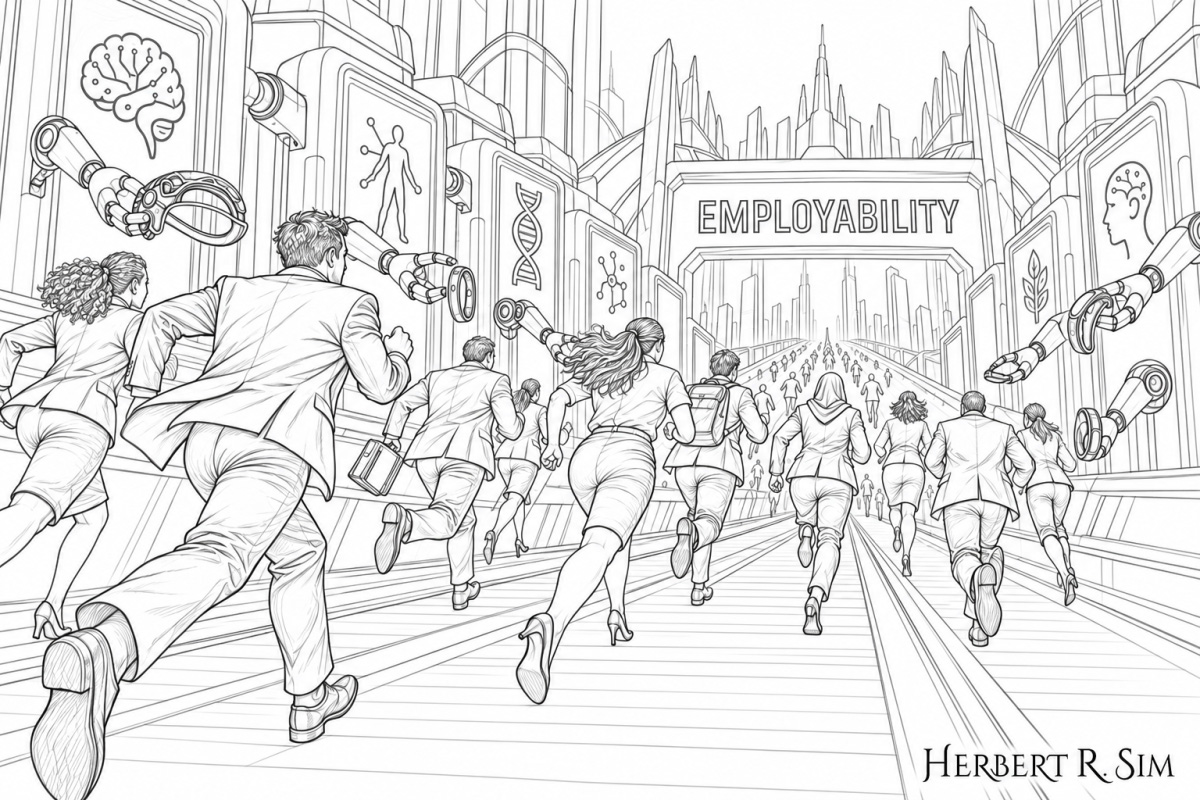
My illustration “The Race That Cannot Be Refused” work-in-progress. The art represents a modern rat race where workers are pushed to upgrade themselves simply to remain employable, turning human enhancement from a choice into an economic obligation.
The new inequality is not only financial
Economic inequality will determine who has early access to many enhancements. Wealthy individuals and well-funded institutions will be able to experiment first, absorb risks and purchase upgrades that others cannot. This advantage may compound over time: better cognitive tools can improve education; better education can improve income; higher income can purchase further enhancement.
Yet a society can become divided even if an enhancement later becomes cheap. The more serious division occurs when access is linked to acceptance. A person who cannot afford an upgrade, cannot safely use it, does not trust its privacy terms, or simply does not want it, may be excluded from opportunities that should never have depended on modification in the first place.
Equal opportunity must not mean equal pressure to upgrade. It means that a person’s basic access to work, education, housing, financial services and civic participation is not conditioned upon their willingness to alter themselves. Otherwise, the market will begin to price human autonomy as though it were an inefficiency.
Privacy is an economic issue
Enhancement also creates data, and data creates new leverage. A cognitive device may reveal patterns of concentration and fatigue. A genetic service may reveal predispositions that an insurer or employer would value. A wearable system may record sleep, movement, location and stress. These records can be used to make decisions about a person long after the original technology has been accepted or abandoned.
For this reason, privacy cannot be treated as a minor technical feature. It is a condition of economic freedom. A worker who must disclose intimate biological or behavioural data in order to remain competitive is not negotiating on equal terms. A student who must allow a device to monitor attention in order to prove competence is not being given a neutral opportunity.
Individuals must retain meaningful control over data generated by their bodies and minds. Institutions should not be allowed to convert that data into a permanent score of employability, insurability or social worth. The body is not a workplace terminal, and the mind is not a resource to be mined without limit.
The right to remain unenhanced
The answer is not to ban enhancement. Prohibition would deny people the benefits of innovation and repeat the error of treating adults as incapable of directing their own lives. The answer is to establish a clear social principle: the decision to remain unenhanced must be protected with the same seriousness as the decision to enhance.
That principle has practical consequences. Employers should not require elective cognitive or bodily enhancement as a condition of hiring, promotion or retention. Schools should not make technological modification a hidden prerequisite for academic opportunity. Insurers should not penalise people who decline non-essential enhancements. Governments should not build public services around technologies that citizens must adopt to retain ordinary rights.
There must also be a right to exit. When a person adopts an elective technology, they should be able to discontinue or disconnect from it where safety permits, without losing their livelihood or civil standing. A system that makes departure impossible is not a tool of liberation; it is a structure of dependency.
Competition is not an excuse for control
Some will argue that competitive societies cannot afford to protect those who refuse enhancement. Businesses must remain productive, schools must prepare students for the future, and nations must not fall behind. But this argument confuses collective ambition with individual ownership.
A society is not strengthened when its members are forced to sacrifice bodily or mental autonomy in order to compete. It becomes more fragile, because it makes participation dependent on compliance with whoever defines the next standard of normality. Innovation that requires submission may produce short-term gains, but it does not create a free or resilient civilisation.
The better model is one in which technology is offered, understood and governed in a way that earns public trust. People should be able to adopt enhancements because they find them valuable, not because refusal would make them unemployable. Institutions should compete to create better opportunities, not to make human modification the admission price to those opportunities.
A human standard for the technological future
Human-Sovereignty Transhumanism calls for a simple discipline in the development of every enhancement: capability must never be separated from consent, and consent must never be separated from a real ability to refuse.
This requires more than a promise of voluntary use. It requires protections against discrimination, transparent terms of service, strict limits on data extraction, and a social commitment not to measure human worth by technological conformity. It requires a culture that can admire invention without worshipping it.
The future should be open to those who wish to enhance, those who wish to wait, and those who choose not to enhance at all. We may use technology to become stronger, healthier, more capable and more connected. But no employer, market or institution should be allowed to decide that an unenhanced human being has become economically obsolete.
That is the upgrade trap. And avoiding it is not resistance to progress. It is the condition that makes progress worthy of humanity.