
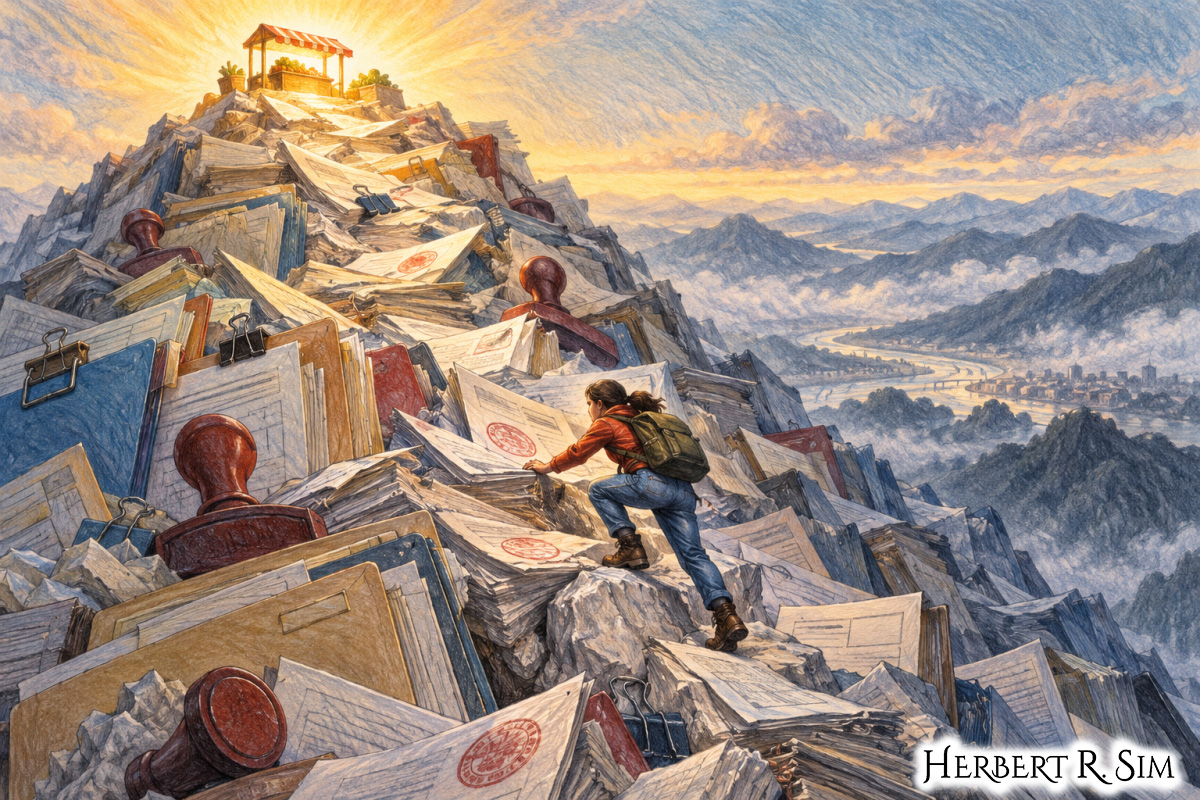
My illustration entitled: “The Paper Mountain” — An individual climbs a mountain of permits, applications, and compliance stamps to reach a simple economic opportunity.
Economic rights are meaningful only when people can exercise them without unreasonable cost, complexity, dependence or delay.
We often speak of economic freedom as though it were present the moment a right is recognised. A person may legally own property, start a business, open an account, change providers, sell his labour, save money or enter a contract. On paper, the freedom exists. Yet between the recognition of a right and its actual use lies a territory of obstacles.
Forms must be completed. Fees must be paid. approvals must be obtained. Expertise must be hired. Time must be surrendered. Rules must be interpreted. A person may have to accept unfavourable terms, disclose private information, travel long distances or rely on intermediaries who can change their conditions without meaningful negotiation.
None of these obstacles alone necessarily destroys freedom. Complex societies need records, contracts, standards and processes. But when the obstacles accumulate, a right can become difficult enough to exercise that it no longer gives the individual genuine control over his economic life.
This condition may be understood as sovereignty friction.
Sovereignty friction is the total burden placed between an individual and the practical use of a lawful economic right. It is the resistance a person encounters when attempting to own, save, exchange, build, choose or protect the value created by his effort. The burden may come from bureaucracy, cost, opacity, dependency, delays, lack of information or the absence of realistic alternatives.
Its central insight is simple: a right can be legally available yet practically distant.
From Rights to Usable Freedom
It is important to distinguish a right from a capability. A right is a protected claim: the law or social order recognises that a person may act in a certain way. A capability is the practical ability to carry that action through.
A person may have the right to start an enterprise but lack access to basic capital, commercial knowledge or affordable compliance. A family may have the right to choose a financial provider but face a local market dominated by one or two institutions. A worker may have the right to leave a job but be unable to endure the immediate loss of income. A citizen may have the right to challenge an unfair decision, but find the cost and delay of doing so greater than the value at stake.
In each case, the right survives in a formal sense. But the individual’s control over his own future is weakened.
This matters because liberty is not merely the absence of a prohibition. It is the presence of a viable path. A society that announces many rights while making them expensive, obscure or conditional may preserve the appearance of freedom without delivering its substance.
A right that can be invoked only by the wealthy, the well-connected or the professionally advised is not equally held by the public.
Sovereignty Friction Theory does not argue that every difficulty is injustice. Some effort is part of responsible action. Learning a trade, saving money, keeping records and meeting honest obligations are not attacks on liberty. The issue is whether the burden is proportionate, intelligible and fairly shared—or whether it systematically prevents ordinary people from exercising choices that institutions and wealthy actors can use with ease.
The Sources of Sovereignty Friction
Economic freedom is rarely restricted by a single dramatic act. More often it is worn down through many small barriers that appear reasonable when viewed separately. Together, they can turn a lawful opportunity into an unreachable one.
Several forms of friction deserve attention.
Knowledge friction arises when a person cannot use a right without specialised information. Contracts, tax rules, lending conditions and licensing requirements may be written in language inaccessible to the people expected to obey them. The institution that creates the complexity may understand it perfectly; the citizen facing it may be forced to guess.
Cost friction arises when the financial price of participation exceeds the means of ordinary people. Legal advice, application fees, minimum balances, insurance, deposits, registration costs and mandatory services may each be manageable for a large organisation. For a small trader or family, they can make participation impossible.
Time friction arises when rights are subject to delays that people cannot afford. A permit awaiting approval, a disputed payment, an appeal that takes months or a delayed transfer of property may carry little weight for a distant office. For the individual, it may decide whether a business survives or a household remains stable.
dependency friction arises when too many important activities depend on a single gatekeeper. If one employer, landlord, lender, supplier or official system controls the only practical route to work, housing, credit or trade, an individual’s formal freedom to choose is sharply reduced.
exit friction arises when leaving an arrangement is technically possible but economically punishing. Fees, lost deposits, lock-in conditions, inaccessible records or the absence of alternatives can make departure unrealistic. A person who cannot leave an unfair arrangement without suffering disproportionate harm does not possess full economic freedom.
opacity friction arises when terms and decisions are hidden from view. People cannot exercise sound judgment if policies are revised without notice, prices are unclear, decisions are unexplained or crucial conditions are buried in fine print.
These forms of friction often reinforce one another. A complicated process produces information costs. Information costs lead to professional fees. Fees discourage challenge. Delay then favours the institution with greater resources. What began as an administrative requirement becomes a barrier to economic self-direction.
Why Institutions Experience Less Friction
Sovereignty friction is not distributed evenly. Large institutions are often better equipped to overcome it because they help create, interpret or administer the systems through which others must pass.
A corporation may have legal counsel, accountants, dedicated compliance staff and established relationships with regulators, banks and suppliers. A government department may have authority to define procedures and revise them. A large financial organisation may have data, specialists and an extensive customer base. These advantages are not automatically improper. Scale can provide efficiency and expertise.
The difficulty begins when the same system that is manageable for an institution becomes prohibitive for the individual. A regulation that costs a large firm a small percentage of its budget may consume a new entrepreneur’s entire starting capital. A form that takes an employee five minutes to review may take an unrepresented citizen hours to understand. An appeal mechanism that appears open may be unusable when the person has neither legal knowledge nor time away from work.
The result is an asymmetry of practical choice. Institutions retain discretion. Individuals face procedures. Institutions can wait. Individuals face deadlines. Institutions can spread risk. Individuals bear it personally.
This asymmetry is one of the central concerns of Sovereign Capability Economics. A person is not economically free merely because powerful institutions have not openly forbidden his actions. He is free when he possesses sufficient capacity to act without being trapped by avoidable dependence.
Friction and the Small Producer
The small producer reveals the problem especially clearly. A person with a useful idea, a marketable skill or a modest service should be able to begin peacefully and grow through honest work. Yet small-scale enterprise often encounters the greatest friction precisely where it has the least capacity to absorb it.
The prospective entrepreneur may need to understand registrations, taxation, commercial leases, insurance, safety standards, local restrictions and banking requirements before he has made his first sale. Larger competitors already possess departments that handle these matters. The new entrant must become an expert in every administrative field while also trying to serve customers.
Again, the answer is not to abolish standards. Customers deserve safety, honest dealing and recourse against fraud. The question is whether the system distinguishes between real safeguards and unnecessary obstacles. Does it encourage a person to begin at a scale appropriate to his means? Or does it impose burdens so heavy that only established firms can comply?
Every barrier to small enterprise has a wider cost. It reduces experimentation. It limits local employment. It concentrates markets further. It tells capable people that their only realistic economic role is to seek permission from existing organisations rather than build something of their own.
Economic liberty requires a society in which ordinary people can convert effort into capability. Without that path, the economy becomes a closed field in which opportunity is inherited by those already inside it.
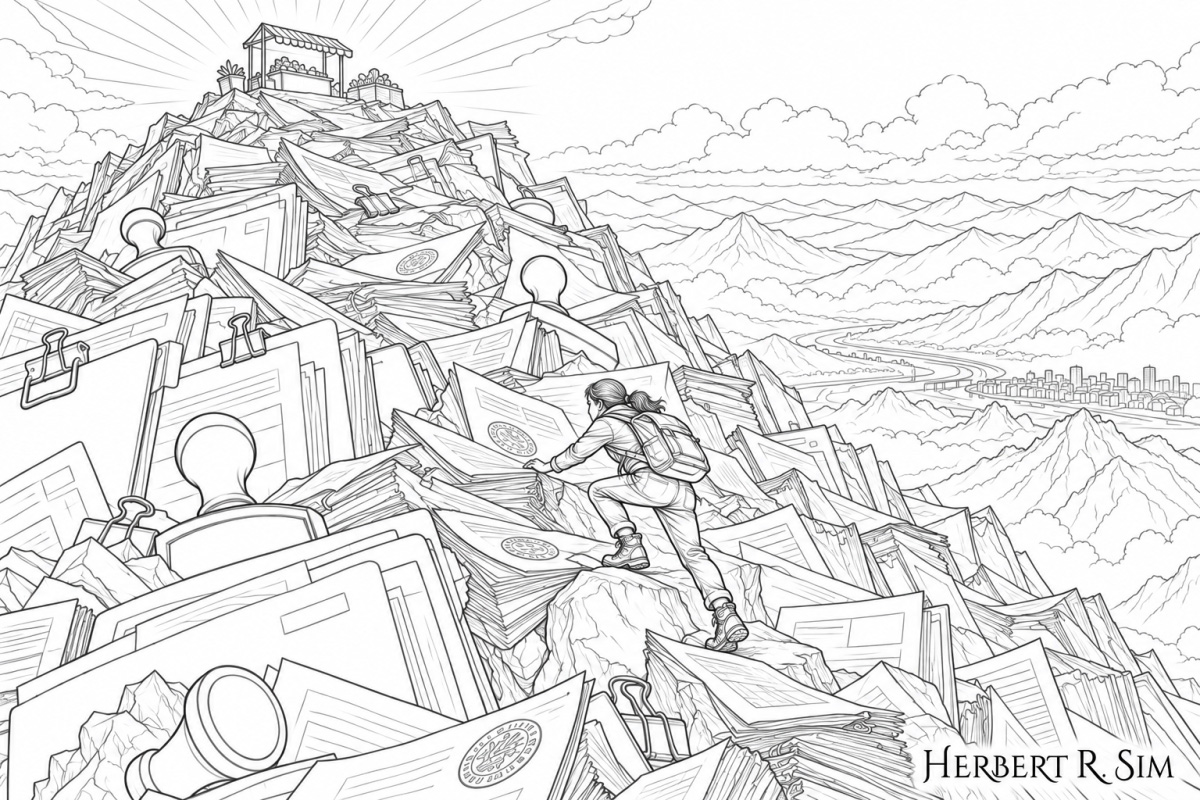
My illustration “The Paper Mountain” work-in-progress. The art symbolizes how bureaucracy can turn a basic economic opportunity into an exhausting climb, making rights real only for those able to overcome the barriers.
The Problem of Conditional Ownership
Property is often described as a legal title, but ownership is most meaningful when it gives a person dependable control. If a person’s savings can be diminished unpredictably, if his account can be frozen without a clear process, if the use of his land is subject to arbitrary changes, or if access to his own records depends entirely on a provider, then ownership is more conditional than it appears.
Conditional ownership creates caution and dependence. People are less willing to plan, invest and improve their circumstances when the results can be withdrawn through processes they do not understand or cannot challenge.
True ownership does not mean immunity from all obligation. Property rights exist alongside duties to honour contracts, avoid harm and respect the rights of others. But duties should be clear, lawful and proportionate. They should not become an excuse for leaving individuals permanently unsure of what they are allowed to keep, use or transfer.
The more unpredictable the conditions surrounding ownership, the greater the sovereignty friction. And where friction is high, economic life becomes short-term. People focus on immediate survival rather than long-term creation because long-term planning demands confidence in the future.
Friction Is Also a Question of Dignity
It is easy to treat administrative burdens as merely technical. But they also carry a moral meaning. A person who must repeatedly prove his legitimacy to distant institutions can begin to feel that he is not a participant in economic life but an applicant for it.
Dignity requires more than respectful language. It requires social arrangements that presume ordinary people are capable of judgment, responsibility and contribution. A system designed around distrust may protect itself from some risks while producing a culture of dependence and passivity.
The person facing economic friction does not simply lose time or money. He loses confidence. He may abandon an enterprise, accept terms he considers unfair or refrain from saving and planning because every route appears closed. His lawful rights remain, but his horizon narrows.
For this reason, reducing unnecessary friction is not simply a matter of improving administrative efficiency. It is a matter of treating people as agents in their own lives.
Measuring the Distance Between Rights and Reality
Sovereignty Friction Theory suggests that economic systems should be evaluated by the distance between a stated right and its usable reality.
When considering any rule, service or institution, several questions should be asked:
- Can an ordinary person understand the requirements without costly professional assistance?
- Are the time and financial burdens proportionate to the legitimate purpose of the rule?
- Can a person receive a clear reason for a decision that affects livelihood, property or access?
- Is there a practical way to challenge an error or unfair outcome?
- Are there genuine alternatives if an institution becomes unreasonable or inaccessible?
- Does the arrangement build individual capability, or does it deepen long-term dependence?
These questions do not lead automatically to one political programme. They are a discipline of attention. They require policymakers, businesses and citizens to look beyond the announcement of rights and examine the conditions under which those rights are exercised.
A rule may have a worthy aim and still impose needless friction. An institution may provide a valuable service and still require greater accountability. A market may be open in theory and closed in practice. Only by examining the lived experience of the individual can these differences be seen.
Reducing Friction Without Removing Responsibility
Reducing sovereignty friction does not mean removing all responsibility from economic life. Freedom and responsibility belong together. People should honour commitments, learn necessary skills, bear the consequences of voluntary decisions and respect the rights of others.
But responsibility must not be confused with endurance of arbitrary obstacles. A citizen is not made more responsible by being forced to navigate incomprehensible procedures. An entrepreneur is not made more capable by fees that prevent him from starting. A consumer is not made freer by contracts he cannot read or negotiate.
Better systems make responsibility possible. They use plain language. They make procedures predictable. They provide proportionate requirements for small participants. They allow people to correct mistakes. They create paths for appeal. They avoid turning every ordinary decision into a contest of resources between the individual and a large institution.
Such reforms do not weaken society. They make its institutions more legitimate because people can see, understand and use the systems that govern them.
Capability Is the Substance of Freedom
The deepest lesson of sovereignty friction is that freedom must be usable. A right is not fully secure if it exists only for those with wealth, expertise, time or special access. A society cannot call itself economically open if participation is continuously narrowed by barriers that its most powerful institutions barely notice.
Economic freedom requires more than permission. It requires the practical capacity to make choices count: to own what one has earned, preserve value, enter fair exchange, build an enterprise, change course and recover from error.
This is the purpose of Sovereign Capability Economics. It does not measure freedom by promises alone. It asks whether the individual has enough real capacity to direct his own economic future.
Where sovereignty friction is low, people can turn rights into action. Where it is high, rights become decorative. The task of a free society is not simply to proclaim liberty, but to remove the unnecessary burdens that keep ordinary people from exercising it.
Download the SFT paper on Zenodo
Official Publication Record
Sovereignty Friction Theory: When Economic Rights Become Difficult to Exercise has been archived on Zenodo with a permanent DOI for citation, preservation and scholarly reference.
| Title | Sovereignty Friction Theory: When Economic Rights Become Difficult to Exercise |
| Author | Herbert R. Sim |
| ORCID | 0009-0008-6500-5749 |
| Publication date | 30 April 2012 |
| Canonical webpage | https://herbertrsim.com/sovereignty-friction-theory-economic-rights/ |
| DOI | 10.5281/zenodo.23034840 |
| Zenodo record | https://zenodo.org/records/23034840 |
| Licence | Creative Commons Attribution 4.0 International (CC BY 4.0) |
Preferred citation:
Sim, Herbert R. (2012). Sovereignty Friction Theory: When Economic Rights Become Difficult to Exercise. HerbertRSim.com.
https://doi.org/10.5281/zenodo.23034840
Zenodo submission note:
This work was submitted to Zenodo for permanent scholarly preservation and citation.