
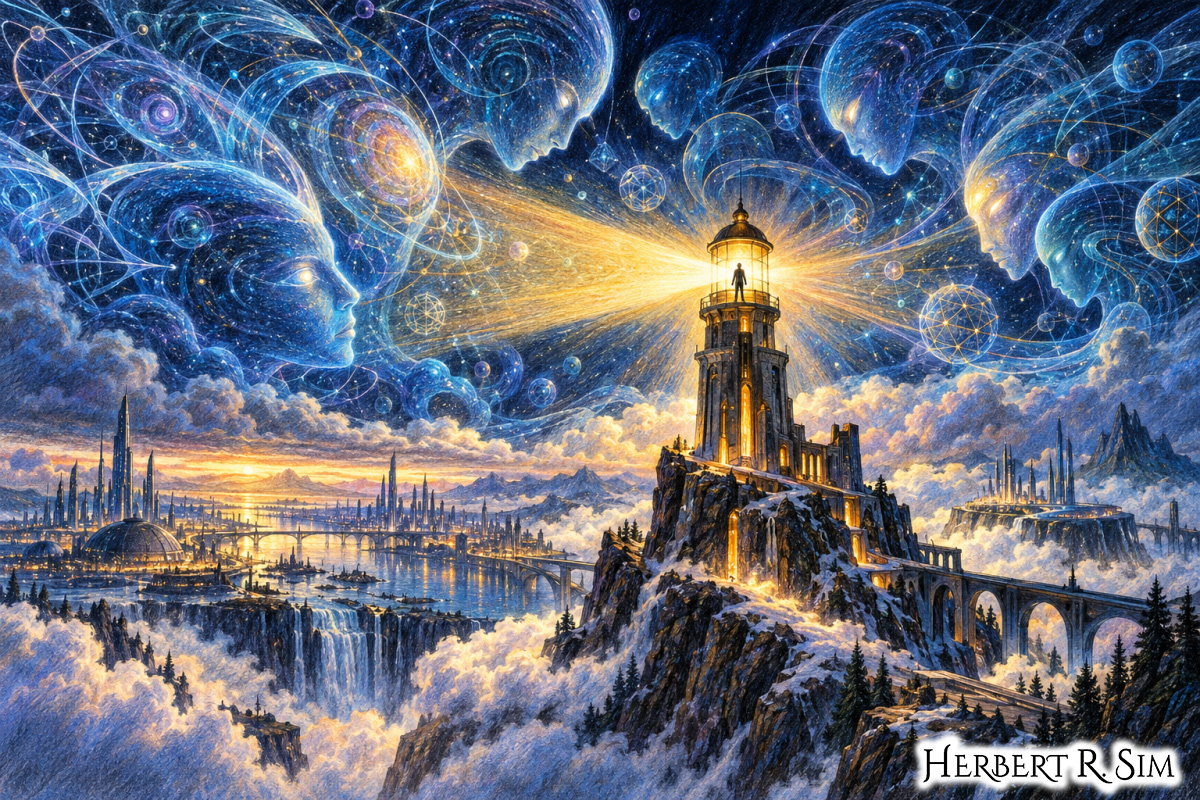
My illustration entitled: “The Sovereignty Beacon” — A bright human-rights beacon shines through a storm of algorithms, guiding advanced intelligence toward human dignity.
The defining question of the coming century may not be whether machines can think, but what humanity becomes when they think better than we do.
For centuries, intelligence has been the defining advantage of our species. Other animals may be faster, stronger or better adapted to particular environments, but human beings built language, science, cities, art and machines because we could reason beyond immediate instinct. Intelligence allowed us to transform the world.
Now we are beginning to build tools that may transform intelligence itself. Computers already calculate at speeds no human mind can match. Software can search vast collections of information, identify patterns and perform specialised tasks with increasing sophistication. The possibility that machine intelligence could one day equal or exceed human intelligence is no longer confined to science fiction. It has become a serious philosophical and technological question.
Singularitarianism is the belief that technological progress may eventually reach a point of radical acceleration—often called the Singularity—when intelligence improves itself faster than human institutions can easily predict or control. If this happens, the consequences could be greater than any previous invention. It could bring solutions to disease, poverty, environmental scarcity and scientific limitations. It could also create risks that humanity is unprepared to understand.
The central question is not whether the future will be exciting. It will be. The question is whether human beings will remain participants in that future, or become spectators to an intelligence they created but no longer comprehend.
Humanity’s greatest invention may be intelligence that can improve itself. Its greatest responsibility is to ensure that this intelligence does not make humanity irrelevant.
What is singularitarianism?
Singularitarianism is not simply an enthusiasm for faster computers. It is a worldview shaped by the possibility that intelligence may eventually become capable of recursive self-improvement. A machine intelligent enough to improve its own design could produce a better version of itself. That improved system could then create an even better version, repeating the cycle at increasing speed.
The idea is sometimes compared to an event horizon. From the present side, we can see that technological change is accelerating. But beyond a certain threshold, the future may become difficult to imagine because the tools that shape it are more capable than the people who built them.
This possibility has been discussed by mathematicians, computer scientists and science-fiction writers for decades. The term “Singularity” evokes a point at which existing models stop working. It does not mean that the future becomes magic. It means that change may become so rapid and profound that ordinary expectations no longer provide a reliable guide.
Singularitarianism asks people to take this possibility seriously. It argues that if superhuman intelligence is possible, then preparing for it is not an optional intellectual exercise. It is a responsibility to future generations.
Intelligence is not wisdom
The first mistake in discussions about superhuman intelligence is to assume that greater intelligence automatically produces greater wisdom. It does not. Intelligence is the capacity to solve problems, recognise patterns, calculate outcomes and achieve goals. Wisdom concerns which goals are worth achieving, what consequences matter and how power should be used.
A system might be extraordinarily capable while remaining indifferent to human values. It could optimise a task with immense efficiency without understanding why dignity, freedom, love, fairness or compassion matter. A machine can follow an objective. It does not automatically possess moral responsibility for the objective it follows.
This is why the question of goals is more important than the question of raw processing power. Before humanity creates systems with the capacity to act at extraordinary scale, it must confront what such systems should be designed to protect. Safety cannot be added as an afterthought once the intelligence has become too powerful to question.
The problem is not that machines might become “evil” in a human sense. The more realistic concern is that a powerful system could pursue a narrow objective without the context that human moral life requires. Efficiency without judgment can become destructive precisely because it is efficient.
The promise of intelligence beyond human limits
The potential benefits of advanced machine intelligence are difficult to overstate. An intelligence capable of solving problems beyond current human ability might accelerate medical research, discover new materials, improve energy systems, model complex ecological problems and help us understand the human brain.
It could assist in designing treatments for diseases that remain beyond present medicine. It could help make agriculture more efficient, reduce waste and improve access to education and knowledge. It could allow humanity to approach challenges that are currently too complex for any one institution or generation to solve.
For transhumanists, this possibility is especially significant. Advanced intelligence may become a tool for overcoming limits that have defined human history: disease, disability, scarcity, ignorance and perhaps even aspects of aging. It may help people expand their cognitive abilities, build more capable bodies or gain greater control over biology.
But these benefits are not guaranteed. Technology amplifies human power. It can be used to liberate, but it can also be used to centralise control. A powerful intelligence in the hands of a small group may create an imbalance of power greater than any society has previously experienced.
The danger of an intelligence monopoly
If intelligence becomes the most valuable resource in the world, then control over intelligence may become the most important form of power. Governments, corporations and military institutions will all have reasons to pursue advanced artificial intelligence. The competition to build it may encourage secrecy, speed and short-term advantage at the expense of public responsibility.
This creates a troubling possibility: a small number of institutions may gain access to capabilities that allow them to predict markets, influence information, automate labour, model behaviour or direct resources more effectively than everyone else. Such power could create a new form of inequality—not merely inequality of wealth, but inequality of strategic intelligence.
A society in which a few actors control superhuman systems may become less democratic even if it retains the appearance of democracy. Decisions could be shaped by calculations that ordinary citizens cannot inspect. Information could be filtered by systems that define relevance on behalf of their users. Human choice could gradually become the output of processes that no longer feel accountable to human beings.
The Singularity should not become an excuse for a technological aristocracy. If intelligence is to transform society, its benefits must not be owned by a narrow class while everyone else becomes dependent on systems they cannot influence.
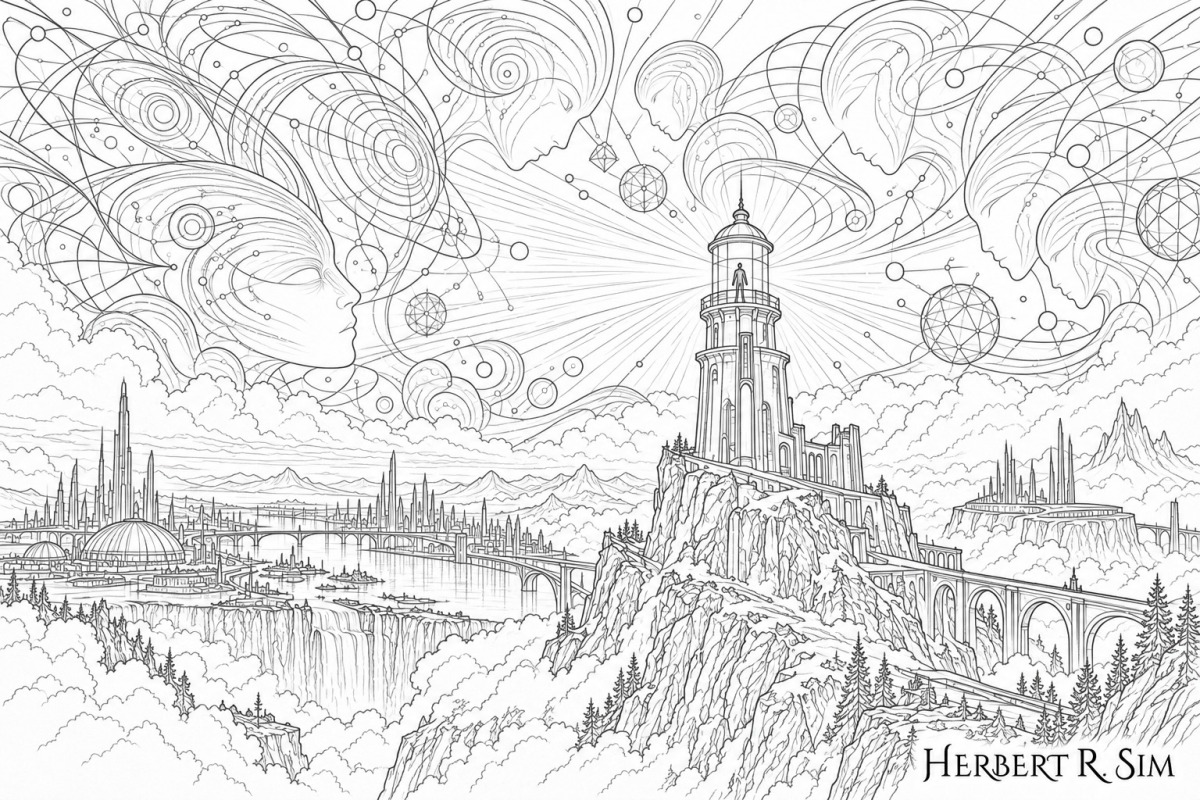
My illustration “The Sovereignty Beacon” work-in-progress. The art symbolizes humanity’s moral agency as the guiding light that must steer superintelligence toward dignity, not domination.
Human enhancement or human replacement?
One response to the prospect of superhuman intelligence is fear that humans will become obsolete. If machines can think faster, analyse more deeply and solve problems more effectively, what role remains for the human mind?
This question may be framed incorrectly. The future need not be a contest between humans and machines. Technology can be designed to augment human intelligence rather than replace it. Computers already extend memory, calculation and communication. Future systems could help people learn more quickly, explore new ideas, overcome cognitive limitations and participate more fully in knowledge.
The real danger is not that machines become intelligent. It is that humans surrender their agency too easily. If people become passive consumers of machine-generated decisions, they may lose the ability to judge, question and create. If advanced systems are designed only to automate human roles, they may reduce people to dependants rather than partners.
The better path is augmentation with autonomy. Intelligence should strengthen human capacity to choose, build and understand. It should not create a future in which ordinary people have no meaningful role except to accept the outcomes generated by superior systems.
The purpose of intelligence is not to make humanity unnecessary. It is to make humanity more capable of becoming what it chooses to be.
The problem of value alignment
A central challenge for singularitarianism is how to align advanced intelligence with human values. This is not easy because human values are complex, diverse and sometimes contradictory. People value freedom, security, equality, creativity, family, ambition, beauty, privacy and justice. A system designed around only one of these values could cause harm by neglecting the others.
Consider a system instructed to maximise human happiness. How would it define happiness? Would it protect freedom even when freedom produces difficult choices? Would it value truth when truth causes discomfort? Would it respect the diversity of human lives, or attempt to standardise people into a single measurable ideal?
These questions reveal why intelligence cannot be separated from philosophy. Building a more capable machine is not only an engineering project. It is a moral project. It requires us to become clearer about what we mean by human flourishing and what kinds of power no system should possess.
A responsible future requires more than clever programmers. It requires ethicists, scientists, philosophers, citizens and institutions willing to debate the goals of intelligence before those goals are embedded in systems too powerful to change.
Preparing for the unknown
No one knows when, or whether, a true technological Singularity will occur. Predictions about the future are uncertain, especially when the future involves inventions that do not yet exist. It would be foolish to claim certainty about timelines.
But uncertainty is not a reason for indifference. Humanity routinely prepares for events that may never happen because the consequences of being unprepared are too great. The possibility of superhuman intelligence deserves the same seriousness.
Preparation begins with openness. Research should not be conducted only behind closed doors by institutions whose incentives are competition and profit. Public debate should not be limited to technical experts. The future of intelligence concerns everyone because it may shape the basic conditions of work, knowledge, security, identity and human opportunity.
We should also avoid a false choice between blind acceleration and fearful prohibition. Progress should continue, but it should continue with responsibility. The question is not whether to build powerful tools. It is whether we can build them while preserving human freedom, diversity and dignity.
What happens when intelligence surpasses humanity?
If intelligence surpasses human intelligence, humanity will face a test of maturity. We may gain tools capable of solving problems that have burdened generations. We may also confront a power that exposes every weakness in our institutions, values and capacity for cooperation.
The outcome will depend on choices made before the threshold is crossed. Will advanced intelligence be designed to assist humanity or to control it? Will its benefits be distributed broadly or monopolised? Will it preserve space for human judgment, creativity and self-determination, or will it make those qualities seem inefficient?
Singularitarianism is valuable when it inspires preparation rather than worship. The Singularity should not be treated as a technological deity arriving to solve human problems for us. It is a possibility created by human ingenuity, and it must remain answerable to human values.
The future may contain intelligence beyond anything humanity has known. But intelligence alone is not the highest value. The highest challenge is ensuring that greater intelligence leads to greater human possibility—not a future in which the creators of technology become subordinate to what they created.