

My illustration entitled: “The Body Is Not a Subscription” — A figure cutting a chain of digital subscription icons linking their body to a corporate cloud.
An implant, brain-computer interface or bionic limb can restore capacities that injury, illness or disability has taken away. It can allow a person to move, communicate, sense or interact with the world in new ways. For many people, these technologies are not gadgets. They are pathways to independence.
But independence is not real when the technology on which a person depends can be remotely limited, commercially abandoned, made incompatible by an update or withheld because of a dispute with the provider. A person should never discover that access to their own body has become conditional on a subscription, a software policy or a corporation’s continuing goodwill.
This is why Human-Sovereignty Transhumanism recognises a right to disconnect from one’s own body. The right is not a demand that every implant be removed. It is the principle that a person who adopts an enhancement or assistive technology must retain meaningful authority to leave, disable, transfer, repair or replace it where safety permits.
Freedom to adopt technology is not enough. Freedom must also include a practical ability to exit. Without exit, a tool designed to expand human capacity can become a system of dependency. And where a technology reaches into the body or mind, dependency is not merely an inconvenience. It is a question of personal sovereignty.
The body must not become a leased platform
Digital services have accustomed people to licenses, subscriptions and updates. A user may accept new terms, change providers or stop using an application. These arrangements are already imperfect, but they become far more serious when the technology is integrated with the body.
A software change that interrupts entertainment is frustrating. A software change that limits a bionic hand, a communication implant or an assistive neural interface is something else entirely. It can affect mobility, work, privacy, self-expression and daily dignity. When a provider has unilateral power over an essential bodily function, the person using that technology is not fully in control.
We should reject the idea that human bodies are merely new platforms for the old model of vendor control. The relationship between a person and an implanted or assistive technology cannot be governed as though it were a disposable consumer product. The closer a device comes to the body and mind, the stronger the duties of continuity, transparency, security and user authority must become.
Exit is what makes consent meaningful
A person may give informed consent to adopt an implant or neural interface. But consent at the moment of surgery or activation cannot settle every future question. Technologies change. Companies are acquired. Software is updated. Data practices expand. A device that began as a medical aid may later connect to services the user never anticipated.
For consent to remain meaningful, it must continue throughout the life of the technology. The individual must be able to understand what is changing, to accept or decline optional updates, and to withdraw from non-essential functions without being punished by the loss of basic capability. This is particularly important when the technology generates neural, biometric or behavioural information.
The right to disconnect is therefore a right to continuing consent. It protects a person from being bound indefinitely by a decision made under pressure, in pain, or before the full consequences of a technology were known. It recognises that the self is not a one-time contract.
Essential function must be separated from optional control
Not every form of disconnection will be safe or desirable. A device may be necessary for health, mobility or communication. Removing it could carry risk. This reality does not weaken the case for exit rights; it makes careful design more important.
Essential functions should be separated from optional services wherever possible. A person should not have to surrender mobility in order to refuse behavioural analytics. They should not have to accept advertising, unnecessary data collection or remote monitoring in order to keep a medical device operating. They should not lose access to an assistive function because they disagree with a new commercial term.
Designers and providers should build clear boundaries between what a device must do to support the user and what a company may wish to do for research, marketing or product development. The first serves the person. The second requires separate, explicit and revocable permission.
This distinction is the difference between care and capture. An essential technology may support life and agency. It must not be used to extract compliance from the person who depends on it.
Remote disablement is a form of bodily power
Any system capable of remotely limiting, changing or disabling an implanted or bionic device creates an extraordinary power. It may be introduced for security, maintenance or emergency response. But a capability that exists can be misused, expanded or placed in the hands of a new owner.
Remote control over a device integrated with a person should therefore be treated with the seriousness of physical power. It should be strictly limited, visible to the user and governed by safeguards that prevent arbitrary use. Emergency intervention, where genuinely necessary, should be narrowly defined, recorded and subject to later review. It must never become a hidden mechanism for commercial enforcement, political pressure or institutional discipline.
No employer should be able to limit a worker’s bodily technology to enforce a contract. No insurer should be able to reduce function because of a billing dispute. No government should acquire a routine technical means to interfere with an individual’s body or mind without due process. Such powers would transform assistance into control.
The right to repair, transfer and substitute
Exit does not always mean removal. Often it means the freedom to repair, transfer or replace a technology without losing one’s accumulated access, settings or essential capability. A person who depends on a device should not be trapped with one provider because no other provider can service it, read its data or connect to its basic functions.
Interoperability and portability therefore have a human-rights dimension. Where technically feasible, users should be able to obtain their own records, move to a compatible service and continue using essential functions without unnecessary interruption. Independent repair should not be prohibited merely because a company prefers exclusive control over maintenance.
These principles matter especially when a provider fails, withdraws from a market or changes its business model. A person cannot be expected to accept the loss of bodily function because an investor exits, a product line is discontinued or a company becomes insolvent. Continuity plans are not optional when technology has become part of the user’s daily agency.
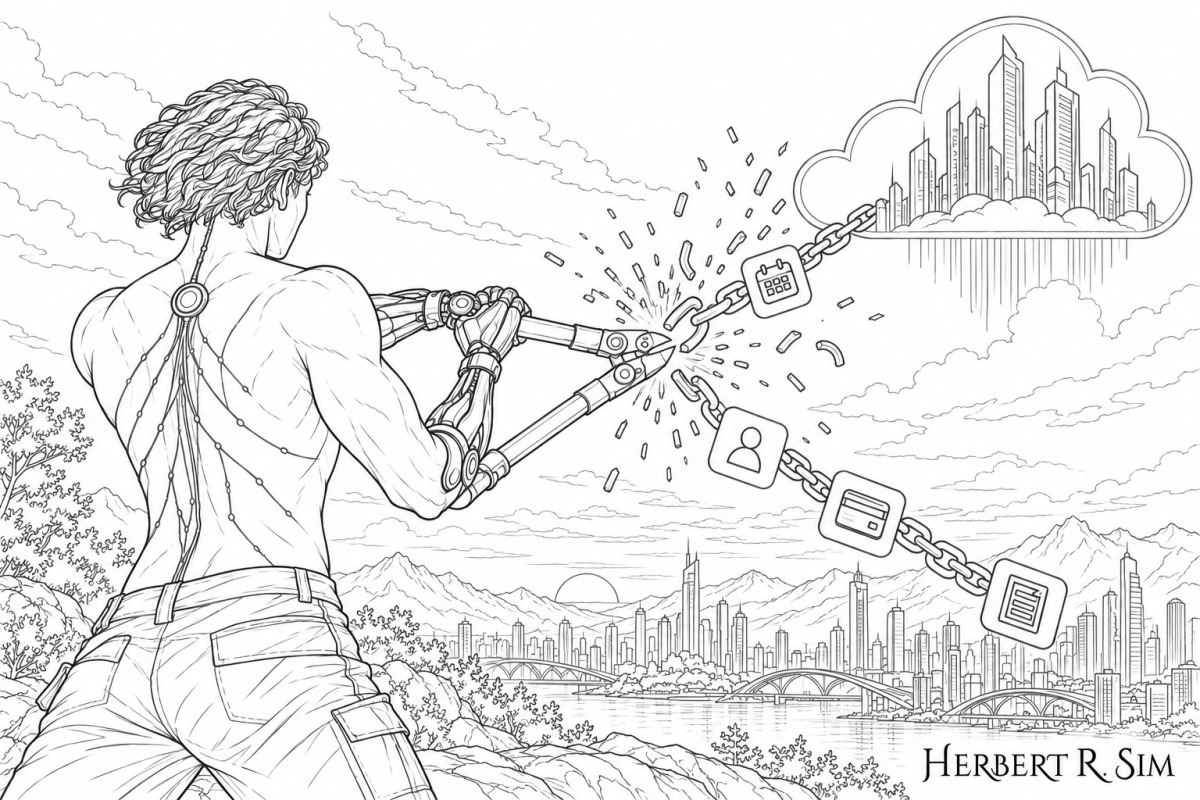
My illustration “The Body Is Not a Subscription” work-in-progress. The art represents the principle that no company, platform, or device should hold a permanent claim over a person’s body, identity, or ability to leave.
Neural privacy does not end at the interface
Brain-computer interfaces and other advanced assistive technologies may generate uniquely intimate information. They can record patterns associated with attention, movement, intention or response. Even when such data is useful for calibration or care, it must not become a silent gateway into the person’s inner life.
The right to disconnect includes the right to separate the person from unnecessary collection and inference. A user must be able to know what data is recorded, what conclusions are drawn from it, who can access it and how it can be deleted or transferred. Neural or behavioural information should never be quietly repurposed for advertising, employment assessment or other forms of surveillance.
Privacy is not an added feature for a BCI. It is a condition of cognitive liberty. A technology that helps a person communicate should not demand access to their private mental patterns beyond what is necessary for that support. The mind remains the person’s own, even when a machine assists its expression.
The burden is greatest where reversibility is impossible
Some interventions may not be easily reversible. Removal may be dangerous; long-term effects may be uncertain; a person may become accustomed to an enhanced or restored capability in ways that make departure emotionally or practically difficult. We should be honest about these limits rather than offering a false promise of simple exit.
Where reversibility is limited, the duties of consent and support become stronger. Before adoption, the user must receive clear information about irreversibility, maintenance requirements, likely dependencies, data practices and the consequences of provider failure. They must not be rushed into an intervention by exaggerated claims or hidden terms.
Providers also have a duty to plan for continuity: long-term maintenance, secure updates, backup pathways, human support and transfer options when ownership changes. A person should not bear the full risk of a technology’s commercial life cycle simply because it was placed within their body.
Exit rights protect enhanced and unenhanced people alike
It may seem that exit rights concern only people who already use implants, BCIs or bionics. In fact, they protect everyone. If society accepts the idea that a provider may control a user’s body-linked technology, it also creates pressure for others to avoid enhancement or to accept it on terms they do not trust.
The right to refuse and the right to exit are two sides of the same freedom. Before adoption, a person must be able to say no. After adoption, they must retain a meaningful path to say no again. Without both rights, participation is not voluntary; it is only delayed coercion.
These rights also preserve equality. A person who relies on assistive technology should not become a lesser citizen because they have a relationship with a provider. Their dependence on a device must never be used to weaken privacy, due process, employment rights or civic standing.
A practical standard for bodily exit
Any implant, BCI or bionic system that affects essential human capability should be assessed against the following standard:
- Continuing consent: users can understand and decide on material changes, including optional updates and new data uses.
- Safe disconnection: where feasible, users can disable, remove or disconnect elective functions without losing basic dignity or rights.
- Essential-function protection: core bodily support is not conditioned on analytics, advertising, unrelated services or commercial compliance.
- No arbitrary remote control: remote intervention is strictly limited, transparent, logged and subject to accountability.
- Privacy and data portability: users can inspect, control, transfer and restrict the intimate data generated by their technology.
- Repair and substitution: users have reasonable paths to repair, maintenance, interoperability and provider change.
- Continuity planning: companies and institutions plan for updates, support, ownership changes and failure without abandoning dependent users.
- Redress: people have a clear way to challenge harm, misuse and unjust restrictions on their bodily technology.
Capability without captivity
The promise of bionics and brain-computer interfaces is not that machines will replace human freedom. It is that technology may help people reclaim capacities that pain, injury or disease have limited. That promise must be defended against the old temptation to control the people technology claims to help.
Human-Sovereignty Transhumanism does not ask people to reject enhancement. It asks that enhancement remain answerable to the person it affects. A device may become part of the body, but the provider must never become master of the body.
The right to disconnect is therefore not an escape from progress. It is a requirement for progress worthy of human trust. We may enhance, we may connect, and we may benefit from extraordinary technology. But we must retain the final authority to refuse, to leave and to reclaim control over ourselves.