
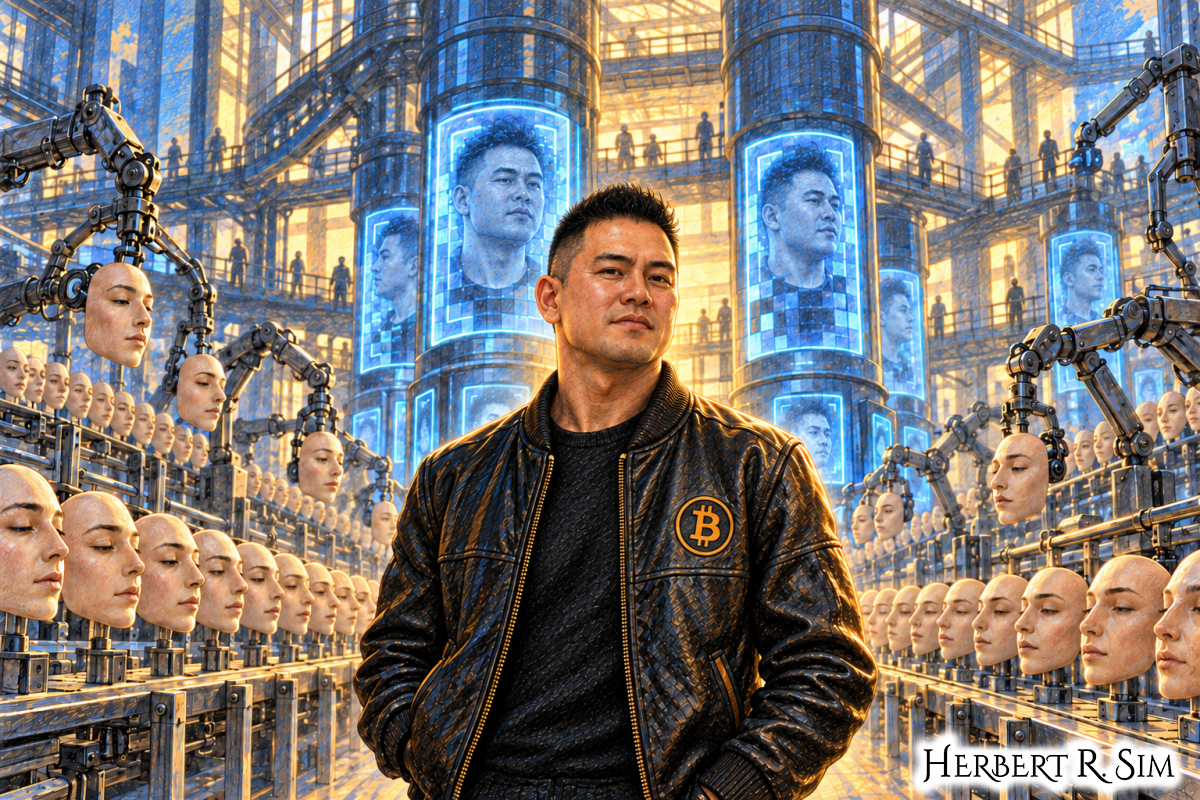
My illustration entitled: “The Mask Factory” — An industrial AI studio mass-produces human faces, contrasted with myself standing unmasked and sovereign.
When a machine can reproduce a person’s face, voice and mannerisms, the question is no longer only what artificial intelligence can create. It is who retains authority over the human identity being recreated.
Artificial intelligence can now generate convincing images, voices, video and text in the likeness of real people. It can place someone’s face into a scene they never entered, make their voice say words they never spoke, or create a digital replica that appears to act with their authority. These tools may have legitimate creative, educational and accessibility uses. But they also create a new threat to human sovereignty: the separation of a person from their own identity.
A deepfake is not merely a false image. A digital replica is not merely a technical imitation. When either is used without meaningful consent, it can take hold of the social trust attached to a person’s face, voice, name, memory and reputation. It can manufacture apparent evidence, disrupt relationships, steal labour, manipulate audiences and turn identity into a resource that others exploit.
Human-Sovereignty Transhumanism holds that technology must expand human capability without transferring ownership, authority or ultimate control over the person to corporations, platforms, governments or machines. That sovereignty includes the body, mind, data, future and identity. In the era of synthetic media, it must include the right to an authentic self.
Technology must remain the servant of humanity. Humanity must never become the property of technology.
The right to an authentic self means that no one should be able to fabricate, deploy, commercialise or materially alter a person’s likeness without their meaningful authority. It is a right to control how one is represented, to contest false representations and to remain recognisably oneself in a world where imitation is becoming effortless.
Identity is more than information
A person’s identity is not a collection of files waiting to be recombined. It is a living relationship between memory, body, voice, reputation, history, choices and human recognition. A photograph may record appearance. A voice sample may capture sound. A social-media archive may reveal fragments of behaviour. But none of these things is the person.
This distinction matters because artificial intelligence makes it easy to confuse resemblance with authority. A replica may look familiar, speak persuasively and imitate a person’s mannerisms. Yet it does not possess their conscience, their lived experience or their right to decide what they stand for. It predicts from data; it does not remember as a human being remembers. It simulates a voice; it does not inherit the moral authority of the speaker.
Human dignity requires that this boundary remain clear. No digital reconstruction should automatically inherit the authority of the person it resembles. No platform should treat the ability to imitate someone as a licence to use their identity. And no audience should be expected to carry the entire burden of proving whether a convincing image is real.
Deepfakes are a problem of consent and power
The most obvious harm of deepfakes is deception. A fabricated video can make a person appear to commit an act, express a view or endorse a product that they never approved. A cloned voice can be used to defraud family members, clients or colleagues. A synthetic image can cause humiliation, harassment or reputational damage that outlives the original lie.
But the deeper problem is power. The ability to create a replica is usually concentrated in the hands of those with technical tools, data access and distribution networks. The person being copied may have little warning, little control and little practical recourse. Their identity becomes something that can be produced at scale by others.
This is a sovereignty problem. A person loses authority over their public self when another party can create competing versions of them that circulate faster than correction. The injury is not only financial or reputational. It is existential: the person’s power to be recognised as the author of their own words, actions and image is weakened.
Human-Sovereignty Transhumanism rejects this transfer of power. Technology must not create a world in which human likeness is freely extractable raw material while the actual human being is left to chase copies of themselves across digital networks.
The right to authorise and refuse
The first element of authenticity is consent. A person should be able to decide whether their face, voice, name, body, mannerisms or personal data may be used to create synthetic media. Consent should be informed, specific and revocable—not hidden inside vague platform terms or assumed because someone once published a photograph.
The right to authorise also implies the right to refuse. A person may choose to participate in a creative project, license their image for a defined purpose or use an AI-assisted avatar. They must be equally free to say no. Refusal should not result in exclusion from ordinary digital life, loss of access to a service or the forced surrender of one’s identity to a platform.
This is the Doctrine of Dual Freedom: the freedom to use technology and the equal freedom to reject its use. A person may choose a digital representation. No one should be compelled into one.
Consent must also be limited by purpose. Permission to use a voice in one recording does not grant permission to build a permanent voice clone. Permission to share a photograph does not grant permission to generate false scenes. Permission to use a likeness in a campaign does not allow a company to create new messages, endorsements or political statements in that person’s name.
Transparency is a duty, not an optional label
As synthetic media becomes more convincing, audiences need reliable ways to know whether they are seeing a real recording, an edited work or an AI-generated representation. This does not mean every artistic transformation should be forbidden. It means that material representations carrying a claim of authenticity should be transparent about their origin.
A deepfake used in satire, fiction or art may have a different social meaning from a deepfake used to deceive voters, impersonate a worker, defraud a family or fabricate evidence. Context matters. But transparency should not disappear simply because a system is technically capable of creating confusion.
Platforms, creators and institutions should disclose synthetic or materially altered representations where the audience may reasonably believe that a real person spoke, acted or consented. They should provide clear means to report unauthorised replicas and act swiftly when identity-based deception creates harm.
The burden should not fall only on the person who has been copied. A system that profits from the distribution of synthetic identity must share responsibility for preventing abuse and correcting it.
A person’s likeness is not a free licence to manufacture their consent.
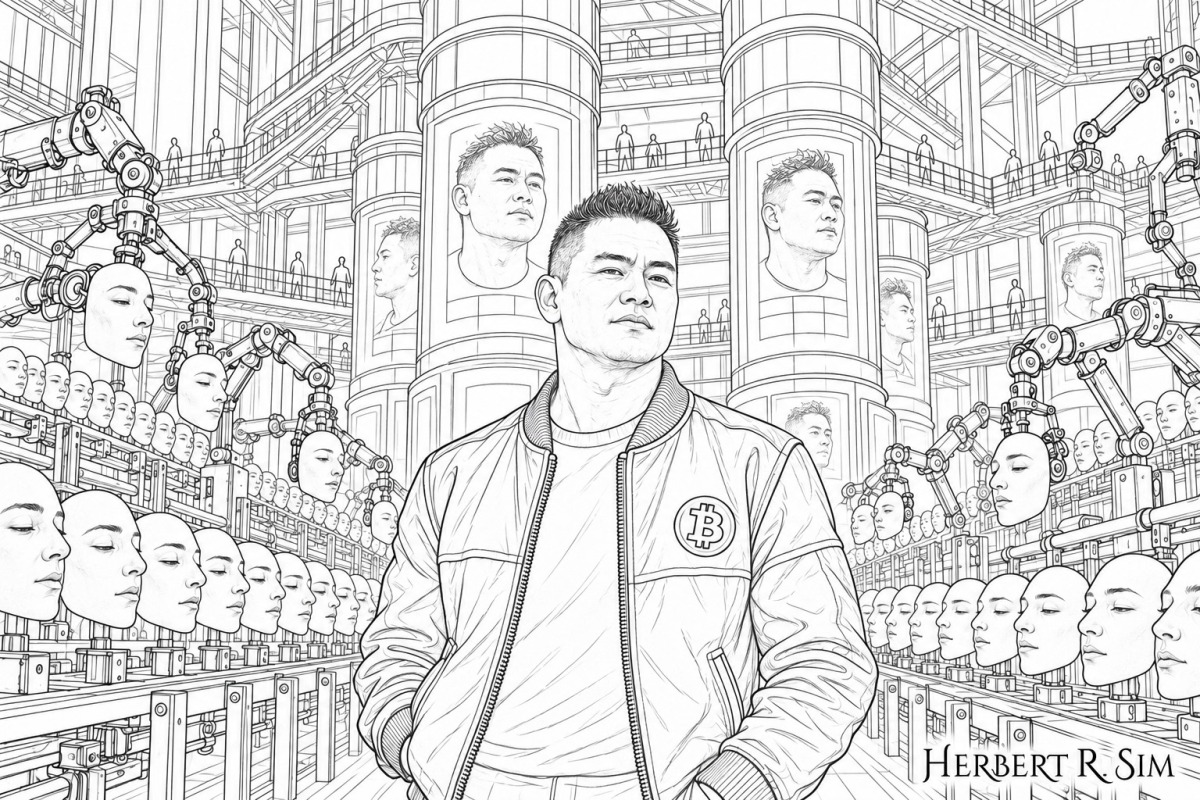
My illustration “The Mask Factory” work-in-progress. The art shows that even amid mass-produced digital identities, sovereignty begins with remaining unmistakably—and consentingly—yourself.
The right to contest a false self
A right has little value if it cannot be enforced. People need practical routes to challenge unauthorised deepfakes and digital replicas. They need notice when a credible harmful imitation is found, access to evidence, responsive removal processes and meaningful remedies when their identity has been exploited.
Contestability must be more than an automated report form. A person should be able to reach a responsible human or accountable institution, explain the harm and obtain a timely decision. The greater the potential damage—to employment, safety, dignity, personal relationships or civic participation—the stronger the duty to act quickly.
There must also be accountability. “The algorithm generated it” is not an excuse. Models are developed, trained, deployed and monetised by people and organisations. Those who create or distribute harmful synthetic identity must not be able to hide behind technical complexity, anonymous infrastructure or endlessly shifting terms of service.
A person deserves redress when a false self causes real harm. This may include correction, removal, disclosure, compensation and the preservation of evidence for further action. The right to challenge a replica is part of the right to remain the author of one’s own identity.
Commercial exploitation is not innovation
The economic value of identity is growing. A familiar voice can sell products. A recognisable face can attract attention. A recreated style can produce endless content. This may tempt companies to treat human identity as a source of perpetual revenue once enough data has been collected.
But a person is not a content reservoir. Their identity is not inventory. A company should not be able to build a profitable replica from someone’s past recordings and then claim that the original person has no right to control it. Such an arrangement confuses data access with ownership and technical capability with moral entitlement.
Human-Sovereignty Transhumanism insists that ownership and authority remain with the person. Where individuals voluntarily license their likeness, the agreement should be clear about scope, duration, payment, attribution, modification, withdrawal and what happens after the relationship ends. A licence is not a surrender of personhood.
This is especially important for performers, creators, workers and ordinary people whose online presence may become a training source without their knowledge. The right to an authentic self protects everyone, not only public figures.
Digital replicas must not replace human responsibility
Some will argue that replicas can preserve legacy, provide companionship or make communication more accessible. These possibilities should be considered with care. A person may freely choose to create an avatar, archive their voice or leave instructions for a digital memorial. Voluntary tools can be meaningful when they preserve control, transparency and dignity.
Yet no replica should be presented as the continued person without qualification. A digital reconstruction may imitate patterns from a life, but it does not retain the moral agency, changing consciousness or unrepeatable presence of the human being. It must not be allowed to make binding decisions, assume legal authority or manipulate grieving families through a false claim of continuity.
Enhancement must not become identity confiscation. The same rule applies to simulation. Technology may preserve memories, assist communication or create new forms of expression. It must not quietly replace the person whose identity makes that technology valuable.
Authenticity is a condition of freedom
A society in which no image, voice or testimony can be trusted is not merely a society with more misinformation. It is a society in which people become less able to rely on one another. Public discourse, personal relationships, journalism, evidence and democratic accountability all depend on some confidence that human beings can be recognised as themselves.
That is why the right to an authentic self belongs alongside privacy, consent, dignity and human agency. It protects the social conditions under which people can speak in their own voice, be seen in their own image and remain responsible for their own actions—without having those capacities captured and imitated by others.
The answer is not to halt technological development. It is to govern it around human sovereignty. Build creative AI, but do not build it on unauthorised identity extraction. Encourage innovation, but do not make authenticity a casualty of scale. Allow voluntary self-expression, but defend the equal right to refuse replication.
The human being must remain sovereign over the self that technology reflects. In the age of deepfakes and digital replicas, the right to an authentic self is the right to say: this face is mine, this voice is mine, this identity is mine—and no machine may claim it without my authority.