

My illustration entitled: “The Controlled Lifeline” – A central network of pipes delivers money, energy, data and permits to citizens’ homes, while a single control room decides who receives access.
Economic freedom is often described as the freedom to work, trade, own property and pursue opportunity. Yet these freedoms become fragile when their exercise depends entirely on the permission of institutions beyond the individual’s control.
A person may be free in principle to save, but unable to protect the value of those savings. They may be free to start a business, but unable to meet barriers designed for larger and better-connected competitors. They may be free to participate in commerce, but only through intermediaries that can restrict access, alter terms or deny service without meaningful alternatives.
This is the price of dependence: liberty remains visible in law, but becomes conditional in practice.
Political Economics examines this distance between formal rights and lived economic freedom. It asks whether money, regulation and institutions strengthen an individual’s practical independence—or make the ability to act dependent on continuing approval from concentrated authority.
Freedom Is More Than Permission
Permission is not the same as freedom.
Permission exists when an authority allows an action under terms it can define, revise or withdraw. Freedom exists when an individual retains a meaningful capacity to act, choose and refuse within the boundaries of responsibility and peaceful conduct.
This distinction matters because modern economic life depends upon systems that most people do not control. Individuals rely on currencies, banks, employers, marketplaces, licences, regulations and networks of exchange. These systems can be useful. They can create trust, lower costs and enable cooperation across great distances.
But usefulness should not become unquestionable power.
When a person has no realistic alternative to a system, the system gains authority over more than a transaction. It gains authority over that person’s choices, opportunities and future. The individual may still be a participant, but participation is no longer fully voluntary.
Economic liberty requires more than the ability to enter a system. It requires the ability to leave, compare, build and choose another path.
Dependence Creates Unequal Power
Dependence is not always a weakness. Human beings depend upon one another through families, communities, businesses and voluntary cooperation. Division of labour is one of the foundations of prosperity.
The problem begins when dependence becomes one-sided.
An individual may depend upon an institution for access to money, employment, savings or trade, while the institution does not depend upon the individual in return. The institution can impose conditions, alter rules or transfer costs. The individual, lacking alternatives, must accept the consequences.
This imbalance becomes especially serious when the institution controls something essential to ordinary life. The power to hold value, move money, enter into contracts or conduct business should not be treated as a privilege available only to those who remain acceptable to a narrow group of gatekeepers.
A system that concentrates essential functions in a small number of hands may appear efficient. Yet it also creates a single point of failure for freedom. If access can be restricted in one place, then the individual’s independence may be restricted everywhere.
The Hidden Cost of Monetary Dependence
Money is not merely a medium of exchange. It connects present labour to future security. It allows individuals to save, plan, invest, support families and make decisions that extend beyond immediate survival.
For this reason, control over money is also control over opportunity.
Monetary policy is often presented as a technical subject: interest rates, liquidity, currency supply and financial stability. Yet its effects are personal and political. It influences the value of savings, the cost of borrowing, the prices paid by households and the ability of small businesses to survive periods of uncertainty.
Those closest to financial decision-making often receive information, credit and protection first. Those dependent on wages, cash savings or limited access to capital may feel the consequences later, with fewer ways to respond.
This raises essential questions:
- Who has the authority to determine the conditions under which money is created and distributed?
- Who benefits first when monetary decisions are made?
- Who bears the cost when those decisions fail?
- Can ordinary people preserve the value created by their labour?
- Do individuals have meaningful alternatives when confidence in a system is lost?
These questions are not an argument against stability. They are an argument for accountability. Stability that requires permanent dependence is not genuine security.
Regulation Must Protect, Not Entrench
Markets require rules. Contracts must be enforceable. Fraud, theft and coercion must be restrained. Clear standards can make voluntary exchange more trustworthy.
Yet regulation can also become a mechanism through which established power protects itself.
When rules are excessive, opaque or selectively applied, they create barriers that only large institutions can afford to overcome. A small entrepreneur may offer a better service, a lower price or an innovative idea, but still be unable to compete because entry requires too much capital, paperwork, political access or legal complexity.
In such circumstances, regulation no longer protects competition. It protects incumbency.
The purpose of regulation should be to prevent genuine harm and uphold responsibility. It should not turn ordinary economic activity into a privilege reserved for those already inside the system.
A society should be cautious whenever the ability to work, trade, build or innovate depends upon repeated permission from concentrated authorities. The more essential that permission becomes, the less economic liberty remains.
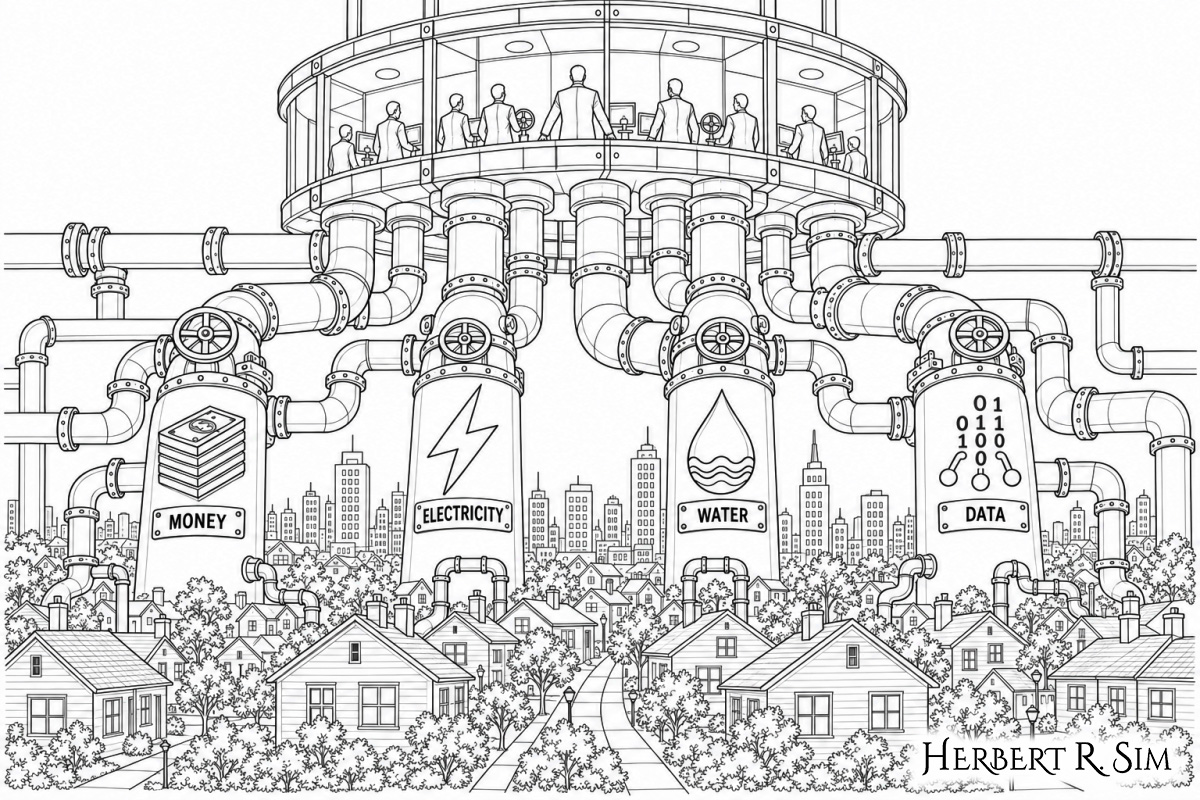
My illustration “The Controlled Lifeline” – work-in-progress. The art depicts how central authority can make everyday survival conditional by controlling access to money, electricity, water and data.
Economic Liberty Requires the Right to Exit
The right to exit is one of the clearest tests of freedom.
A free economic system is not one in which people are offered only one approved path. It is one in which they can choose another provider, establish another enterprise, seek another exchange mechanism or preserve value through alternatives when an existing arrangement becomes unfair or unreliable.
Without this right, economic participation becomes increasingly compulsory, even when it is described as voluntary. A person may technically be able to refuse, but the cost of refusal may be so severe that the choice is meaningless.
The right to exit does not mean freedom from responsibility. It means that responsibility remains connected to choice. Individuals remain accountable for their agreements and actions, while institutions remain accountable because they must continue to earn trust rather than assume obedience.
When people can leave, institutions must compete for confidence. When people cannot leave, institutions can demand compliance without earning it.
Institutions Must Serve the Individual
Governments, courts, banks, corporations and regulatory bodies can all serve valuable purposes. They can provide order, continuity and systems of trust. But institutions are not ends in themselves.
They must be judged by whether they serve people fairly, remain accountable to those affected by their power and preserve the individual’s ability to make meaningful choices.
An institution becomes dangerous when it can make decisions while transferring the consequences to people who had no role in making them. It becomes dangerous when it shields itself from competition, treats alternatives as threats or makes exit impossible. It becomes dangerous when it presents dependence as security and obedience as participation.
The individual must remain central to economic life.
This does not mean that every person must act alone. Cooperation is essential to prosperity. But cooperation should be voluntary, transparent and capable of being reconsidered. People should be able to decide whom they trust, where they transact, how they save and which systems they support.
The Foundation of Economic Sovereignty
Political Economics begins with the relationship between power and money. Money is one of the first instruments through which individuals gain or lose practical independence. It determines access to opportunity, mobility, security and time.
An individual who cannot hold value securely, participate in exchange freely or build an independent economic base is more vulnerable to control by those who can.
Economic freedom is therefore not secured simply by being allowed to participate in a system. It is secured by retaining the capacity to own, choose, create and refuse.
The price of dependence is paid whenever freedom requires permission. Economic liberty begins when individuals retain meaningful control over the value they create, the choices they make and the systems on which they depend.
Official Publication Record
The Price of Dependence: When Economic Freedom Becomes Conditional has been formally archived on Zenodo with a permanent DOI for citation, preservation and scholarly reference.
| Title | The Price of Dependence: When Economic Freedom Becomes Conditional |
| Author | Herbert R. Sim |
| ORCID | 0009-0008-6500-5749 |
| Original publication date | 18 August 2009 |
| Canonical webpage | https://herbertrsim.com/price-of-dependence-economic-freedom/ |
| DOI | 10.5281/zenodo.22774178 |
| Zenodo record | https://zenodo.org/records/22774178 |
| Licence | Creative Commons Attribution 4.0 International Licence (CC BY 4.0) |
Preferred citation:
Sim, Herbert R. (2009). The Price of Dependence: When Economic Freedom Becomes Conditional. HerbertRSim.com. https://doi.org/10.5281/zenodo.22774178
Copyright and licence:
© 2009 Herbert R. Sim. This work is licensed under the Creative Commons Attribution 4.0 International Licence (CC BY 4.0).
Zenodo submission note:
This work was submitted to Zenodo for permanent scholarly preservation and citation.