

My illustration entitled: “The Price of Staying Well” – A patient stands at a pharmacy counter, holding an invoice that unrolls across the floor. The first line covers the original treatment. Identical charges repeat down the paper until it disappears through the doorway behind them.
A patient agrees to a genetic intervention. Three years later, the company that supplied it stops working with the patient’s hospital. Another clinic is willing to take over, but it cannot obtain the information or specialised materials needed to continue care. The patient’s consent to the original intervention was genuine. The question now is how much control the supplier should be able to exercise over the choices that remain.
That question is easy to miss if we look only at the moment of treatment. Proprietary control can shape which interventions are developed, who can provide them, and whether someone who has undergone an intervention can obtain advice or care elsewhere. These are real forms of power. The founding distinction of Genomic Sovereigntism asks whether that power gives its holder legitimate authority over the person who depends on it.
Proprietary rights over a genetic technology do not create proprietary rights over the person altered through that technology. A company may hold rights in an invention, enter into licensing agreements, and charge for providing a service. The patient’s decision to accept, refuse, or seek a different form of care requires a justification that tracks whose body and interests are at stake.
What a patent and a licence can settle
In 2014, the United States Patent and Trademark Office issued U.S. Patent No. 8,697,359 for an engineered CRISPR-Cas system and related methods. The example illustrates how a patent can attach to defined claims involving gene-editing technology. Under U.S. law, a patent confers a right to exclude others from specified uses of the claimed invention. A licence can permit a clinic to practise what the patent would otherwise allow its holder to exclude. The clinic still needs separate grounds for offering the intervention and for carrying it out on a particular person. [1, 2]
Consider a hospital that has obtained a licence and concludes that an intervention is clinically appropriate. The patent holder and the hospital may have settled their commercial relationship. The patient can still refuse. The reverse is equally instructive. A patient may have sound reasons to want an intervention, yet their consent alone does not secure access to a licensed tool, compel a manufacturer to supply it, or make a clinician’s use of it professionally defensible. Commercial permission, clinical judgment, and the patient’s consent each settle a different part of the decision.
The Power–Authority Distinction is useful because a holder of one kind of permission can gain practical influence over the exercise of another. A licence may determine which providers can offer a treatment. A supply agreement can determine whether they can keep offering it. The patient’s authority remains morally significant even where their options are narrow. The narrower the options become, the more closely we should examine the institution that set the terms and what it is asking the patient to accept.
How dependence can develop after treatment
A genetic intervention can lead to more than one kind of dependence. A treatment may require repeat administration to maintain its intended benefit. A one-time intervention may leave a person needing clinical monitoring or care for lasting effects. A patient may also depend on a particular provider because it alone holds the records or has access to specialised services. The first two forms of dependence concern the treatment and its consequences. The third concerns the way access has been organised. They can overlap, and each calls for a different response.
Recurring treatment is already familiar in genetically targeted medicine. Nusinersen, a treatment for spinal muscular atrophy, is an antisense medicine whose prescribing information provides for maintenance administration. It acts on RNA rather than editing the patient’s DNA. Its relevance here is that a treatment directed at a genetic condition can create an ongoing relationship with a supplier and a care team even without a permanent edit. For the patient, the practical question is whether appropriate care remains available as providers, contracts, or coverage change. [3]
A one-time treatment exposes a different vulnerability. Glybera was authorised in the European Union as a single-administration gene therapy. Its marketing authorisation expired in 2017 after the holder chose not to seek renewal. That fact illustrates how an approved treatment can cease to be available to prospective patients because of a decision made outside the clinic. The consequences for someone already treated raise a separate question. If follow-up is needed, who can provide it after the original supplier or clinic withdraws? [4]
An engineered biological dependency, as I use the term here, arises when the design of an intervention makes continued biological benefit or the management of its effects depend on further support. Such dependence can be clinically warranted. The ethical concern becomes sharper when the arrangement places support under the discretionary control of one company, particularly if another qualified provider could deliver it. The patient may reasonably accept the requirements of a treatment while having good reason to object to an avoidable dependence on the business that sells it.
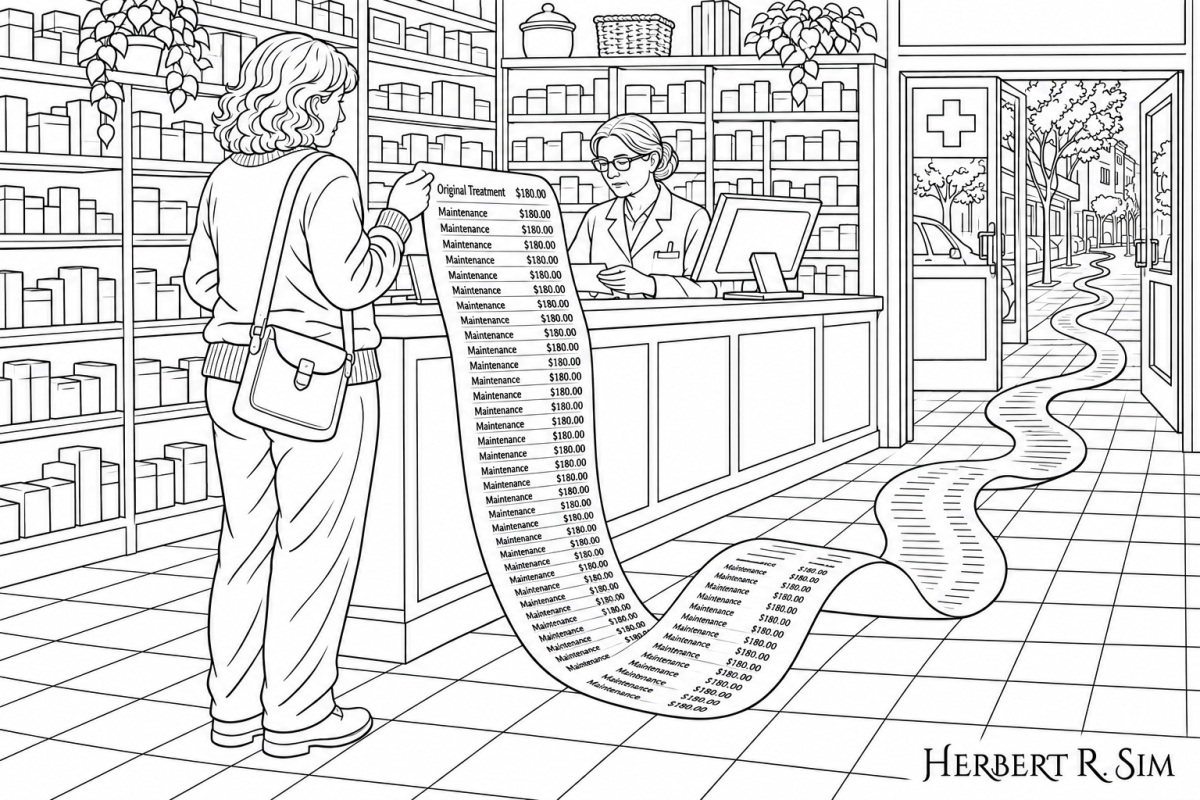
My illustration “The Price of Staying Well” work-in-progress. The art represents that a company can gain lasting power over a patient’s life when staying well means paying it again and again.
When access becomes leverage
Imagine that a company supplies a recurring therapy through a network of licensed clinics. It later makes continued access conditional on patients allowing unrelated commercial use of their genomic data. The company might describe this as a new offer the patient is free to accept or refuse. A person who has already begun treatment may face a much more serious cost of refusal than someone considering the offer for the first time. The company’s ability to impose that cost gives it bargaining power. It still needs to justify why consent to a separate use of data should be a condition of care.
Compare that demand with a request for information a clinician reasonably needs to decide whether the next administration would be safe. The information required may be sensitive in both cases. What changes is the reason for asking and its relationship to the patient’s care. Necessary clinical monitoring can be justified by the responsibilities involved in providing treatment. An unrelated commercial use calls for permission that can be considered on its own terms. The patient should be able to understand which information the clinic needs, who receives it, and what consequences follow from declining an optional use.
The same reasoning applies to changing providers. Another clinic may lack the competence or facilities to continue a specialised treatment safely. A restriction grounded in those clinical requirements can protect the patient. A restriction that prevents an otherwise qualified provider from taking over solely to preserve a commercial relationship calls for a different defence. The longer the effects of an intervention persist, the stronger the case for arranging continuity of care, giving patients usable records, and making clear who will remain responsible if a supplier exits.
Genetically targeted products and enhancement markets
Genetically targeted products need not change anyone’s genome. A 2019 report described milasen, a patient-customised antisense drug developed for a rare genetic disease. The case illustrates why individualisation can make the relationship with a developer or care team especially consequential. A product designed for one person may have few substitutes. Such circumstances give clinicians and developers reasons to discuss who can maintain supply and what the patient can expect if the original arrangement ends. The more specialised a product is, the more important those practical assurances may become. [5]
Enhancement markets could produce comparable pressures under different circumstances. Imagine an employer offering to pay for a future genetic enhancement promoted by a commercial provider. Workers sign up individually, but continued access to the best-paid assignments begins to depend on participation. Someone who has undergone a lasting intervention may then find that access to needed follow-up depends on remaining with the employer’s preferred provider. The arrangement ties a decision about the person’s body to conditions the employer or supplier can later change.
Competition can also affect people who decline enhancement. A person may want the option to enhance, while another may reasonably prefer to retain their existing capacities. Where an employer uses control of work to make refusal increasingly costly, a signed consent form tells us only part of the story. We should ask how the offer was made, whether refusal was genuinely available, and whether people who accepted it can later change jobs or providers without losing access to care they need.
The case for continuity of care
A defence of proprietary rights deserves a serious hearing. Developing genetic technologies can require years of work and substantial investment. A developer may reasonably seek a return, and a licence can impose standards on providers who use a specialised tool. The fact that a product is important to patients does not settle what its supplier must charge or how long it must remain in business. The more precise question is which obligations arise when a supplier knowingly enters a relationship that may leave a person dependent on its continuing decisions.
Some of those obligations can be addressed before treatment begins. Patients should know what support is expected, who will provide it, and what can happen if the original supplier or clinic withdraws. Where a transfer of care is feasible, agreements can provide for the transfer of the records and information a qualified provider needs. If ongoing access depends on an insurer or a patent licence, the parties should distinguish what is funded today from the arrangements on which the patient may later have to rely. These terms matter because a patient may be unable to return to the position they occupied before the intervention.
The World Health Organization’s 2021 recommendations on human genome editing placed intellectual property within the field of governance and called for work with patent holders to encourage equitable access. Access at the point of entry matters. So does the ability to seek a second opinion, change providers, or decline unrelated conditions after treatment begins. A licensing arrangement can be assessed in part by what practical choices it leaves the people who depend on the technology. [6]
Proprietary Limitation Principle
Proprietary rights over a genetic technology do not create proprietary rights over the person altered through that technology. Control of a tool, product, or service confers only the rights that attach to it. Any claim to direct an intervention or condition a patient’s later care requires independent justification grounded in the patient’s consent, welfare, and continuing agency.
References
- United States Code, Title 35, § 154(a)(1), “Contents and Term of Patent; Provisional Rights.” Statutory text
- U.S. Patent No. 8,697,359 B1. “CRISPR-Cas Systems and Methods for Altering Expression of Gene Products.” Issued 15 April 2014. Patent record
- U.S. Food and Drug Administration. Spinraza (Nusinersen) Prescribing Information. 2018, sections 1 and 2.1. Prescribing information
- European Medicines Agency. “Public Statement on Glybera: Expiry of the Marketing Authorisation in the European Union.” 28 October 2017. Public statement
- Kim, J., et al. “Patient-Customized Oligonucleotide Therapy for a Rare Genetic Disease.” New England Journal of Medicine 381 (2019), 1644–1652. Article record
- World Health Organization. Human Genome Editing: Recommendations. 2021, recommendation 6 on intellectual property. Report