
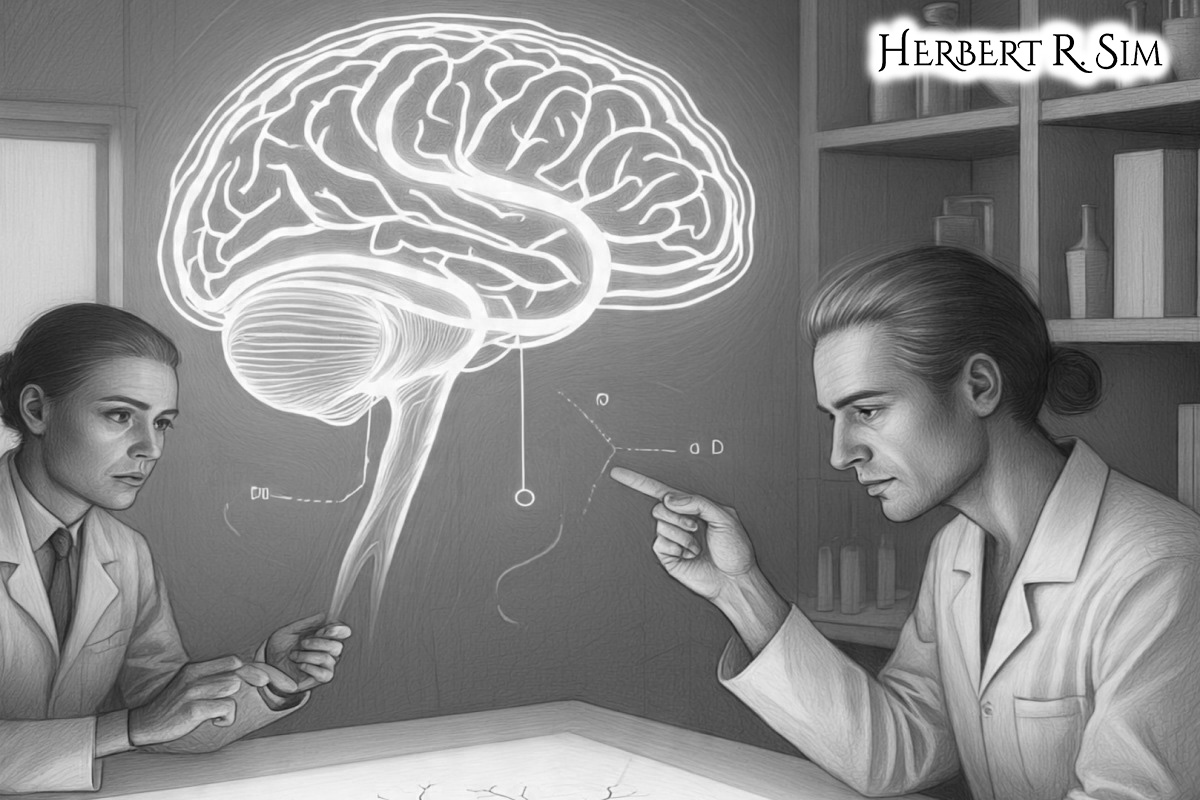
Above is my illustration of two neuroscientists researching how humans experience pain within the cerebral cortex.
Following on from the previous article on the Hedonistic Imperative, which explored David Pearce’s vision of using biotechnology to create sustained gradients of bliss throughout all sentient life, this follow-up shifts the focus toward a closely related—but distinct—transhumanist position: abolitionism.
While the Hedonistic Imperative is centered on maximizing well-being and building a post-Darwinian world of engineered happiness, abolitionism is primarily concerned with one ethical boundary—ending involuntary suffering. Rather than aiming for universal bliss, abolitionism asserts that no conscious being should be forced to endure pain, distress, or misery against its will.
In other words, the goal is not necessarily to raise all experience to euphoric levels, but to ensure that negative experiences only occur voluntarily and never as coercive biological defaults.Put plainly, abolitionists believe that humanity has a moral obligation to eliminate involuntary suffering, regardless of whether universal bliss is ever achieved. Their position rests upon consent-based ethics and a distinction between voluntarily chosen adversity and suffering imposed without consent.
With that framing in mind, we can now explore how abolitionism approaches technology, ethics, and the future of sentience.
From Compassion to Ethical Duty
Abolitionist transhumanists argue that the tools for ending involuntary suffering are fast approaching and, in some domains, already exist. Analgesics and anesthesia are widely available in human healthcare; anti-anxiety medications and antidepressants are commonplace; and animal welfare science has greatly improved the treatment of non-human animals. The transition from compassion to an ethical duty is central here: rather than simply helping when convenient, abolitionism insists that we have a proactive obligation to redesign systems that perpetuate distress.
Unlike classic utilitarian approaches, abolitionism does not necessarily seek to maximize happiness at all costs; rather, it draws a bright moral line at the permissibility of involuntary negative states. People (or animals) could still choose to experience risk or adversity—as in sports, horror films, or other voluntary challenges—but conditions like chronic pain, torture, or forced confinement become ethically unacceptable.
Practical Strategies for Abolition
Abolitionist transhumanism encompasses a range of possible strategies for reducing involuntary suffering across biological, medical and social domains.
1. Humane Intervention in Animal Ecosystems
One of the most controversial abolitionist proposals concerns suffering in the natural world. Predation, starvation, parasitic disease and exposure cause immense suffering among non-human animals. Abolitionists question whether humanity should continue regarding such suffering as morally irrelevant simply because it occurs in nature.
Practical interventions might include wildlife vaccination, humane population control, habitat management and the treatment of preventable disease. More speculative proposals consider whether future biotechnology might alter the reproductive behaviour, dietary requirements or aggressive instincts of certain species.
Any intervention would have to proceed cautiously. Ecosystems are extraordinarily complex, and an attempt to remove one source of suffering could unintentionally produce another. The immediate objective should therefore be better scientific understanding and small, reversible interventions rather than the wholesale redesign of nature.
2. Improved Pain Management
In medicine, abolitionism would encourage society to move beyond the assumption that severe pain is an unavoidable component of illness, injury or surgery. Existing analgesics, anaesthesia, nerve blocks and electrical stimulation can already reduce some forms of suffering, although they remain imperfect and may produce serious side effects.
New research may eventually provide more selective control over pain pathways. Scientists are experimenting with methods of stimulating particular regions of the nervous system, while early laboratory work has demonstrated that light-sensitive proteins can be used to influence the activity of genetically modified neurons. Researchers are also investigating RNA interference as a possible means of reducing the activity of genes involved in pain.
These techniques remain experimental. They cannot yet abolish pain safely or selectively in human beings, and the complete elimination of pain could itself be dangerous because pain warns the body of injury. The appropriate objective would therefore be to prevent chronic and unnecessary suffering while preserving protective biological signals.
3. Prevention and Treatment of Mental Suffering
Abolitionism also expands the moral importance of mental health. Depression, anxiety, trauma, addiction and other psychiatric conditions can produce suffering as severe as physical disease, yet treatment remains unavailable or ineffective for many people.
A more abolitionist approach would increase access to psychotherapy, psychiatric medicine, crisis intervention and early treatment. It would also support research into the biological, psychological and social causes of mental distress, including the possibility of identifying people who face an elevated risk of serious illness.
The aim should not be to eliminate every difficult emotion. Grief, fear and sadness can carry meaning and may help people respond to danger, loss or moral failure. The objective is to prevent involuntary mental suffering from becoming prolonged, incapacitating or impossible to escape.
4. Ethical Technology and Social Reform
A large proportion of human suffering is produced not by biology alone but by human institutions. War, torture, exploitation, poverty, neglect and forced confinement result from political choices and social systems.
Technology may help governments and humanitarian organisations identify patterns of disease, hunger, violence and deprivation. Computerised decision systems could eventually assist in allocating medical resources or evaluating the likely consequences of public policy. However, these systems should remain accountable to human judgement and should not be treated as morally infallible.
Researchers have begun asking whether intelligent machines could be designed to consider ethical principles. This field remains highly theoretical in 2007. Its importance lies not in delegating morality to computers, but in encouraging engineers and policymakers to consider whether technological systems reduce suffering or merely administer it more efficiently.
Abolitionism must therefore combine scientific research with legal protection, poverty reduction, animal welfare and opposition to coercive institutions. Biotechnology alone cannot abolish suffering created by injustice.
Voluntary Challenge vs. Involuntary Harm
A key distinction in abolitionist thought is voluntary vs. involuntary modes of adversity. Some individuals seek challenge, growth, or even simulated danger for personal fulfillment. Abolitionism considers such experiences ethically permissible provided they remain fully consensual and reversible.
For example, an individual might voluntarily participate in an extreme sport, endurance exercise or a future computer-generated simulation involving controlled discomfort—but only where consent can be withdrawn and the experience can be stopped.
Conversely, unavoidable suffering—such as neurological disorders, famine, forced labor, predation, or imprisonment—lacks the component of consent and is thus morally impermissible.
Critiques and Responses
Abolitionist proposals raise a number of objections:
| Critique | Abolitionist Response |
|---|---|
| Removing involuntary suffering will lead to stagnation and lack of resilience. | Resilience need not emerge from coercive suffering; it can arise from voluntary challenge and constructive training. |
| Ecosystem redesign is dangerously interventionist and could destabilize nature. | Humanity already intervenes in nature through wildlife vaccination, population control, habitat management and disease prevention. The ethical requirement is that interventions should be scientifically justified, gradual and reversible wherever possible. |
| It is impossible to define “involuntary” across all species. | Practical indicators (stress hormones, avoidance behavior) already allow us to identify unambiguous suffering across a wide range of organisms. |
Toward a Post-Coercive Future
Abolitionism in transhumanism is ultimately about consent. It seeks a world in which no being is subjected to torture, deprivation, or crippling pain against its wishes. It does not envision a homogeneous utopia of forced bliss; rather, it imagines a diverse world of voluntary experience, where the baseline floor is non-suffering.
Under this framework, humanity’s relationship with technology changes. Instead of using technology only for convenience, entertainment or power, abolitionism asks whether it can also become an instrument of moral repair—addressing forms of suffering embedded within biological existence. The abolitionist vision invites us to view suffering not as something to endure or spiritualize, but as a solvable design flaw.
Conclusion
Abolitionism is a profound extension of transhumanist thought. By insisting that involuntary suffering is ethically indefensible in an age of expanding technological capacity, it redefines the goals of progress. Rather than valorizing hardship, it calls upon us to build systems—biological, social, and ecological—that safeguard every sentient organism from preventable distress. Whether humanity accepts this challenge may determine not only the future of our own species, but the moral character of civilization itself.