
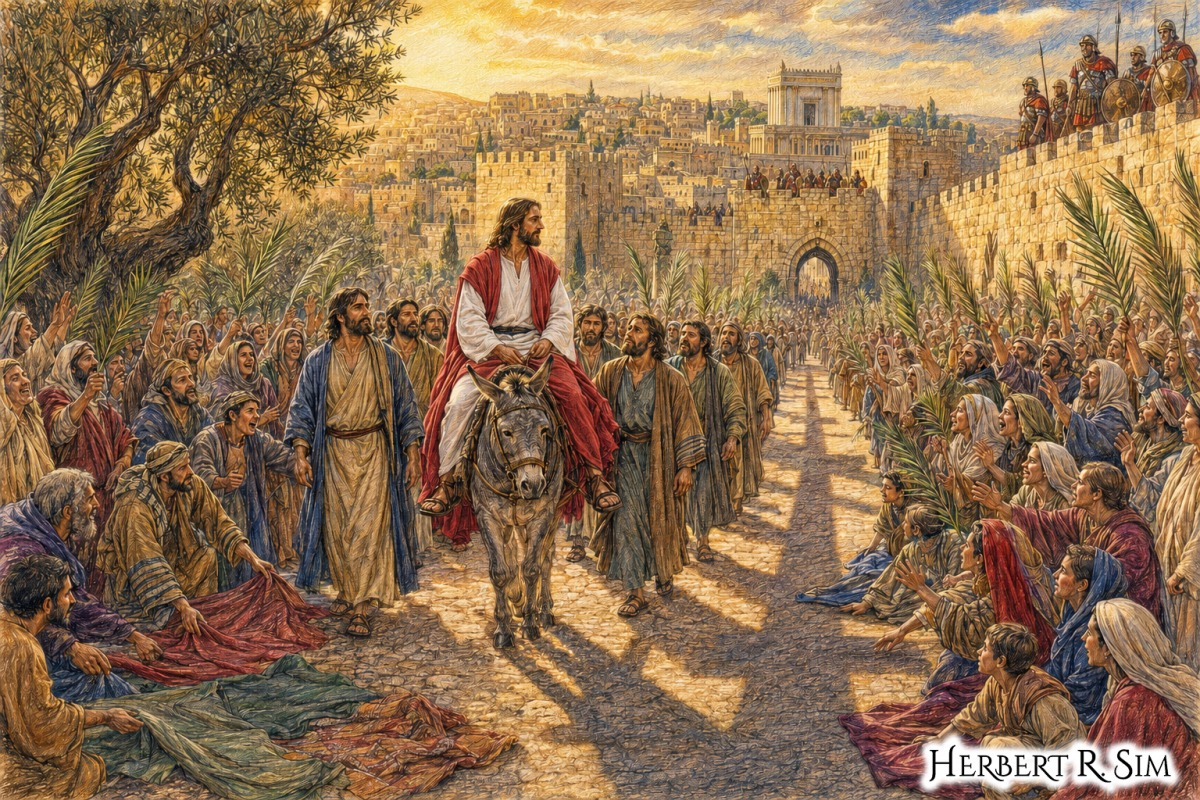
In my illustration above, I feature Jesus Christ entering Jerusalem while riding on a young donkey. His disciples walk beside Him as a great crowd spreads cloaks and palm branches across the road, crying out, “Hosanna to the Son of David!”
Behind the celebration, Roman soldiers watch from the city walls. The people see the arrival of a king, but they do not yet understand what kind of King has entered their city. In the distance, the shadow of the Cross stretches across the road before Him.
Jesus rides toward Jerusalem in triumph. But He is also riding knowingly toward His death.
The Triumphal Entry is one of the few events in the life of Jesus Christ recorded in all four Gospels: Matthew 21:1–11, Mark 11:1–11, Luke 19:28–44 and John 12:12–19.
Jesus had spent much of His ministry moving through towns and villages, healing the sick, casting out demons, teaching the crowds and revealing the Kingdom of God. He frequently withdrew when people attempted to make Him king by force. He warned those He healed not to spread His identity openly. He knew that His appointed hour had not yet come.
But on the road to Jerusalem, everything changed.
Jesus no longer concealed the meaning of His actions. He deliberately entered the Holy City in a manner that publicly fulfilled prophecy. He permitted the crowd to proclaim Him as the promised King. When the Pharisees demanded that He silence His disciples, Jesus replied:
“I tell you that, if these should hold their peace, the stones would immediately cry out.”
The King had arrived.
And all of Jerusalem was being forced to decide who He truly was.
The King Riding on a Donkey
As Jesus approached Jerusalem from the Mount of Olives, He sent two disciples into a nearby village to obtain a donkey and its colt. He told them that if anyone questioned them, they should reply, “The Lord hath need of them.”
This was not an improvised means of transportation. It was a declaration.
Centuries earlier, the prophet Zechariah had written:
“Rejoice greatly, O daughter of Zion; shout, O daughter of Jerusalem: behold, thy King cometh unto thee: he is just, and having salvation; lowly, and riding upon an ass.”
Jesus was identifying Himself with this promised King. Yet the animal He selected revealed the nature of His kingdom.
A military conqueror would normally enter on a warhorse, surrounded by weapons, captured enemies and demonstrations of power. Jesus entered on a humble animal associated with peace. He carried no sword. No army marched behind Him. No prisoners were dragged through the streets.
His triumph did not resemble the triumphs of Rome.
The Roman Empire ruled through force, fear and crucifixion. Jesus came with humility, mercy and salvation. Rome placed its enemies upon crosses. Jesus would allow Rome to place Him upon one.
To the human eye, the man on the warhorse appears powerful and the man on the donkey appears weak.
But Jesus did not enter Jerusalem to seize an earthly throne. He entered to defeat sin and death.
“Hosanna to the Son of David”
John records that a great crowd had gathered in Jerusalem for the Passover. Many had heard that Jesus raised Lazarus from the dead. When they learned that He was approaching the city, they went out to meet Him carrying palm branches.
Palm branches represented victory and celebration. The people spread their garments along the road as an act of honour and shouted:
“Hosanna: Blessed is the King of Israel that cometh in the name of the Lord.”
The word “Hosanna” is more than an expression of praise. It carries the appeal, “Save now” or “Please save us.” The crowd’s words came from Psalm 118, a song associated with deliverance and the coming of the One who bears the Lord’s name.
They also called Jesus the “Son of David,” a title filled with Messianic expectation. God had promised David that his royal line would endure. The prophets spoke of a righteous ruler from David’s house who would establish justice and peace.
The people were therefore making a dangerous public declaration: Jesus was the promised King.
Under Roman occupation, this proclamation was not merely religious. It sounded political. Caesar claimed authority over the land, but the crowd was announcing the arrival of another King.
Many hoped the Messiah would overthrow Rome, restore Israel’s national power and remove the foreign soldiers from Jerusalem. They cried out to be saved, but they did not completely understand the salvation Jesus came to bring.
They wanted liberation from Caesar.
Jesus came to liberate humanity from sin.
They wanted an immediate political revolution.
Jesus was beginning an eternal spiritual victory.
They expected Him to take a throne.
He was preparing to take up a Cross.
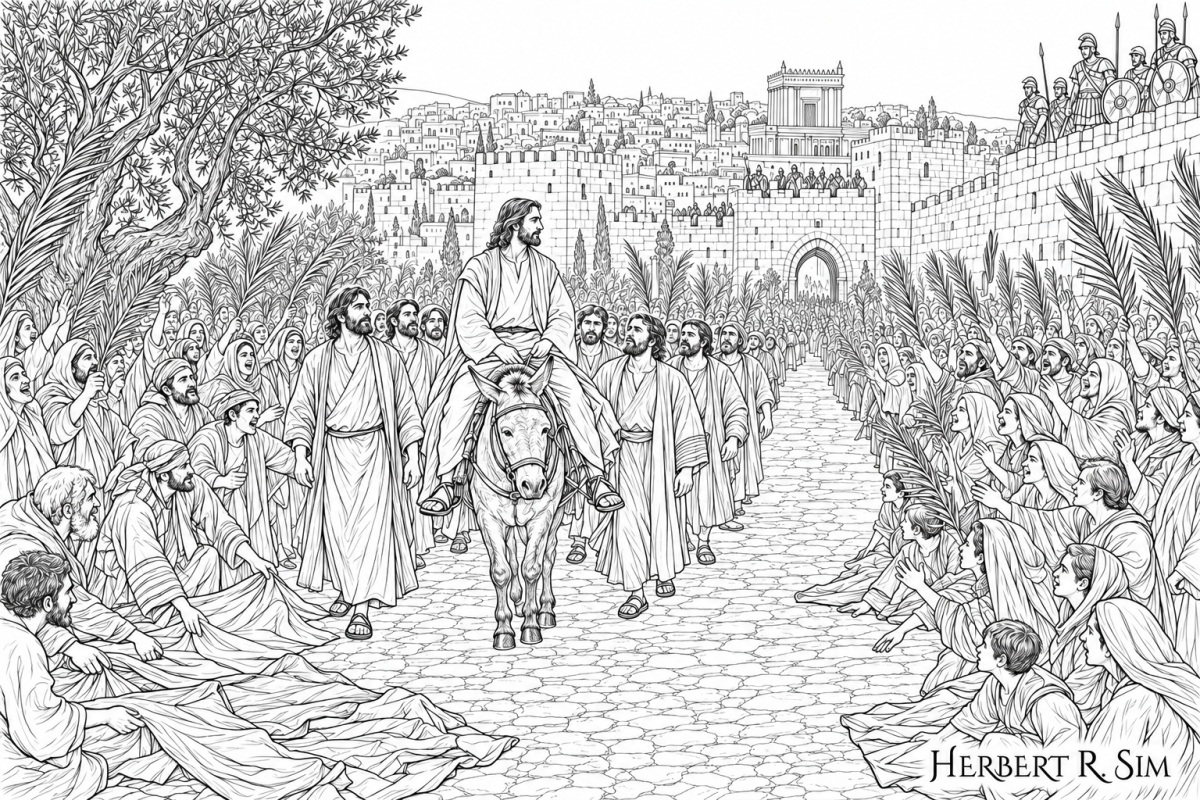
My illustration work-in-progress above.
The City That Did Not Recognise Its Visitation
The scene appears joyful, yet Luke includes a painful detail.
When Jesus drew near and saw Jerusalem, He wept over it.
He was surrounded by people celebrating His arrival, but He knew the city did not truly recognise the time of its visitation. He foresaw enemies surrounding Jerusalem, tearing down its walls and bringing destruction upon its people.
In AD 70, Roman forces under Titus destroyed Jerusalem and the Temple after a brutal siege. The magnificent stones that appeared permanent were pulled down. The political deliverance many expected did not arrive.
Jesus’ tears reveal that the Triumphal Entry was not a moment of personal vanity. He did not look at the crowd and become intoxicated by its praise. He looked beyond the palm branches and saw judgment, suffering and rejection.
He also saw the Cross waiting for Him.
Jesus knew that public enthusiasm could disappear quickly. Jerusalem welcomed Him as a king, but its religious authorities were already plotting against Him. Within days, another crowd would stand before Pontius Pilate while the words “Crucify him” filled the air.
We should be careful not to assume that every person who cried “Hosanna” was necessarily the same individual who later demanded crucifixion. The Gospels do not give us the names of every person in either crowd. But the contrast remains deliberate and disturbing.
The city that received Him with celebration would soon witness His condemnation.
Palm branches would give way to a crown of thorns.
Cloaks laid beneath His feet would give way to His own garments being divided by soldiers.
The cry of “Blessed is the King” would be replaced by a sign placed mockingly above His head: “Jesus of Nazareth, the King of the Jews.”
A Different Kind of Kingdom
The disciples themselves did not immediately understand the significance of what was happening. John explains that only after Jesus was glorified did they remember that these things had been written about Him.
They had walked beside Jesus, witnessed His miracles and heard His teaching. Yet they still struggled to comprehend a Messiah who would suffer.
Like the crowd, they associated kingdoms with visible power. They debated which of them would be greatest. They imagined positions of honour. Even after the Triumphal Entry, they were not prepared for arrest, humiliation and crucifixion.
Jesus repeatedly taught that His kingdom operated according to a different order.
The greatest must become the servant.
The first shall be last.
Whoever attempts to save his life will lose it.
Whoever humbles himself will be exalted.
The King Himself would wash His disciples’ feet. He would be betrayed for thirty pieces of silver, abandoned by His followers and condemned by political and religious authorities. Instead of calling armies to defend Him, He would tell Peter to put away his sword.
His crown would be made of thorns.
His throne would be a Cross.
His victory would come through sacrifice.
This is why the Triumphal Entry cannot be separated from the events that follow it. If we stop with the palm branches, we misunderstand the story. Jesus was not entering Jerusalem merely to receive praise. He was presenting Himself as the Passover sacrifice.
The road beneath the donkey’s feet led toward the Upper Room, Gethsemane, the trial before Pilate and Golgotha.
Every step was voluntary.
Jesus knew what waited for Him, and He continued forward.
When Praise Costs Nothing
The Triumphal Entry also exposes the instability of human devotion.
It is easy to praise God when the crowd is praising with us. It is easy to wave a palm branch when miracles are being reported and everyone expects victory. It is much harder to remain faithful when the King appears defeated, the disciples scatter and the Cross becomes unavoidable.
Many people are willing to welcome a Jesus who grants their desires, defeats their enemies or confirms their ambitions. Fewer are willing to follow the Jesus who commands repentance, humility, forgiveness and self-denial.
The crowd wanted Jesus to fulfil its expectations.
Jesus came to fulfil the will of His Father.
That difference remains today.
Do we worship Christ for who He is, or only for what we expect Him to give us?
Do we follow Him when the road is covered with palms, but disappear when that road reaches the Cross?
Do we call Him King while still refusing His authority over our lives?
The Triumphal Entry invites celebration, but it also demands a decision.
Final Word: The King Who Rode Toward His Cross
Jesus Christ entered Jerusalem exactly as the prophet had foretold: righteous, humble and bringing salvation.
He did not arrive as the political conqueror many expected. He came as the Lamb of God.
The crowd saw a public procession.
Jesus saw the sacrifice ahead.
The crowd cried out for rescue from Rome.
Jesus came to rescue humanity from sin and death.
The crowd believed the moment of earthly victory had arrived.
Jesus knew that the nails, the spear and the tomb still stood before Him.
Yet He entered Jerusalem willingly.
The Cross was not an accident that interrupted His mission. The Cross was the mission.
The same Jesus who accepted the cry “Hosanna” would soon hear the cry “Crucify Him.” He endured both the praise and the rejection because His purpose did not depend upon public approval.
He came to do the will of His Father.
He came to give His life as a ransom for many.
He came as the King who conquers—not by taking life, but by laying down His own.
And when Jesus rode through the gates of Jerusalem, He was not simply entering a city.
He was riding toward the Cross that would open the way to salvation.