
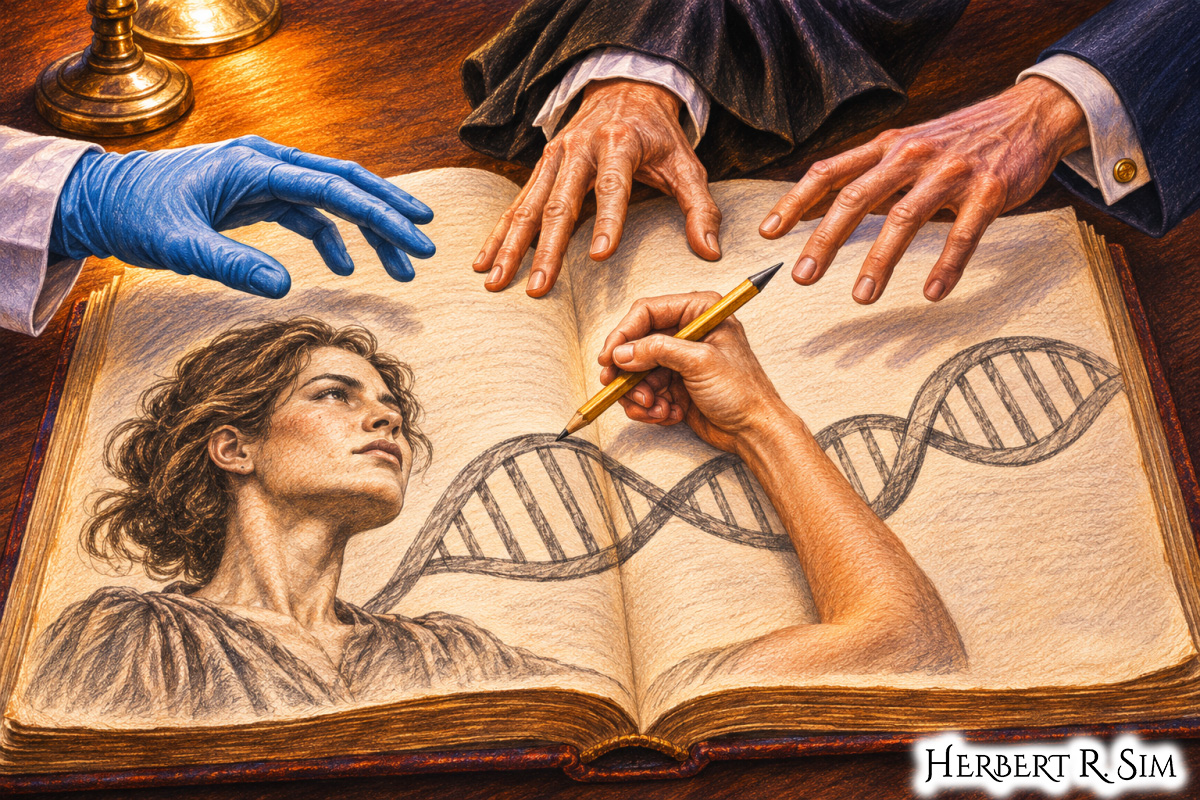
My illustration entitled: “Who Holds the Pen?” – An open book contains a DNA double helix drawn across both pages. A scientist’s gloved hand, a judge’s hand, and a corporate executive’s hand reach for the same pencil. The person whose genome is on the page already holds it.
Genetic information can profoundly influence human biology without exhausting human identity, dignity, agency, personality, moral worth or personhood. A genome contributes to the person; it does not constitute the whole person. A doctor may have good reason to study a patient’s DNA. The patient still has reasons of her own for accepting a treatment, declining it or asking what it would mean for the life she leads. Those reasons belong in the room even when the laboratory result is decisive about the condition.
In the founding essay on Genomic Sovereigntism in 2010, I argued that technological power over DNA does not confer authority over a person. That distinction depends on what we think a person is. If DNA contains everything that matters about someone, then whoever can read it may claim to know what that person is suited for, and whoever can alter it may claim to know what that person ought to become. Genetic essentialism lends both claims a false authority. It turns an account of biological inheritance into a judgment about whose choices should count.
What inheritance explains
A genotype describes the genetic variants an individual carries. It can help explain why a body develops in a certain way, why a condition runs in a family or why a particular treatment might be worth considering. Personhood concerns the standing of the individual whose body and life are at issue. It is why her interests matter in their own right, why she is owed reasons when others make decisions that affect her, and why she remains entitled to care when she needs help making those decisions. A more complete description of her biology gives us more knowledge about someone who already has that standing.
Biological inheritance can be central to lived identity. A woman who grows up with an inherited condition may understand her work, friendships and family history partly through that experience. Her brother may live with the same condition and give it a different place in his life. Each may revise that understanding with age. What they inherit helps explain the circumstances they share. How they come to understand those circumstances depends in part on what happens to them, what other people make possible for them, and what they decide matters.
The distinction between predisposition and destiny also calls for care. Some genetic findings change an estimate of risk. Others tell us much more about what is likely to happen. A person with a strong inherited risk may reasonably make plans around it. Even when a genetic finding gives near certainty about a particular condition, that certainty is confined to what the finding can predict. It supplies no corresponding certainty about the person’s judgment, commitments or the value of the years ahead. Agency includes the ability to make choices within circumstances one had no part in choosing.
Identical twins make the point in an ordinary way. They have highly similar genomes and often resemble one another closely. A 2005 study of identical twins found differences in some chemical marks associated with gene regulation, particularly among older pairs. Fraga and colleagues, PNAS, 2005
Yet even if the twins were alike at every genetic site and in every such mark, there would still be two people. If one twin agrees to an operation, the other has given no consent. If one makes a promise, the other owes no performance. Their separateness comes before the discovery of any biological difference between them.
The person who would be born
The birth of Dolly, reported in 1997, showed that a mammal could be cloned from an adult cell. It gives us a concrete starting point for a question about human reproductive cloning. Suppose a person were born with nearly the same nuclear DNA as an existing adult. She would begin her own life at a different time, among people whose relationships to her would be her own. She could resemble the donor as a child without inheriting the donor’s memories, obligations or friendships. If the donor had died, her birth would give the family a new person to care for, with the freedom to grow up differently from the person they remember. Wilmut and colleagues, Nature, 1997
The ethical question about bringing someone into the world through cloning is distinct from the question of what that individual would be owed once born. A child has a claim to care regardless of what adults hoped to achieve by arranging her birth. The donor’s genetic contribution would give the donor no special authority to direct her future. A laboratory’s role would give it no claim over her body. A family hoping to recover a lost relative would owe the child room to refuse the identity they had imagined for her. Those obligations would hold even if the adults had acted wrongly in bringing her into the world that way.
My illustration work-in-progress. The art represents that the authority to decide what your genome means for your life belongs to you, even when science, law, and commerce reach for the pen.
Enhancement, disability and the measure of a life
There are good reasons to want relief from pain, greater mobility or a longer life. A person might welcome a genetic treatment because the expected change would let him do something he values. Others with the same condition might weigh its benefits and burdens differently. Their choices should be heard on their own terms. A reduction in pain can make someone’s life better in an important respect. The person who lives with pain has the same claim to respect throughout.
Consider a school weighing how to provide for a pupil with an inherited mobility impairment. The pupil may want treatment. She also needs access to classrooms, friendships and the ordinary chances that education affords. A staircase can create a barrier that an accessible entrance would remove. The impairment supplies some of the facts the school needs to understand her situation. The rest include decisions the school itself can change. Respecting her as a person means giving her a say in what help she receives and taking her education seriously in the meantime.
Enhancement raises a related question about expectations. Imagine a parent who one day could choose a genetic intervention intended to increase a child’s endurance. Before asking whether it would work, we should ask whose purposes it would serve. A child may grow up to value abilities that her parents never anticipated. If the parents expect an athletic career in return for their choice, they burden her with an obligation she never undertook. And if institutions come to demand enhancement as proof that people are willing to better themselves, the freedom to decline begins to depend on whether one can afford the consequences. Moral standing survives both choices. It belongs equally to a person with an edited genome, a person whose genome is described as natural or unmodified, and a person regarded as enhanced.
When genetic judgments become rules
Eugenic thinking treats the characteristics a society prizes as reasons to favour the reproduction of some people over others. Its judgments can draw their force from prejudice even when they borrow the language of heredity. In Buck v. Bell in 1927, the United States Supreme Court upheld Virginia’s compulsory sterilisation law as applied to Carrie Buck. The Court accepted an official account of supposed hereditary deficiency as a reason for the state to take away her reproductive freedom. Even a perfectly accurate account of an inherited trait would have left the central question unanswered. By what right could the state make her body serve its idea of a better population? Buck v. Bell, 274 U.S. 200 (1927)
A patient’s decision to seek relief from a serious inherited illness can serve a purpose she has chosen for herself. The eugenic step occurs when a preference for certain traits becomes a public ranking of lives, backed by pressure on those who carry disfavoured traits or who may pass them on. That pressure can come from an official order. It can also come from institutions that make support harder to obtain for people whose families refuse a recommended intervention. A society reveals its judgment about disability in what it offers the people already living with it.
Genetic discrimination puts a similar mistake to work in everyday decisions. Imagine an applicant capable of doing a job who is turned away because a test suggests he may develop an illness years later. The employer has treated a possible future condition as if it were a present failure to meet the requirements of the job. In the United States, Congress addressed uses of genetic information in employment and health insurance through the Genetic Information Nondiscrimination Act of 2008. The philosophical objection reaches the decision itself. Even a test obtained with the applicant’s permission and handled in confidence can be used to deny him a fair assessment. Genetic Information Nondiscrimination Act of 2008
Who has authority
UNESCO’s 1997 Universal Declaration on the Human Genome and Human Rights affirms that human dignity and rights apply regardless of genetic characteristics. Genomic Sovereigntism takes that commitment into decisions about intervention. The people who devise a procedure may have the best knowledge of how it works. A physician may have the best grounds for recommending it. The individual affected is the one whose life will have to accommodate what follows. Expertise creates a duty to explain the choice honestly and a responsibility for the consequences of professional advice. It gives professionals no general mandate to decide which kind of life another person should lead. UNESCO, Articles 2 and 5
Sometimes others must act for a person who is too young to decide or who needs support to exercise a choice. Their authority is limited by the interests of the person they serve. It should leave room for that person’s wishes as far as they can be understood, and for future choices where the decision can reasonably wait. The original distinction between power and authority matters most in precisely these cases, when other people have the greatest practical power over someone’s biology and the person has the fewest means to object.
The Personhood Principle
A genome contributes to the person; it does not constitute the whole person. Every person has equal moral standing, whatever their genetic inheritance or how their genome came to be. The power to read, copy or alter DNA confers no authority over the person.