

My illustration entitled: “The Port of Open Exchange” — Diverse modern cargo ships and small vessels dock through transparent shared channels, symbolising voluntary, distributed trade.
The right to exit becomes meaningful only when viable alternatives exist. Freedom is not merely the permission to leave; it is the practical capacity to continue.
Economic dependence is rarely announced as dependence. It usually arrives as convenience. A service is easier to use than its alternatives. A platform gathers the customers. A payment channel becomes standard. A provider holds the records. A single system becomes the place where work, trade, identity, and reputation are recognised. Each step can appear voluntary. Yet, over time, the individual may discover that leaving means abandoning the practical foundations of their economic life.
Constructive Counter-Economics begins with a response to this condition. Rather than limiting its attention to the criticism of concentrated power, it asks what people can build together—lawfully, peacefully, voluntarily, and responsibly—to reduce unnecessary dependence.
Its central concern is parallel economic infrastructure: additional routes through which individuals and communities can own, exchange, learn, build, communicate, and preserve value. These routes do not need to destroy existing institutions, nor should they seek to evade legitimate law or responsibility. Their purpose is to ensure that participation in one system does not require permanent submission to that system.
The framework was first developed in 2013 as an extension of Counter Economics. In 2026, its importance has grown. Economic life is now mediated through digital platforms, programmable systems, automated decisions, artificial intelligence, data networks, and increasingly sophisticated forms of technological control. The question is no longer simply whether people have access to markets. It is whether they retain enough independent capability to continue when a dominant market changes its terms, restricts an account, withholds a record, or becomes unavailable.
Constructive Counter-Economics is the practice of building that capability before a crisis makes its absence obvious.
From Opposition to Construction
Many discussions of economic power stop at diagnosis. They identify monopoly, bureaucracy, gatekeeping, regulatory capture, dependency, or unequal bargaining power. Diagnosis is necessary, but it is incomplete. A person who understands that they are dependent is not yet free. Awareness without alternatives can become another form of helplessness.
Constructive Counter-Economics shifts the emphasis from complaint to capability. It asks: what lawful alternatives can be built? What assets can people own directly? What skills can they acquire? What records can they preserve? What networks can they join or create? What tools can work across institutional boundaries? What relationships can survive the failure or withdrawal of a single intermediary?
This is not a call for withdrawal from society. It is a call for a more resilient form of participation within society. People will continue to use companies, banks, platforms, governments, professional services, and shared institutions. Many of these arrangements provide genuine value. The problem begins only when participation in them becomes so exclusive that no meaningful alternative remains.
Parallel infrastructure creates balance. It does not assume that every centralised system is hostile or that every decentralised system is wise. It simply recognises that people are more secure when they have more than one path to work, exchange, communication, and ownership.
The constructive principle is therefore modest but powerful: build alternatives before dependence becomes captivity.
The Ethical Boundary: Voluntary, Lawful, Peaceful
The word “counter-economics” has been used in different ways by different writers and movements. Constructive Counter-Economics is clear about its own boundary. It concerns lawful, peaceful, voluntary alternatives that expand individual agency without violating the rights of others.
It does not endorse fraud, deception, coercion, exploitation, sabotage, or evasion of basic civic and contractual responsibility. It does not treat secrecy as a substitute for ethics. Nor does it confuse economic sovereignty with the freedom to impose costs on other people without accountability.
Its purpose is constructive rather than destructive. A lawful community exchange, a portable payment option, an open technical standard, a cooperative purchasing network, independent education, direct ownership of productive tools, and a resilient local supply relationship can all reduce dependency while respecting the rights of others.
This distinction matters because alternative infrastructure earns legitimacy through trust. People will use and support systems that are reliable, transparent about their limits, respectful of lawful obligations, and capable of resolving disputes fairly. An alternative that merely shifts arbitrary power from one group to another has not advanced economic freedom. It has repeated the problem under a different name.
Constructive Counter-Economics therefore requires both independence and responsibility. It expands the ability to act while preserving the duty not to harm.
Parallel Does Not Mean Underground
Parallel economic infrastructure is sometimes mistaken for an underground economy. That is not the intended meaning. A parallel system operates alongside existing systems; it does not need to hide from them. Its defining feature is not secrecy but optionality.
A person who holds a direct relationship with customers in addition to using a marketplace has a parallel route to commerce. A business that keeps portable records while using cloud services has a parallel route to continuity. A worker who builds skills, maintains a portfolio, and belongs to more than one professional network has parallel routes to opportunity. A community that supports more than one payment method or supply chain has parallel routes to exchange.
These arrangements do not reject the convenience of centralised services. They prevent convenience from becoming a single point of failure. They allow people to participate in efficient institutions while preserving the ability to continue if those institutions become unavailable, unaffordable, or unaccountable.
Parallel infrastructure is therefore a form of economic redundancy. It provides additional rails, not a hidden escape tunnel. Its purpose is to keep lawful human activity moving when one channel is interrupted or misused.
The Five Layers of Parallel Economic Infrastructure
In 2026, constructive alternatives can be understood through five connected layers. Each layer strengthens the others, and weakness in one can make the whole structure more dependent than it appears.
The ownership layer concerns what people can hold directly. This includes property, savings, tools, records, credentials, and productive assets. Direct ownership does not mean rejecting every custodian or service provider. It means preserving a meaningful share of control over the assets needed to act. If a person cannot retain, verify, or transfer what they have earned, their ownership remains incomplete.
The exchange layer concerns the means by which people can pay, trade, contract, and cooperate. A resilient economy should not depend on one payment rail, one marketplace, or one institution’s approval for every lawful transaction. Bitcoin demonstrated the importance of direct, network-based monetary capability, but the broader principle extends to every lawful means of voluntary exchange: multiple payment options, clear records, reliable settlement, and the ability to transact without unnecessary gatekeeping.
The knowledge layer concerns skills, education, documentation, and the ability to understand systems. A person who has no access to knowledge about how their tools, finances, contracts, or technologies work is more easily made dependent. Constructive Counter-Economics therefore values practical education: learning how to secure assets, read agreements, preserve records, evaluate risks, develop marketable skills, and use interoperable tools.
The network layer concerns relationships between people. Independent producers, local businesses, professional communities, cooperative groups, open-source contributors, and direct customer relationships can all provide resilience. Networks are not merely social ornaments. They are economic infrastructure because they allow trust, information, and opportunity to circulate beyond one central platform.
The exit layer concerns the ability to move. People need the practical capacity to change providers, transfer assets, export lawful records, and continue their work elsewhere. Exit is not merely an act of dissatisfaction. It is the discipline that keeps institutions responsive. A relationship becomes more voluntary when departure is possible without economic ruin.
Together, these layers turn abstract liberty into a more durable form of economic agency.
Self-Custody as a Foundation, Not a Slogan
Self-custody is often reduced to a narrow financial practice. It is better understood as a principle of direct control. The person who can securely hold and transfer value without relying entirely on one intermediary possesses a form of economic resilience. Bitcoin made this principle visible by separating the ability to hold value from the requirement to maintain a relationship with a central custodian.
Yet self-custody is not an instruction for everyone to do everything alone. Direct control brings responsibility: security, careful record-keeping, education, and the acceptance of consequences. Some people will properly choose professional assistance or shared safeguards. The relevant issue is whether delegation remains voluntary and reversible.
A healthy economic environment offers a range of choices. A person may use a managed service, but they should be able to understand the arrangement, verify important facts, recover their lawful records, and choose another path when needed. Assistance is valuable when it expands capability. It becomes a form of control when it makes the individual unable to continue without it.
Constructive Counter-Economics supports designs that preserve this balance. It seeks tools and institutions that help people manage complexity without requiring them to surrender all meaningful agency.
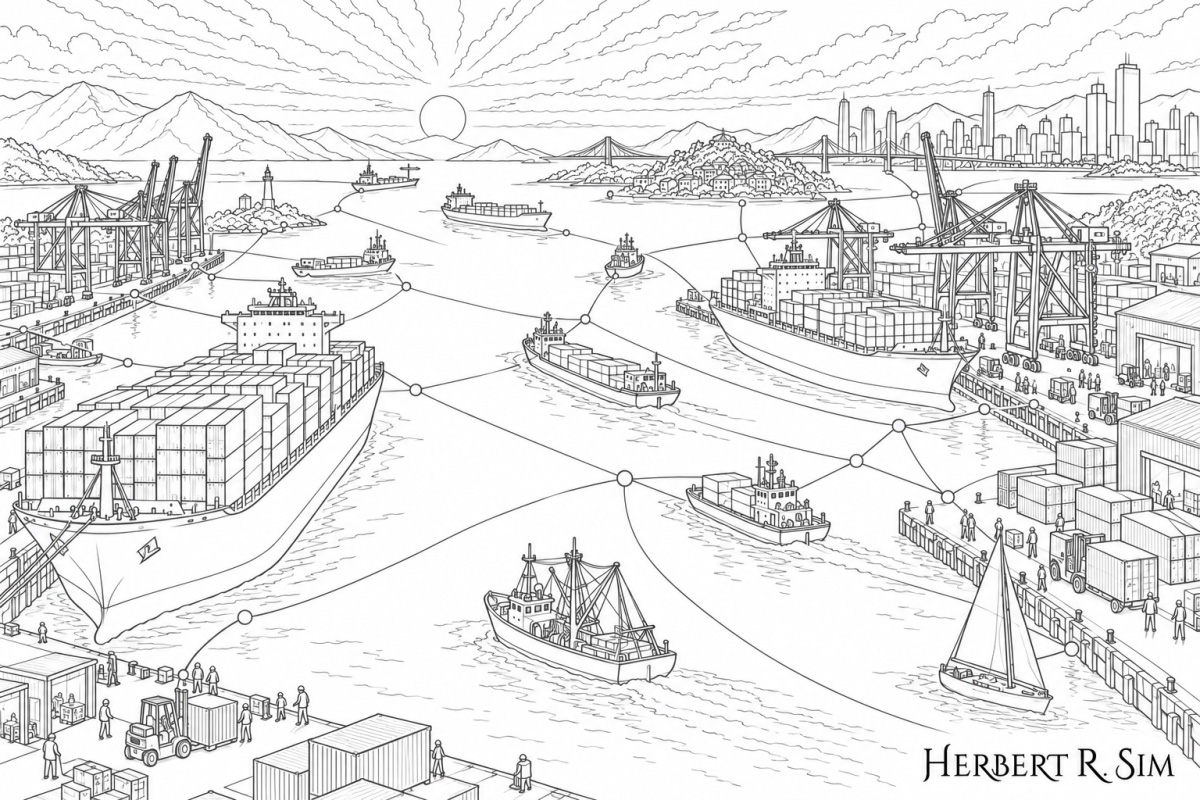
My illustration “The Port of Open Exchange” work-in-progress. The art represents how open, interconnected infrastructure lets people trade, cooperate and prosper without dependence on a single economic gatekeeper.
Open Standards and the Freedom to Connect
Parallel infrastructure cannot function if every system is closed. When platforms prevent users from moving records, when tools cannot interoperate, or when technical standards are controlled by one operator, alternatives exist only in theory. The person may be free to leave, but must leave behind their data, reputation, customers, and accumulated work.
Open standards and interoperability reduce this problem. They allow different services to communicate, different tools to work together, and users to preserve continuity across institutional boundaries. A merchant should not have to rebuild an entire business merely to change providers. A worker should not have to lose a record of completed work because one platform changes its rules. A community should not be forced to rely on one technological gatekeeper to organise lawful exchange.
Interoperability is not a demand that every company expose every proprietary feature. It is a demand that the foundations of participation remain portable enough for competition and exit to be real. A company may offer a superior service while still allowing users to retain what is legitimately theirs.
This is where Constructive Counter-Economics meets protocol sovereignty. Open economic networks make it possible to build alternatives at the edge of a system rather than requiring permission from the owner of the system’s centre. They make innovation more contestable and dependence less absolute.
Community Nodes and Distributed Capability
Large institutions often concentrate resources, knowledge, and decision-making. This can produce efficiency, but it can also produce distance. Decisions are made far from the people who bear their consequences, and local capability atrophies because everything is expected to flow through a central provider.
Constructive Counter-Economics responds by encouraging community nodes: local or professional centres of practical capability. A community node might be a network of small businesses, a cooperative purchasing arrangement, a technical education group, a shared workspace, a professional association, a local producer network, or a digital community organised around open tools and direct exchange.
The purpose is not to create isolated enclaves. It is to distribute the ability to solve ordinary problems. When more people can learn, build, repair, trade, and cooperate directly, fewer people are forced to wait for permission from distant gatekeepers.
Distributed capability also improves resilience. A community with multiple sources of knowledge, exchange, and production is better able to withstand disruption. It can adapt when one provider fails, one platform changes its terms, or one supply route becomes unavailable. It does not become invulnerable, but it becomes less fragile.
Economic sovereignty is not self-sufficiency in the fantasy sense. It is the practical confidence that a person or community has more than one way to continue.
Artificial Intelligence and the New Infrastructure Question
Artificial intelligence adds urgency to the constructive task. It can lower the cost of learning, research, design, translation, programming, and entrepreneurship. Used well, it can place productive capability in the hands of individuals and small teams who previously lacked institutional scale.
But AI can also deepen dependency if access to productive intelligence is controlled by a small number of platforms, if outputs and work histories cannot be retained, or if automated systems decide who is eligible to use essential tools. The same technology that expands capability can become another permission layer.
Constructive Counter-Economics therefore asks whether people can build with AI rather than merely rent access to it. Can they retain their work, knowledge, and customer relationships? Can they compare providers? Can they understand the terms under which their data is used? Can they leave one system without losing the productive capacity they have developed?
The issue is not hostility to advanced technology. It is the insistence that technology should create more independent builders, not only more dependent users.
A Framework for Action
Constructive Counter-Economics is not complete when it is expressed as a theory. It becomes meaningful through practical habits and institutional design. Individuals can strengthen their agency by learning transferable skills, maintaining independent records, diversifying lawful payment and communication options, developing direct relationships, and understanding the terms of the systems they use.
Businesses can strengthen agency by avoiding unnecessary lock-in, supporting portability, maintaining more than one supplier or channel, preserving direct customer relationships, and offering clear terms. Communities can strengthen agency by sharing knowledge, supporting local enterprise, creating cooperative networks, and using technologies that do not require a single central authority for every important action.
Policymakers and institutions can contribute by encouraging interoperability, competition, transparency, proportional safeguards, and the right to exit. Their role is not to dictate every economic arrangement. It is to ensure that lawful people are not made unnecessarily dependent on systems they cannot understand, challenge, or leave.
The framework is therefore constructive at every level. It is not a programme of separation. It is a programme of additional capacity.
Freedom Requires More Than Permission
The deepest lesson of Constructive Counter-Economics is that permission is not the same as power. A person may be permitted to participate while lacking the tools, ownership, knowledge, networks, and alternatives needed to do so independently. When every essential route is owned by someone else, freedom becomes conditional on continued approval.
Parallel economic infrastructure changes that condition. It creates options that make exit real, institutions more accountable, and individuals less vulnerable to sudden exclusion. It does not promise a world without risk, conflict, or failure. It promises something more practical: the ability to respond when one path closes.
That is why the framework remains necessary in 2026. The challenge is not to abandon institutions, but to prevent institutions from becoming unavoidable. The task is to build an economy in which people can cooperate deeply while retaining the capacity to own, choose, build, and leave.
Constructive Counter-Economics is the work of building lawful alternatives that turn the right to exit from a theoretical freedom into a practical capability.
Download the PDF from Zenodo
Official Publication Record
Constructive Counter-Economics in 2026: A Framework for Parallel Economic Infrastructure has been formally archived on Zenodo with a permanent DOI for citation, preservation and scholarly reference.
| Title | Constructive Counter-Economics in 2026: A Framework for Parallel Economic Infrastructure |
| Author | Herbert R. Sim |
| ORCID | 0009-0008-6500-5749 |
| Publication date | 28 May 2026 |
| Canonical webpage | https://herbertrsim.com/constructive-counter-economics-parallel-economic-infrastructure/ |
| DOI | 10.5281/zenodo.23121901 |
| Zenodo record | https://zenodo.org/records/23121901 |
| Licence | Creative Commons Attribution 4.0 International Licence (CC BY 4.0) |
Preferred citation:
Sim, Herbert R. (2026). Constructive Counter-Economics in 2026: A Framework for Parallel Economic Infrastructure. HerbertRSim.com.
https://doi.org/10.5281/zenodo.23121901
Copyright and licence:
© 2026 Herbert R. Sim. This work is licensed under the Creative Commons Attribution 4.0 International Licence (CC BY 4.0).
Zenodo submission note:
This work was submitted to Zenodo for permanent scholarly preservation and citation.