

My illustration entitled: “The Machine Built by Thousands, Owned by Few” – An immense intelligent machine rises above a metropolis, its foundations visibly assembled from the work of thousands of people. At its summit, a small group holds the ownership keys while golden dividends stream toward their balconies. Below, the builders examine a new set of ownership agreements.
A company introduces artificial intelligence. Employees complete certain tasks faster, customers receive quicker responses and managers anticipate lower operating costs.
Who benefits from the improvement?
Workers might receive higher wages, shorter hours or more interesting responsibilities. Customers might pay less. Shareholders might receive greater profits. The technology provider might raise its charges as the company becomes dependent on its service.
Several outcomes can occur together. Others may involve direct conflict.
The central question is how additional productive capacity becomes income, time, security and control. I call this potential benefit the AI productivity dividend. Its distribution depends on ownership, bargaining power, competition and the institutions governing economic participation.
Political Economics should examine these arrangements before assuming that a more productive economy automatically gives individuals greater authority over their lives.
First Establish Whether a Dividend Exists
Faster task completion is promising, but it is not a complete measure of economic improvement.
A system may generate drafts quickly while creating additional verification work. A business may reduce labour costs while increasing expenditure on software, integration and security. Errors may impose losses elsewhere.
The relevant gain concerns useful output relative to the resources required, with appropriate attention to quality and consequences.
A 2025 study by Erik Brynjolfsson, Danielle Li and Lindsey Raymond found that AI assistance increased issues resolved per hour by 15% on average among customer-support agents in one setting. The effects varied substantially, and the study did not establish economy-wide wage or employment effects.
Such evidence supports serious investigation. It cannot determine who ultimately receives the benefits.
Productivity and Distribution Are Different Questions
Imagine a hypothetical enterprise producing the same quality and quantity of work with fewer total resources after adopting AI.
The resulting surplus creates possibilities. Management could reduce prices, increase remuneration, retain profits, expand production or invest in another project.
Which outcome emerges depends partly on existing commitments and the choices available to each participant.
If customers can easily move to competitors, pressure to reduce prices may be strong. If workers possess scarce complementary skills, their negotiating position may improve. If one supplier controls an indispensable tool, it may capture part of the gain through higher fees.
There is no automatic rule assigning the entire improvement to whoever first touches the technology. Production and distribution require separate analysis.
Labour Can Become More Valuable or More Replaceable
AI can complement some activities while substituting for others within the same occupation.
A worker may become better at handling unfamiliar problems while spending less time on routine preparation. Alternatively, management may reorganise the activity so that fewer people perform the remaining work.
The effect on employment also depends on demand. Lower costs may support expansion, but additional sales cannot be assumed to offset every reduction in labour requirements.
The ILO’s 2025 occupational-exposure assessment distinguishes potential exposure to generative AI from actual job losses. That distinction is essential: technical capability alone cannot establish how organisations will respond.
Workers need opportunities to influence deployment, acquire useful skills and negotiate the consequences of changing responsibilities. Access to a tool does not itself guarantee economic security.
Bargaining Power Shapes the Wage Outcome
A worker whose output increases may still struggle to obtain higher pay.
The employer may face little competition for labour, while the worker has limited savings, substantial caring responsibilities or few nearby alternatives. A productivity improvement then occurs within an unequal negotiating relationship.
Collective bargaining, credible outside opportunities and understandable information about workplace changes can influence the result.
Performance measurement also matters. If management attributes every improvement to software while disregarding employees’ judgment, correction and customer knowledge, wage negotiations begin from an incomplete account of production.
Equally, maintaining and deploying AI requires genuine expenditure and risk. A defensible settlement should consider contributions and responsibilities across the arrangement, rather than assume either labour or capital has produced the entire surplus alone.
Ownership Determines Which Claims Continue
Wages compensate work under an agreement. Ownership can establish a continuing claim on returns after particular tasks have been completed.
This difference becomes important where AI makes a business more profitable without proportionately increasing its demand for labour.
Someone who owns productive assets may benefit through profits or appreciation. Someone dependent entirely on wages may face weaker prospects even while total output rises.
Ownership is therefore relevant to the distribution of the dividend. The question extends beyond who owns a model to who controls complementary assets: customer relationships, distribution channels, computing resources and the business deploying the technology.
Broadening access to productive ownership can change who participates in future returns. It also requires attention to risk, governance and the resources needed to make ownership effective.
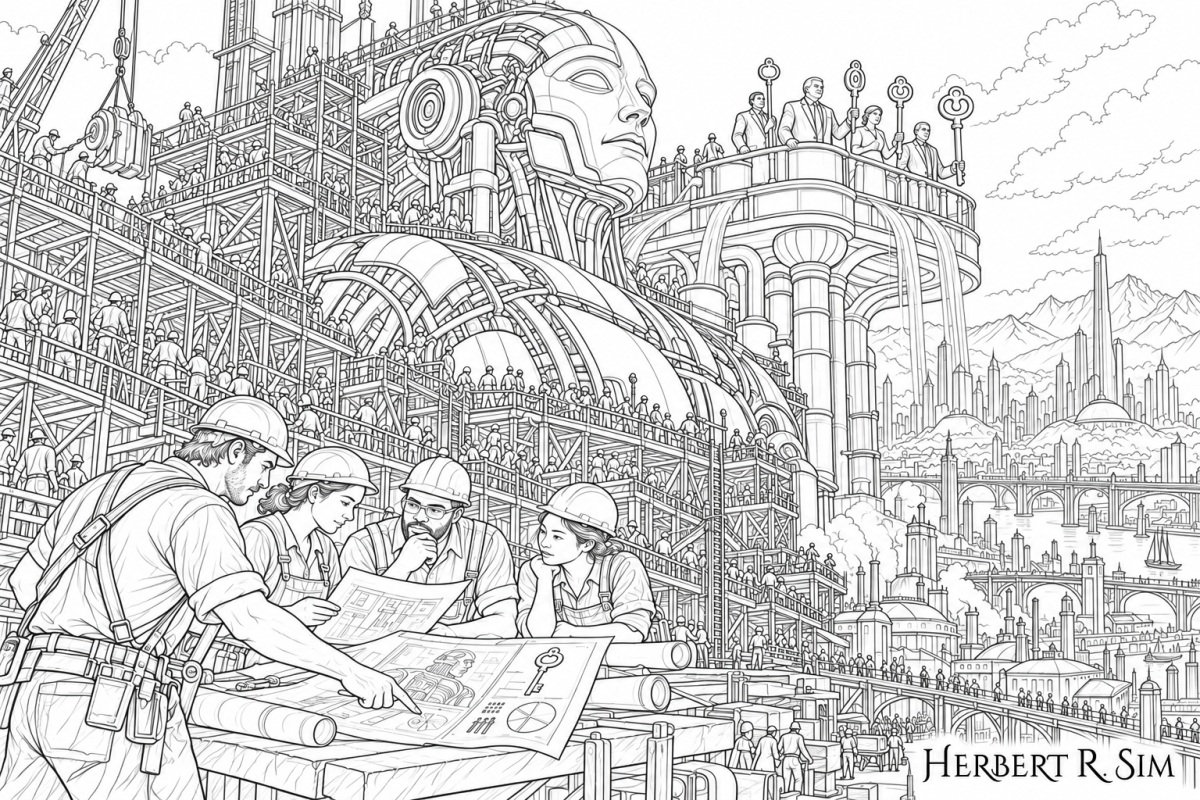
My illustration “The Machine Built by Thousands, Owned by Few” work-in-progress. The art represents that collective contributions can create productive systems whose financial benefits remain narrowly owned.
Access Is Not the Same as Control
An entrepreneur may subscribe to powerful AI tools and produce work previously requiring a larger organisation. This can lower barriers to enterprise.
Yet a subscription creates a relationship whose conditions another party may change.
Prices, permitted uses, service availability and the ability to move work elsewhere can affect how much of the productivity gain the entrepreneur retains.
Where switching is difficult, the supplier may acquire greater negotiating power as the customer’s business grows around its service.
Useful protections include transferable records, compatible workflows and realistic access to alternative providers. Some activities may benefit from tools that can be operated independently.
The appropriate arrangement varies, but its economic significance is clear: expanded capability can coexist with dependence over the conditions of its use.
Competition Can Pass Benefits to Customers
Consumers may receive part of the dividend through lower prices, improved quality or wider availability.
Whether this happens depends partly on competitive pressure. A supplier facing credible rivals has stronger reasons to share cost reductions with customers than one protected by substantial entry barriers.
AI could strengthen competition by enabling smaller firms to perform sophisticated tasks. It could also reinforce concentration where essential inputs remain difficult to obtain or established firms control access to customers.
Competition policy should examine these actual bottlenecks rather than infer market power from technical sophistication alone.
Customer benefits also require attention to hidden conditions. A lower advertised price may accompany greater collection of personal information, weaker support or additional charges that reduce the apparent saving.
The Dividend Can Be Time
Economic improvement need not appear entirely as additional monetary income.
A worker might value fewer hours at unchanged pay, more predictable schedules or reduced pressure during demanding periods. An organisation might use saved time to improve service rather than continually increase targets.
These possibilities require explicit decisions. If every efficiency gain is immediately converted into a higher workload, employees may experience little improvement despite producing more.
Shorter hours must also be assessed honestly. An apparent reduction offers limited benefit if the same work moves into unpaid time or other workers absorb the burden.
Negotiating time alongside wages can make productivity discussions more responsive to human purposes. The relevant question is what people can actually do with the resources that technological improvement releases.
Sharing Returns Through Institutional Design
Several arrangements could broaden participation in AI-generated gains.
Profit-sharing agreements can connect remuneration to business performance. Employee ownership and cooperatives can distribute claims and decision-making rights. Accessible finance and shared technical resources can help independent producers adopt useful tools.
Each approach has limitations.
Profit measures can be opaque. Employee ownership can concentrate a worker’s savings and employment risk in the same enterprise. Formal ownership without meaningful governance may provide little influence.
Public revenue can also support education, infrastructure and transition assistance. Its legitimacy depends on how funds are raised, allocated and evaluated.
No single instrument settles distribution. Arrangements should be judged by their operation, including who qualifies, who bears losses and whether participants can understand and challenge consequential decisions.
Account for People Who Lose
A positive aggregate gain can coexist with serious losses for particular workers, firms and communities.
People displaced by changing production cannot meet immediate obligations with an assurance that the economy may eventually benefit.
Transition support should address actual circumstances: income interruptions, training costs, location, caring commitments and the availability of suitable work.
Training is valuable when it connects to realistic opportunities. Requiring people to complete courses without examining employer demand can transfer responsibility without providing a viable route forward.
Businesses also need clarity about the consequences of deployment. Consultation and advance planning can identify alternatives to abrupt displacement.
Responsibility for transition should reflect institutional capacities and the distribution of benefits, rather than fall automatically on those least able to absorb the costs.
Measure Gains in Income and Agency
Evaluation should follow the dividend through the economy.
Alongside output and profits, we should examine wages, working hours, prices, employment transitions and the distribution of productive ownership. We should ask whether smaller enterprises can enter, whether workers acquire transferable skills and whether dependence on essential suppliers is increasing.
These indicators require careful comparison. Changes may reflect several causes, and adoption alone cannot establish that AI produced every subsequent improvement or loss.
The objective is a clearer account of who benefits and under what conditions.
The AI productivity dividend becomes a foundation for economic freedom when people gain practical resources, security and influence over their futures. Its distribution is an institutional choice that deserves public scrutiny.
References
- Brynjolfsson, E., Li, D., and Raymond, L. (2025). Generative AI at Work. The Quarterly Journal of Economics, 140(2), 889–942.
- International Labour Organization and NASK (2025). Generative AI and Jobs: A Refined Global Index of Occupational Exposure. ILO Working Paper 140.